10 min read
Cancelled Slot Not Lost Yet: Waitlist Texting for Fusion Practices
Mira Gwehn Revilla
:
August 19, 2026
- The cancellation comes in by text and lands in your shared inbox, tied to the child's record.
- One action sends that slot to matched OT, PT, or speech families. A speech hour never goes to a child waiting on PT.
- First parent to reply YES books it. The rest get a note that the slot is taken and keep their place.
- Fusion holds the schedule and the waitlist. Curogram runs the outreach beside it, with opt-out built in.
- Recall texting drove a 35% reconversion rate and 1,240 patients seen at one multi-location practice, based on our internal data.
Fusion's Advanced plan comes with 50 free text messages per practice each month. Send one open Thursday slot out to 15 waitlist families, and you've spent almost a third of that before lunch.
That math is one reason pediatric therapy clinics still backfill cancellations by phone. The waitlist itself lives in Fusion, tidy and current. Dialing happens by hand, between check-ins, whenever someone at the desk gets a free minute.
A cancelled session keeps its value for a few hours. Then one o'clock arrives, the room stays empty, and the hour is gone. Families on your waitlist are still counting weeks. None of them knew a slot opened and closed that morning.
Rehab therapy runs on standing weekly visits, so your waitlist is rarely short. Pediatric speech and OT practices carry evaluation backlogs that stretch for weeks. Empty chairs and a waiting line turn up in the same week, which is about as fixable as clinic problems get.
Waitlist texting for Fusion therapy practices shuts that gap. One cancellation, one message out to families matched by discipline, and the first parent to reply YES takes the hour. Cancelled session backfill stops being a phone chore and wraps up before the front desk gets back from lunch.
We built this to sit beside Fusion rather than over it. Fusion holds the schedule, the notes, the billing, and the waitlist. Curogram runs the piece Fusion's own materials don't describe: reaching every matched family at the same second and settling who gets the slot.
Why the Cancelled Slot Dies on a Sticky Note
Pediatric therapy runs on standing slots. A child with a Tuesday 4 PM occupational therapy hour keeps that hour for months, often a whole school year. Cancellations then cluster around plain family life: a fever, a sibling's pickup time moving, a car that won't start in the school lot.
Your calendar absorbs the cancellation fine. Fusion marks it, the therapist sees the change, and the day rolls on. Money leaks out of the empty hour that follows.
Filling that hour means reaching someone who wants it while the hour still exists. For most clinics, that means the phone. A phone holds one conversation at a time, and your waitlist has eleven families on it.
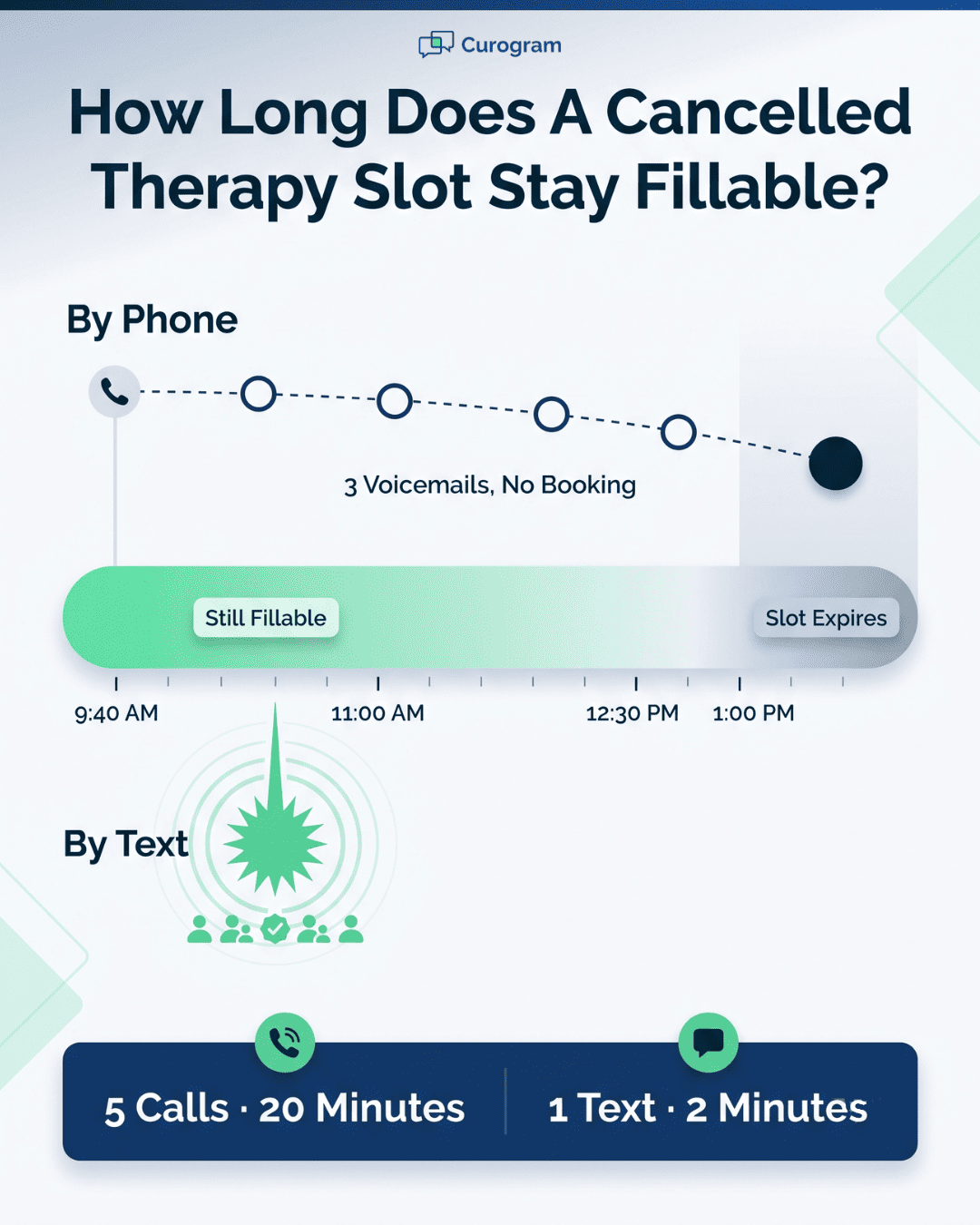
A 9:40 Cancellation and a 1:00 Slot
A parent texts at 9:40 to say her daughter can't make the 1:00 speech session. Your coordinator sees it between two check-ins and opens the waitlist.
First call goes to voicemail. Second call goes to voicemail. Third parent picks up, but she's at work until 3 and can't get across town by one.
By 11:15 there's a line at the desk, two intake packets to scan, and a therapist asking about a supervision note. The waitlist tab stays open behind everything else. Someone remembers it at 12:30, tries two more families, and gets voicemail twice more.
One o'clock arrives. The room sits empty and the hour bills nothing. Eleven families would have taken it, and not one of them knew it was free.
What One Empty Hour Costs
Put a number on the hour. At an illustrative $110 per therapy session, every expired slot is a direct write-off. The therapist's time is already paid for, child in the room or not.
|
Expired slots per month |
Lost at $110/session (illustrative) |
Over 12 months |
|
4 |
$440 |
$5,280 |
|
10 |
$1,100 |
$13,200 |
|
20 |
$2,200 |
$26,400 |
Most clinics never track this line. No-shows show up in reports and get talked about in staff meetings. Cancelled slots that nobody refilled close out as "cancelled" and never get counted as revenue you could have kept.
Count the labor too. Five call attempts at four minutes each is twenty minutes of front desk time, spread across a morning when the desk already has a line. That time comes out of check-in, insurance verification, or the intake packet a new family is waiting on.
Covina Arthritic Clinic confirms more than 1,100 appointments a month through automated texting, based on our internal data.
Reaching that volume by phone would need a full-time person doing nothing else. Backfill calls compete with every other task at the desk, which is why they lose.
Reminders help upstream, and the gap between the two problems matters. Based on our internal data, practices using Curogram reminders and two-way texting run no-show rates 53% below the industry average. Atlas Medical Center cut its own rate from 14.20% to 4.91% in three months.
Fewer surprise no-shows means fewer gaps you find out about at 1:05. Cancellations with a few hours' notice sit in a different pile. Those are the ones you can still sell.
Empty Chairs and a Waiting Line, Same Week
Pediatric OT and speech practices carry real evaluation backlogs. Parents wait weeks for a first appointment, call now and then to check, and hear that nothing has opened up.
Something did open up. Last Thursday at one o'clock, for three hours, and it closed again before anyone could be reached.
So the clinic holds two facts at once: a waiting line at the front and an unused hour in the back. Fusion knows about both. Your waitlist is right there on the Essentials plan and up, kept current by the same staff who booked every appointment on the calendar.
What sits between the list and the slot is a phone call that takes four minutes and reaches one household.
How the Backfill Actually Runs
Reminders that go both ways change where the cancellation shows up. Instead of a voicemail nobody checks until eleven, the parent's message lands in a shared inbox, attached to the child's record, visible to whoever is covering the desk.
Your coordinator reads it at 9:41. She already knows the discipline, the therapist, and the length of the visit, because the message sits next to the appointment it belongs to.
From there, refilling the hour is a decision, not a project. She picks the slot, picks the matched waitlist group, and sends. No hunting for phone numbers on a printed list. No sticky note that survives until 12:30 and then stops mattering.
Four Steps, Cancellation to Booked
Written out, the workflow is four steps:
- A parent texts to cancel. The message arrives in your shared inbox, tied to the child's chart in Fusion.
- Staff select the open slot and send it to waitlist families matched on discipline and stated availability.
- Every matched family receives the same offer at the same second. The first parent to reply YES claims the hour.
- Everyone else gets an immediate note that the slot is taken, and keeps their place on the list.
Staff time from step one to step four runs about a minute of typing.
Discipline Matching Keeps the Offer Worth Opening
Offering a speech hour to a family waiting on physical therapy wastes two people's time and teaches parents to ignore your texts.
Matching solves that. Families are grouped by discipline, so an OT opening reaches OT-waitlisted children and a speech opening reaches speech-waitlisted ones.
Availability matters just as much. A parent who told you mornings only shouldn't get a 4 PM offer she can't use.
A working version of the wording:
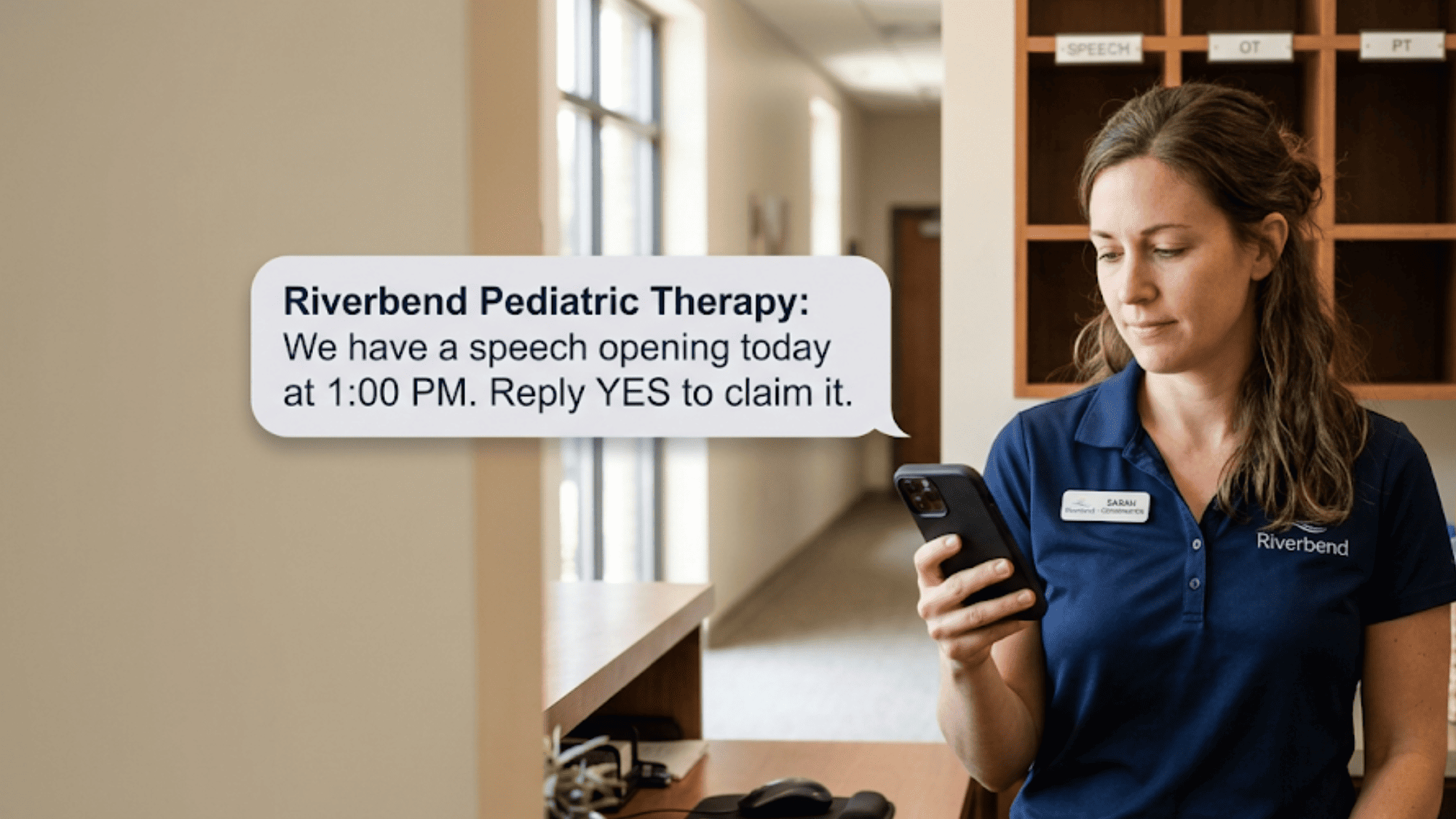
Riverbend Pediatric Therapy: we have a speech opening today at 1:00 PM. Reply YES to claim it. First reply gets the slot. Reply STOP to opt out.
Logistics only. No diagnosis, no therapist notes, nothing about why the first family cancelled. Each family sees the offer and nothing about anyone else on the list.

What a Refilled Hour is Actually Worth
Take one Thursday at a three-therapist pediatric clinic. A parent cancels a 1:00 speech session at 9:40 because her daughter woke up with a fever.
|
Time |
What happens |
|
9:40 AM |
Parent texts to cancel the 1:00 speech visit |
|
9:42 AM |
Coordinator sends the open slot to 14 speech-waitlisted families |
|
9:48 AM |
Two parents reply YES within seconds of each other |
|
9:48 AM |
The earlier reply books the hour; the second parent gets a note that it's filled |
|
9:49 AM |
Twelve other families learn the slot is taken and keep their place |
|
1:00 PM |
A child who had waited five weeks is in the room |
Front desk time spent: under two minutes, all of it before the 10:00 check-in rush. Nobody dialed anyone. Nobody left a voicemail that got returned at 4 PM about a slot that expired at one.
That 9:48 collision is worth a closer look. Two parents replied within seconds. One got the hour. The other got a message inside the same minute telling her the slot was taken and that she stayed near the front of the list.
She didn't drive across town for nothing. She didn't call the desk to ask what happened. Handled badly, a second YES costs you a phone call and some goodwill from a family already waiting five weeks.
The Same Engine, Aimed at Today
The mechanics here aren't new to us. Sending an open-slot offer to a matched group and letting the first confirmation win is the same engine behind our recall campaigns, just aimed at today instead of next month.
Based on our internal data, one multi-location practice sent SMS recalls to patients who were overdue for follow-up care. 35% of those patients booked an appointment within a month, and 1,240 patients were seen from recall messages alone.
Same-day backfill compresses that timeline. Parents on an evaluation waitlist are already motivated. They asked to be on the list, and the offer arrives about an opening they can actually use.
Upstream volume keeps the pipeline honest. Curogram clients average a confirmation rate above 75%, based on our internal data, which means most of the schedule is verified before the day starts and the cancellations you do get arrive with hours to spare.
Run Your Own Arithmetic
Run your own arithmetic. A clinic seeing 12 cancellations a month that refills 4 of them recovers $440 at the illustrative $110 session rate. Over a year that's $5,280, from a task that takes about a minute each time.
Refill 8 of 12 and the same math reaches $10,560. Neither figure requires a new therapist, a new room, or a longer day.
Three Things That Change at the Desk
Therapist days fill in. A 1:00 gap that used to become a long lunch turns back into a billed visit, which matters most for part-time speech and OT staff whose schedules are already tight.
Waitlists get shorter for a reason parents can see. A family that waited five weeks got in on week five because a slot opened and someone told them within two minutes.
Phone volume drops. Backfill was one of the last desk tasks that truly required dialing, and it stops requiring it.
Track four numbers in your first month: cancellations received, broadcasts sent, slots refilled, and minutes from cancellation to confirmation. That last one tells you the most.
Under fifteen minutes means your waitlist is warm and your matching is right. Past two hours, either the offer went to the wrong families or the availability notes on your list have gone stale.

Curogram: Running Beside Fusion, Not Over It
First-Confirm-Wins Offers is the piece that makes a group text safe to send. Every matched family gets the same open-slot offer at the same moment.
The first parent to reply YES books the hour. Everyone else receives an automatic note that it's filled, with their place on the waitlist unchanged.
Fairness is the point. Nobody is picked over anyone else, and nobody finds out ten minutes later that they replied too slowly. The reply clock decides, and it decides in seconds.
Two parents replying at once is the case worth planning for. One confirmation goes through, the other gets the filled notice inside the same minute, and no second family shows up at 1:00 expecting a room.
The offer itself carries logistics only: discipline, date, time, and how to claim it. Consent and opt-out ride along with every message, so a parent who texts STOP stops receiving offers without calling your desk.
All of it runs on HIPAA-compliant texting, on the same number your reminders already come from, which is why parents open it.
Fusion stays the system of record throughout. Once a parent confirms, your front desk books the visit in Fusion the usual way.
Practices already using our two-way texting have the pieces in place. Cancellations arrive as messages, waitlist families are reachable, and the offer goes out from a number parents recognize.
Conclusion: Count Last Month's Expired Slots
Pull last month's cancellation report out of Fusion. Count the sessions that came in with a few hours' notice and never got refilled. Multiply by your average session rate.
That number is what the phone costs you.
Fusion is a strong system for a therapy practice, and this article doesn't ask you to swap any part of it. The schedule stays there. The waitlist stays there. What sits between them is a way to reach fifteen families in one second instead of one family every four minutes.
Cancellations will keep coming. Fevers, snow days, cars that won't start. The question a practice can actually control is how many of those hours get sold again before they pass.
Based on our internal data, 35% of patients who received an SMS recall from one multi-location practice booked within a month, and 1,240 patients were seen from those messages alone. Same-day backfill runs on the same mechanics, just faster.
Book an integration demo and we'll show you a slot refill live: a cancellation coming in by text, a matched broadcast going out, a first YES landing, and the rest of the list getting their notice.
Frequently Asked Questions
The offer carries logistics only: discipline, date, time, and how to claim it. No diagnosis, no therapist notes, no mention of the family who cancelled. Each parent sees only their own message, never the recipient list. Consent and STOP handling ride along with every send, and the whole exchange runs on HIPAA-compliant texting from your existing practice number.
The earlier reply books the hour. The second parent receives an automatic notice inside the same minute telling her the slot is taken and that her waitlist position hasn't moved. She doesn't drive over, and she doesn't call your desk to ask what happened. That instant notice is what keeps a group offer from generating cleanup work later.
Fusion keeps the list, the schedule, and the chart, and its waitlist comes with Essentials and up. Curogram handles the outreach that turns that list into bookings: the matched broadcast, the replies, and the filled notice. Once a parent confirms, your front desk enters the appointment in Fusion the same way it always has.
Pediatric families often carry separate waitlists for OT, PT, and speech, sometimes for siblings in the same household. Sending a speech opening to a child waiting on physical therapy wastes the parent's attention and trains her to stop reading your texts. Matching keeps every offer usable, which is what protects your reply rate over months.
Watch the gap between cancellation and confirmation rather than the raw refill count. Under fifteen minutes means your matching is right and your waitlist data is current. Past two hours, the offer is probably reaching families whose availability notes have gone stale. Our recall data shows 35% reconversion over a month, and same-day offers compress that window considerably.