


9 min read

The 2-Hour Reminder: Using SMS to Reduce Same-Day Therapy No-Shows

The 2-Hour Reminder: Using SMS to Reduce Same-Day Therapy No-Shows
💡 The most effective way to reduce same-day therapy no-shows is by sending a tiered SMS reminder strategy that includes a 2-hour "just-in-time" text.  

This final nudge works best for pediatric therapy practices, where morning disruptions can derail even the most carefully planned family schedule.  

A 2-hour SMS appointment reminder gives parents a low-pressure chance to confirm, ask for a short delay, or flag a cancellation — all without picking up the phone.  

When connected to Fusion Web Clinic automated alerts, this message goes out automatically, no manual effort required.

Practices that use this approach see a measurable lift in therapy arrival rates and give their front desk team a real head start on filling any gaps. It is a small message with a big impact on both clinic revenue and patient outcomes.

Mornings are unpredictable. A child who fell asleep fine the night before wakes up mid-meltdown. A school bus is late. A sensory issue flares up at the worst possible moment.

For parents of children with special needs, the window between "we're definitely coming" and "we can't make it" can slam shut in under ten minutes.

A 24-hour appointment reminder is great for planning. But it cannot account for the chaos that unfolds on the day of the visit. By the time that reminder was sent, life has moved on.

The school run happened. The morning routine went sideways. And now a parent is staring at the clock, unsure whether it's too late to call and cancel — so they just don't show up.

That empty slot costs your practice real money. More than that, it means a child missed a session that could have moved their therapy goals forward. The good news is that this problem has a simple, proven fix.

Sending a 2-hour SMS appointment reminder through Curogram does something the 24-hour text cannot do: it meets parents exactly where they are, right in the middle of their morning, with a message they can act on immediately.

It is one of the most powerful tools available to help practices reduce same-day therapy no-shows — and it works because it asks for nothing more than a quick reply.

This article walks through how the 2-hour "just-in-time" reminder works, why it matters for pediatric therapy practices specifically, and how to use Fusion Web Clinic automated alerts to make the whole process run without any extra work from your front desk team. Let's get into it.

When 24 Hours Just Isn't Enough: The Morning-of Problem

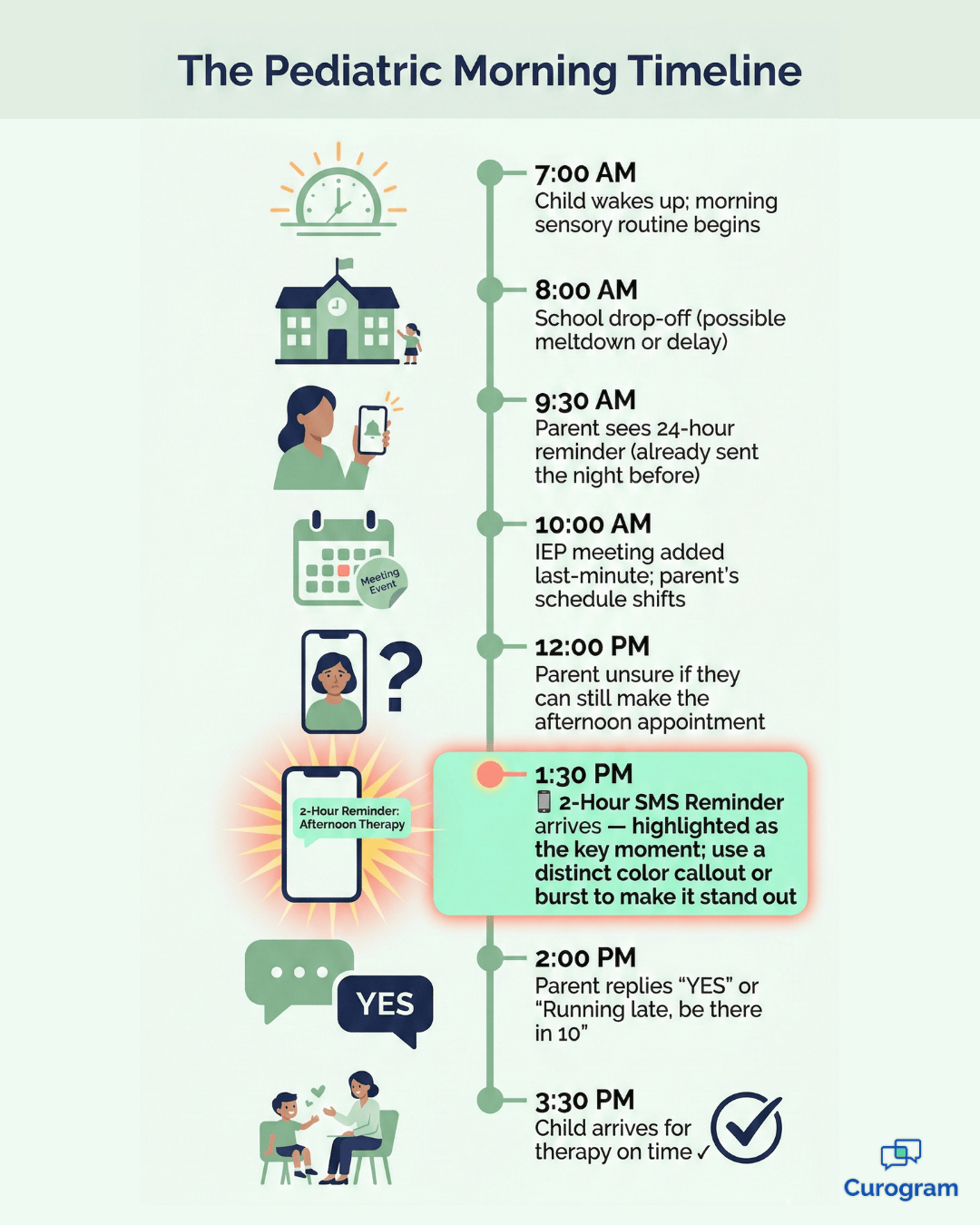
A parent may have confirmed their child's appointment last Sunday night without a second thought. But a lot can happen between a Sunday evening and a Monday afternoon slot.

This is especially true for families managing children with autism, sensory processing disorders, or other developmental needs that make daily transitions unpredictable.

What Can Change Between Sunday Night and Monday Afternoon

  • A sensory meltdown that derails the morning routine entirely
  • A last-minute IEP meeting added to the school calendar
  • A sibling's school issue that disrupts the carpool plan
  • Traffic, car trouble, or a transition struggle that pushes everything back by 30 minutes

These are not excuses — they are the real logistics of special needs parenting, and they happen constantly.

Without a final check-in, parents often find themselves at a decision point:

"It's already 10 AM. If I call now, is there even any point?" Many assume it is too late to do anything and simply do not show.

This creates what practices know as the "silent no-show" — an empty chair with no advance warning, no chance to fill the slot, and no revenue recovered.

What makes this especially frustrating for clinic staff is that the silent no-show is almost always preventable. The parent did not forget about the appointment.

They were not being careless. They were overwhelmed, lost track of time, and talked themselves out of calling.

A single, well-timed message could have changed the entire outcome.

It is also worth noting that 24-hour reminders, while still essential, serve a different purpose. They help families plan and prepare. They are not built to handle the chaos of the actual morning.

That is a separate problem — and it needs a separate solution.

The gap in pediatric therapy scheduling logistics is not about parent negligence. It is about the absence of the right message, at the right time. That is exactly what a day-of SMS reminder is designed to close.

Why a Single Text Two Hours Out Changes Everything

There is something uniquely effective about a text that lands while a parent is already in motion. Two hours before the appointment, they are in the middle of their morning — packing a bag, picking up from school, or managing a transition.

A quick message on the lock screen requires almost zero friction to read and respond to.

This low-friction, high-impact quality is what makes 2-hour SMS appointment reminders so effective for this audience. It does not ask the parent to log into a portal or return a voicemail.

It just says:

"Reminder: [Child's Name] has therapy at 2 PM today. Reply YES to confirm or call us if you need to make a change."

That is a message anyone can handle in ten seconds.

Pediatric morning timeline showing how a 2-hour SMS reminder reduces therapy no-shows

More Than a Confirmation: What a Single Reply Can Trigger

Two-way SMS means the conversation does not end at the reminder. Depending on how the parent replies,

Your team gets exactly the information they need to act — before any damage is done to the schedule.

  • "YES" — confirms the appointment and closes the loop automatically
  • "Traffic is bad, be there in 10" — flags a short delay; therapist adjusts the session start
  • "Can we reschedule?" — opens a direct line for the front desk to step in
  • "We can't make it today" — early enough warning to offer the slot to a waitlist family

You can also make these texts more useful by including actionable links. A Google Maps link to your clinic, a short daily check-in form, or pre-session prep instructions can all be embedded in the message.

This turns a simple reminder into a small care package that helps families arrive prepared and on time, which directly helps increase therapy arrival rates.

Think about what that means for a parent who is already stressed. Instead of scrambling to remember the clinic's address or digging through old emails for arrival instructions, everything they need is in one text.

That kind of convenience is not just helpful — it removes every remaining barrier between the family and the front door of your clinic.

It is also worth considering what happens when there is no 2-hour message at all. The parent assumes everything is still on. The clinic assumes the same.

Neither party has a real-time read on the situation. That information gap is where no-shows are born — and it is entirely avoidable with a single automated text.

How to Stop the Afternoon Scramble Before It Starts

Ask any pediatric clinic front desk team what their least favorite part of the afternoon is.

The answer is almost always the same:

Watching the clock tick past the appointment time, waiting to see if the family is just running late — or not coming at all. That reactive scramble is stressful, wastes time, and rarely leads to a filled slot.

A tiered reminder system flips this dynamic entirely. When Curogram sends the 2-hour message and the parent does not respond, the system can flag that appointment for the front desk to follow up on — proactively, while there is still time to act.

This shifts the team from reactive firefighting to smart, calm scheduling. That shift is a major driver of pediatric clinic front desk efficiency.

The integration with Fusion Web Clinic automated alerts is what makes this hands-off.

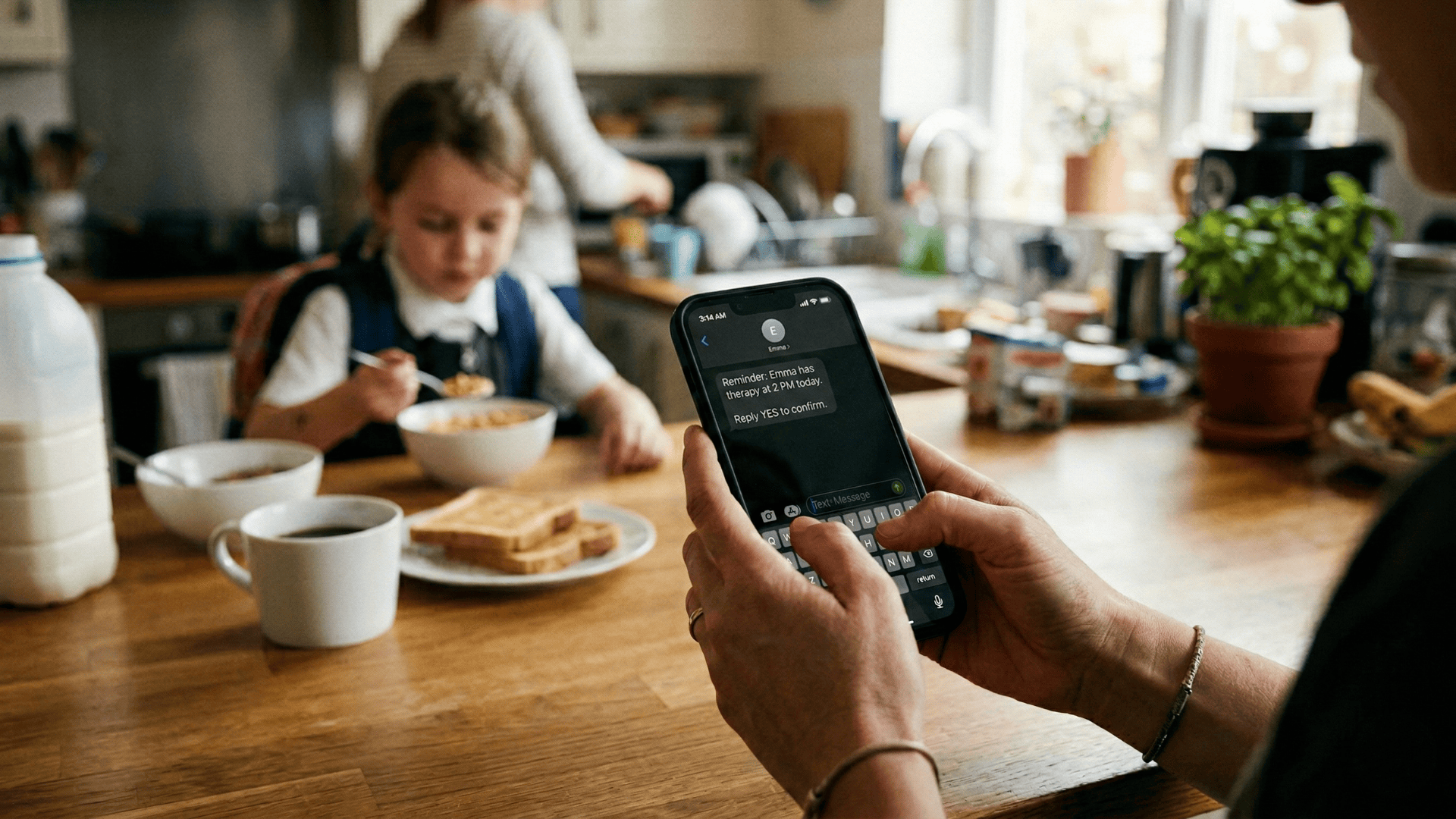
Parent receiving a same-day SMS therapy appointment reminder on their smartphone

Here is what happens behind the scenes:

  • Curogram reads each patient's confirmation status directly from Fusion in real time
  • If a patient already confirmed at the 24-hour stage, the system skips the nudge or sends a lighter courtesy message
  • If they have not confirmed, the 2-hour text fires automatically — no manual review needed from your team

Here is where revenue recovery comes in.

If that 2-hour reminder triggers a "We can't make it" reply, the clinic still has a window to offer the slot to a family on the waitlist.

Based on our internal research, practices using Curogram see up to a 10–20% increase in revenue, with each recovered appointment contributing directly to the bottom line.

That kind of result does not come from luck — it comes from having the right system in place.

Think about what the alternative looks like.

Without that early warning, the front desk has no idea there is a gap until the family fails to show. By the time staff realize the slot is empty, there is no time to fill it, no time to reach the waitlist, and no chance of recovering that hour.

The appointment is simply gone — along with the revenue it would have generated.

There is also a staff morale dimension here that is easy to overlook. When the front desk has to deal with last-minute scrambles every afternoon, it wears on the whole team.

A system that flags at-risk appointments early does not just protect the schedule — it gives staff the breathing room to do their jobs well. That is the kind of daily improvement that shows up over time in how a clinic runs and how a team feels.

Building a Practice Parents Actually Trust

Building a practice parents actually trust requires more than just reminders; there is a meaningful difference between a clinic that nags patients and one that supports them. The families you serve know that difference immediately.

When a practice takes the time to send a helpful, well-timed text — one that accounts for the reality of their morning — it sends a message beyond the reminder itself: we understand what your life looks like, and we are here to help.

For many families navigating pediatric therapy, that feeling of being understood is rare.

Their daily lives involve a level of coordination that most people never see. When a clinic communicates in a way that fits into that life — brief, clear, and sent at exactly the right moment — it earns something that no marketing campaign can buy: genuine loyalty.

That kind of communication builds trust, and in the world of pediatric therapy, trust travels.

Parents talk to each other in school pickup lines, in Facebook groups, in "Mom Groups" and referral networks. A practice known for thoughtful, mobile-first communication gets recommended. A practice that leaves families scrambling to reach a busy front desk does not.

The professional edge here is real. Families increasingly expect mobile-first communication from every service they use. When a pediatric therapy clinic shows up on the lock screen with a helpful, well-timed message, it stands out — not just as convenient, but as a practice that has its act together.

Every time a family receives a timely, helpful message and their child arrives for therapy on time, a routine is reinforced. That routine keeps children on track with their therapy goals — goals tracked and documented inside Fusion Web Clinic.

Consistent attendance is not just good for the schedule; it is the single greatest predictor of therapy progress. Therapists notice when a child misses sessions.

Progress slows, and re-establishing momentum takes time that could be spent moving forward.

When a clinic's communication system supports families in showing up consistently, it is not just helping the business — it is actively contributing to better clinical outcomes for kids.

Based on internal data, practices using Curogram's automated reminder system achieve an average appointment confirmation rate above 75%, with overall no-show rates running 53% lower than the industry average.

That is what a chaos-calming communication culture looks like in practice: fewer empty slots, more consistent care, and a front desk team that can breathe.

Stop Losing Slots to Last-Minute No-Shows — There Is a Better Way

No-shows are not a people problem. They are a communication timing problem. Families want to keep their appointments. They want their children to get the care they need. What they often lack is a well-timed, low-friction prompt that catches them before the window to act closes.

The 2-hour reminder is that prompt. It does not replace your 24-hour message or your initial confirmation request. It completes the system.

Together, these touchpoints form a tiered strategy that keeps families informed, keeps your schedule full, and gives your front desk the information it needs to respond quickly when plans change.

When you pair this approach with Fusion Web Clinic automated alerts through Curogram, the entire workflow runs on autopilot. Your team is not manually tracking who confirmed and who did not.

The system handles it. What your team gets back is time — time to focus on the patients who are in the building, not the ones who might not show.

Practices that have made this shift report real, measurable results. Based on our internal research, Atlas Medical Center cut their no-show rate from 14.20% to just 4.91% in three months — a result that was three times better than the industry average.

That kind of outcome starts with a single text, sent at the right moment.

Schedule a demo today and see how a 2-hour SMS reminder — connected directly to your Fusion Web Clinic schedule — can transform the way your practice runs day to day.


Frequently Asked Questions

Is a 2-hour reminder too much contact for families?

Not for pediatric therapy. Our internal data shows that parents of children with special needs welcome the nudge because it helps them manage complex daily transitions. Rather than feeling nagged, most families report that the day-of text makes them feel supported. The key is keeping the message short, friendly, and easy to act on.

Can we set this up to run automatically for every appointment in Fusion?

Yes. Once configured, Curogram pulls appointment data directly from Fusion Web Clinic and sends the 2-hour reminder automatically, based on each appointment's scheduled time. There is no manual step required from your team. You set the rules once and the system takes it from there, making it a core part of your pediatric therapy scheduling logistics without adding to anyone's workload.

What if a parent does not have a smartphone?

Curogram uses standard SMS, which works on any mobile device — smartphone or basic cell phone. The parent will receive the text and can reply with a simple "YES" to confirm or "LATE" to flag a delay. No app download, no account login, and no data plan is required. The message reaches them just the same.

What happens when a 2-hour reminder leads to a cancellation?

A last-minute cancellation triggered by a 2-hour reminder is actually a win compared to a silent no-show. When the parent replies that they cannot make it, your team still has a short window to offer the slot to a nearby family on the waitlist. Curogram's Smart Waitlist feature is built for exactly this scenario, making it possible to recover revenue that would otherwise be lost entirely.

Does the 2-hour message go out even if the parent already confirmed earlier?

You have full control over this. Curogram can be configured to skip the 2-hour message for patients who already confirmed at the 24-hour stage, or to send a lighter courtesy message to everyone — whichever approach fits your practice's communication style. Fusion Web Clinic automated alerts feed the confirmation status into Curogram in real time, so the system always has up-to-date information to act on.


Prevent Regression: Consistent Attendance Boosts Therapy Outcomes

Prevent Regression: Consistent Attendance Boosts Therapy Outcomes

💡 The most reliable way to prevent clinical regression in pediatric therapy is to maintain consistent session attendance — every week, as...


Read More
The Consistency Engine for Pediatric Therapy

The Consistency Engine for Pediatric Therapy

💡 Curogram integrates with Fusion Web Clinic to give pediatric therapy practices a smarter, faster way to manage appointment reminders. By...

Read More
The Mom-Link: 2-Way Texting for Fusion Web Clinic Pediatric Parents

The Mom-Link: 2-Way Texting for Fusion Web Clinic Pediatric Parents

💡 The best 2-way texting integration for Fusion Web Clinic that keeps pediatric parents engaged is Curogram. It gives therapy clinics a direct SMS...

Read More