
Cut CollaborateMD No-Shows, Fill Empty Slots
 Jo Galvez : Jul 3, 2026, 10:00:00 AM
Reminders that don’t confirm leave staff guessing. See how CollaborateMD two-way reminders cut no-shows 65% and fill cancellations the same day.

A six-therapist pediatric clinic runs 48 to 72 treatment sessions on an ordinary weekday. The person named on each chart confirms none of them. Four-year-olds don't check email, and they don't move Thursday's speech session when a fever shows up Wednesday night.
Parents do all of it. So in pediatric therapy, the reminder has exactly one job: reach the parent on the device already in their hand, and let them answer it.
Fusion handles the clinical half of this well. Pediatric goal banks, plan of care documentation, HEP assignment, recurring weekly blocks across three disciplines, drag-and-drop rescheduling that front desk staff picks up in a day.
None of that is the weak point. The weak point sits one step downstream, in how the reminder actually reaches the family.
On Essentials, reminders go out by email and nothing else. Texting begins on Advanced at $159 per month for the first user, with 30 free messages monthly and $0.10 for each one after. Those texts are one-directional. A parent who types “running 10 min late, Ellie's bus was late” is typing into a void.
Pediatric schedules already miss more than adult ones. A three-year review of 121,347 visits at an academic otolaryngology practice, published in Cureus, found pediatric clinics had the highest nonattendance rate of any subspecialty at 21.3%, against 12.6% in head and neck.
Pediatric therapy adds a multiplier that specialty clinics don't carry. Plans of care are recurring. One family that stops confirming doesn't cost you one session. It costs you a standing Tuesday slot for eleven weeks.
Fusion was built for rehab therapy rather than adapted from a generic medical scheduler, and the difference shows in recurring appointment handling and multi-discipline views. Credit where it belongs.
The tier structure is where pediatric clinics get squeezed. Essentials at $49 per month for the first user gives you email reminders. To text a parent at all, you move up to Advanced at $159, take 30 messages free, then pay $0.10 per message after that. Unlimited texting waits at Premier, $189 for the first user.
Run the message math for a mid-size clinic. Fifty sessions a day, one reminder each, 22 clinic days: 1,100 messages a month. Subtract the 30 free ones, and you're at $107 in per-message charges on top of the tier jump. That's before anyone replies, because on Advanced, replies don't come back.
Dana has two kids in your clinic. Marcus gets OT Tuesdays at 4:15. Ellie has speech Thursdays at 5:00 and PT alternating Mondays. That's three standing slots, two children, three therapists.
Tuesday's reminder email lands at 8:04 a.m., stacked under a school lunch menu and a soccer sign-up. Dana opens her phone at 3:40, remembers Ellie's dentist, and Marcus doesn't come.
Kayla, the OT, has 45 minutes of prepared sensory work and no client. The front desk starts calling. On a bad week that's two to three hours a day spent confirming appointments by phone, which is exactly the labor the reminder was supposed to remove.
Two months later, Dana explains she never saw the emails. Nobody was careless. The channel just didn't fit how she lives.
Illustrative model, six therapists, eight treatment sessions each per day, 22 clinic days:
|
Monthly Picture |
At 15% No-Show |
At 25% No-Show |
|---|---|---|
|
Sessions scheduled |
1,056 |
1,056 |
|
Sessions missed |
158 |
264 |
|
Revenue lost at $125 per session |
$19,750 |
$33,000 |
|
Therapist hours idle |
158 |
264 |
Swap in your own reimbursement rate and the shape holds. Rehab no-show rates commonly land between 10% and 30%, and pediatric caseloads sit toward the upper half of that band.
The part the table can't show is developmental. A child working toward goal mastery on a 12-week plan of care who misses four sessions isn't 33% behind schedule. Progress in early intervention windows doesn't pause politely and wait.
Parents feel that, therapists feel it at reassessment, and the authorization renewal conversation with the payer gets harder when attendance data looks thin.
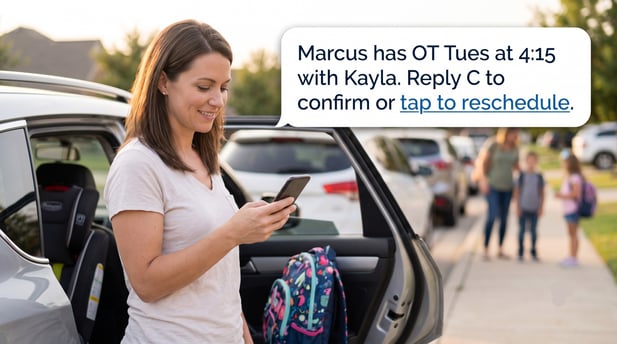
This is what a working pediatric reminder reads like:
Hi Dana, this is Riverbend Therapy. Marcus has OT Tues 8/11 at 4:15 with Kayla. Reply C to confirm or R to reschedule.
Twenty-three words, no login, no portal, no PDF attachment. Dana taps C at a red light and the schedule updates. If she taps R, a staff member sees it and calls her back with two options instead of chasing her cold.
Curogram sends the sequence to the parent's mobile number, per child, per discipline. A common cadence for recurring pediatric plans is one text seven days out, one 48 hours out, and one the morning of the session.
Unconfirmed after the 48-hour message, the appointment flags for the front desk while there's still time to refill it. Confirmations post automatically, so staff only touch the exceptions.
Nothing clinical goes in the message body. Child's first name, discipline, date, time, therapist, clinic name. Logistics only, which is also what keeps the reminder inside a defensible HIPAA posture.
2-Way Confirmation is the piece Fusion's Advanced tier can't do. Replies land in a shared inbox the whole front desk can see, assign, and resolve.
When Dana texts “running 10 min late with both kids,” someone reads it, tells Kayla, and Kayla adjusts the session plan instead of standing in the lobby wondering.
When a parent asks to swap Thursday for Friday, the thread carries the whole exchange, so the next person picking it up isn't starting over.
That thread also becomes the audit trail. Every confirmation, every reschedule request, every no-response is timestamped and searchable by family.
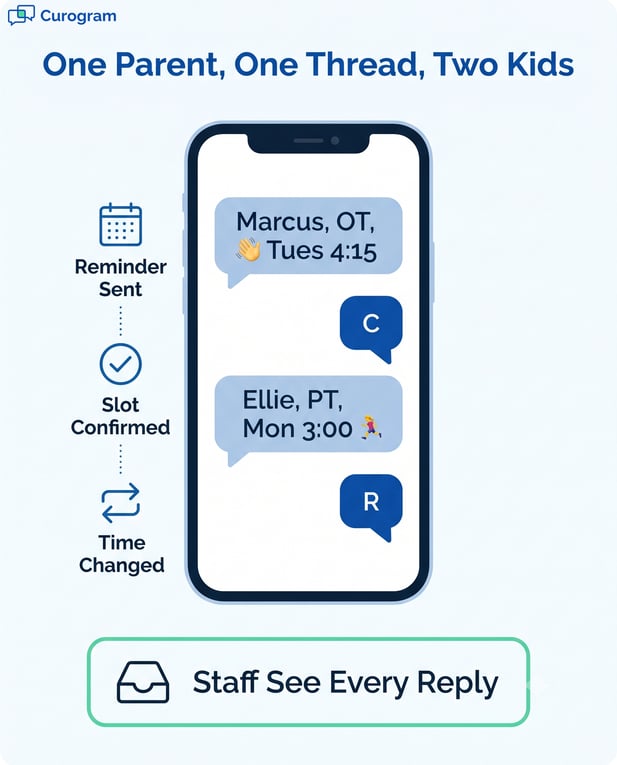
Dana doesn't want three separate reminder streams from the same building. She wants one thread from Riverbend that names which kid, which therapy, which time.
Consolidated threading is why pediatric clinics see confirmation behavior improve without adding message volume. One parent, one conversation, several children inside it. Practices comparing setups often start with two-way texting for pediatric therapy practices before layering on anything else.
It Runs Alongside Fusion, at Any Tier
Curogram complements your Fusion setup and replaces none of it. Fusion keeps documentation, goal tracking, HEP assignment, billing, and the master schedule. Curogram handles the family-facing conversation.
Practices staying on Essentials for clinical reasons don't have to buy the Advanced tier to get texting, and practices on Advanced stop watching a per-message counter.
You can see how Curogram works alongside Fusion for the setup details, including how appointment data reaches the reminder engine without any write-back claims we can't support.

Atlas Medical Center cut no-shows from 14.20% to 4.91% within three months of turning on automated reminders and two-way confirmation, based on our internal data. Roughly three times better than the industry average they started against.
Across Curogram clients, average appointment confirmation rates run above 75%, and no-show rates sit 53% below the industry average. Covina Arthritic Clinic confirms more than 1,100 appointments a month with no one dialing a phone.
Apply the 14.20% to 4.91% delta to the illustrative six-therapist model above: 150 recovered sessions a month, about $18,700 at $125 a session, and 150 hours of therapist time spent treating.
Walk one recurring family through it.
Compare that against the one-way version, where step 4 never happens, and you learn about the cancellation when the slot is already empty.
Early warning is the whole return. A cancellation caught 72 hours out is a filled slot. A cancellation caught at 2:58 p.m. for a 3:00 p.m. session is a loss you document.
Two-way texting moves cancellations forward in time, which is what makes waitlist texting for therapy cancellations worth running. The two systems feed each other.
Confirmation flags create the openings, the waitlist fills them, and utilization stops depending on how many calls the front desk can make before lunch.
We'll make one claim plainly: for pediatric therapy, the reply path matters more than the reminder itself. Reminders reduce forgetting. Replies recover schedule.
Authorization periods are finite. A payer approves 12 or 24 visits, and every missed session eats calendar without eating the authorization in a way that helps the child.
Practices running two-way confirmation finish plans of care closer to as-written.
Reassessments show cleaner attendance, goal mastery data reflects the treatment intended, and renewal requests carry stronger evidence. That's the version of this that a lead therapist cares about more than the revenue table.
The chart belongs to the child. The calendar belongs to the parent. Every reminder decision your clinic makes either respects that or works against it.
Email-only reminders on Essentials ask a parent to check an inbox on your schedule. One-way texts on Advanced reach the right device and then hang up mid-conversation, metering you at $0.10 a message for the privilege. Neither lets Dana tell you she's running ten minutes late with two kids in the back seat.
Do the arithmetic on your own numbers before you do anything else. Take your daily session count, multiply by your clinic days, apply your current no-show rate, and multiply by your average reimbursement per treatment session.
Most six-therapist pediatric clinics land somewhere between $19,000 and $33,000 a month. That figure is usually the reason this moves from a nice-to-have to a Tuesday priority.
What we'd change first isn't your EHR. Fusion's documentation and goal tracking are worth keeping, and we've never asked a practice to leave them. What we'd change is who receives the reminder, on what device, and whether their answer reaches a human being.
Book a demo and bring your last 90 days of attendance data. We'll walk your actual schedule, show you where confirmations would have caught the leaks, and give you a real recovery estimate rather than a range. Thirty minutes, your numbers, no free-trial runaround.
 Jo Galvez : Jul 3, 2026, 10:00:00 AM
Reminders that don’t confirm leave staff guessing. See how CollaborateMD two-way reminders cut no-shows 65% and fill cancellations the same day.
 Jo Galvez : Apr 14, 2026, 3:00:00 PM
Office Ally staff spend 60+ minutes daily calling unconfirmed patients. Curogram's dashboard automates follow-ups and shows real-time confirmation...
 Jo Galvez : Aug 10, 2026, 8:00:00 AM
Elastics compliance, aligner wear, broken-bracket triage. Follow-up texting for Cloud 9 ortho practices between visits. Book a demo.