

Sequences fire from the appointment type. A bonding visit triggers a day-3 soreness check and a week-3 prompt about anything loose, while aligner patients get a wear check at each tray change. Replies land in one staffed inbox, addressed to the parent on pediatric panels, with consent on file.
Messaging is HIPAA-compliant and Curogram is SOC 2 Type II certified. Curogram practices average above 75% appointment confirmation. Fewer adjustment visits get spent on problems a text could have solved three weeks earlier.
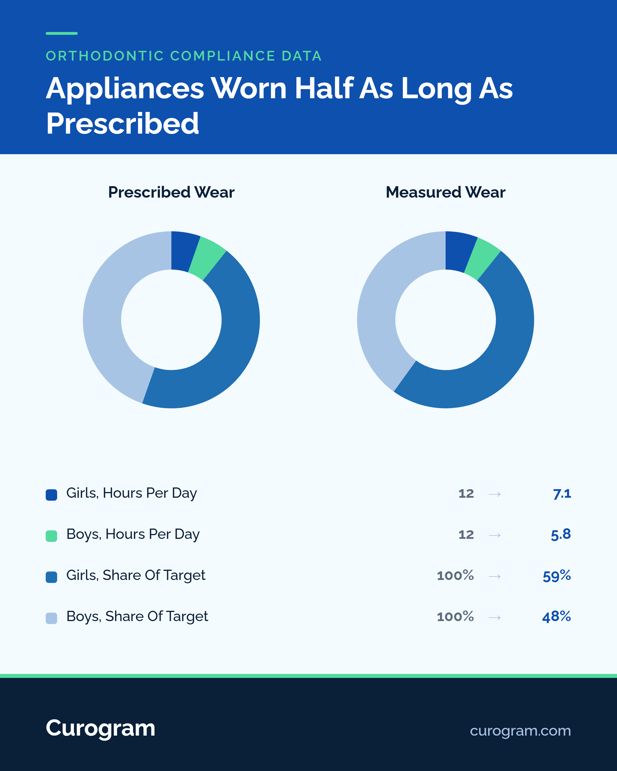
A 2022 cohort study in Sensors tracked 167 young orthodontic patients using temperature microsensors embedded in their removable appliances. Prescribed minimum: 12 hours a day. Actual average: 7.1 hours for girls, 5.8 for boys.
Nobody in that group was lying. They drifted, and no one asked until the next visit.
That gap is what this article is about. Cloud 9 tracks the treatment plan well: sequencing, appliance history, ortho billing codes, the whole 18-month arc. Day 9 of a 42-day interval sits outside its view.
The elastics go in a drawer. A bracket pops off eating a bagel. You find out chairside, and the visit you booked for progress turns into a repair.
Legwork, the Planet DDS patient engagement product bundled with Cloud 9, handles the outbound side: online scheduling, reminders, reputation, patient communication.
Real product, and plenty of ortho practices run it well. Our question is narrower. What does a between-visit conversation look like when it works, and who is staffing it?
We'll make one claim and then show the workflow behind it. Most surprises at the adjustment chair were knowable three weeks earlier, by text, for about 40 seconds of front desk attention.
The Villain: The Six-Week Silence
Forty-two days is a long time to assume things are fine.
Compliance Drifts and Nobody Files a Report
Elastics are the classic case. A patient leaves with a bag of them, wears them four days, forgets on the fifth, never restarts.
At the next visit the arch hasn't moved and you're explaining a shifted debond date to a family paying monthly.
Aligner cases follow the same shape: one tray behind, then two. Parents rarely report either drift, because from the kitchen table nothing looks wrong. The trays are getting used, more or less. The bag of elastics is still on the counter.
None of it lands in Cloud 9, because nothing happened in Cloud 9. The record shows a completed visit and a scheduled next one, which is exactly what it should show.
The Calls You Don't Get, and the Ones You Do
Two failure modes, pointing opposite directions. Families who won't call sit on a broken bracket for three weeks while the wire that should be leveling does nothing. Families who do call take the emergency slot for a poking wire that wax fixes in 30 seconds.
Both cost you the same thing, which is a chair that could have held a progress visit. Front desk absorbs the difference either way, usually by calling three other families to shuffle the afternoon.
Where the Native Toolset Stops
Legwork is built for outbound cadence and reputation work. Between-visit clinical follow-up is a different job: phase-aware, two-way, and someone has to read the replies and decide something.
That staffed layer is what we're describing, and it runs alongside whatever engagement bundle your practice already pays for.

The Guide: Between-Visit Touchpoints
Appointment type in Cloud 9 is the trigger. Nobody sets these by hand.
Nudges Timed to the Treatment Phase
Bonding day fires a different sequence than a tray change. After bonding: a day-3 soreness and food check, a day-10 hygiene nudge, a week-3 prompt asking about anything loose. Elastics open their own thread the day they're prescribed and repeat on a set interval until the next visit.
Aligner patients get a wear check pegged to each tray change date. Six touches or so across a 42-day interval, all queued from the appointment record rather than a spreadsheet somebody maintains.
Triage a Broken Bracket in Three Texts
Day 21 auto-nudge goes out: "Hi Maria, quick check on Diego’s braces. Anything loose, poking, or broken since his last visit? Reply here."
Parent replies within the hour: "The bottom right one came off yesterday."
Staffed reply, same morning: "Thanks. Is the wire still in the bracket next to it, or is it hanging loose? If the bracket is off but the wire is still seated and not poking him, this can wait for his 8/26 adjustment. We’ll add 10 minutes to that visit."
No emergency slot burned, no repair-only appointment, and 8/26 gets booked with correct chair time. The thread stays in the patient's record, so whoever seats Diego on the 26th already knows what to expect.
Total staff time on that exchange: under a minute, split across two mornings. The alternative version of the same problem costs an emergency slot, a phone call, and 20 unplanned minutes at the chair.
Curogram Highlight: Between-Visit Touchpoints
Between-Visit Touchpoints sequences those messages by treatment phase, sends them from your practice number, and drops every reply into one shared inbox your team already watches.
Threads are addressed to the parent on pediatric panels, with consent recorded. Staff answer from a desktop or phone, and the conversation history stays attached to the patient.
Curogram works with Cloud 9 rather than replacing any part of it. Cloud 9 stays the system of record for treatment sequencing, appliance tracking, and billing. Nothing here asks you to drop Legwork either. Messaging is HIPAA-compliant and Curogram is SOC 2 Type II certified.
Practices running multiple locations get the same inbox across all of them, which matters when a parent texts the Roswell number about an appliance placed at your second office. See how this pairs with the orthodontic appointment reminder workflow on the attendance side.
The Success: No Chairside Surprises
Illustrative comparison of one broken-bracket interval:
|
Chairside Discovery |
Between-Visit Texting |
|
|---|---|---|
|
Problem found |
Day 42, at the chair |
Day 21, by text |
|
Chair time used |
Repair plus adjustment, unplanned |
Adjustment plus 10 planned minutes |
|
Emergency slot |
Used, or the visit runs long |
Stays open |
|
Elastics discussed |
Once |
Three prompts before the visit |
Fewer Repair Visits, More Progress Visits
The schedule is where practices notice this first. An adjustment appointment that opens with a repair loses most of its value, because the wire you planned to change was never doing its job.
Catch the same bracket at day 21, and the visit keeps its purpose. You add 10 minutes of chair time on purpose instead of losing 20 by surprise.
Across a panel of 400 active patients, that difference decides whether your emergency column is a buffer or a second schedule.
The Attendance Side Carries Its Own Numbers
Based on our internal data, Curogram practices hold appointment confirmation above 75% and run no-show rates 53% below the industry average. Atlas Medical Center moved from 14.20% to 4.91% no-shows inside three months.
Those figures come from two-way reminders rather than compliance texting, and we're not going to claim a wear-time study we haven't run. What they do establish is that families answer texts.
That's the same assumption between-visit follow-up depends on, tested at volume. More on the reminder side in our guide to two-way patient texting for Cloud 9 practices.
Conclusion: Getting the Six Weeks Back
Orthodontics is the one specialty where a missed detail compounds for a year and a half. Every interval you close with real information instead of a guess is an interval that ends on the treatment plan’s original date. Practices tell us the visible change is the emergency schedule: it stops filling with wax questions.
Six touches over an interval is not a heavy program. It is one sequence per appointment type, built once, running on every patient after that.
Cloud 9 runs the treatment plan. Curogram keeps the conversation going in the 42 days when nobody is in your chair.
Book a demo, and we will walk you through a broken-bracket triage thread, start to finish, in three texts.
Frequently Asked Questions
Consent is recorded per patient, with the parent named as the authorized contact. Messages travel through a HIPAA-compliant platform on a SOC 2 Type II certified system, and every thread is logged to the patient record.
Legwork covers outbound cadence: scheduling, reminders, reputation. Between-visit follow-up needs phase-aware sequences plus a staffed inbox where replies get read and acted on. Curogram runs that layer alongside, and moves with you if your practice system changes.
Practices typically keep the parent as the consented contact for scheduling and clinical questions, then decide per patient whether wear-time nudges go to the teen's number. Both threads stay visible to staff in the same inbox.
Staff ask two or three routing questions by text: what came loose, whether the wire is still seated, whether anything is poking. Most answers point to wax and the next scheduled adjustment rather than an emergency slot.
Treatment length stretches when problems sit unreported. Catching a debonded bracket on day 21 instead of day 42 preserves three weeks of tooth movement, and repeated elastics prompts keep wear closer to what the plan assumes.