
 Jo Galvez

A missed therapy slot can't be resold, and the skipped session sets a plan of care back. Curogram sends governed two-way reminders from the Fusion schedule, and cancellations from family replies write back to Fusion.
Early cancellations give staff a better chance to offer the slot to another family. Curogram client data from clinical settings shows a 10% to 20% revenue lift from recovered visits.
A missed therapy session rarely shows up as a line item. It sits on the schedule as an empty slot, and most groups never add those slots up. When they do, the total is usually bigger than anyone guessed.
Therapy groups pay for no-shows twice. An empty 3:30 slot on a Tuesday can't be sold on Wednesday. And the child who missed it loses a week of progress on a plan built around steady visits. Neither loss shows up on the daily schedule, which only lists who's booked.
In the groups we talk to, clinic directors track who arrived. Few put a dollar figure on who didn't, and fewer compare that figure across sites.
So each director fights attendance with local habits. Brookside's front desk calls every unconfirmed family by noon the day before. Lakeview's desk doesn't have time, and its no-show rate shows it. This scenario is illustrative, and both clinics are examples.
A fix that works at one clinic rarely spreads to the next. Nothing in the group carries it over.
We think attendance is a group metric and should be run like one. That means one reminder sequence for every clinic, one Monday review, and one owner who answers for the number. Operations teams on Fusion already have the schedule data to do it.
What most lack is a shared reminder layer every clinic runs the same way. Without a weekly habit of comparing sites, a slipping clinic stays hidden for months.
What Missed Therapy Sessions Cost Each Clinic
The therapy no-show cost per clinic is easy to compute and rarely computed. Four inputs are enough.
The Leak Formula, Worked Through
Multiply missed sessions by your average visit rate. Then multiply by the number of clinics, and by 12 months. The table runs it for an illustrative five-clinic group.
|
Input |
Illustrative value |
|---|---|
|
Missed sessions per clinic, per month |
40 |
|
Average visit rate |
$110 |
|
Clinics in the group |
5 |
|
Monthly missed session revenue leak |
$22,000 |
|
Annual leak |
$264,000 |
Swap in your own numbers from Fusion's reports. Keep the visit rate honest by using your blended payer mix, with Medicaid and private pay averaged in.
Run the formula per clinic before you total it. A group losing $22,000 a month might find $9,000 of it at one site. That site usually has the oldest reminder setup.
Why a Therapy Slot Can't Be Resold
A busy primary care office can sometimes fit a walk-in into a no-show. Therapy rarely works that way. Sessions run 30 to 60 minutes with a set therapist, a set room, and often set equipment. Families book weeks out around school and work.
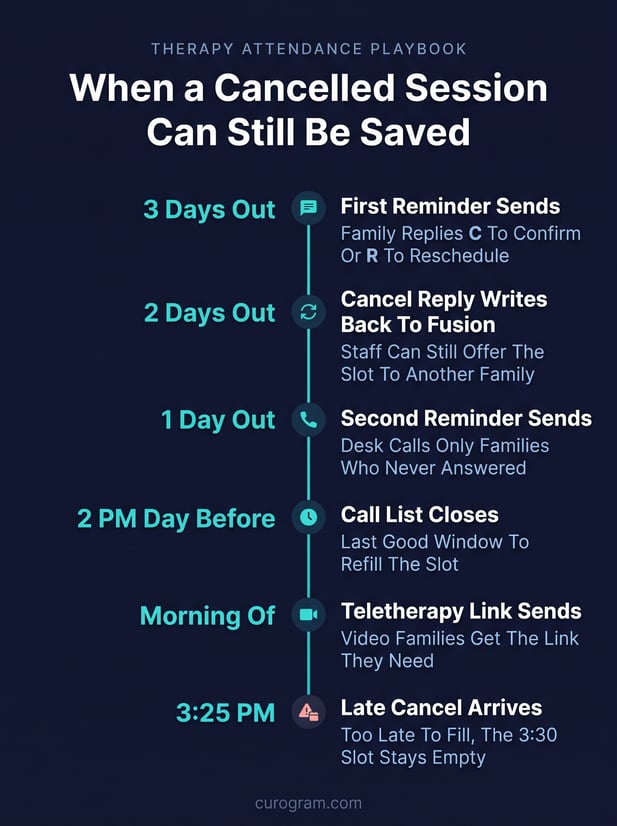
A 3:30 opening found at 3:25 stays empty. The only way to recover it is to learn about the cancellation a day or more ahead. That gives the desk time to call a family on the waitlist who can make it.
What Missed Sessions Do to Plans of Care
Plan of care adherence operations depend on steady visits. A missed session pushes progress notes back. Enough of them can stretch a plan past its certified period, which means more paperwork and a harder talk with the family.
Caregiver strain plays a part, too. A 2026 study in Patient Preference and Adherence surveyed 108 caregivers of children with cerebral palsy in Saudi Arabia.
Of those, 57.4% reported irregular PT attendance. Irregular attenders reported more trouble with appointment booking policies than regular ones.
How One Confirmation Workflow Runs at Every Front Desk
Attendance work should look the same at every clinic. A shared workflow has three parts, and staff only touch the last one.
Families Answer in the Thread
Three days ahead, a text asks the family to reply C to confirm or R to reschedule. A second text follows the day before.
Teletherapy families get the video link the morning of. The confirmation workflow therapy front desk staff used to run by phone now runs in the thread.
Across Curogram clients, more than 75% of appointments get confirmed this way, per Curogram client data from clinical settings. Covina Arthritic Clinic alone confirms more than 1,100 appointments a month.
Cancellations Land on the Fusion Schedule
When a family cancels by text, Curogram writes the cancellation back to the Fusion schedule, along with no-show and declined statuses.
Confirmations stay in Curogram, where staff check them each morning without retyping anything. Curogram's appointment reminders for Fusion users work this way at every site in the group.
An early cancellation gives the desk a better chance to fill the slot. Each one filled is a small dent in the missed session revenue leak.
Staff Work the Exceptions
Front desk time moves to the short list of families who never answered. By 2 PM the day before, staff call only those families. Staff can offer openings to waitlisted families, starting with those who asked for an earlier slot.
Groups that want a wider view of open slots across sites can look at a multi-location command center approach. It helps when one clinic has gaps and another has a waitlist.
Curogram Highlight: Two-Way Confirmation Logic
Curogram's Two-Way Confirmation Logic lets families confirm, cancel, or ask to reschedule by reply. The owner sets one sequence, and every clinic runs it.
Curogram's Ensora Fusion integration pulls appointments from Fusion and writes cancelled, no-show, and declined statuses back to it. Setup usually takes about a day with a Fusion user login, and no server access is needed.
Owners can review confirmation activity to spot a clinic that's falling behind. Messages can vary by provider or visit type. Curogram is HIPAA-compliant and SOC 2 Type II certified.

A Six-Week Attendance Playbook for Fusion Groups
Our plan uses an illustrative group of five clinics. Each step has an owner and a day, so it runs without a project manager.
Weeks 1 and 2: Set the Baseline and the Standard
Pull last quarter's no-shows by clinic from Fusion. Our example group ranged from 6% at its best site to 15% at its worst. Next, the operations lead locks one sequence for all five clinics.
Turn off duplicate reminders, so no family gets two texts for one session. Clinic managers add local details like parking notes and therapist names. They don't touch timing or reply options.
Before launch, clean the caregiver contact list. Many therapy families list a parent's work line or an old number from intake, and those texts never land.
Weeks 3 and 4: Run the Monday Benchmark
Every Monday, the operations lead shares a one-page view. It shows the no-show rate and the confirmation rate for each clinic, side by side.
Those two lines drive the utilization multi-clinic group owners care about. If one clinic's confirmation rate trails the rest by 10 points, check caregiver phone numbers first. In our example, Lakeview had stale numbers for one in five families. Fixing them took one afternoon at check-in.
Keep the meeting to 15 minutes. Each director names one cause behind their clinic's misses and one fix to try before next Monday.
Weeks 5 and 6: Spread What Works
By week 5, the best clinic's habits become the group default. If Brookside's 2 PM call list cut its no-shows, every clinic adopts it that Monday.
Track attendance rate improvement (PT, OT, SLP) by discipline as well as by clinic. Gains should show up as fewer gaps in each therapist's day.
For a real benchmark, Atlas Medical Center cut no-shows from 14.20% to 4.91% in three months on Curogram's sequence. Owners who want the policy side of this can start with standardizing appointment reminders across Ensora Fusion clinics.
Conclusion: Own the Attendance Number Group-Wide
Attendance is a group number with clinical stakes. Managing it clinic by clinic leaves the best fixes stuck where they started.
Fusion keeps the schedule. A shared reminder sequence and a Monday benchmark keep families on it, at every site, with the same rules. Clinic directors keep running their rooms, and the owner answers for the group number. Every director sees the same page each Monday.
Run one calculation this week: missed sessions, times visit rate, times clinics, times 12. Put the result in front of your leadership team. Then decide whether the current patchwork gets another year.
Book a demo to walk through how a shared reminder sequence could work across your Fusion clinics.
Frequently Asked Questions