
 Aubreigh Lee Daculug

Curogram makes each clinic's local number textable. Parents send a plain text. Staff reply from a secure, HIPAA-compliant inbox, and each chat ties to the patient record. We call this "The Network Switchboard."
Fusion's client portal still handles documents and home programs. Curogram covers the quick, daily back-and-forth that keeps plans of care on track. Practices on Curogram see no-show rates fall 53% below the industry average.
A mom is waiting in the school pickup line with eight minutes to spare. Her youngest has speech therapy at 3:30, traffic is already backing up, and she needs to tell the clinic she'll be about 10 minutes late.
Typing that message would take roughly five seconds, while recovering a forgotten portal password could take five minutes she simply doesn't have.
So she does nothing and arrives late, the session runs short, and the front desk spends the afternoon wondering what happened. Nobody made a mistake, but the system asked for too much effort at exactly the wrong moment.
This is the hidden cost of requiring logins for small, everyday questions. Therapy families are among the busiest patients your clinics serve, often managing several children, two work calendars, and a constant stream of school paperwork. Their entire week runs through the messaging app on their phone.
Yet most therapy groups still offer parents only two options: call during business hours or sign into a portal. Both choices demand time and attention that a parent rarely has to spare. When a question feels too small to justify the hassle, it quietly goes unasked.
That silence adds up. Missed reschedules become empty appointment slots, and late arrivals become shortened sessions. Within a few months, a plan of care that depended on steady weekly visits begins to drift off course.
Parents texting your Ensora Fusion clinic without a portal login solves this problem at its source. Families can reach your team the same way they already reach their school, their coach, and their pediatrician, using the clinic number saved in their phone.
In this guide, you'll learn why the portal-first approach breaks down for therapy parents, how a text-first channel works alongside Fusion, and what improves once your front desk can simply reply.
Why Simple Questions Never Get Asked
Therapy parents carry more scheduling responsibility than almost any other group in healthcare. Weekly visits, multiple providers, and appointments squeezed around the school day turn every week into a complicated puzzle.
Even so, most clinics still route parent questions through a busy phone line or a login screen.
We call this obstacle "The Portal Detour." It's the extra step standing between a parent's question and your team's answer. For a larger task like reviewing documents, that step makes sense, but for a one-sentence question, it becomes a wall.
A Lunch-Hour Call That Never Connects
Consider a dad who needs to move his son's Thursday physical therapy session to Friday. He calls from work at 12:40, but the clinic is closed for lunch, so his call goes straight to voicemail.
He fully intends to call back later. Then a meeting runs long, dinner gets busy, and the rest of the week moves on without him. Thursday arrives, the appointment slot sits empty, and his son's plan of care slips by another week.
Login Walls Filter Out the Families Who Need You Most
Here's the most frustrating part of the problem.
The families most likely to disappear are usually the most overwhelmed ones. A single parent with three children in therapy has the least free time and the most details to coordinate.
Every extra login step filters out exactly those families. A question that takes five seconds to think of should take about five seconds to ask, and when it takes longer, it often never happens at all.
The Gap Between the Therapy Room and Everything Else
Inside each session, your therapists are attentive, patient, and genuinely invested in every child. Outside the session, however, the group can feel surprisingly difficult to reach. Parents notice that contrast, even when they never mention it.
That gap affects more than satisfaction scores. Consistency is the foundation of effective pediatric therapy, because progress depends on regular, repeated practice.
When contacting the clinic starts to feel like work, appointments get skipped, and each child's progress slows down as a result.
How "The Network Switchboard" Connects Families to Every Clinic
The solution isn't another app for parents to download and remember. It's letting families use the tool they already use every day. Curogram acts as "The Network Switchboard" for your therapy group, receiving and answering texts from each clinic's own local number.
That number is already saved in the parent's phone, printed on appointment cards, and listed in their recent calls.
There's real trust in a familiar clinic number, and Curogram builds on that trust rather than asking families to learn an unfamiliar system.
Here's how it works in practice:
- No-app 2-way texting: Parents send standard SMS messages from any phone, with nothing to install and no account to create.
- A secure, routed inbox: On your side, every message lands in a HIPAA-compliant inbox and goes to the right clinic and staff member.
- Context tied to the record: Each conversation connects to the patient record, so the care team sees recent family messages before the next session.
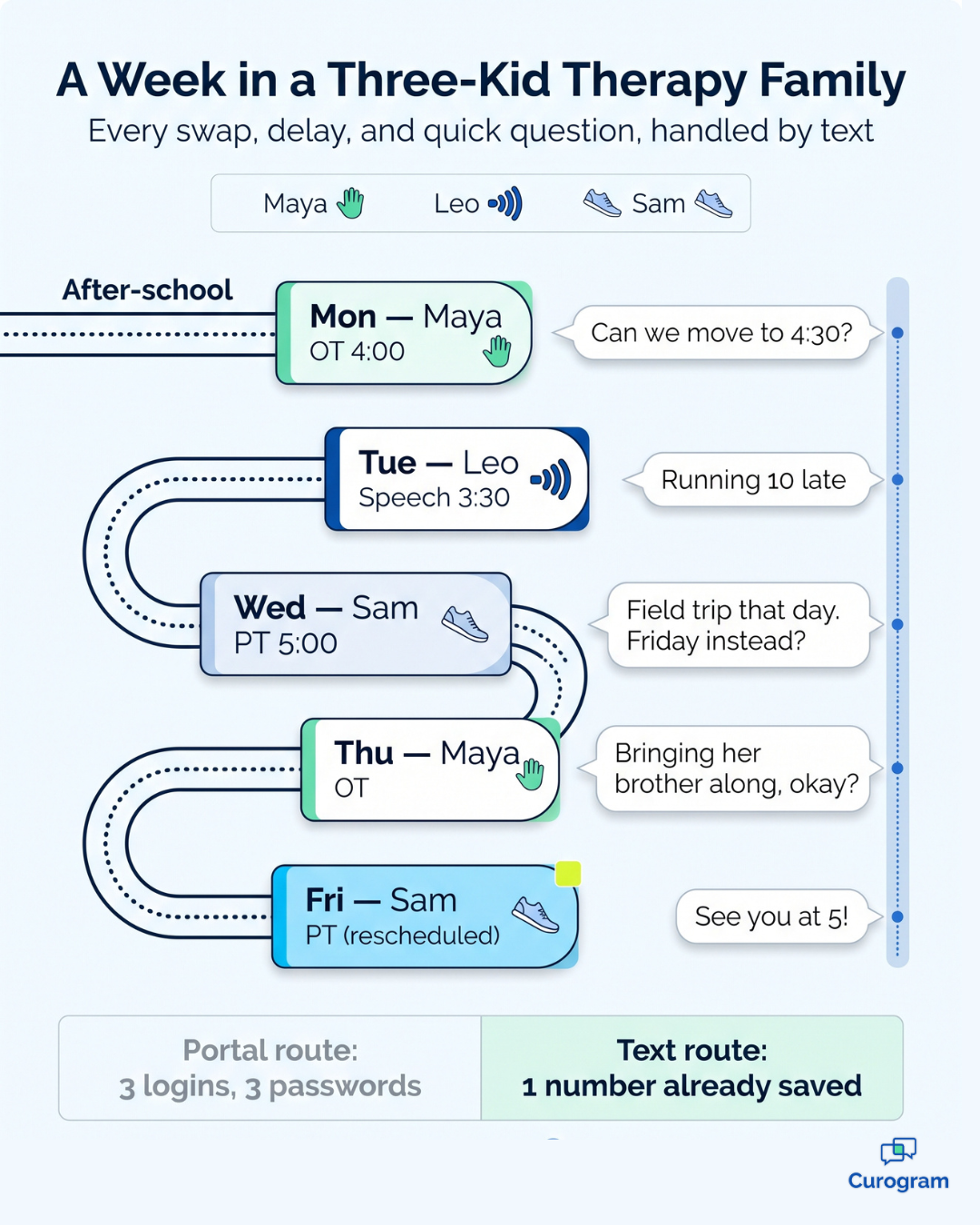
- One thread for the whole family: A family texting three kids' schedules can manage everything in a single conversation instead of juggling three separate portal accounts.
That matters. Parents rarely plan their week one child at a time.
They think,
"Maya has occupational therapy Monday, Leo has speech Wednesday, and Sam's physical therapy might conflict with a field trip."
That's how families think, and one thread fits it.
This is the kind of parent communication pediatric therapy teams have been missing for years. It's fast for families and organized for your staff.
When busy parents schedule therapy by text, they handle it immediately, whether they're in the pickup line or standing in a grocery store aisle. They no longer need to set a reminder to call back during office hours.
Throughout all of this, Ensora Fusion remains your system of record. Curogram doesn't replace it or compete with it. Instead, it provides a Fusion client portal alternative for messaging, a faster lane for the many questions that never needed a login in the first place.
What Changes When the Clinic Texts Back
Once parents learn they can simply send a text, communication patterns change quickly. Families who previously would have stayed silent now send a short update.
Your front desk responds within seconds instead of trading voicemails for days.
Practices using Curogram see no-show rates fall 53% below the industry average. In practical terms, parents who can text are more likely to attend appointments, reschedule in advance, and remain on their child's plan of care.
Here's how everyday situations compare:
| Situation | Portal or phone only | With "just text us" |
|---|---|---|
| Running late | Parent stays silent, and the session runs short | "Running 10 late for Leo's 3:30" arrives in five seconds |
| Need to swap a session | Voicemail, callback, and a missed connection | Swap confirmed in one thread, often within minutes |
| Quick question | With no portal login, the quick question for the clinic never gets asked | Parent asks, staff replies, and it's handled |
| Three kids, one week | Three separate logins or three phone calls | One conversation covers every child |
The underlying shift is simple. "Call during business hours or log in" becomes "just text us," and that single sentence makes a therapy group feel genuinely family-friendly.
Now let's put some rough numbers on that change. The following is an illustrative example, not actual client data.

Imagine one clinic handles 400 visits each month, and 8% of those visits are lost to no-shows or same-day cancellations. That's 32 empty appointment slots every month. If texting helps parents preserve even a quarter of them, the clinic recovers 8 visits monthly, or 96 visits per year, at a single location.
For your team, that means fuller schedules without hiring additional staff. For families, it means fewer interruptions in care. And for each child, it means a plan of care that keeps its steady weekly rhythm, which is exactly what therapy requires.
Keeping Family Texting Safe and Simple for Your Staff
Opening a text line for parents naturally raises two questions from clinic leaders. Will it stay secure, and will it bury the front desk in messages? Both are fair concerns when the conversations involve children's care.
Curogram was designed for exactly this situation. Here's how it keeps texting safe and manageable:
- Consent comes first. Parents opt in before messages begin, and opt-outs are honored automatically, so staff never track preferences by hand.
- Messages stay minimal. Texts focus on logistics like times, swaps, and reminders, while sensitive clinical details stay inside Fusion where they belong.
- Access stays scoped. Each clinic's inbox is visible only to the staff who need it, which matters even more when the patients are minors.
- Routing prevents overload. Messages go straight to the right location and team member, so no single person becomes the bottleneck for an entire group.
That last safeguard also explains why texting usually lightens the workload instead of adding to it.
A text can be answered in seconds between check-ins, while a phone call demands full attention and often turns into several rounds of voicemail. Practices using Curogram have seen call volume drop by 50%, which gives front desk teams back hours every week.
For your staff, this means fewer interruptions and a clearer record of every family conversation. For parents, it means a quick, reliable answer without wondering whether their message reached the right person.
Let Families Reach You Where They Already Are
Therapy parents already manage most of their lives through text messages. School announcements, carpool arrangements, and practice changes all flow through the same message threads. Your clinic belongs in that flow.
The problem was never a lack of compassion. Your therapists show up fully for families during every session. The real problem was the detour between a parent's question and your team's answer.
Removing that detour doesn't require giving anything up. Fusion's portal still has an important role as the place where families access documents, home programs, and records. Curogram handles the other role: the everyday coordination that keeps those programs on schedule.
The two tools work together, with Fusion remaining the system of record behind both. Parents no longer have to choose between a secure channel and a convenient one, because they get both through the number they already trust.
Here's a simple test you can run this week.
Ask your front desk staff how often a parent says, "Can I just text you?" If the honest answer is "all the time," you already understand what families want.
Then consider what saying yes could accomplish. Late arrivals get flagged before sessions begin, and reschedules happen in one thread instead of three voicemails. Plans of care maintain their cadence, and families feel like your group is genuinely on their side.
You don't need to launch texting everywhere at once. Start with your busiest clinic, the location where the phones never seem to stop ringing. Most groups find that parents discover the new option on their own within just a few days.
The families you serve are already reaching for their phones. Make sure your clinic is ready to answer.
Schedule a Demo to see how Curogram can text-enable your Ensora Fusion clinics, beginning with the location that needs it most.