
 Aubreigh Lee Daculug

A hotel can sell tonight's empty room at 11 p.m., and an airline can rebook a passenger on the next flight. A therapy clinic doesn't get that kind of second chance.
When a parent cancels a 9:00 speech session at 7:40 a.m., that therapist's hour starts to expire. If nobody fills it by around 8:30, it disappears permanently, because you can't sell yesterday's session tomorrow.
Most practice managers understand this. Very few have a reliable process that moves quickly enough to respond effectively.
The cancellation usually arrives as a voicemail while the front desk is checking in children, collecting copays, and calming a toddler in the lobby. By the time someone listens to the message, the appointment window is nearly over. Then the waitlist calls begin, one family at a time, for a session already slipping away.
It sounds like a minor scheduling headache. It isn't.
If you run tightly booked PT, OT, and speech calendars across five locations, one missed refill per clinic each day accumulates surprisingly fast. In a month, that loss can exceed what you spend on most of your software.
Yet it never appears as a line item on a billing report; it simply disappears unnoticed.
Meanwhile, waitlisted families wait several weeks for appointments that were available all along. Your therapists remain underutilized, and your front desk feels like it failed, even though it did its best with a telephone and a spreadsheet.
This guide explains filling cancelled therapy slots by text in Ensora Fusion clinics, and why speed is everything. You'll see how the problem develops, what a text-based waitlist workflow looks like, and what changes when a cancelled hour gets a second life within minutes.
The objective is simple: every available slot should reach an interested family while there's still enough time to arrive.
Why a Cancelled Therapy Hour Becomes a Dead Slot
Pediatric therapy runs on recurring schedules. Most children attend once or twice a week, at the same time, for months at a stretch, which keeps calendars consistently full and predictable. It also guarantees that cancellations happen every single day.
Children get sick, parents get stuck at work, and school events appear without much warning. Each cancellation leaves a hole in a carefully packed schedule, and that hole has an extremely short shelf life.
We call this "The Dead Slot": a cancelled session that doesn't get refilled before the appointment begins. Once the hour passes, the revenue is permanently gone, and no billing correction or follow-up call can recover it.
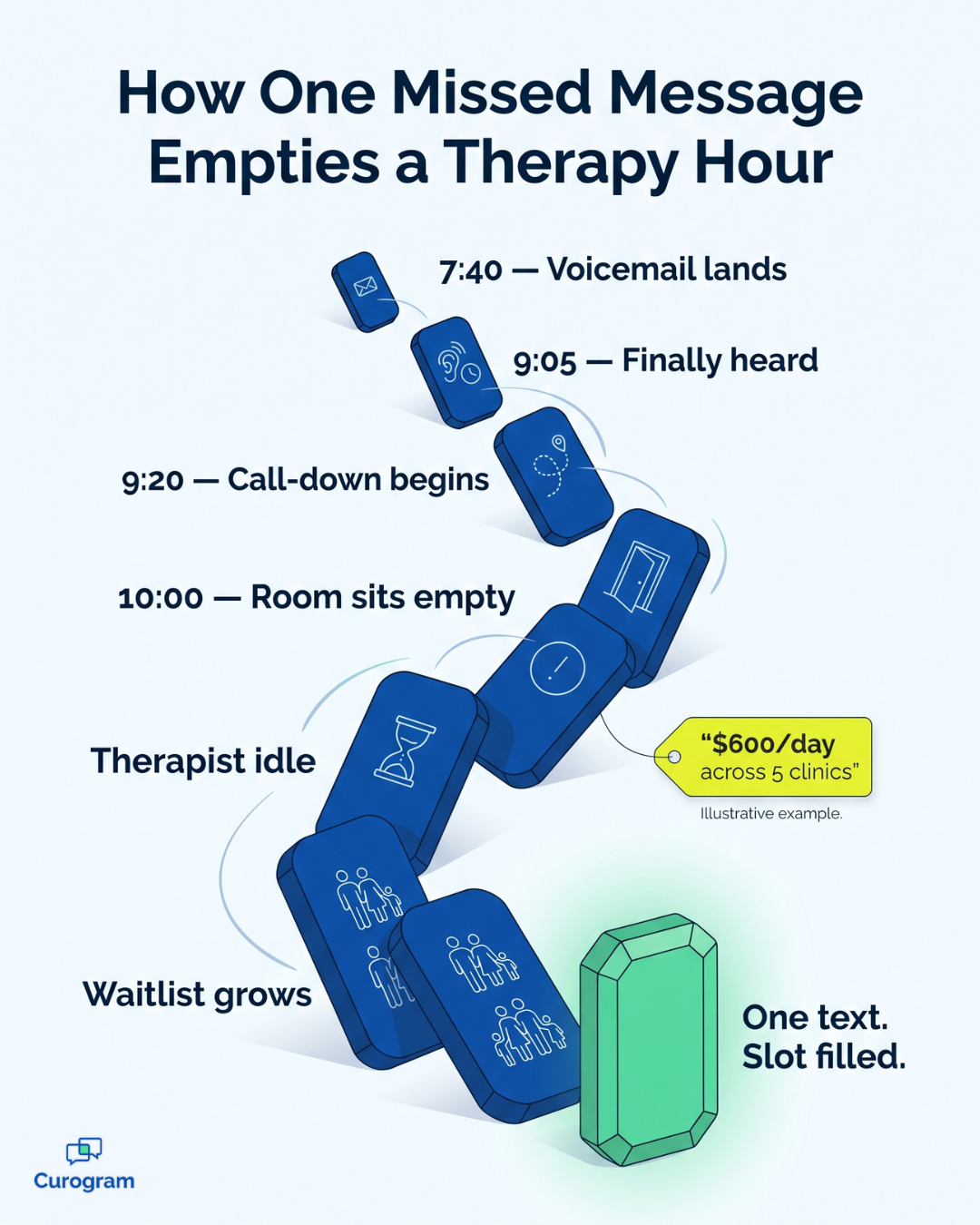
Here's how a typical slot dies when the process depends on voicemail and manual phone calls:
| Time | What happens |
|---|---|
| 7:40 a.m. | A parent leaves a voicemail to cancel the 9:00 OT session. |
| 8:00–9:00 a.m. | The front desk manages check-ins, copays, and incoming calls while the voicemail waits. |
| 9:05 a.m. | Someone finally listens to the message. |
| 9:20 a.m. | The waitlist call-down begins, and the first two calls go to voicemail. |
| 10:00 a.m. | The session window closes without anyone filling it. |
The frustrating part is that three families on that waitlist would have accepted the opening immediately. They simply never heard about it in time.
This is the cancellation cascade therapist calendar managers deal with every week. One unheard message causes a delayed response, the delayed response leads to slow outreach, and slow outreach ends with an empty treatment room.
Manual call-downs are slow by design. Each call takes several minutes, many go straight to voicemail, and some families call back after the slot has passed. When you add up all the front desk waitlist calls, time your team could have spent helping families standing in the lobby, the hidden operational cost keeps growing.
Now let's attach a dollar figure to the problem. In this illustrative example, your average therapy visit generates $120 in revenue, and each of your five clinics loses one slot per day:
- Per day: 5 slots × $120 = $600
- Per month (21 workdays): about $12,600
- Per year: about $151,200
These are sample numbers rather than industry benchmarks, so substitute your own visit rate and location count.
For most multi-location groups, unfilled therapy slot revenue loss is dramatically larger than any software expense they've ever debated in a budget meeting.
The damage isn't only financial, either. Therapists sit idle while waitlisted children wait weeks for appointments that technically existed every single day, which means the real cost is lost care as well as lost dollars.
Meet the Network Switchboard for Text-Speed Refills
The solution isn't asking your team to work harder on the phone. It's changing how quickly information travels between your clinic and the families who want those openings.
Curogram is a HIPAA-compliant patient texting platform. It acts as "The Network Switchboard" for your clinics. It turns cancellation-to-refill into a text-speed workflow instead of a phone-speed one.
Here's how each step changes.
Cancellations Arrive the Moment Parents Decide
Parents can cancel by text message instead of leaving a voicemail, so the notification reaches your team as soon as the decision is made rather than an hour later.
That single change wins back most of the time a slot has left. A cancellation sent at 7:40 can be acted on at 7:41.
Instant Waitlist Offers Reach Matched Families
As soon as a slot opens, Curogram texts the waitlist families who fit that particular opening.
A message might read:
"A 9:00 OT slot just opened at Brookside. Reply YES to take it." The first family to respond claims the appointment.
Your waitlist lives inside Curogram as tagged families, sorted by discipline, clinic, and availability window. That way, a speech offer only reaches speech families who can actually come in at 9:00.
Text messages achieve a 98% open rate, which means offers get noticed almost immediately. A single same-day slot recovery text can accomplish what ten phone calls couldn't.
The Swap Stays in Fusion
Cancellations and refills coordinate with your Fusion schedule, so your front desk confirms each swap in the system they already use every day. There's no separate calendar to maintain and no duplicate data entry.
Families who replied too late get an automatic follow-up. It tells them the slot is filled and they're still on the list. Nobody is left wondering what happened.

Refill Rates Land on the Scoreboard
Curogram shows refill rates for every clinic. Dead slots stop being invisible leakage and become a number you can measure and manage. If one location refills most of its cancellations while another refills only half, you immediately know where to focus.
This visibility also supports cross-clinic slot coverage. When a family is tagged as willing to visit more than one nearby location, an opening at either site can be offered to them, so your entire network draws from one shared pool of demand.
Combined, these pieces create a therapy waitlist slot refill workflow your team can complete in two texts: one to offer the slot and one to confirm it.
What Happens When a Cancelled Slot Gets a Second Life
Speed changes the math. Curogram practices achieve confirmation rates above 75%, and because cancellations arrive by text instead of voicemail, open slots get identified early enough to refill them the same morning.
Here's the same 9:00 cancellation, replayed as an example using text messaging:
- 7:40 a.m. — The parent texts to cancel the appointment.
- 7:42 a.m. — The front desk releases the slot, and an offer goes out to matched waitlist families.
- 7:51 a.m. — One family replies YES, and everyone else receives a quick "slot filled" update.
- 7:55 a.m. — Staff confirms the swap in Fusion.
- 9:00 a.m. — A new child arrives, and the therapist's hour is fully utilized.
Same event, completely opposite result.
The most important change happens in how your team interprets a cancellation. It used to mean loss. Now it means a chance to help a family that has been waiting for weeks.
That shift delivers results in three areas. Therapist utilization improves, so clinicians spend more of their day providing the care they trained to deliver. Waitlisted families get appointments sooner, which matters enormously when a child is waiting for speech, motor, or developmental support.
Your front desk notices the difference as well. Curogram practices have reduced call volume by 50% and increased front desk productivity by 30% or more, because staff send one offer and confirm one reply instead of working through a lengthy call list.
The daily race against the clock doesn't disappear. You finally have a reliable way to win it.
Stop Paying the Dead Slot Tax
Every therapy appointment is perishable inventory. Once the hour passes, it can't be resold, rescheduled, or billed, and only text-speed communication moves quickly enough to save it.
That's the central lesson here. Phones and voicemail aren't broken; they're simply too slow for an appointment that expires in roughly fifty minutes.
Think of your technology as two halves of one system.
Fusion is your schedule of record, the place where the official version of your calendar lives, while Curogram is how you reach families for their instant yes. Working together, they keep therapist calendars consistently full.
Now try a quick exercise. Count last week's cancelled-and-unfilled appointments across all your clinics, then multiply that number by your average visit rate.
That figure is your Dead Slot tax. You paid it last week, and you'll pay it again this week unless something in your process changes.
For a group operating five clinics, the number is rarely small. Even one empty hour per location per day can become a five-figure monthly loss that never appears on a financial report, though it definitely shows up in your margins, your therapists' schedules, and your waitlist.
Fortunately, this tax is optional. The families who want those openings are already on your list; they just need to hear about them while there's still time to say yes.
Text messaging is how they hear in time. One offer reaches the right families within seconds, the first reply claims the slot, and your front desk confirms it in Fusion before moving on with the morning.
That's how a cancelled session becomes a filled one in about twenty minutes, instead of a lost one by 10:00.
Ready to calculate your own Dead Slot numbers? Schedule a Demo, and we'll design a waitlist-offer workflow around your real cancellation patterns, clinic by clinic.