
 Aubreigh Lee Daculug

Curogram acts as "The Compliance Backbone." It gives each location one familiar number. It runs on a HIPAA-compliant platform and syncs every thread to the DrChrono chart.
The result is zero patient conversations on personal devices, plus texts patients actually read. Curogram SMS messages see a 98% open rate.
Your patients have heard the warning many times: never trust a text from a number you don't know, and never click an unfamiliar link.
Then someone from your own office sends them a message from a personal cell.
The message is kind and useful, maybe a reminder to fast before labs or a quick answer about a prescription refill. To the patient, though, it looks almost exactly like the suspicious texts they've been taught to delete.
That's the quiet problem inside many busy medical practices. Staff reach for their own phones because it's the fastest option, and patients appreciate a fast response. Nobody means any real harm, yet the patient now holds a message with no verified sender, no privacy guarantee, and no connection to their care record.
Scammers understand this vulnerability well. According to the FTC, people reported losing $470 million to text scams in 2024. When legitimate care instructions arrive from random numbers, patients can't easily distinguish their care team from a fraud.
Secure patient texting without personal phones in DrChrono practices solves this problem from the patient's side first. Every message arrives from a number patients already recognize, and every reply reaches the whole care team instead of one employee. Each exchange stays protected, whether the sender is on shift or not.
In this guide, you'll learn why "The Mystery Number" causes more damage than it seems, and why good intentions can't make a personal phone safe. You'll also see how Curogram works as "The Compliance Backbone" for DrChrono practices, giving each location one trusted number that syncs directly to the chart.
The goal isn't to blame the staff who improvised. They were solving a real problem with the only tool in reach, so the better answer is a tool that's just as fast and far safer.
The Mystery Number: How a Helpful Text Turns Into a Privacy Problem
Let's be fair to your staff before anything else. When a medical assistant texts a patient from her own phone, she's usually trying to save that patient a callback, a long hold, or an extra trip to the office.
The intent is good, but the patient inherits every risk that comes with the shortcut.
What the Patient Actually Sees
Here's the kind of message that goes out in practices every day:
"Take the second pill with food — Jenny from Dr. Park's office." It's clear, friendly, and medically correct.
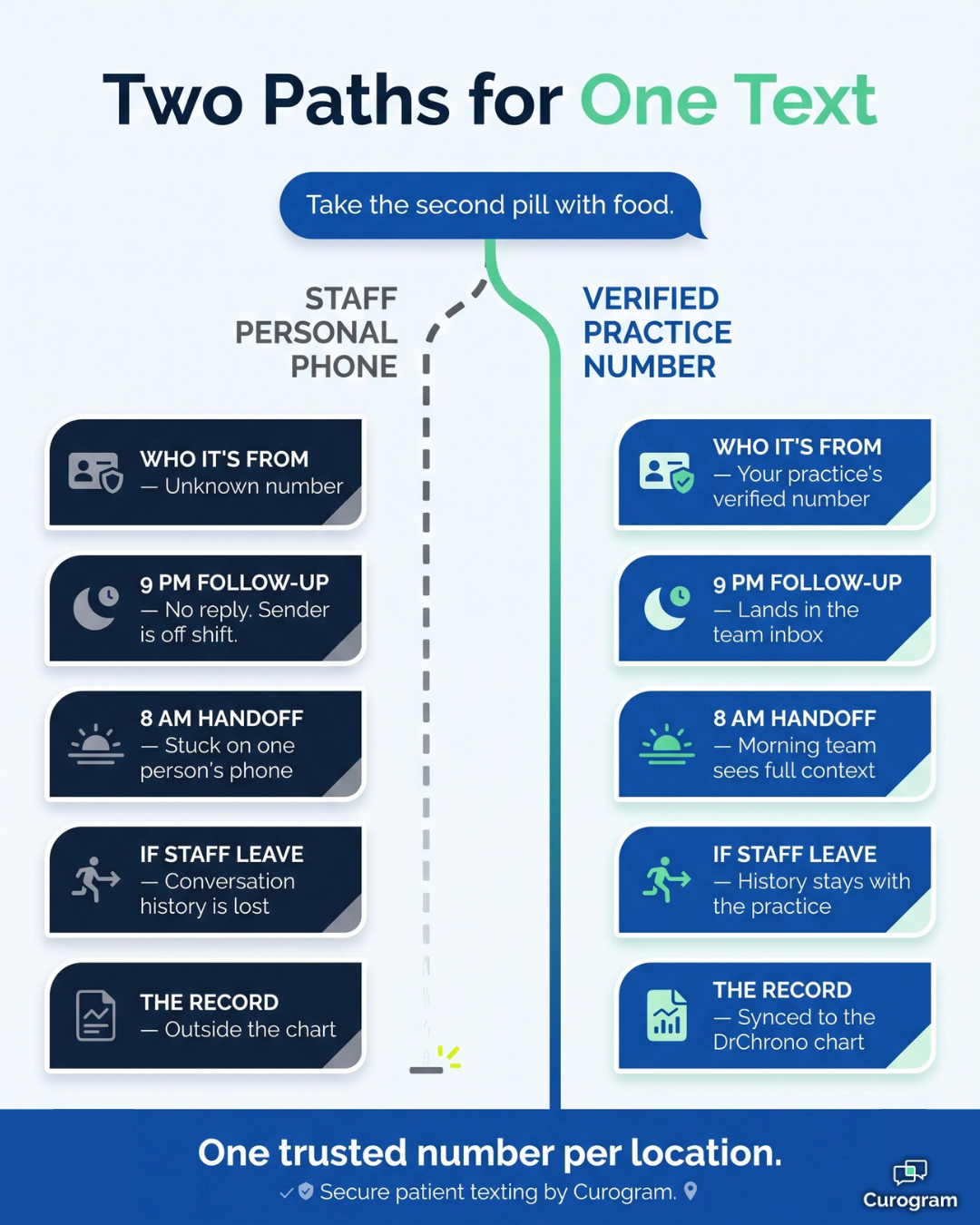
The problem is that the patient doesn't recognize Jenny's number, so they save it as "clinic??" and move on with their day. That evening, a new side effect appears, and they text a question at 9 pm. Jenny is off shift with her phone on silent, so the patient receives no answer at all.
Silence at the exact moment someone needs help is not a minor inconvenience. It's often when patients begin doubting the practice or making medical decisions on their own.
The Trust Trap
An unknown number text from clinic staff puts patients in an uncomfortable position.
They've been coached for years to distrust mystery texts, so some patients simply ignore the message, including important care instructions. Others learn the opposite lesson and decide that random numbers claiming to represent their doctor are safe to trust.
Both outcomes create real harm. The first leads to missed instructions, while the second makes patients easier targets for scams that imitate healthcare messages. Either way, a responsible patient privacy texting practice can't depend on patients guessing which messages are legitimate.
Where the Conversation Ends Up
Now consider where that conversation actually lives. It sits on one employee's personal device, completely invisible to the rest of the care team. If the phone is lost or stolen, the patient's health information goes with it, and if the employee leaves, the entire history disappears too.
This is the personal cell PHI risk that most practices underestimate. It rarely looks like one dramatic breach; instead, it's hundreds of small exposures scattered across pockets, purses, and car cupholders.
Consider an illustrative example. Suppose a three-location practice has 12 staff members who each text about 15 patients a week from personal phones. That adds up to 180 conversations every week, or roughly 9,360 conversations a year, sitting completely outside your official records.
In practical terms, that means thousands of opportunities for a lost phone, a missed reply, or a dangerous gap in the patient chart.
Meet the Compliance Backbone: A Safer Home for Every Patient Text
Staff members didn't start texting from personal phones because they wanted to break the rules. They did it because the old options were slow. Phone tag, voicemail, and portal logins simply can't compete with a quick text.
That's why the solution can't be a strict "stop texting" policy. It has to be a faster, safer place to text, and that's exactly the role Curogram plays as "The Compliance Backbone." It places a professional channel right where the improvising used to happen, without slowing anyone down.
Each location gets its own verified number. Every message comes from the same number patients already see on their reminders. And because each conversation belongs to the location, anyone on the team can pick it up.
Remember the patient with the 9 pm question? With Curogram, that message syncs to the DrChrono chart, so whoever covers the morning shift at 8 am sees it immediately, with full context, and replies from the same familiar number.
Here's how the two approaches compare from the patient's point of view:
| What the patient experiences | Staff personal phone | Curogram practice number |
|---|---|---|
| Who the text comes from | An unknown number | The location's verified number |
| Replies sent after hours | Reach one person, who may be off shift | Reach the whole team's shared inbox |
| Where the chat is stored | One employee's phone | Synced to the DrChrono chart |
| When staff leave or change shifts | History is lost | History stays with the practice |
| Privacy safeguards | Depends on phone settings | HIPAA-compliant, with consent and opt-out handled automatically |
The table tells a simple story. On a personal phone, every safeguard depends on one person's habits. On Curogram, those safeguards are built into the system.
Patients receive one trustworthy number per location for everything, including confirmations, questions, and care instructions. Their information never passes through anyone's private phone.

That's patient data protection built into the channel itself, not left to chance. For a closer look at the policy side, explore our guide to HIPAA-compliant texting governance for DrChrono group practices.
One Trusted Number, Unbroken Care: What Changes for Your Patients
So what does success actually look like? The clearest measure is simple: zero patient conversations on personal devices, with every exchange protected, documented, and ready for any team member to continue.
That one change helps patients in three big ways:
- Patients respond with confidence. A recognized number removes the guesswork. Patients trust official practice number texts far more than messages from a stranger's cell phone, which helps explain why Curogram SMS messages see a 98% open rate.
- Answers no longer depend on shifts. A question sent late at night doesn't disappear into an off-duty employee's phone, because the next person on shift sees it and responds.
- Privacy stops depending on individuals. Protection no longer relies on one person's screen lock or app habits. It's built into the channel.
Seen from the secure messaging patient perspective, the difference is easy to feel: the practice finally speaks with one clear voice.
Reminders, follow-ups, and replies all come from the same familiar place. It's one reason centralized reminder governance pairs so well with this approach. Patients only need to learn and trust one number.
The real shift is moving from "Jenny's cell" to "the practice's thread." Help remains just as fast, but protection becomes automatic.
Your front desk will notice the difference as well. Curogram practices have seen call volume drop by as much as 50%, because routine questions get handled by text instead of endless phone tag.
For your team, that means fewer interruptions and more attention for the patients standing right in front of them.
Make the Safe Way the Easy Way for Helpers and Patients
Your staff didn't start texting from personal phones to cut corners. They did it because patients needed quick answers, and no other option was fast enough. That instinct to help deserves to be protected.
What really needs to change is the communication channel sitting underneath it.
Think of the division of responsibilities this way.
DrChrono protects your official record of care, while Curogram protects your patients' everyday conversations about that care. Together, they close the gap where a mystery number used to sit.
When every text comes from a verified practice number, patients stop guessing. They save the number, reply whenever they need to, and receive answers regardless of who's working that day. Their health information stays with your practice instead of in someone's pocket.
Here's a simple first step.
Ask your teams, without placing any blame, how often patients currently receive texts from personal phones. The honest answer may surprise you, and most staff members will gladly share it once they know a better option is coming.
Then make the safe way the easy way. Secure patient texting without personal phones in DrChrono practices only succeeds when it's just as quick as the habit it replaces. That's the entire purpose of Curogram: one trusted number per location, conversations the whole team can see, and every message synced to the patient chart.
Speed is what ultimately wins over the improvisers. Once your medical assistants realize the practice line works just as fast as their own phones, the old workaround fades away naturally, without lectures or warnings.
Ready to see how quickly the governed channel works? Schedule a Demo with Curogram and watch a patient text move from inbox to chart in real time. Your patients already trust your practice, so make sure every message proves that trust is well placed.
Frequently Asked Questions