
 Jo Galvez

Staff who have watched a new platform launch every quarter learned the rational response years ago. Comply minimally, wait, and most initiatives pass. The counter is ownership backed by proof.
Show each location manager her own numbers, not the group’s. Give her a trained super-user from her own team. Let the pilot location’s verified results carry the argument instead of headquarters enthusiasm.
Curogram clients average a confirmation rate above 75% across clinical settings, and every location that clears that line makes the next manager easier to win. Evidence compounds in a way that memos never have.
Location managers at tool-happy groups are not skeptical by temperament. They are skeptical by experience, and the experience was earned.
Count the retired logins on a veteran manager’s desktop. Three platforms, maybe four. Each arrived with a memo that used the word exciting, and each was gone within two years.
She complied minimally and waited. She was right every time.
Research backs what she learned. A systematic review by Pettersen, Eide and Berg in BMC Health Services Research, published April 2024, screened 1,629 studies and analyzed 23 on technology champions in healthcare.
Champions help adoption, but only under conditions: a clear mandate, dedicated time, and real training. Announce a tool without those, and there is no mechanism for it to stick.
Passive resistance is the expensive kind. Nobody objects. The location reports as live, usage sits at nominal, and the old workflows keep running underneath while the group pays full price.
Our position on frontline adoption in a modern practice is blunt. A memo cannot win a manager who has already been right three times. Only her own numbers can, and only if someone sits down and shows them to her.
The Villain: The Headquarters Memo
What The Manager Hears
The memo says exciting new platform. She reads it as another quarter, another login, another round of questions from her front desk that she will answer without training.
Her filter is a single question: will this one still matter in March? Nothing in a memo answers it. A memo is an announcement, and announcements are exactly what the last three tools also had.
Minimal Compliance Looks Like Success
Passive resistance produces no complaint to escalate. Staff attends the training. The location goes live on schedule. The dashboard says installed.
Underneath, the front desk keeps calling patients the old way, because nobody made a case for the new way that survived contact with a busy Tuesday.
The Four Objections, And What Answers Them
|
What she is actually asking |
What answers it |
|---|---|
|
Will this still exist in six months? |
The pilot site’s results, dated and per-location |
|
How much of my staff’s time? |
Hours of training, DrChrono workflows unchanged |
|
Who handles questions at the desk? |
A named super-user from her own team |
|
How will I know if it worked? |
Her location’s confirmation rate on the weekly scoreboard |
None of these are answered by enthusiasm. All four are answered with specifics she can check.
The Gap Surfaces At Renewal
Nobody reports nominal usage. It has no owner and no alarm.
Eighteen months on, the renewal conversation produces the sentence every group has heard: we never really used it. By then, the fix costs another full rollout.
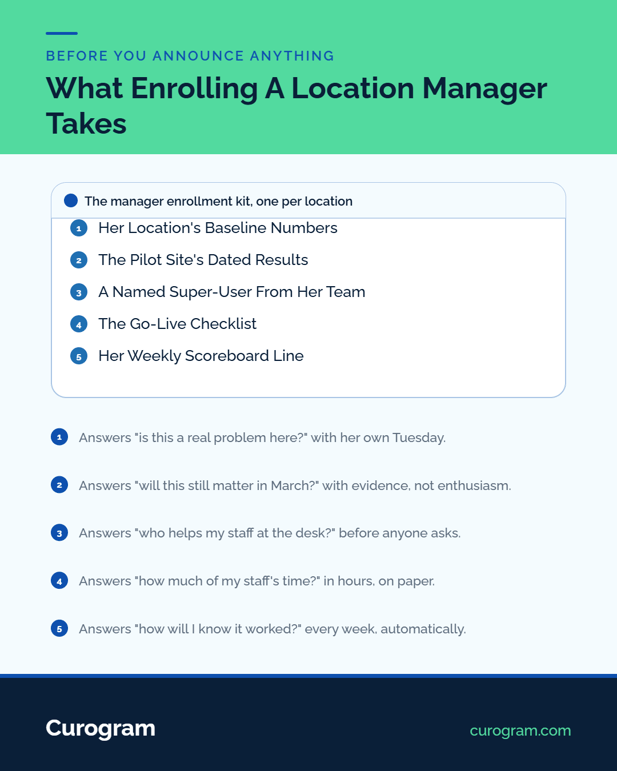
The Guide: The Rollout Playbook
Her Data, Not The Group’s
Change management for DrChrono patient communication rollout starts with thirty minutes and one screen. Her location’s call volume. Her location’s no-show count. Her staff’s interruption load during check-in.
Group averages persuade nobody. A manager who sees her own baseline stops evaluating a memo and starts evaluating a number, and that shift is the whole objective of the meeting.
A Super-User From Her Own Team
One respected staffer per location gets trained early, before go-live. She answers the how-do-I questions at the desk, in the flow of work, from someone her colleagues already trust.
The BMC review is specific about what makes this work. Champions need a mandate, protected time, and training. A super-user named on a slide and given none of the three is a title, not a role.
Training Measured In Hours
DrChrono workflows do not change, so the training burden is one simple inbox. A front desk learns it in a morning.
That is a promise a manager can verify with her own staff by lunchtime on day one, which is why we put it in writing rather than in a memo.
Curogram Highlight: The Super-User Model
The Super-User Model puts adoption in the hands of one person per location who already has credibility at the front desk. Pick someone the team asks questions of today, not the person with the most free time.
Three things make the role real. A written mandate that says this is part of the job. Protected hours in the first two weeks, scheduled in advance. Training that runs before go-live rather than alongside it.
Reporting goes to the manager first. Calls deflected, confirmations up, response time down, all for her location, all benchmarked the same way as everything else in the group.
Go-live success is defined by her numbers improving, which makes the rollout hers to win rather than headquarters’ to impose.
One caveat worth stating plainly. If the super-user gets the title without the protected hours, the model degrades into a busy person fielding interruptions, and adoption tracks the same curve as every previous tool.

The Success: From One More Thing to My Win
Enrolled Managers Reach The Benchmark Sooner
Locations led by an enrolled manager clear the confirmation benchmark faster than locations that were simply switched on. Both sites got the same software. Only one got an owner.
The go-live checklist for staff is identical in each case. What differs is whether anyone at that location believed the checklist mattered.
Listen To How Staff Describe It
The language at the front desk is the leading indicator. Watch for the shift from “the new thing we have to do” to “our upgrade.”
Staff describes a tool as help when it removes work they resented. They describe it as homework when it adds a step to a day that had no room.
Her Before-And-After At The Ops Meeting
A manager who shows her own numbers at the ops meeting is doing recruitment you could not buy. Her peers discount headquarters. They do not discount her.
That is how the second location becomes easier than the first, and the fourth easier than the second.
Conclusion: Enroll, Don’t Announce
Adoption is decided at the front desk, by people the memo stopped persuading several tools ago. Any plan that routes around them is a plan to report nominal usage.
DrChrono stays the familiar system nobody has to relearn. Curogram arrives as the relief valve, with pilot numbers attached.
Before the next go-live, spend thirty minutes showing that location’s manager her own baseline. Watch what happens when skepticism gets something to engage with.
Schedule a consultation. We’ll build the manager-enrollment kit for your first location: baseline data pulled per site, the go-live checklist, and the super-user curriculum.
Frequently Asked Questions