10 min read

Reduce Dolphin Ortho No-Show Rate With Smart Reminder Dashboard

Reduce Dolphin Ortho No-Show Rate With Smart Reminder Dashboard
💡 Dolphin orthodontic no-show prevention with Curogram's Confirmation Intelligence Dashboard cuts missed adjustments from 15–30% down to under 5%. Smart reminders turn the unconfirmed schedule into a real-time, color-coded view of tomorrow. Key outcomes for Dolphin ortho practices:
  • Real-time confirmation status on every appointment
  • 75%+ average confirmation rate across Curogram clients
  • 53% lower no-show rate than industry average
  • 3.5 hours of daily phone-call time returned to staff
  • Works alongside Dolphin Management — no platform swap
Atlas Medical Center dropped no-shows from 14.20% to 4.91%. Covina grew from 369 to 1,300+ monthly confirmations in five months, based on our internal data.

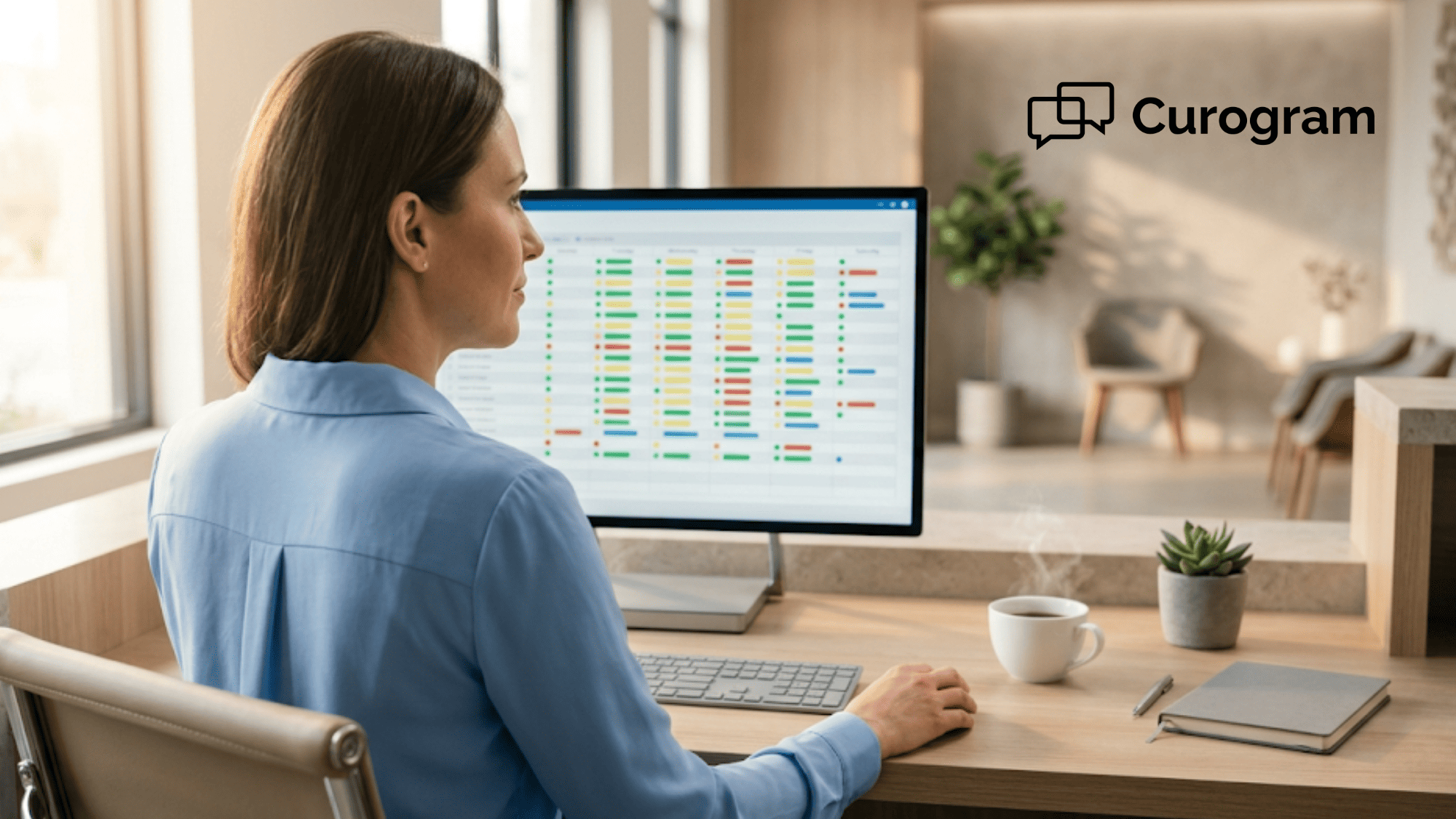
It's 7:30 AM on a Tuesday. Your treatment coordinator opens Dolphin Management. The screen shows 50 adjustments for today. How many are confirmed? Zero.

Dolphin sent reminders last night. Texts went out. Emails too. But patients had no easy way to reply back. So the status column stays blank.

Now the phones come out. Your coordinator starts dialing. Each call takes 2 to 3 minutes. Most go straight to voicemail. By 9 AM, maybe 15 are confirmed. The other 35? Still a mystery.

This is the daily grind for Dolphin orthodontic practices. The schedule looks full. But the confirmed seats are unknown. One no-show breaks a treatment arc that spans 18 to 30 months. Wires stay in longer. The next three visits shift. Parents get frustrated.

The money side stings too. At $150 to $400 per adjustment, a 15% no-show rate hurts fast. For a practice seeing 50 patients daily, that's 7 to 8 empty chairs. That adds up to $1,050 to $3,200 in lost daily revenue. Over a year: $250K to $750K gone.

Most practices try to fix this with bigger platforms. Weave bundles reminders with phones and billing for $300 to $500+ a month. But the core problem stays. Your coordinator still calls. You still see a no-show report after the damage is done.

There's a better way. Curogram's Confirmation Intelligence Dashboard flips the script. Instead of tracking no-shows after they happen, it prevents them before they start. Green means confirmed. Yellow means pending. Red means cancelled. Your coordinator walks in knowing, not guessing.

This guide shows how Dolphin practices cut no-show rates from 15% to under 5% with smart reminders. No phone replacement. No bundled bloat. Just real-time confirmation visibility.

The Villain: The Unconfirmed Schedule

Every Dolphin orthodontic practice faces the same enemy. It's not a competitor. It's not insurance. It's the blank confirmation column on tomorrow's schedule.

The Daily Ritual

Your treatment coordinator arrives at 7:30 AM. She opens Dolphin Management and pulls up tomorrow's list. Fifty appointments are booked. Zero show a confirmed status.

Dolphin sent reminders the night before. Text messages told patients their time and date. Email blasts went out too. But one-way reminders don't track replies. Patients might have seen the text. They might not. You can't tell from the screen.

So the coordinator grabs the phone. She starts at the top of the list. First call: voicemail. Second call: voicemail. Third call: busy signal. Each call takes 2 to 3 minutes.

After 90 minutes of dialing, only 15 of 50 patients are confirmed. The other 35 remain question marks until they either show up — or don't.

The Cascade Effect

A no-show in general dentistry is a gap. A no-show in orthodontics is a broken chain. Treatment arcs span 18 to 30 months. Each adjustment depends on the one before it.

Here's what a single missed adjustment does. The archwire stays in place an extra 4 to 6 weeks. Tooth movement pauses. The next three visits shift later on the calendar. Your financial coordinator adjusts the payment plan. The parent calls upset that treatment is taking longer than promised.

Now multiply that by 7 missed adjustments per day. Twenty to thirty treatment plans slip each week. Case acceptance drops. Referrals slow. Google reviews start mentioning "endless appointments" — all because patients had no easy way to confirm last Tuesday's 2:30 PM visit.

The Financial Compound

The math is brutal. At $150 to $400 per adjustment, a 15% no-show rate eats directly into production. For a practice scheduling 50 patients daily, that's 7 to 8 no-shows every day.

Let's run the numbers:

Metric

Value

Daily no-shows (15% of 50)

7–8 visits

Daily lost revenue

$1,050–$3,200

Monthly lost revenue

$20K–$60K

Annual lost revenue

$250K–$750K


That's a treatment coordinator's full salary. Or a new chair. Or a second hygienist. All walking out the door because nobody confirmed via text. The worst part? Most practices accept this as normal.

The Feeling

Here's what practice owners tell us: "I spent $400 a month on Weave. My treatment coordinator still calls patients every morning. The analytics dashboard tells me my no-show rate is 18%. I already knew that."

The frustration is real. You paid for a platform that promised to fix this. Instead, you got a chart showing the damage after it happens. You don't need a prettier report. You need patients to confirm before they no-show.

This is what we call the unconfirmed schedule problem. Your Dolphin system handles treatment planning and imaging beautifully.

But confirmation tracking isn't its job. Most add-on tools send reminders without tracking replies. So the staff fills the gap with phone calls — the slowest, most costly way to confirm anything.

The villain isn't Dolphin. It's the absence of a real-time confirmation layer on top of Dolphin. Until that layer exists, your schedule stays a mystery until patients either walk in or don't. And that uncertainty costs you tens of thousands every month in chair time you'll never recover.

The Guide: The Confirmation Intelligence Dashboard

Meet the tool built to solve the unconfirmed schedule problem. It's not another analytics report. It's a live window into tomorrow's real attendance.

The Solution

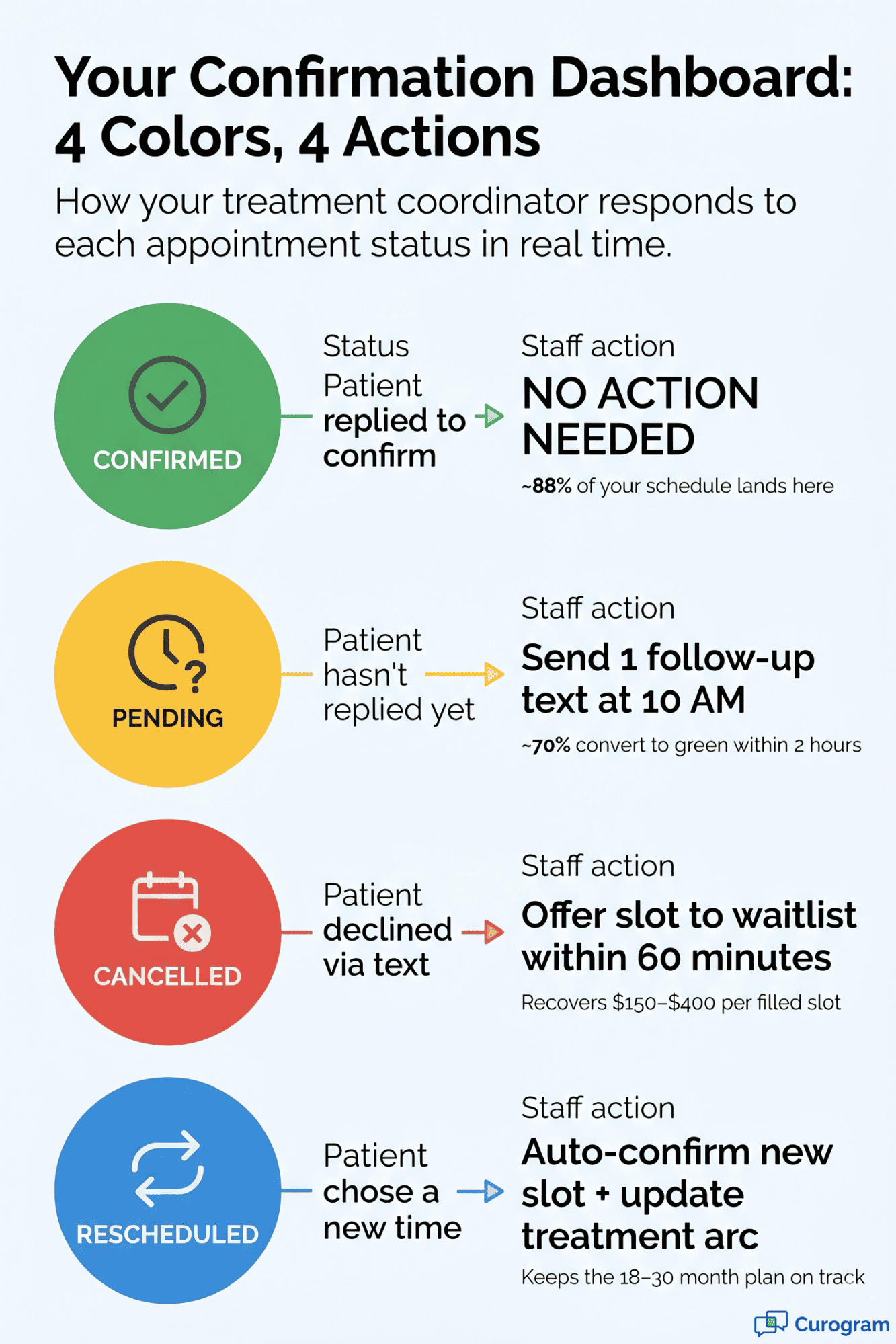
Curogram's Confirmation Intelligence Dashboard shows every appointment's status in real time. Your treatment coordinator sees color-coded clarity on one screen. Green means confirmed. Yellow means pending. Red means cancelled. Blue means rescheduled.

No phone calls needed for the confirmed patients. Status updates flow in as patients reply to smart reminders. The reminder goes out at 5 PM. Patients text back "C" to confirm or "R" to reschedule. The dashboard updates the moment they hit send. By 9 PM, most of tomorrow's schedule is color-coded.

The Feature

The dashboard puts all confirmation data in one place. Your coordinator sees four key views at a glance:

  • Tomorrow's full schedule with live status colors
  • Today's remaining unconfirmed patients
  • This week's rolling confirmation rate trend
  • A priority queue of patients who haven't replied yet

That last one is the game-changer. Instead of calling all 50 patients, your coordinator focuses on the 5 or 6 who didn't respond to the smart reminder. The other 44 or 45 already confirmed by text. That's about 88% of the work done automatically.

The dashboard also flags patterns. A patient who always confirms but suddenly goes silent? That shows up. A sibling group where one confirmed but the other didn't? Flagged. Your staff stops guessing and starts acting on real signals.

Visual guide to confirmed pending cancelled and rescheduled appointment statuses with coordinator response actions

The Proof

This isn't theory. Atlas Medical Center is a real multi-provider practice. Based on our internal data, they dropped no-shows from 14.20% to 4.91% using Curogram's 2-way confirmation system. That's more than 3X better than the industry average.

Let's apply those numbers to an ortho practice booking 50 adjustments daily:

Metric

Before Curogram

After Curogram

No-show rate

15%

Under 5%

Daily no-shows

7–8

2–3

Daily recovered chairs

5–6

Daily recovered revenue

$750–$2,400


Covina tells a similar story. Based on our internal research, the practice grew from 369 monthly confirmations to 1,300+ in just five months. That's 3.5X growth without adding staff. The system scaled with them instead of creating new workload.

The Orthodontic Fit

Here's why this matters for orthodontics more than any other specialty. Ortho treatment is a series, not a single visit. A typical braces case includes 18 to 24 adjustment visits across two years. Each one matters.

The Confirmation Intelligence Dashboard tracks patterns across the full treatment arc. If a patient confirmed the first 8 visits but starts going pending on visit 9, your coordinator sees the trend. She can reach out before the patient disengages. That's retention, not damage control.

This longitudinal view is unique to Curogram's approach. Generic reminder tools treat each visit as a standalone event. Curogram connects them. In orthodontics, where a single dropped case means losing $4K to $6K in remaining treatment fees, that visibility is priceless.

Teen patients add another layer. They're the hardest group to reach by phone. But they text constantly.

Smart reminders meet them where they already live — on their phones. Reply rates for teens jump from single digits (phone) to above 70% (text). That's the difference between a confirmed adjustment and a call from mom explaining they forgot.

The dashboard isn't flashy for its own sake. It's built around one job: turning your unconfirmed schedule into a confirmed one.

The Success: Walk in Knowing, Not Guessing

Curogram clients average 75%+ appointment confirmation rates across all specialties. No-show rates sit 53% below the industry average. Based on our internal research, these numbers hold up across solo practices and multi-provider groups alike.

For orthodontics specifically, the gains are even bigger. Why? Because ortho starts from a worse baseline.

The industry average for orthodontic no-shows is 15% to 30%, depending on the patient mix. Teen-heavy practices trend toward the higher end. Adult Invisalign practices trend lower but still hover near 12% to 15%.

Curogram pulls those numbers down to 5% or less. Here's what that shift looks like for a practice seeing 50 patients daily:

The Shift

The biggest change isn't the number. It's how your staff spends their day. Before Curogram, your treatment coordinator's morning looked like this:

  • 7:30 AM — Open Dolphin, see blank confirmation column
  • 7:45 AM — Start calling patients
  • 9:00 AM — Still calling, 30 of 50 confirmed
  • 10:00 AM — Voicemails filling up, 40 confirmed
  • 11:00 AM — Give up on the last 5, hope they show

That's 3 to 4 hours of calling every morning. Five days a week. Twenty hours of labor per week just for confirmations. At a fully-loaded staff cost of $25 to $35 per hour, that's $500 to $700 per week in phone-call labor. Over a year: $26K to $36K in staff time spent chasing confirmations.

Now compare that to the post-Curogram morning:

  • 7:30 AM — Open Confirmation Intelligence Dashboard
  • 7:31 AM — See 44 of 50 appointments already confirmed (green)
  • 7:32 AM — Spot 5 pending (yellow) and 1 cancelled (red)
  • 7:35 AM — Send one follow-up text to each of the 5 pending
  • 7:40 AM — Offer the cancelled slot to waitlist patient #1
  • 8:00 AM — All 50 slots confirmed or filled from waitlist

Total time: 30 minutes. The other 3.5 hours? Your coordinator now works on new-patient consultations, case presentations, insurance verifications, and treatment plan reviews. Those are revenue-generating activities. Phone confirmations were just revenue-protecting ones.

This is what we mean by "from confirmation calls to confirmation clicks." The work shifts from chasing patients to engaging them where they already are — on their phones.

Candid scene of orthodontic staff greeting walk-in patient in modern practice with no-show prevention system in place

The Outcome

Picture a typical Wednesday morning three months after going live. Your treatment coordinator Sarah arrives at 7:30 AM. She doesn't grab the phone. She opens the dashboard.

Tomorrow's Thursday schedule loads on her screen. Forty-two of fifty adjustments show green. Three patients cancelled last night (red) — their slots are already offered to the top three names on the waitlist. Five patients haven't replied yet (yellow).

Sarah sends a quick text to the five pending. "Hi! Just confirming tomorrow at 2:30 PM. Reply C to confirm or R to reschedule." By 8:15 AM, four of five reply to confirm. The fifth reschedules. Sarah offers that slot to waitlist patient #4.

Result: 47 of 50 confirmed by 8:20 AM. Three slots filled from waitlist. The schedule is effectively full. Sarah spent 15 minutes on confirmations instead of three hours.

Now she has time for what actually grows the practice. She reviews the three new-patient consults coming in at 10 AM. She preps case presentation materials for tonight's treatment plan meeting. She calls the two patients whose Invisalign trays just arrived and books their delivery visits.

The waiting room fills. The doctor stays on schedule. The next patient walks in before the current one finishes. Flow improves. Stress drops. The entire practice feels different.

That kind of daily flow adds up fast over a month. If you want to see the exact dollar impact for your own practice, calculate how no-show reduction can impact your ROI based on your daily volume and average visit revenue.


How Curogram's Confirmation Intelligence Dashboard Works Alongside Dolphin

Curogram is designed to sit on top of Dolphin — not replace any part of it. Your scheduling, treatment planning, and imaging stay right where they are. Curogram adds the missing confirmation layer that Dolphin was never built to handle.

Here's how it fits into your existing workflow. Dolphin stays your source of truth for appointments. Curogram uses that schedule data to power the smart reminder flow around it.

Patients get text reminders at optimized times — typically 48 hours, 24 hours, and 2 hours before the visit. Each reminder invites a simple reply.

When a patient replies, Curogram updates the appointment status in real time. The Confirmation Intelligence Dashboard reflects the change instantly. Your staff sees it the moment they refresh the screen.

What makes this different from bundled platforms like Weave? Three things stand out:

  • Curogram focuses on confirmation and messaging — it doesn't bundle phones, billing, or forms you don't need.

  • Pricing stays under $160 per month for most ortho practices. That's less than half the cost of bundled tools.

  • You keep your current phone system, billing software, and any other tools that already work.

The setup takes less than a week. Our onboarding team handles the Dolphin connection, configures your reminder templates, and trains your staff on the dashboard. Most practices go live on day 4 and see measurable gains in confirmation rates by day 7.

Curogram is HIPAA-compliant out of the box. Patient data stays encrypted in transit and at rest. You get a signed Business Associate Agreement before go-live. The dashboard also runs behind role-based access, so only authorized staff see patient-level data.

Conclusion: Stop Calling, Start Confirming

Dolphin practices don't need more analytics. You already know your no-show rate. What you need is a system that stops no-shows before they happen — not a report that shows them after.

The core problem is simple. Dolphin handles treatment planning and imaging. It was never built to track real-time confirmation status. That's not a flaw — it's a scope choice. Curogram fills that gap with a tool built for one job.

The Confirmation Intelligence Dashboard turns schedule uncertainty into confirmed revenue. Green means confirmed. Yellow means follow up. Red means offer the slot to your waitlist. Your treatment coordinator walks in at 7:30 AM knowing exactly where the day stands — no phone calls required.

The numbers prove the approach. Atlas Medical Center cut no-shows from 14.20% to 4.91%. Covina scaled from 369 monthly confirmations to 1,300+ in five months. Curogram clients average 75%+ confirmation rates across all specialties. For ortho, that means dropping no-shows from 15–30% down to under 5%.

The financial impact is real. A 50-patient-per-day practice recovers $750 to $2,400 in daily revenue. That's $22K to $72K per month. Your staff gets their mornings back. Your patients get a smoother experience. Your P&L reflects the difference within the first quarter.

See it work in your own practice. Curogram connects to Dolphin without replacing your phones or billing. No bundled platform. No long contracts. Just the confirmation layer Dolphin was missing.

Find out how many of tomorrow's appointments are actually confirmed right now. Book a call with one of our experts to watch your unconfirmed appointments turn green in real time.


Frequently Asked Questions

How quickly do confirmation rates improve after deploying Curogram?
Most practices see measurable gains within the first week. Based on our internal data, Covina scaled from 369 to 1,300+ monthly confirmations in five months. Patients already prefer text — they just didn't have an easy way to reply until now.
How does the Confirmation Intelligence Dashboard integrate with Dolphin's scheduling?
The dashboard runs alongside Dolphin Management. Your scheduling data powers the confirmation workflow, and your treatment coordinator sees confirmed versus unconfirmed status for every visit. Dolphin keeps handling scheduling and treatment planning; Curogram adds the confirmation layer.
What happens when a patient cancels via text message?

The appointment status updates to cancelled in the Confirmation Intelligence Dashboard right away. Your scheduling coordinator sees the open slot in real time. She can offer it to waitlist patients — filling the gap before it becomes lost revenue.

Why do teen patients respond to text reminders more than phone calls?

Teens live on their phones but rarely answer unknown numbers. Text reminders meet them in their normal channel — and reply rates jump from single digits to above 70%. Parents also appreciate the shared visibility when siblings share accounts.

How does Curogram's pricing compare to Weave for Dolphin ortho practices?

Curogram stays under $160 per month for most ortho practices. Weave bundles phones, billing, and forms at $300 to $500+ per month. You pay only for the confirmation and messaging layer you actually need — and keep your existing phone system.


Confirm a Dolphin Orthodontic Appointment With One Text Reply

Confirm a Dolphin Orthodontic Appointment With One Text Reply

💡 Parents can confirm a Dolphin orthodontic appointment with one text reply through Curogram. No link. No app. No menu. Reply "yes," "yep,"...

Read More
Dolphin Ortho Reminders: Two-Way SMS That Confirms Every Visit

Dolphin Ortho Reminders: Two-Way SMS That Confirms Every Visit

💡 Dolphin sends reminders. It does not confirm them. That gap is where your schedule leaks revenue. Dolphin orthodontic appointment reminders go...

Read More
Cloud 9 Ortho Reminders | Close the Loop on Every Appointment

Cloud 9 Ortho Reminders | Close the Loop on Every Appointment

💡 Cloud 9 orthodontic appointment reminders powered by Curogram's Confirmation Loop Engine send automated text reminders that patients and parents...

Read More