
Consistent Reminders at Every Tebra Location
 Jo Galvez : Oct 20, 2026, 12:00:00 PM
Patients judge your whole group by one location's reminder. Curogram makes every Tebra location send the same clear, reply-able texts. 75%+ confirmed.

Patients who miss visits often get labeled unreliable. Many of them meant to come, or meant to cancel. The reminder they got just gave them no easy way to say so. On the chart, both groups look the same.
CureMD offers patients two official ways to respond about a visit. They can log into the Patient Portal or call the practice. There, the AI Contact Center answers 24/7 in 14 languages.
CureMD's CureConfirm adds a phone call the day before, with press 1 to confirm or 2 to deny. A patient who needs a new time is told to call during business hours.
Each route asks for more than the moment deserves. A 78-year-old who answers her grandkids' texts within minutes may never have set up a portal password. A parent in the school pickup line won't sit through a phone menu. Neither one is avoiding the practice.
Both would answer a text, and both show up on the schedule as patients who never responded.
Our view: a reminder should accept an answer on the channel it arrived on. For most patients, that's a plain text thread. One word confirms, one word cancels, and one word starts a conversation about a new time.
Patient-friendly appointment confirmations come down to that short exchange. There's no app to download, no account to create, and no call to make.
The practice keeps CureMD for charts and scheduling, and the patient gets a reminder that finally takes a reply. Patients who like the portal or a phone call keep both.
CureMD's patient tools cover a lot of ground. The friction sits in one spot: the reminder itself.
Registered patients can use the Patient Portal for records, refills, and appointment requests. The AI Contact Center can schedule, reschedule, and cancel visits in real time, around the clock. CureConfirm handles the day-before call.
Those are useful routes for patients who already use them. None of them is a reply to the reminder on the same channel it came in on. A patient who wants to answer has to switch to a login or a phone call.
On the chart, that visit reads as a no-show. From the patient's side, it was a cancellation with nowhere to go.
MGMA's August 2025 look at patient no-shows puts it plainly: "Appointment reminders that can't be replied to, portals that lock people out, and language/access barriers all compound risk." Its advice is to keep messages "ultra-plain (what, when, where, prep) and in the patient's preferred language."
Older adults are among the most exposed. So are people more at ease in another language, and anyone whose phone is mainly for texting.
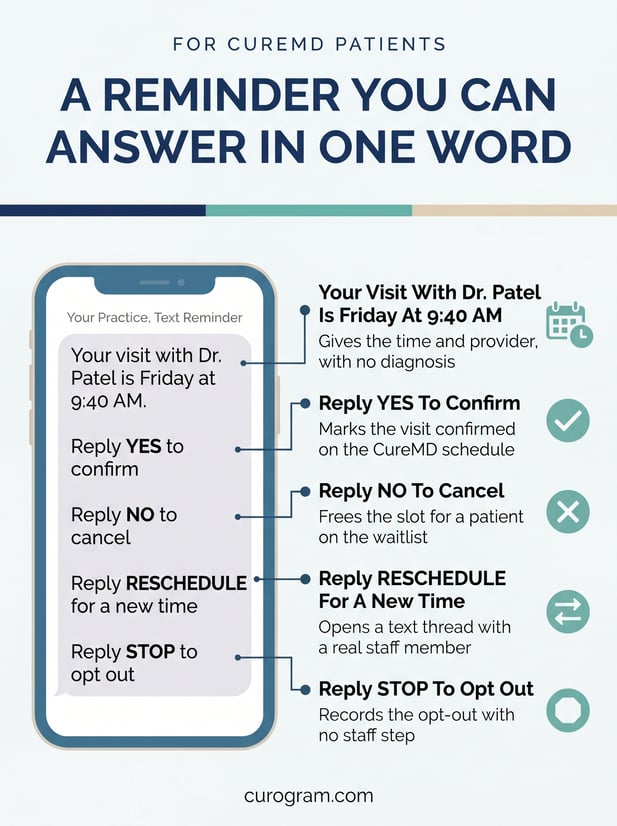
A full reschedule takes five short messages. A sample thread looks like this:
|
From |
Message |
|---|---|
|
Practice |
Reminder: your visit with Dr. Patel is Friday at 9:40 AM. Reply YES, NO, or RESCHEDULE. |
|
Patient |
RESCHEDULE |
|
Staff |
No problem. We have Monday at 10:20 AM or Tuesday at 3:00 PM. Which works? |
|
Patient |
Tue |
|
Staff |
You're set for Tuesday at 3:00 PM. See you then. |
That's how patients text to reschedule a medical appointment without a phone tree or a hold queue.
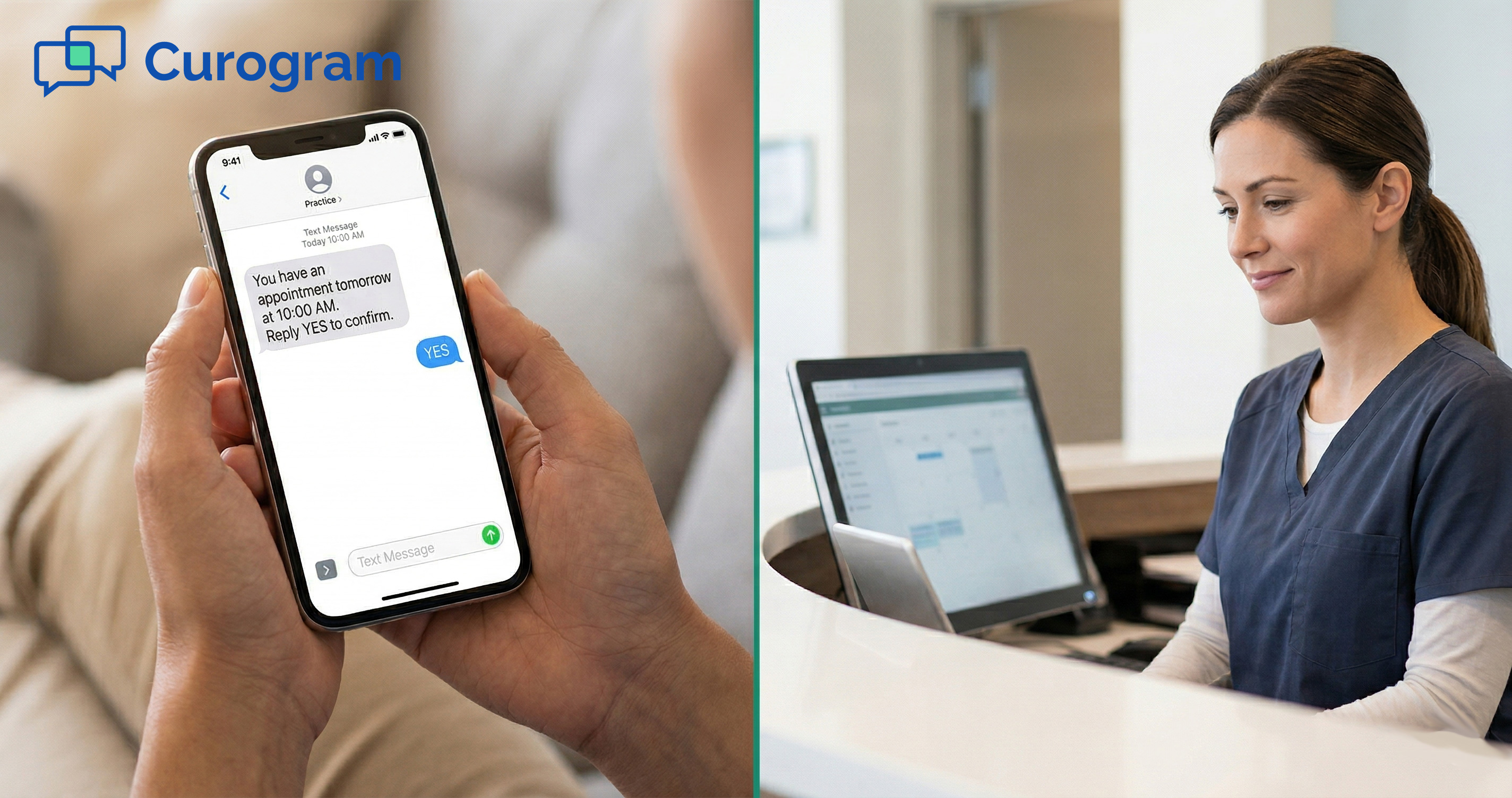
YES confirms the visit, and NO cancels it so the slot can go to someone waiting. Both update the CureMD schedule through Curogram for CureMD. RESCHEDULE opens a thread with a real staff member, who offers new times and books the one the patient picks.
These are appointment reminders without portal login steps. The patient answers in the same thread the reminder arrived in.
Texting works on any cellphone, flip phones included. Pew Research Center's 2026 mobile fact sheet finds 98% of U.S. adults own a cellphone. Among adults 65 and older, 96% own a cellphone, and 79% own a smartphone.
That leaves about 17% of adults 65 and older on a basic cellphone, with no app store at all. It's why no-app appointment reminders for older patients matter: a plain text reaches them.
Curogram lets a practice set message wording and language by provider or visit type. CureMD doesn't pass a patient's language preference through the sync, so the front desk sets it in Curogram once. After that, SMS confirmations reach any age or language group the practice serves.
Psychiatry patients get a quieter benefit. They can confirm from a desk at work without saying a word out loud.
Curogram Highlight: 2-Way Smart Reminders2-Way Smart Reminders send an automated sequence before each CureMD visit, and every reply gets a response. YES and NO update the schedule on their own. RESCHEDULE puts the patient in a text conversation with staff, so changing plans takes a minute. Sequences run 100% automated. Curogram is HIPAA-compliant and SOC 2 Type II certified, signs a BAA, and manages consent and opt-outs. Patients who reply STOP are removed without staff action. Setup options are on the appointment reminder page for CureMD users. |
Atlas Medical Center cut no-shows from 14.20% to 4.91% in three months with Curogram's automated reminders and confirmations. Across clients, Curogram client data from clinical settings shows an average confirmation rate above 75%.
Once patients can answer, they start holding their own appointments. A NO two days out frees a slot in time for someone else to take it. A RESCHEDULE keeps the patient on the books, where silence used to drop them off.
For the physician, the chart changes too. Fewer no-show flags land on patients who tried to do the right thing. They finally have an easy way to say so.
These patients are illustrative composites. Each reply took under a minute and no login.
Freed slots go to patients waiting for an opening. A NO often arrives a day or two ahead, which leaves time to fill the slot by text.
The same thread can send secure online forms before the visit and text-to-pay for CureMD practices after it.
Front desk setup is covered in the CureMD confirmation workflow for front office staff. For the full loop, see CureMD reminders that confirm by text reply.
Many of your patients want to answer their reminders. They've been handed one with no reply button. CureMD stays the home for the clinical record and the schedule. Curogram adds the ten-second reply that replaces a login or a phone call.
The AI Contact Center keeps serving patients who'd rather call. Text covers the ones who'd rather answer where they read. Ask your front desk how many no-shows last month were patients who always seemed reliable. Those are the patients a reply button keeps.
Book a Curogram demo to see two-way confirmations from your patients' side of the phone. We'll walk through the thread a CureMD patient would get, from the first reminder to a booked reschedule.
 Jo Galvez : Oct 20, 2026, 12:00:00 PM
Patients judge your whole group by one location's reminder. Curogram makes every Tebra location send the same clear, reply-able texts. 75%+ confirmed.
 Jo Galvez : May 12, 2026, 10:00:00 AM
AdvancedMD sends a reminder link. Patients ignore it. Curogram lets them text YES to confirm. One reply, no link, no portal, no phone call. 75%+...

 Mira Gwehn Revilla : Sep 18, 2026, 9:00:02 AM
Behavioral health no-shows run 23–50% while portal updates go unread. Curogram adds automated text reminders to InSync EHR — over 75% of patients...