
 Aubreigh Lee Daculug
1 min read
The ROI of Appointment Reminders for Tebra Clinics
💡 Automated appointment reminders do more than reduce no-shows. Text reminders drive measurable ROI for Tebra clinics. By automating reminder...

Here is a scene that plays out in CureMD practices every single day. Your front desk gets in early, pulls charts, confirms rooms, and lines up the schedule. Everything looks solid.
Then by 10 a.m., two patients have ghosted their appointments and a third calls five minutes before their slot to cancel.
That is not just an inconvenience. It is a revenue problem, and it is bigger than most practice owners realize.
The frustrating part? You already have the tools to manage your schedule. CureMD does a solid job handling appointments, billing, and clinical workflows.
But scheduling a patient and actually getting them through the door are two very different things. And the gap between the two is where your money disappears.
Portal messages sit unread because patients forget their login. Email reminders land in spam folders or get buried under promotions. Paper statements take weeks to arrive and even longer to get paid. Each one of these small failures adds up to a massive leak in your revenue.
We call it the "Portal Gap" — that space between what your EHR can do and what actually reaches your patient. When messages fall into that gap, so does your income.
Reducing patient no-shows for CureMD practices is really about closing that gap with a channel patients actually check: their text messages.
In this article, we are going to follow the money. We will show you exactly where it leaks out, how much it costs you over a year, and what a simple SMS layer can do to plug those holes. No fluff, no theory — just the math and the fix.
When a patient does not show up, the obvious loss is the visit fee. But that is only the surface. Underneath, there are layers of hidden costs that most practices never track. Here is where the real damage happens.
Before that patient ghosted, someone on your team pulled their file, prepped a room, and blocked off provider time. All of that effort — maybe 15 or 20 minutes of admin work — turned into waste.
The appointment slot that could have gone to someone on your waitlist is gone too. You cannot get that hour back, and you cannot bill for a patient who never walked in.
Multiply that by two or three no-shows a day, and you start to see how much productive time your staff loses each week. It is not just a scheduling inconvenience. It is a drain on your entire operation.
When you send a statement through your patient portal or by mail, you are starting a collection cycle that can stretch 60 to 90 days. Patients forget portal passwords constantly.
Paper bills end up in a junk drawer or straight in the recycling bin. Revenue recovery for your CureMD practice slows to a crawl when every dollar depends on a patient remembering a login they created two years ago.
Then there is the recall problem, and this one is a silent killer. You send a portal notification telling a patient it is time for their annual checkup or a follow-up visit.
About 80% of those messages never get seen. That means dozens of patients who should be filling your schedule this month do not even know they need to come in.
Every one of them is deferred revenue sitting in your database, doing nothing. This is why reducing overhead at your medical practice starts with closing the communication gap that lets money drain out before it ever hits your bank account.
CureMD keeps your clinical side running, but without a direct line to your patients, the financial side is full of cracks.
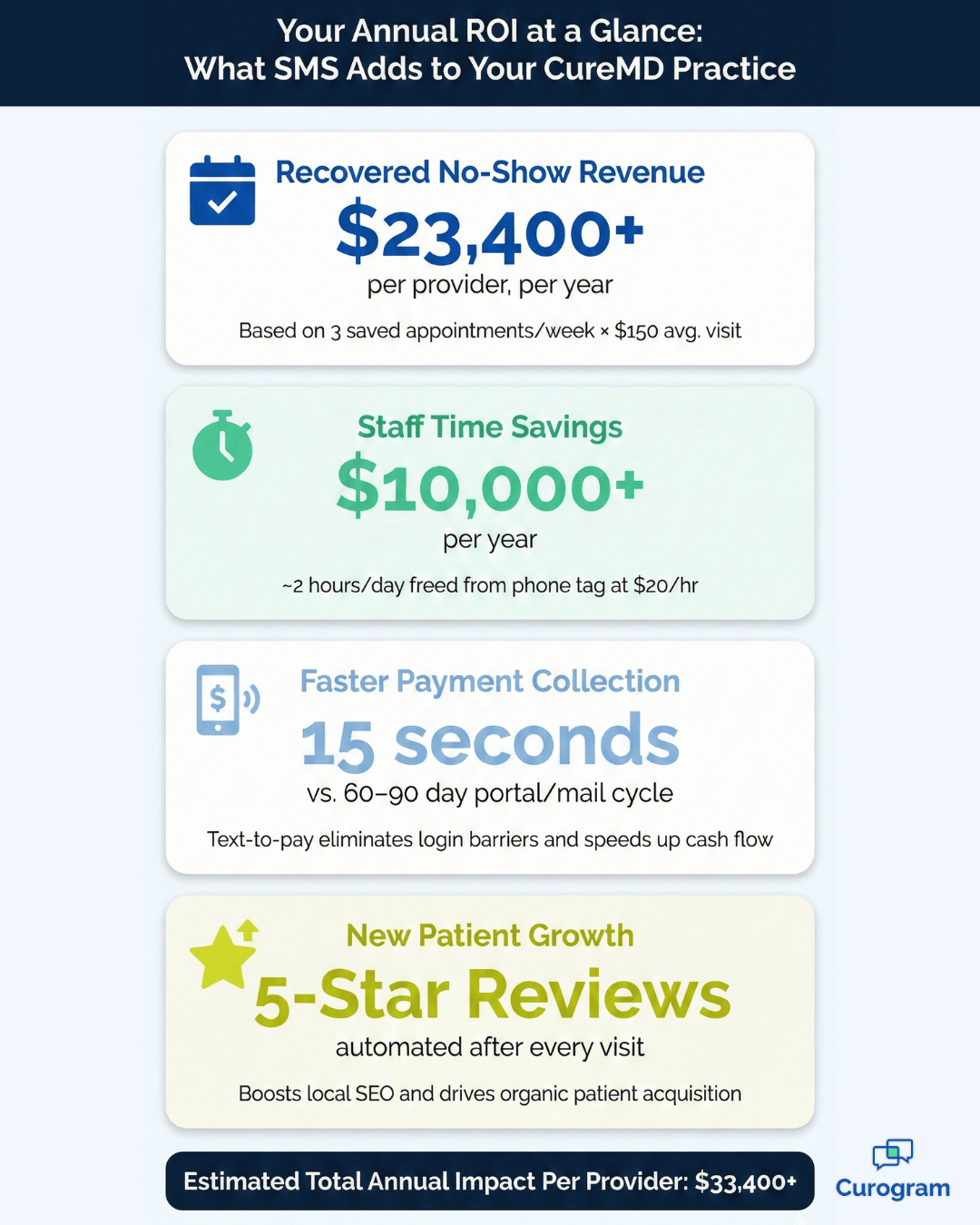
Here is what a typical last-minute cancellation looks like at most practices. A patient calls 30 minutes before their appointment. Your front desk scrambles to fill the slot, makes a few phone calls, and usually comes up empty. That slot stays vacant. Revenue: zero.
Now picture this instead. A patient cancels at 1:30 p.m. Within seconds, Curogram sends a text to your waitlist: "We have a 2 PM opening today — reply Y to grab it." Someone responds in under a minute.
The slot gets filled. Revenue: captured. That is the difference between a reactive front desk and a proactive system that works even when your team is busy.
Payment collection gets the same upgrade when you add text-to-pay with CureMD integration.
Curogram sends a secure payment link straight to a patient's phone. They tap it, enter their card, and pay their copay or balance in less than 15 seconds. No portal login. No paper check. No 60-day wait.
This alone can cut your accounts receivable timeline dramatically. When patients can pay from their phone the moment they get the message, your cash flow stays healthy week to week instead of trickling in months later.
Happy patients who just had a great visit are your best source of new business.
Using HIPAA Compliant Texting, Curogram sends an automated text right after checkout asking them to leave a Google review. These reviews build your online presence, boost your local search rankings, and bring in new patients without any ad spend.
When you increase patient retention for your CureMD practice, you are also building a growth engine powered by the patients you already serve. Every text Curogram sends ties back to your bottom line.
Here is how each message type creates value:
It is communication that pays for itself, one text at a time.

Let us stop talking in generalities and look at real numbers. The Atlas Medical Group saw a 53% reduction in no-shows after adding SMS reminders through Curogram. That is not a marginal improvement. That is cutting their missed appointment rate by more than half.
Here is what that means in dollars. The table below breaks down how quickly a few recovered appointments each week turn into serious annual revenue.
| What We Are Measuring | The Numbers |
|---|---|
| Average revenue per visit | $150 |
| No-shows prevented per week (with SMS) | 3 |
| Revenue recovered per week | $450 |
| Revenue recovered per month | $1,950 |
| Revenue recovered per year (1 provider) | $23,400 |
| Revenue recovered per year (3 providers) | $70,200 |
Those numbers are based on just three saved appointments per week, which is a conservative estimate for most practices. If your average visit value is higher — as it is in many specialties — the recovered revenue climbs even faster.

But recovered no-show revenue is only one piece of the puzzle. When you factor in staff time savings and faster payment collection, the total return becomes even more compelling. Here is what the complete ROI looks like for a typical CureMD practice:
| Revenue Source | How It Works | Annual Value |
|---|---|---|
| Recovered no-show revenue | 3 saved visits/week at $150 each | $23,400+ per provider |
| Staff time savings | ~2 hours/day freed from phone tag at $20/hr | $10,000+ |
| Faster payment collection | Text-to-pay cuts 60–90 day cycle to seconds | Improved cash flow |
| New patient growth | Automated Google reviews after visits | Ongoing growth |
| Estimated total annual impact (per provider) | Combined savings + recovered revenue | $33,400+ |
Add it all up, calculate ROI across recovered visits and time savings, and the picture becomes clear. Reducing patient no-shows for CureMD practices with HIPAA Compliant Texting is not just a revenue strategy — it is a direct investment in Service Quality.
It is one of the fastest ways to add five or six figures to your annual revenue without bringing in a single extra patient.
The money is already in your schedule — you just need to stop it from leaking out.
It works as a payment layer that sits alongside your existing CureMD billing setup. When a patient pays through a Curogram text link, you can see the transaction in Curogram and post it to your CureMD ledger. It does not replace your billing system — it just makes it faster and easier for patients to pay, which means you get paid sooner.
Not at all. Curogram uses smart logic to make sure patients only receive relevant messages — appointment reminders, payment links, and recall notices. Nobody gets a flood of random texts.
Patients can opt out at any time, which protects your brand reputation. Most patients actually prefer texts over portal messages or phone calls because they are quicker and more convenient.
Yes, and it tends to work better than you might expect. A friendly text reminder feels much less aggressive than a collections call, which means patients are more likely to respond and pay.
It is a smarter, lower-friction way to reduce overhead at your medical practice while still recovering the money you are owed. Many practices see higher recovery rates on past-due accounts when they switch from phone calls to text reminders.
Your daily schedule is the engine that drives your entire practice. Every filled appointment is revenue earned. Every no-show is money that quietly walks out the door. Over 12 months, those empty slots add up to a number that would keep any practice owner up at night.
You have already seen the math. A 53% drop in missed appointments. More than $23,000 in recovered revenue per provider. Over $10,000 saved in staff time. Faster collections through text-to-pay. And new patient growth powered by automated Google reviews.
CureMD gives you the tools to run your practice. Curogram makes sure the patients — and the payments — actually show up. Together, they create a system where nothing falls through the cracks and revenue does not leak through the Portal Gap.
The fix is not complicated. You do not need to overhaul your workflows or retrain your staff. Adding an SMS layer takes your existing CureMD setup and gives it a direct line to every patient on your schedule. No passwords, no portals, no waiting — just a text that gets read in minutes.
If you are tired of watching revenue disappear into empty time slots and unpaid balances, it is time to see the difference for yourself.
Schedule a demo with Curogram and we will walk you through your exact ROI. We will show you how much your practice is currently losing, and how quickly you can start getting it back.
1 min read
💡 Automated appointment reminders do more than reduce no-shows. Text reminders drive measurable ROI for Tebra clinics. By automating reminder...
1 min read
.jpg?width=30&name=square-formal-photo%20(1).jpg) Mira Gwehn Revilla : May 1, 2026, 10:00:00 AM
Mira Gwehn Revilla : May 1, 2026, 10:00:00 AM
💡 OncoEMR mass messaging and patient recalls for oncology follow-up campaigns help practices reach patients who skip portal logins. Curogram adds...

1 min read
Mira Gwehn Revilla : May 25, 2026, 10:00:01 AM
💡 Mass SMS patient recall campaigns help Elation Health practices reactivate thousands of dormant patient records in minutes. They turn an aging...