11 min read

Cloud 9 Ortho Text-to-Pay | Collect Balances in 2 Taps

Cloud 9 Ortho Text-to-Pay | Collect Balances in 2 Taps
💡 Cloud 9 orthodontic text-to-pay, powered by Curogram, sends parents a secure SMS payment link when a payment plan balance needs collection.      

The parent taps the link, confirms the amount, and the transaction is complete in under 60 seconds — no phone call, no paper statement required.    

This two-tap payment channel handles failed auto-pay recovery, monthly payment plan reminders, post-treatment balance collection, and co-pay collection.  

For practices managing hundreds of active treatment plans, Curogram's SMS secure link approach reduces A/R recovery time from 90+ days to same-week collection — without adding staff or chasing parents by phone.

It's Monday morning. Your billing coordinator opens the failed payment report and sees 63 transactions that didn't process over the weekend.

Expired cards. Insufficient funds. Changed accounts.

That's $11,200 in treatment plan balances your practice expected to collect — and didn't.

She starts calling. First parent: voicemail. Second parent: voicemail. Third parent picks up, promises to call back with a new card number, and doesn't.

By noon, she's made 18 calls and recovered two payments. The other 16 parents are still out there, each one owing money your practice has already earned.

The rest will age. Thirty days turns into 60. Sixty turns into 90. And those families — parents who were genuinely thrilled with their child's new smile — are now letting your office calls go to voicemail because they recognize it as the billing department calling.

This is the reality of managing an orthodontic practice built on payment plans.

You've delivered the care. The braces are on, the adjustments are happening, and the revenue is stuck in a spreadsheet aging by the day while your billing team burns through hours on calls that mostly go nowhere.

The problem isn't the payment plans themselves. Multi-year installment plans are what make orthodontic treatment accessible for most families. Without them, you'd lose a significant share of your case starts.

The problem is the collection channel.

Phone calls were built for a world where people answered their phones. Paper statements were built for a world where people opened their mail. Neither of those worlds exists anymore.

Parents respond to texts. They always have their phones nearby and act on notifications in minutes, not weeks.

And yet most practices are still trying to collect hundreds of thousands of dollars in monthly payment plan balances the old way — calling, mailing, waiting, and chasing.

There is a better way to collect the revenue your practice has already earned. It starts with one text, one secure link, and two taps.

Why Traditional Payment Collection Is Costing You More Than You Think

The average orthodontic practice with 500 active payment plans collects between $75,000 and $175,000 in patient payments each month. That's a large, recurring revenue stream — but only if the collection channel can keep pace.

When it can't, the financial damage compounds quickly and quietly.

The Failed Auto-Pay Cascade

Auto-pay is meant to be effortless. When it works, it's one of the best collection tools available.

But failure is built into the system — and the causes are entirely predictable:

  • Credit cards expire on a fixed cycle, and most families don't update them proactively.
  • Banks flag recurring charges, especially on new or recently changed accounts.
  • Families switch bank accounts or credit cards without notifying the practice.
  • Tight months lead to insufficient funds, particularly at the start of a billing cycle.

For a practice with 500 auto-pay plans, a 10–15% monthly failure rate means 50–75 transactions fail every single month.

Each failure kicks off a manual recovery process: identify the failure, reach the parent, update the payment method, reprocess the charge. If recovery stretches 30–60 days, the next month's auto-pay often fails too — same expired card, same closed account.

One missed payment becomes two, then three.

A $175/month plan that misses three months is now $525 past due.

At that point, the balance feels too large for the parent to deal with quickly, and the aging accelerates.

When Paper Statements Do More Harm Than Good

When the phone call doesn't reach the parent, most practices fall back on paper statements.

It costs $1–$3 to print, stuff, stamp, and mail each one.

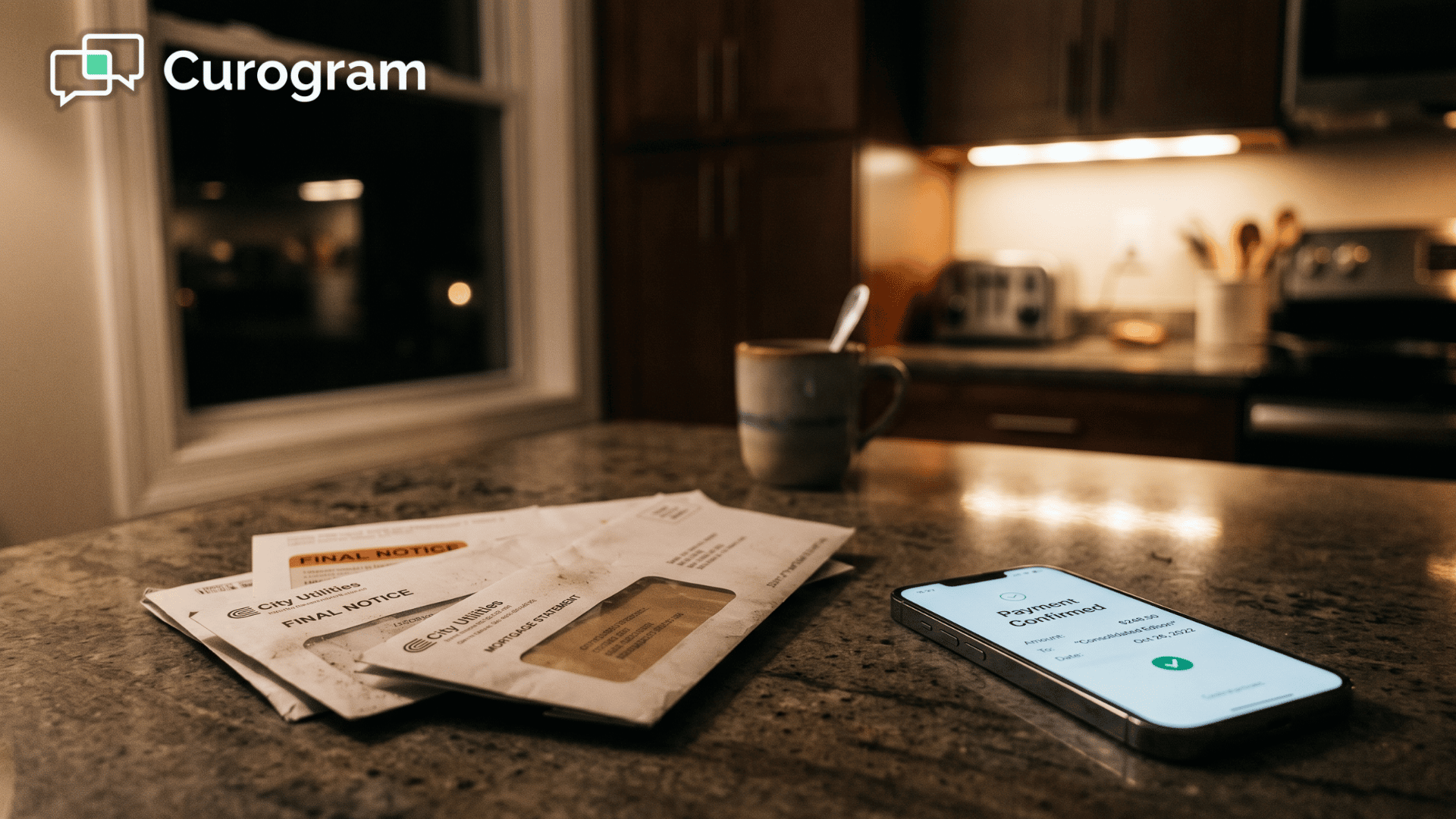
The statement takes 5–7 business days to arrive. The parent sees it, places it on the kitchen counter with the rest of the mail, and intends to deal with it later.

Most of them don't.

After 30 days, a second statement goes out. A third follows at 60 days.

By the end of three statement cycles, the practice has spent $6–$9 per balance in mailing costs — and the balance has aged 90 days without resolution. In practice, this approach recovers roughly 40% of the balances it chases.

The rest age further or eventually get written off.

The Phone Call That Nobody Wants to Make — or Receive

Your billing coordinator calls a parent during business hours. Most parents can't answer — they're at work, in meetings, or managing their kids. The call goes to voicemail. The parent sees a missed call from a number they may not recognize and doesn't call back.

When the parent does answer, the conversation is uncomfortable for both sides.

The billing coordinator has to introduce herself, explain the purpose of the call, and navigate the parent's embarrassment.

The parent promises to pay. They may or may not follow through.

The hidden time cost:

Each phone-based collection attempt takes 5–10 minutes of staff time when you factor in hold time, voicemails, and callbacks. For 50–75 failed payments per month, that's 4–12 hours of billing staff time spent on phone collection alone — every single month. That's a part-time job's worth of hours dedicated entirely to chasing payments that a text message would recover in 48 hours.

The Post-Treatment Collection Cliff

Here is the scenario that quietly costs practices the most.

Tyler's braces came off three months ago. The family owes $400 in remaining treatment balance.

The care is complete, which means there are no upcoming appointments creating urgency to stay current.

The parent has emotionally moved on from orthodontics.

Paper statements arrive and go unread. Phone calls go to voicemail.

The $400 ages from 30 to 60 to 90 to 120 days.

The practice eventually faces a difficult choice:

Send the balance to a collections agency — damaging the relationship with a family that was otherwise happy — or write it off entirely.

Multiply that by 50 patients per year with post-treatment remaining balances.

At a $400 average, that's $20,000 in revenue written off annually on balances that were fully earned, fully owed, and fully collectible — if only the collection channel could reach the parent.

How a Single Text Message Recovers What Months of Phone Calls Couldn't

Cloud 9 orthodontic text-to-pay, powered by Curogram's two-tap payment channel, replaces the phone-and-paper collection workflow with one SMS secure link sent directly to the parent's phone.

The concept is simple. The results are not.

The Core Mechanism: Open, Tap, Done

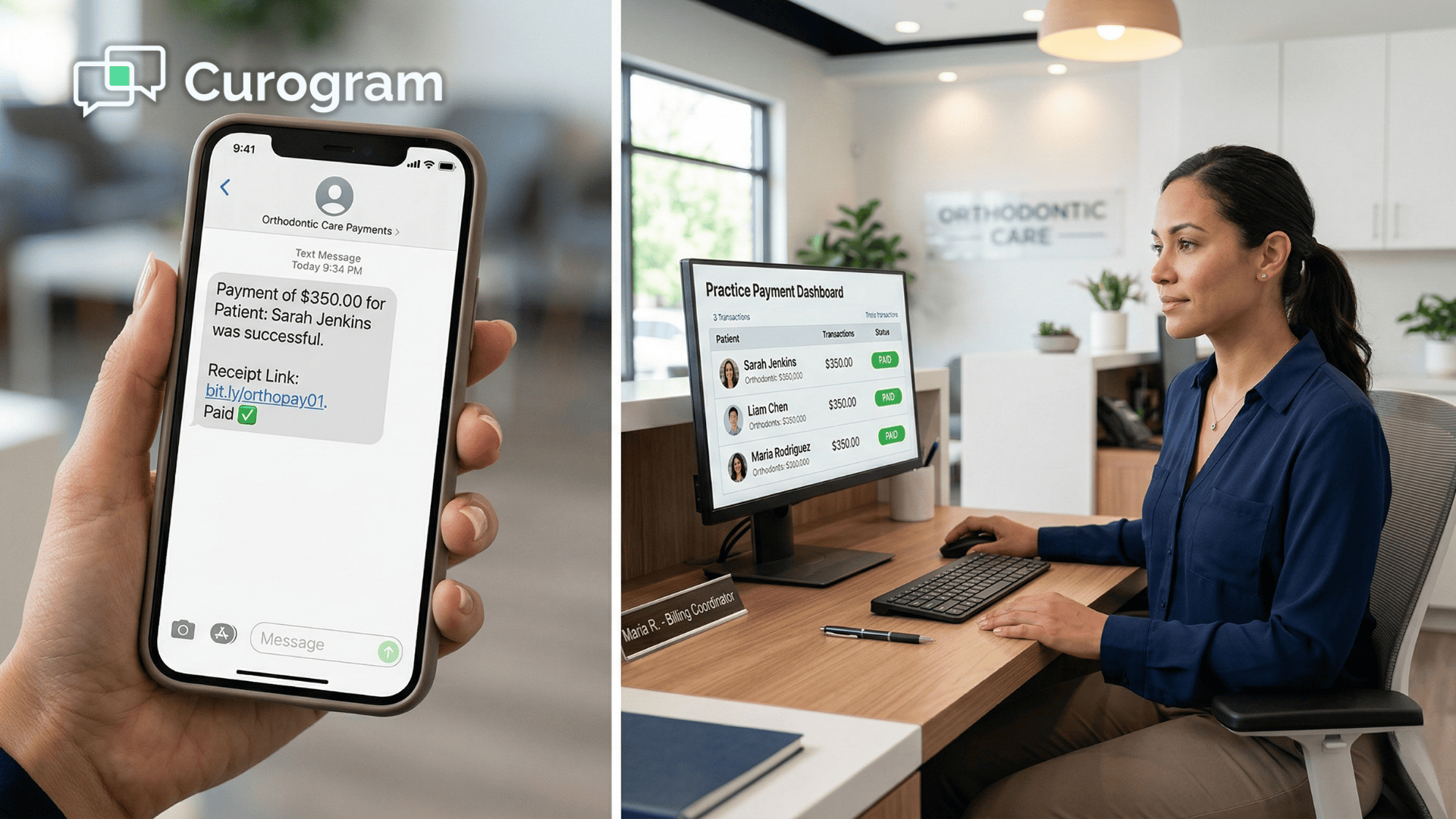
Here is what the parent receives:

"Hi Sarah, your scheduled payment of $175 for Tyler's treatment with Dr. Martinez couldn't be processed. Pay securely here: [Link]."

The parent taps the link. A secure, mobile-optimized payment page opens showing the practice name, the patient's name, the exact amount owed, and a clean payment form. The parent enters their card — or selects a saved method — and taps "Pay."

Confirmation is immediate. Total time: under 60 seconds.

The parent didn't call the office. They didn't open a paper statement. They didn't log into a portal or navigate through a website. They paid from the same device they use for everything else in their life — their phone.

Cloud 9 orthodontic text-to-pay payment plan balance collection SMS secure link two taps parent patient AR recovery - mid

Failed Auto-Pay Recovery: From 90 Days to 7 Days

When a Cloud 9 auto-pay transaction fails, Curogram automatically notifies the parent within hours via text.

The secure link gives the parent two clear options:

Pay the current balance immediately with a new card, or update the card on file for all future auto-pay transactions.

Most parents respond within 24–48 hours because the text reaches them directly, and the payment action requires only two taps. An automated follow-up goes out at day 3 and again at day 7 for parents who saw the first message but didn't act.

By the end of day 7, the majority of failed auto-pay is recovered — without a single phone call from the billing coordinator.

This is the core advantage of Cloud 9 ortho text-to-pay for payment plan balance collection:

It compresses the A/R recovery timeline from 60–90 days to the same billing week.

Post-Treatment Balance Collection: Reach Parents After They've Moved On

The hardest balances to collect are the ones where treatment is already complete. The parent has moved on emotionally. There's no upcoming appointment creating urgency.

Curogram's text reaches the parent in the one channel they don't ignore — their text messages.

For a $400 post-treatment balance, the message might read:

"Hi Sarah, Tyler's remaining balance with Dr. Martinez is $400.00. Pay securely here: [Link]. Or split into 2 payments of $200: [Link]."

Offering a payment plan option directly in the text reduces the psychological weight of a lump-sum payment. The parent sees flexibility, not pressure. That matters — especially for a family that had an otherwise positive experience with the practice.

Monthly Payment Reminders: Make Paying Feel Normal

For patients not on auto-pay, Curogram sends monthly payment reminders to a direct payment link included.

The message lands in the same text thread as appointment reminders and other practice communication, so payment becomes part of the normal patient conversation rather than a separate, friction-heavy billing interaction.

When paying via text requires almost zero effort, the awkwardness of receiving a billing reminder disappears.

Parents pay quickly because the action is immediate and familiar — just like everything else they do from their phones.

Multi-Location Management for DSOs and OSOs

For multi-location orthodontic organizations, text-to-pay Cloud 9 payment plan balance collection operates across all locations from a single centralized dashboard.

Finance leadership gains visibility and control that simply isn't possible when collection is handled location-by-location through phone calls and paper mail.

From that dashboard, your finance team can:

  • Monitor outstanding balances and A/R aging across every location in real time.
  • Deploy payment reminder campaigns to the entire network simultaneously.
  • Compare collection rates and aging buckets by location to identify underperformers early.
  • Standardize the patient payment experience — same messaging, same timing, same branded payment page — regardless of which office they visit.

Location-specific details like provider names and exact amounts are applied automatically.

The result is a consistent, professional collection workflow at scale, without requiring each location to manage its own outreach process.

Cloud 9 orthodontic text-to-pay payment plan balance collection SMS secure link two taps parent patient AR recovery - landscape

What Your A/R Report Looks Like When Recovery Happens in a Week

The shift from phone-and-paper collection to text-to-pay is visible almost immediately in the numbers that matter most: A/R aging, cash on hand, and staff hours.

For practices managing orthodontic payment plan balance collection at scale, the difference is substantial.

The A/R Aging Report Shrinks — Fast

Failed auto-pay amounts that used to sit in the 60–90 day bucket are now recovered within the first billing week.

Post-treatment balances that previously aged for months — because no collection method was actually reaching the parent — get resolved with the first text outreach.

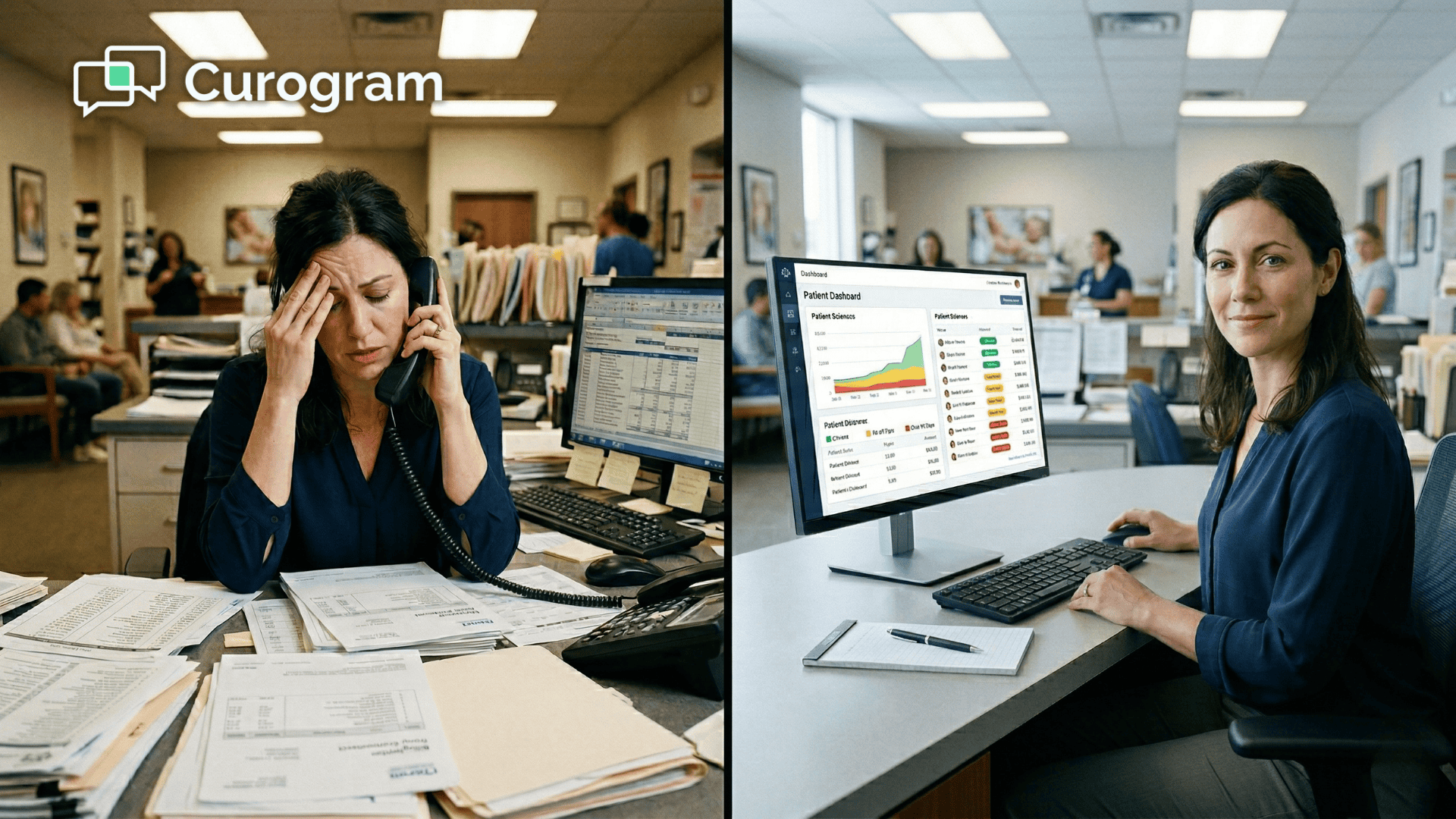
The billing coordinator's daily call list shrinks from 20–30 parents down to 3–5 edge cases that genuinely require a personal conversation.

That is not a modest productivity gain. That is most of her collection workload, automated.

The Cash Flow Impact: Real Numbers

Here is what this looks like for a practice managing $100,000 per month in patient payment collections:

Metric Phone & Paper Collection With Text-to-Pay
Average A/R recovery time 60 days 7 days
Monthly collections in the bank ~$40,000–$50,000 ~$85,000–$95,000
Revenue aged 90+ days $15,000–$25,000 Under $5,000
Annual post-treatment write-offs $15,000–$20,000 $2,000–$5,000
Billing staff hours on phone collection 8–12 hrs/month Under 2 hrs/month

Sample projections for a practice managing 500 active payment plans.

This means that reducing recovery time from 60 days to 7 days puts an additional $35,000–$45,000 into your bank account each month — money that was always owed to you but was sitting in A/R because the collection channel wasn't working.

Over 12 months, that's a material improvement in operating cash flow and practice financial management—freeing you to invest in new equipment, expand, or reduce financial stress.

Staff Hours Reallocated to Higher-Value Work

The billing coordinator who spent 2–3 hours daily calling parents about failed payments now spends 30 minutes reviewing the Curogram text-to-pay dashboard and handling the handful of edge cases that need a personal touch.

The hours she recovers get redirected toward work that actually moves the practice forward:

  • Processing insurance claims faster and reducing reimbursement lag.
  • Managing pre-authorizations for new treatment starts before appointments, not after.
  • Supporting the treatment coordinator during patient financial consultations.
  • Handling complex billing cases that genuinely require human judgment.

You don't need to hire additional billing staff to manage collection volume. You need a collection channel that handles the volume for you — and frees your existing team to do the work that a text message can't.

The Patient Relationship Benefit Nobody Talks About

Collections calls are uncomfortable. The parent who gets called about a past-due balance feels embarrassed — even when the amount is small and the reason is something as routine as an expired card.

That discomfort lingers. It affects how they talk about the practice to friends and how likely they are to refer family members.

Text-based payment is discreet and non-confrontational.

The parent pays quietly from their phone without an awkward conversation. The interaction feels like a helpful notification — not a collections call.

Parents who pay via text are more likely to leave positive reviews because the payment experience stayed consistent with the quality of care: smooth, respectful, and convenient.

Your Practice Has Already Earned This Revenue — Now Let's Collect It

Your practice has spent years building patient relationships. You've given families the gift of confidence through a healthy, beautiful smile, delivered every appointment, every adjustment, every retainer check.

The revenue from that care is owed to you — and most of it is collectible. The only question is how long you're willing to wait for it.

Right now, somewhere in your A/R aging report, there are balances sitting at 60, 90, and 120 days that could have been recovered in the first week. Those parents are not avoiding payment because they're unhappy with the care.

They're not acting on paper statements because that's what everyone does with paper statements. They're not returning phone calls because nobody returns voicemails anymore.

Text them instead.

Cloud 9 orthodontic text-to-pay, powered by Curogram's two-tap payment channel, is built precisely for this gap. Cloud 9 Pay handles in-office payment processing with excellence — Apple Pay, card swipes, auto-pay setup, all of it.

But orthodontic practices collect most of their revenue remotely, through monthly installments processed when the patient isn't at the office. When those payments fail, a remote collection channel needs to step in just as quickly. That's where Curogram's SMS secure link delivers.

A text arrives on the parent's phone. A secure payment page opens in seconds. Two taps and the balance is paid — no call, no statement, no follow-up required.

The billing coordinator who used to spend three hours a day chasing payments now spends 30 minutes on a dashboard. The $15,000–$20,000 in annual write-offs shrinks dramatically. Cash that used to take 60 days to arrive is in your account within the billing week.

Stop mailing statements. Stop making collection calls.

Text your patients a secure payment link and let them pay from the phones they're already holding.

Schedule a demo to see how Curogram's text-to-pay accelerates payment collection at your Cloud 9 orthodontic practice. The revenue is there. Let's go collect it.


Frequently Asked Questions

Does text-to-pay replace Cloud 9 Pay?

No. Curogram's text-to-pay complements Cloud 9 Pay rather than replacing it. Cloud 9 Pay handles in-office payment processing — Apple Pay, Google Pay, card swipes, and auto-pay setup. Curogram's text-to-pay handles remote collection: failed auto-pay recovery, post-treatment balances, monthly payment plan reminders, and co-pay collection. Together, they create a complete payment infrastructure that covers every scenario in an orthodontic practice, both in-office and remote.

Is the payment link secure?

Yes. Curogram's payment links use secure, encrypted connections and are fully PCI-compliant. The payment page is hosted on a certified secure platform, and all card data is processed through certified payment processors. Each payment link is unique to the patient and transaction, which prevents unauthorized access. The parent's financial information is protected at every step from the moment they tap the link to the moment the transaction is confirmed.

Can we send payment links for a specific amount, or can the parent choose how much to pay?

Both options are available. Your practice can send a link for a specific amount — "Your balance is $400, pay here" — or allow the parent to enter a custom payment amount toward their total balance. For practices that want to encourage full payment, the fixed-amount link is more direct and removes any ambiguity. For practices that want to offer flexibility on larger balances, the custom-amount option lets parents make partial payments and start reducing what they owe without the pressure of paying in full immediately.

Can Curogram text-to-pay send automated follow-ups if a parent doesn't respond to the first message?

Yes. Curogram's system sends automated follow-up texts at 3 days and 7 days after the initial payment notification, catching parents who saw the first message but didn't act on it immediately. This automated sequence recovers the majority of outstanding balances within the first billing week without requiring any additional action from your billing team.

Does this work for multi-location orthodontic organizations?

Yes. Curogram's text-to-pay operates across all Cloud 9 locations from a centralized management dashboard. Finance leadership can monitor A/R aging across the entire network, deploy payment campaigns to all locations simultaneously, and compare collection performance by location. Each text is automatically customized with the correct provider name, practice name, and amount for each patient — so the experience is consistent and professional regardless of location.