Improving Cash Flow and Reducing A/R with Text-to-Pay in Office Ally
💡 Late patient payments are one of the most common reasons healthcare organizations struggle with cash flow. Even practices with steady patient...
14 min read
Jo Galvez
:
Dec 22, 2025 11:00:00 AM
Your billing team sends out invoices. Days turn into weeks. Patients forget to pay or misplace their statements. Meanwhile, your practice waits for money that should already be in the bank.
This scenario plays out in medical offices every day. Traditional billing methods create unnecessary delays that hurt your bottom line. When patients have to write checks, find stamps, or remember to call with payment information, your cash flow suffers.
The solution is simpler than you might think. Text-to-pay technology lets patients settle their bills in seconds, right from their phones. No more chasing down payments or wondering when money will arrive.
For practices using Allscripts PM, adding text-to-pay capabilities transforms how quickly revenue flows into your accounts. Patients receive a secure text message with a payment link. They click, pay, and you're done. The entire process takes less time than making coffee.
This isn't just about convenience. It's about protecting your practice's financial health. When you improve cash flow Allscripts text-to-pay integration provides, you gain stability and control over your finances.
Consider the real costs of slow collections. Your staff spends hours on billing calls. You pay for postage, printing, and processing. Patients get frustrated with complicated payment processes. All of this drains resources that could go toward patient care.
Text-to-pay eliminates these pain points. It cuts administrative work, speeds up collections, and makes patients happier. For executives and finance leaders, it delivers measurable returns through better Allscripts A/R reduction and a stronger revenue cycle.
The practices that adopt this technology gain a competitive edge. They operate more efficiently, maintain healthier cash reserves, and offer the modern experience today's patients expect. The question isn't whether to adopt text-to-pay. It's how quickly you can implement it.
Sticking with outdated payment methods creates serious financial risks that many practices underestimate. These risks compound over time, quietly draining resources and limiting growth potential.
Slow collections create the most immediate danger to your practice's financial stability. When patients receive paper bills, payment timing becomes unpredictable. Some pay within days. Others take weeks or months. Many forget entirely.
This unpredictability makes planning nearly impossible. You can't accurately forecast when revenue will arrive. This makes it hard to budget for expenses, plan investments, or handle unexpected costs. Your practice essentially operates in financial limbo, never quite knowing your true cash position.
The impact on your revenue cycle extends beyond just waiting for money. Delayed payments increase the likelihood that bills will never get paid at all. The longer an invoice sits unpaid, the less likely you'll collect. Industry data shows collection rates drop significantly after the first 30 days.
High billing staff overhead represents another hidden cost. Your team spends countless hours on tasks that text-to-pay could automate. They print statements, stuff envelopes, make collection calls, and process payments manually. Every minute spent on these tasks costs money and prevents staff from doing higher-value work.
Calculate what you're really paying for traditional billing. Factor in staff salaries, printing costs, postage, phone time, and processing fees. Many practices are shocked when they see the true cost per payment collected. These expenses eat directly into your margins without adding any value to patient care.
Your billing team also deals with constant interruptions. Patients call with payment questions. They need balances verified. They want to dispute charges or set up payment plans. Each call takes time and attention away from other responsibilities.
Poor patient satisfaction with outdated payment methods creates long-term risks many practices overlook. Today's patients expect digital convenience in every aspect of their lives. When your practice requires checks or phone calls for payment, you're falling behind patient expectations.
This dissatisfaction affects more than just collections. It influences overall patient experience and loyalty. Patients may choose competitors who offer more convenient options. They may leave negative reviews mentioning your complicated billing process. In a competitive healthcare market, these small frustrations can drive patients away.
Consider how patients actually want to handle bills today. They pay for groceries with their phones. They split restaurant checks through apps. They manage all their finances digitally. Then they receive a paper bill from your practice and have to find a checkbook they haven't used in months.
This disconnect frustrates patients and creates barriers to payment. Even patients who intend to pay may procrastinate because the process feels inconvenient. Meanwhile, your accounts receivable grows and your cash flow weakens.
The competitive disadvantage grows more severe over time. As more practices adopt modern payment technology, yours looks increasingly outdated by comparison. Patients start to wonder why your practice can't offer the same convenience as others in your area.
These risks don't stay isolated. They feed into each other, creating a cycle that's hard to break. Slow collections strain cash flow, which limits your ability to invest in improvements. High overhead reduces profitability. Poor patient satisfaction drives people away, further impacting revenue.
Breaking this cycle requires changing how you collect payments. The longer you wait, the harder it becomes to compete with practices that have already modernized. Your financial health, operational efficiency, and patient relationships all depend on adopting payment methods that match today's expectations.
Curogram's text-to-pay solution delivers measurable returns by addressing the core problems that drain practice resources. The system integrates directly with Allscripts PM, creating a seamless experience for both staff and patients.
Faster patient payments strengthen your revenue cycle immediately. When patients receive a text with a secure payment link, most pay within hours rather than days or weeks. This dramatic acceleration in payment timing transforms your cash position.
The speed matters because it reduces the aging of your accounts receivable. Invoices don't sit in the 30-day, 60-day, or 90-day categories. They get paid and closed quickly. This keeps your Allscripts A/R reduction efforts on track and improves your overall financial health.
Think about what faster payments mean for your daily operations. You have cash available when you need it. You can pay suppliers promptly and take advantage of early payment discounts. You avoid the stress of wondering whether you'll have enough to cover payroll or equipment purchases.
The system also makes it easier for patients to pay, which increases collection rates. When paying is simple and convenient, patients do it right away. They don't need to remember to mail checks or call with card numbers. They just click and complete the transaction.
Lower admin costs come from eliminating manual billing tasks. Your staff no longer needs to print and mail hundreds of statements each month. They don't spend hours on collection calls. They don't manually enter payment information from phone calls.
These time savings add up quickly. Consider how many hours your billing team currently spends on tasks that text-to-pay handles automatically. Multiply those hours by staff salaries. The savings become obvious.
Your team can redirect this recovered time toward more valuable activities. They can focus on complex billing issues that require human judgment. They can improve patient communication in other areas. They can help with practice growth initiatives instead of chasing down routine payments.
The reduction in physical materials also cuts costs. No more spending on paper, envelopes, postage, and printer maintenance. These may seem like small expenses individually, but they accumulate to significant amounts over a year.
Compliance with HIPAA and PCI ensures trust, which protects your practice from both legal and reputational risks. Curogram's platform meets all required security standards for handling patient information and payment data. This protection is built into every transaction.
Patients feel more confident paying through a system they know is secure. They see the security indicators and encryption. They trust that their information is protected. This confidence removes a barrier that sometimes prevents patients from paying online.
Your practice also avoids the liability that comes with insecure payment handling. Staff doesn't write down credit card numbers on paper. Payment information isn't stored in unsecured systems. Everything happens through encrypted, compliant channels.
This compliance protection becomes increasingly important as regulations evolve. Data breaches can result in massive fines, legal costs, and reputation damage. By using a compliant system from the start, you avoid these risks entirely.
The combination of faster payments, lower costs, and strong compliance creates a compelling return on investment. You spend less collecting more money in less time. Your staff works more efficiently. Your patients have a better experience.
These improvements don't require massive changes to your workflows. Curogram integrates with your existing Allscripts PM system, so staff can continue using familiar tools. The learning curve is minimal, and implementation happens quickly.
The ROI becomes visible within the first few months. You'll see accounts receivable days drop. You'll notice reduced billing costs. You'll hear from patients who appreciate the convenient payment option. All of these signals point to a system that's delivering real value to your practice.
.png?width=617&height=771&name=improve%20cash%20flow%20Allscripts%20text-to-pay%20-%20mid%20(1).png)
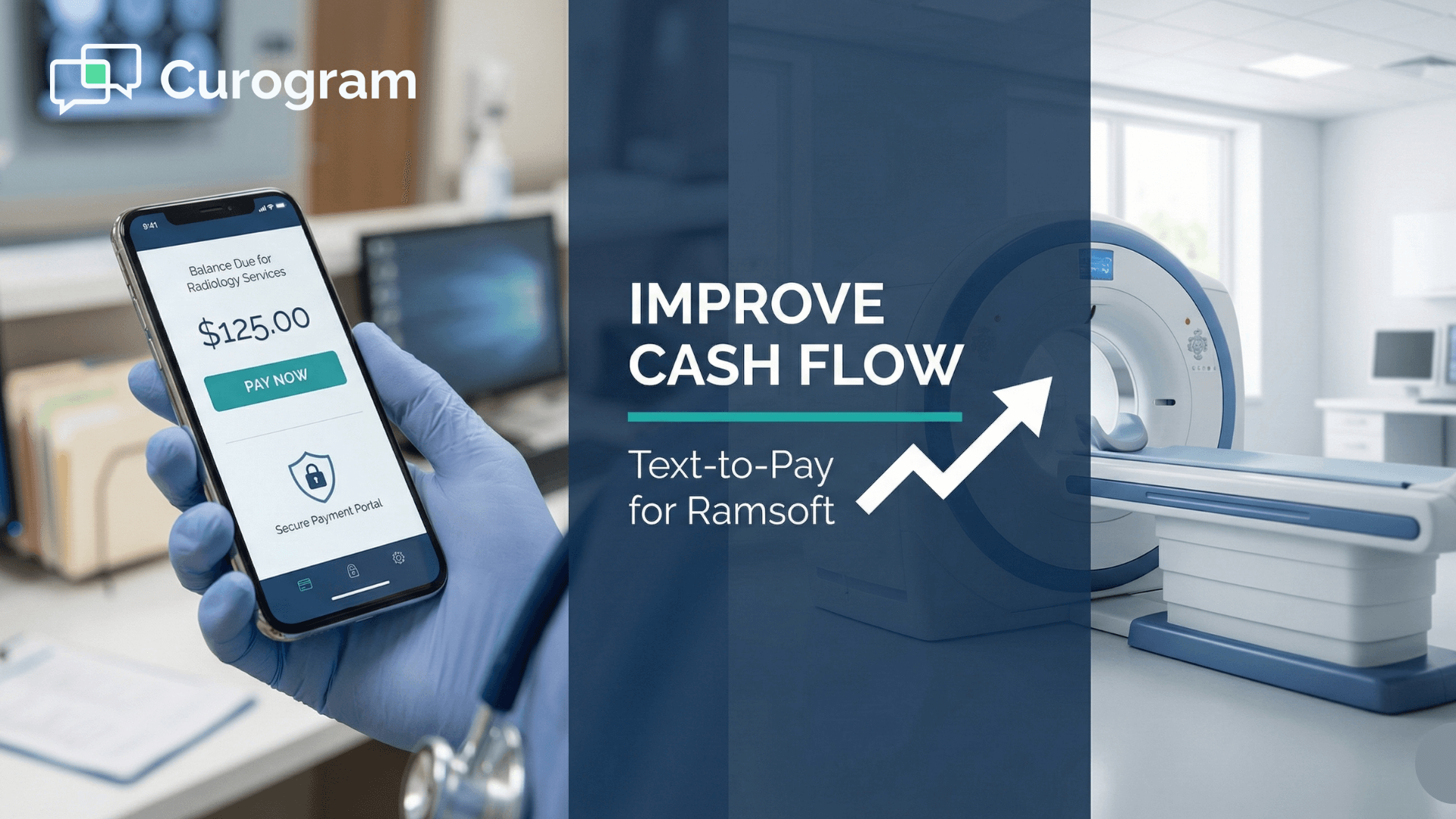
Text-to-pay technology delivers strategic advantages that extend far beyond simple payment processing. For executives and finance leaders, these benefits translate directly into better business performance and competitive positioning.
Predictable cash flow ranks among the most valuable benefits for any practice leader. When you know payments will arrive quickly and consistently, financial planning becomes dramatically easier. You can forecast revenue with confidence instead of making educated guesses.
This predictability affects every aspect of practice management. You can commit to expansion plans knowing the cash will be there. You can negotiate better terms with suppliers when you have reliable payment schedules. You can make strategic investments without worrying about timing gaps in revenue.
Consider how unpredictable cash flow currently impacts your decisions. You might delay needed equipment purchases because you're not sure when payments will arrive. You might miss opportunities because you can't commit the cash at the right time. These missed opportunities have real costs that are hard to quantify but easy to feel.
Text-to-pay eliminates much of this uncertainty. You know that when statements go out, payments will arrive within days. This consistent pattern lets you plan quarterly and annual budgets with much greater accuracy. Finance teams can model scenarios and make recommendations based on reliable data instead of estimates.
The impact on working capital management is equally significant. With faster collections, you need to maintain smaller cash reserves as a buffer. This frees up capital for growth initiatives, debt reduction, or investment in practice improvements. Your money works harder because it's not sitting idle waiting to cover unpredictable gaps.
Lower cost per payment collected improves your margins without requiring you to see more patients or raise prices. Every dollar you save on collections drops straight to your bottom line. These savings accumulate rapidly across thousands of transactions per year.
Break down the traditional cost structure for payment collection. You have direct costs like postage, printing, and payment processing fees. You have labor costs for billing staff time. You have opportunity costs when payments arrive late or not at all. Text-to-pay reduces or eliminates most of these expenses.
The labor savings deserve special attention. When staff can process payments automatically through text-to-pay, you need fewer people handling billing tasks. This doesn't necessarily mean layoffs. Instead, it means your existing team can handle more volume without adding headcount as your practice grows.
This scalability matters tremendously for growing practices. You can add providers, expand services, and increase patient volume without proportionally increasing back-office costs. Your revenue grows faster than your expenses, improving profitability across the board.
The efficiency gains also improve employee satisfaction. Billing staff typically don't enjoy making collection calls or chasing down payments. These tasks can be stressful and unrewarding. When technology handles routine collections, staff can focus on work that feels more meaningful and engaging.
Competitive advantage with modern billing creates differentiation that patients notice and value. In markets where multiple practices offer similar clinical services, the patient experience becomes the deciding factor. Convenient payment options contribute significantly to that experience.
Today's patients compare their healthcare experience to other service industries. They expect the same convenience from their doctor's office that they get from their bank, their retailer, or their restaurant. When your practice delivers on these expectations, you stand out from competitors who haven't modernized.
This advantage extends to attracting new patients as well. People ask friends and family for provider recommendations. They read online reviews. Payment convenience comes up in both contexts. Patients mention it when they're happy with easy payment options. They definitely mention it when frustrated by complicated billing processes.
Your marketing efforts benefit from offering modern payment technology. You can promote convenient payment options in your communications. You can highlight this feature on your website and in patient materials. It becomes a tangible differentiator that's easy for potential patients to understand and value.
The data and insights from text-to-pay systems also support better decision-making. You can track payment patterns, identify trends, and spot potential issues before they become problems. This visibility helps finance leaders make more informed strategic choices.
For example, you can analyze which patient segments pay fastest and which require more follow-up. You can identify seasonal patterns in payment timing. You can measure how changes to your billing process impact collection rates. All of this information helps you continually refine and improve your revenue cycle.
The technology also provides clear metrics for measuring performance. You can track days in accounts receivable, collection rates, cost per transaction, and other key indicators. These metrics make it easy to demonstrate ROI to stakeholders and identify areas for further improvement.
Executive teams can use these insights for strategic planning. If you're considering opening a new location, you can model the revenue cycle based on actual payment data. If you're evaluating service line expansion, you can factor in realistic collection timelines. Better data leads to better strategic decisions.
The credibility that comes with modern billing technology also matters in professional contexts. When you're negotiating with payers, partnering with other providers, or seeking financing, operational sophistication signals a well-run organization. Modern revenue cycle management demonstrates that your practice takes financial performance seriously.
This perception can influence the terms you receive on everything from vendor contracts to bank loans. Financial institutions view practices with strong cash flow and efficient operations as lower-risk borrowers. Payers see organized, technology-enabled practices as more reliable partners.
The cumulative effect of all these benefits creates substantial value over time. Predictable cash flow reduces financial stress and enables growth. Lower costs improve margins and competitiveness. Modern billing enhances patient satisfaction and retention. Data and insights drive continuous improvement.
For practices using Allscripts PM, implementing text-to-pay represents a relatively simple change that delivers outsized returns. The integration works smoothly with existing systems. The technology is proven and reliable. The investment pays for itself quickly through reduced costs and faster collections.
The strategic question isn't whether these benefits are worth pursuing. It's whether you can afford to let competitors capture these advantages while your practice continues with outdated methods. In an increasingly competitive healthcare market, operational efficiency and patient experience become key differentiators. Text-to-pay technology addresses both simultaneously.
A multi-location family medicine practice with eight providers faced mounting challenges with their traditional billing approach.
Before implementing text-to-pay, the practice averaged 52 days in accounts receivable. Their billing team of four spent roughly 60% of their time on collection activities.
The practice leadership decided to integrate the text-to-pay solution with their Allscripts PM system. Implementation took less than two weeks. Staff training required just a few hours since the system worked within their existing workflows.
Results appeared quickly. Within the first month, the practice saw payment timing accelerate noticeably. Patients who received text-to-pay options paid an average of 12 days faster than those who received paper statements. By the third month, this pattern had solidified across the entire patient base.
After six months, the practice reduced A/R days by 35%, bringing their average down to 34 days. This improvement freed up significant working capital that had been tied up in unpaid invoices.
The billing team experienced dramatic changes in their daily work. Collection call volume dropped by 60%. Time spent on manual payment entry fell by 75%. The team could finally focus on complex billing issues and insurance follow-ups instead of routine collections.
Cost savings exceeded projections. The practice calculated they saved over $42,000 annually in reduced labor costs, eliminated postage, and lower processing fees. They also saw improved collection rates, recovering an additional 8% of previously written-off balances.
Getting started with text-to-pay for your Allscripts PM system is straightforward. The first step is scheduling a demo to see how the technology works with your specific setup.
During the demo, you'll see exactly how patients receive payment texts, how they complete transactions, and how payments flow into your Allscripts system. You can ask questions about integration, security, pricing, and implementation timelines.
Next, plan the implementation. They'll assess your current billing workflows and recommend the best approach for your practice. Most implementations complete within two to three weeks from start to finish.
Why Curogram Stands Out for Allscripts Users
Curogram designed its text-to-pay solution specifically for healthcare practices using systems like Allscripts PM. This focused approach means the integration works smoothly without disrupting existing workflows.
The platform handles everything needed for secure, compliant payment processing. Patients receive text messages with encrypted payment links. They can pay using any major credit card or debit card. The system processes the payment and updates Allscripts PM automatically.
Security and compliance are built into every aspect of the platform. Curogram maintains HIPAA compliance for patient communications and PCI compliance for payment processing. Your practice never needs to worry about whether transactions meet regulatory standards.
The patient experience is designed for simplicity. Text messages are clear and professional. Payment pages load quickly on any device. The entire payment process takes less than a minute from text receipt to completion.
For practice staff, Curogram offers a dashboard that provides real-time visibility into payment activity. You can see which patients have received payment texts, who has paid, and which invoices remain outstanding. This transparency helps staff prioritize follow-up efforts efficiently.
Support is available throughout implementation and beyond. Curogram's team helps with setup, staff training, and ongoing questions. They understand the challenges healthcare practices face and provide relevant, practical guidance.
The platform also scales easily as your practice grows. Whether you're a single-location practice or a multi-site organization, Curogram handles increasing payment volume without requiring additional resources or infrastructure on your end.
Integration with Allscripts PM means you don't need to learn a completely new system. Staff can continue using familiar tools while gaining the benefits of automated text-to-pay. This combination of new capability with existing workflows makes adoption smooth and stress-free.
Pricing is transparent and predictable, with no hidden fees or surprise charges. You know exactly what text-to-pay will cost, making it easy to calculate ROI before committing.
The evidence is clear. Text-to-pay technology delivers measurable improvements in cash flow, costs, and patient satisfaction. For practices using Allscripts PM, integration with the help of Curogram is simple.
You've seen the risks of continuing with outdated payment methods. Slow collections drain your cash reserves. High billing costs eat into margins. Patient frustration grows when payment is inconvenient.
You've also seen the alternative. Faster payments improve your revenue cycle. Automated billing reduces overhead. Modern payment options meet patient expectations and strengthen loyalty.
The ROI is straightforward. Practices consistently report reduced A/R days, lower collection costs, and improved cash flow. These aren't theoretical benefits. They're real results that impact your bottom line every month.
Your competitors are already adopting these technologies. Every day you wait gives them more time to capture the advantages of efficient payment processing. Patients notice which practices offer convenient options and which don't.
The decision doesn't require a major investment or risky change to your operations. Curogram integrates with your existing Allscripts PM system. Implementation takes weeks, not months. Staff training is minimal. The risk is low and the potential return is high.
Your billing team will appreciate spending less time on collection calls and manual tasks. Your patients will value the convenient payment option. Your finance team will benefit from predictable cash flow and better visibility into the revenue cycle.
Most importantly, you'll gain confidence in your practice's financial position. You'll make strategic decisions based on reliable cash flow instead of estimates. You'll operate more efficiently and compete more effectively.
The question isn't whether text-to-pay makes sense for your practice. It's when you'll implement it. The sooner you start, the sooner you'll see improvements in the metrics that matter most to your practice's success.
Boost cash flow and patient satisfaction with text-to-pay for Allscripts PM. Book your demo today.
Text-to-pay dramatically accelerates payment timing by making it easy for patients to settle bills immediately. This convenience means most payments arrive within days instead of weeks.
Faster payments reduce the time your money sits in accounts receivable, improving your cash position and making financial planning more predictable. The system also increases overall collection rates since patients are more likely to pay when the process is simple and convenient.
Executives should prioritize this integration because it delivers measurable ROI through multiple channels simultaneously. The investment is relatively small, implementation is quick, and results appear within the first few months.
For practices focused on growth and efficiency, text-to-pay represents one of the highest-return improvements available.
Automated payment collection eliminates time-consuming manual tasks that currently consume billing staff hours. By automating routine collections, you free staff to focus on complex billing issues, insurance follow-ups, and other high-value activities.
The cost savings come from reduced labor hours, eliminated material costs, and improved efficiency across the entire revenue cycle.
HIPAA and PCI compliance protect both your practice and your patients from serious legal and financial risks. Without these protections, your practice could face massive fines, legal liability, and reputation damage if a data breach occurs.
Compliant systems also build patient trust, making them more comfortable using digital payment options. Using a platform like Curogram that maintains these certifications means you don't need to worry about meeting complex regulatory requirements on your own.
Most practices begin seeing ROI within the first 30-60 days after implementation. Cost savings from reduced labor and eliminated materials appear in the first billing cycle. By the third month, patterns solidify and you can measure concrete improvements in days in A/R, collection rates, and total billing costs.
Practices typically report that the system pays for itself within three to six months through a combination of faster collections, reduced overhead, and improved recovery rates. The long-term ROI continues to grow as you process more payments through the efficient automated system.
💡 Late patient payments are one of the most common reasons healthcare organizations struggle with cash flow. Even practices with steady patient...
💡 How AdvancedMD clinics can use text-to-pay to improve collections is simple. It starts with changing outdated billing workflows into secure,...
💡 Many practices struggle to improve cash flow Dolphin text-to-pay can support when payments are delayed or hard to collect. Delayed balances...