

Curogram gives each office a verified number patients can save and call back. It runs on HIPAA-compliant, SOC 2 Type II certified infrastructure, tied to the patient record. Threads belong to the office, so whoever works the 8 am shift can answer the question asked at 9 pm.
Nobody at your practice decided patients should receive texts from unknown numbers. It happened one helpful favor at a time.
A patient asks a scheduler to just text her. The scheduler does, from the phone in her pocket, because that is the phone in her pocket. Six months on, a dozen patients have that number saved under names like “clinic??” One of them is texting it on a Sunday.
Everyone in that story is behaving well. Patient privacy texting clinic staff never meant to put at risk ends up at risk anyway. The favor carried costs nobody weighed at the time.
We'd argue the sending number belongs in the patient safety column, alongside ID checks and allergy flags. A patient who cannot verify who texted her makes worse decisions about her own care.
The Mystery Number
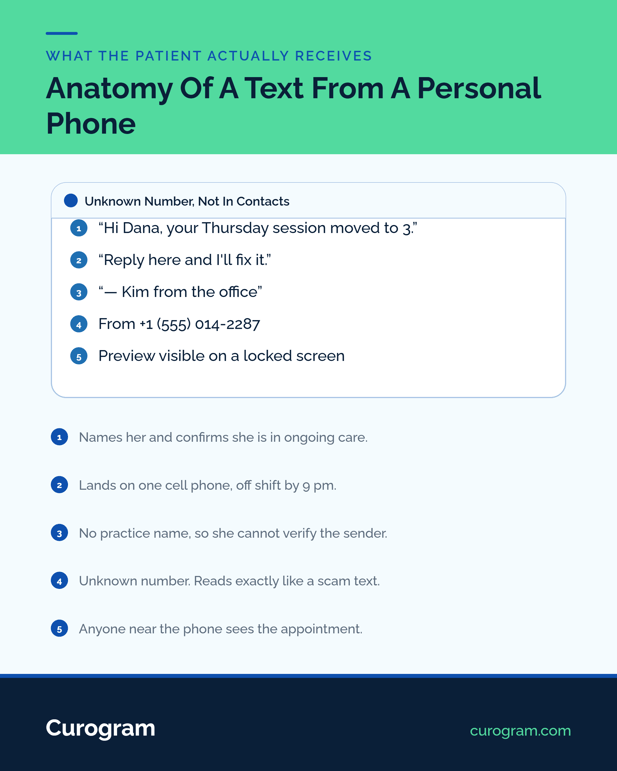
What actually lands on her phone
“Hi Dana, your Thursday session moved to 3. Reply here and I'll fix it. — Kim from the office.”
Read it as the patient. An unfamiliar number, a first name with no practice attached, and a confirmation that she has standing Thursday appointments somewhere. Its preview shows on a locked screen at dinner. Mental health texting privacy for a patient can end there, before she has even opened the message.
She replies at 9 pm with a real question. Kim is off shift, phone face-down. Nobody at the office knows the question was asked.
Why patients learn to distrust their clinic
Patients get told to ignore texts from numbers they don't recognize. That is sound advice, and the FTC's guidance on spotting text scams repeats it. An unknown number text from a clinic asks them to make an exception.
Two outcomes follow, both bad. Some patients ignore real care instructions because the message looked like a scam. Others get trained that mystery texts from strangers can be trusted, which is the exact habit fraud depends on.
There is a third cost, quieter than the other two. Personal cell PHI risk means her details sit on a device the practice cannot control. No remote wipe. No passcode rule. No record of who scrolled past it.

What the Patient Should See Instead
Patients trust official practice number texts for a reason they can articulate. They can call it back, and a person at the front desk answers.
One number per office, saved in contacts
That first message from a verified office number gets saved to her contacts. Everything after it arrives with a name attached instead of a string of digits. Confirmations, reschedules, balance links, follow-up questions, all in one thread she can scroll.
Recognition changes reply rates. Covina Arthritic Clinic confirms more than 1,100 appointments a month through their practice number, based on our internal data. Patients answer numbers they know.
The 9 pm question finally reaches someone
Threads belong to the office rather than to Kim. The Sunday message sits in the queue. Whoever opens it Monday morning sees the patient's record right beside it.
Continuity survives shift changes, vacations, and resignations. When staff leave, their access closes and the conversation stays exactly where the next person will look for it.
Curogram Highlight: Verified Office Numbers
Verified Office Numbers give each location a single texting number patients can save, verify, and call. Messages arrive branded to the practice, so nobody has to guess whether the text is real.
Patient data protection runs underneath it. That means HIPAA compliance, SOC 2 Type II certification, and a signed BAA. Consent and opt-out are handled without anyone tracking them on paper. Content safeguards keep routine texts free of clinical detail. That matters most in specialties where an appointment time alone says too much.
We make the wider case for governing this channel across a group in what governed patient texting looks like across every office.
One Trusted Number, Total Continuity
The patient's view of the difference
|
What the patient does |
Staff personal cell |
Verified office number |
|
Recognizes the sender |
No, unknown number |
Yes, saved in contacts |
|
Checks it isn't a scam |
No way to verify |
Calls the number back |
|
Texts a question at 9 pm |
Reaches one off-shift phone |
Reaches the office queue |
|
When that staffer leaves |
Thread disappears |
Thread stays with the office |
What the practice gets back
Zero patient conversations on personal devices is a number you can reach. It takes one migration, not a year of reminders.
Staff keep the speed that made them improvise. Automated reminders go out from that same verified number, covered in keeping every reminder on the practice's number. Patients see one sender for everything.
Protect the Helpers and the Helped
Ask your teams how often patients get texts from personal phones right now. Ask without blame. The honest answer runs higher than you expect, and the people doing it were solving a real problem.
Then take the problem away. Staff improvised because patients needed answers faster than the official channel gave them. Fix that speed gap and the improvising stops on its own.
Book a demo. Watch how fast the governed channel actually moves, because speed is what converts the improvisers.
Frequently Asked Questions
A recognized number can be saved, called back, and verified. An unknown one asks her to ignore every scam warning she has been given. She either hesitates or stops checking.
Nothing moves. That conversation belongs to the office. Whoever picks it up gets full history, and the patient never repeats herself or learns a new number.
Keep clinical detail out of SMS. Send anything specific through a secure link, and scope the thread to the team that serves those patients. The time and provider name are enough to identify care.
They have called that number before. Familiarity removes the pause. Practices on a verified number see confirmations come back in minutes, not by voicemail the next day.
Frame it as a workload question, not a compliance one. Ask what the official channel was too slow for, then fix that specific step before announcing any new rule.