7 min read

Patients Time Your Replies — Measure Them Too

Practice manager reviewing per-office patient response times on a wall dashboard
💡 Measuring patient response experience across AdvancedMD locations matters because patients already measure it. Every voicemail that takes three days to return tells them how much your group values their time.

Curogram works as "The Network Scoreboard" for AdvancedMD groups. It tracks how long patients wait for answers at each office and gives staff shared queues and cross-office coverage to close the gap.

The villain is "The Three-Day Callback." No one planned it, and no report shows it. Once reply times are visible by office, they become fixable. Curogram client data from clinical settings shows no-show rates 53% lower than the industry average.

Most practice groups track visits, revenue, and no-show rates down to the decimal. Very few track the number patients care about most: how long it takes to get an answer. Your patients know that number for every office, even if your reports have never shown it.

They usually learn it the hard way. A patient calls with a simple question about moving a session, and the call goes to voicemail. The reply arrives three days later. By then, the moment has passed, and so has some of their trust.

For organizations running AdvancedMD across several locations, this problem hides well. Every office has its own staff, its own phone habits, and its own pace. One front desk might return every message within the hour, while another lets voicemails pile up until Friday.

Patients don't experience those offices as separate teams. They see one organization with one name on the door. So a frustrating experience at a single location quietly becomes their opinion of the entire group.

This matters most for patients who return frequently, such as therapy clients, physical therapy patients, and people in ongoing specialty care. They may contact your group every week. For them, a quick reply isn't an extra courtesy; it's part of the care relationship itself.

Here's the difficult part:

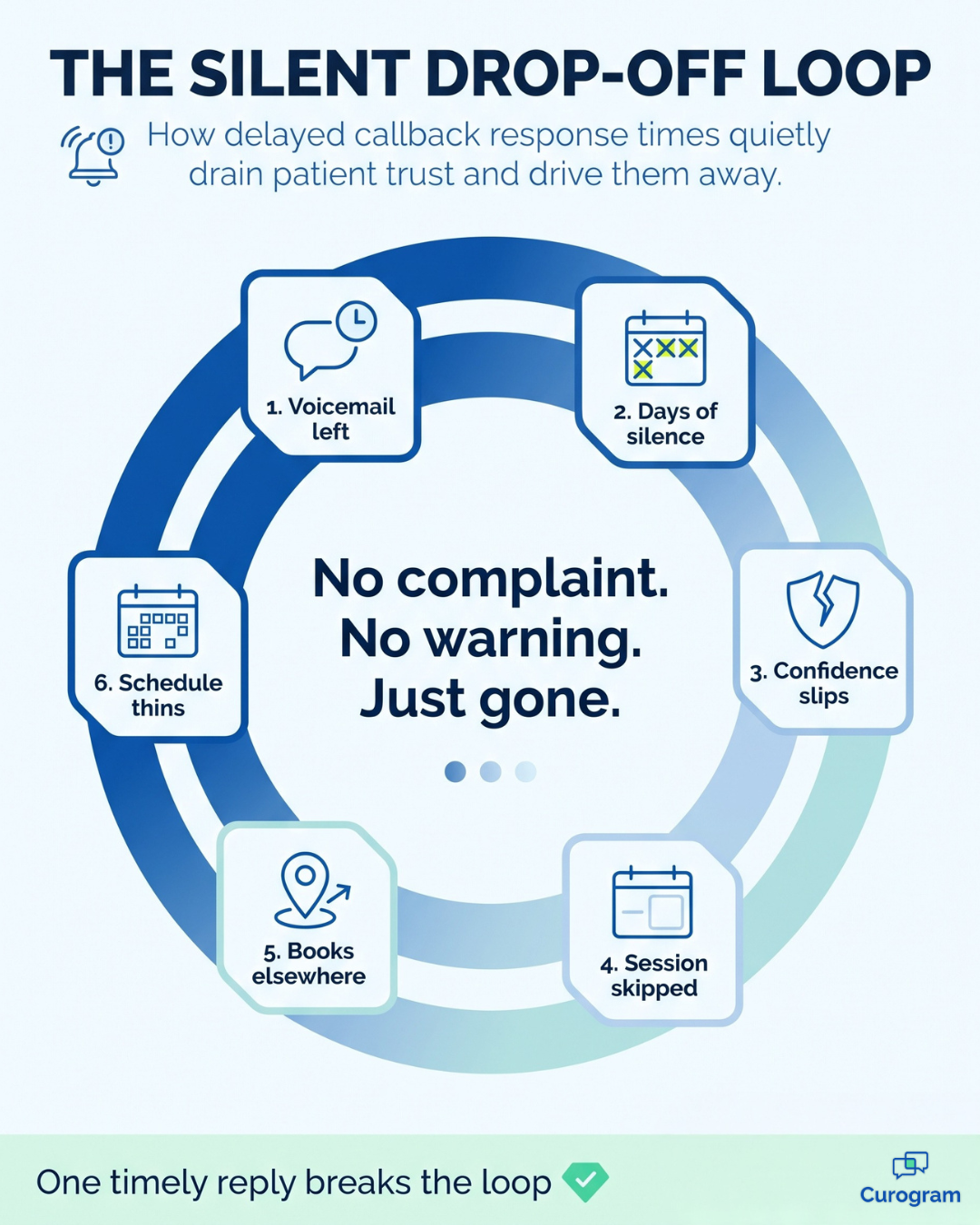
Slow replies rarely generate complaints. Patients don't write letters or ask to speak with a manager. They simply book somewhere else next time, and the office never discovers why the schedule thinned out.

That's why measuring patient response experience across AdvancedMD locations has become a priority for multi-site groups. You can't fix a delay that no report reveals.

This guide explains how slow callbacks drain loyalty and how Curogram makes reply speed visible at each office. It also shows what improves when every location answers quickly.

The Three-Day Callback No One Planned

Nobody sets out to make patients wait three days. The Three-Day Callback grows slowly out of busy phone lines, small teams, and messages without a clear owner. It isn't an official policy, but it becomes an everyday habit that no dashboard ever captures.

Patients Compare You to Their Banking App

Your patients don't compare your reply speed with other medical offices. Instead, they compare it with their bank, their pharmacy, and the retailer that texts them the moment an order ships.

Those businesses usually respond within minutes, so when a medical office takes several days, the gap feels huge.

Recent research supports this pattern. In Bandwidth's 2026 patient preferences report, 32.7% of U.S. patients said slow response times would lead them to consider other providers. Trouble booking appointments ranked even higher, at 42.2%, and both problems often begin with the same unanswered message.

One Voicemail, One Lost Week

Here's how it usually plays out.

On Monday, a patient leaves a voicemail asking to reschedule Thursday's session. By Wednesday, there's still no response, so they can't organize their week.

Eventually they skip the appointment, or they cancel and never rebook.

The answer would have taken about ninety seconds of staff time.

The delay, however, cost something far more valuable:

The patient's confidence in a care relationship that depends on weekly visits.

Each time a patient waits for callback, practice loyalty slips a little further.

Why Patients Leave Without a Word

Why do patients switch practices? Slow communication is one of the least visible reasons. People rarely complain about a delayed callback; they simply book with another provider and move on.

Meanwhile, the office notices a lighter schedule but can't identify the cause. No exit survey flags the problem, and no staff member hears about it directly. That silence is exactly what makes this villain so expensive.

One Slow Office Speaks for the Whole Group

Inside a multi-site organization, reply speed can vary dramatically. One office answers within the hour, while another takes two or three days.

Patients don't average those experiences together;

They remember the worst one. As a result, a single slow location can shape how patients feel about every office that shares your name.

Putting Reply Speed in Plain View

Curogram serves as "The Network Scoreboard" for your organization. It transforms patient wait time into a measurable metric with a clear owner. Instead of guessing which office is falling behind, you can see it, track it, and improve it.

Here's what that looks like in daily operations:

  • Response-time tracking by office and queue: See how long patients wait for a reply at each location. Spot slow offices before delays become patterns.
  • Shared inbox tools: Staff can claim a message so two people don't answer the same patient. Conversations route to the right team instead of bouncing around.
  • Cross-office coverage: When one front desk is overwhelmed, staff at another location can help with its queue. A small team no longer means slow answers.
  • Two-way texting: Patients text a question, and staff respond between other tasks. A text takes seconds to answer, while phone tag can continue for days.

Speed is only half the equation, though, because the answer also needs to be accurate. Curogram's Integration Engine connection with AdvancedMD brings patient and appointment information into Curogram.

That way, staff can see who they're talking to and what's on the schedule before they reply.

Appointment data syncs every 15 minutes for the next three days and every 30 minutes after that. Curogram can also write appointment statuses back to AdvancedMD, including confirmed, canceled, and no-show.

So when a patient texts to cancel, the update doesn't stay trapped inside a message thread.

Texting also fits the way patients actually live. Someone can send a question from a parking lot and receive an answer before lunch. Responding quickly finally becomes inexpensive for your staff and immediately noticeable to patients.

Infographic showing how slow patient callbacks lead to skipped visits and quiet patient loss

What Changes When Every Office Answers Fast

Once response time becomes visible, it usually starts to improve. Office managers can see exactly where messages stall, and leaders can set a clear standard and check whether each location meets it. Most patients now hold a same-day answer expectation for simple questions, which makes it a sensible place to begin.

Faster replies also tend to go hand in hand with better attendance. Curogram client data from clinical settings shows no-show rates 53% lower than the industry average among practices using automated reminders and two-way texting.

Stop playing phone tag! Reduce your call volume by 50% with Curogram's HIPAA-compliant 2-way texting platform.  

When patients can reach you easily, they're more likely to show up.

The table below shows how this shift can look across a group. The "before" column is an illustrative example, not data from a specific practice.

Moment Before After
A patient asks to reschedule Voicemail, with a callback in two or three days A text answered the same morning
Leaders review service quality No data on reply speed Patient experience by office, side by side
A busy office falls behind Messages pile up for days Another location helps clear the queue
A patient describes the group "Hard to get hold of" "Easy to reach"

The change is simple to explain and hard to fake. "We'll call you back" becomes "answered before lunch," and you can prove it at every office.

That change also shows up where new patients look first:

Online reviews. Patients who receive quick answers are more likely to describe a group as "easy to reach."

That phrase shapes where other people decide to book. Communication speed, retention, and reputation tend to rise and fall together.

How to Start Measuring Response Speed at Every Office

You don't need a large project to get started. A few simple habits can turn reply speed from a guess into a number your leaders review every month.

The goal is to measure what patients actually feel, not just what staff report.

  1. Set one clear standard: Choose a target that fits your patients, such as a same-day reply for routine questions. Write it down so every office works toward the same goal.
  2. Measure each location separately: A group-wide average can hide a slow office. Track every site on its own so problems stay visible.
  3. Separate queues by topic: Scheduling, billing, and clinical questions often need different owners. Tracking each queue shows exactly where messages wait longest.
  4. Give every message an owner: Unclaimed messages are where long waits usually begin. When someone clearly owns each conversation, fewer patients slip through the cracks.
  5. Share the numbers openly: Post response times where office managers can see them every week. Friendly comparison often motivates teams more than another policy memo.
  6. Review and adjust monthly: Look for patterns, such as Monday backlogs or slow afternoons. Then shift coverage to match the hours when patients reach out most.

Once these habits take hold, response speed stops being a mystery. It becomes a routine part of how your group manages the patient experience, just like visit volume or no-show rates.

Your Patients Already Keep Score. Start Reading It.

Your patients have been grading your response times for years. They simply never sent you the report card. Every delayed callback, missed voicemail, and "we'll get back to you" contributes to a score your team can't see.

Fortunately, this score can change quickly. Response speed is one of the few parts of the patient experience that an organization can measure, compare, and improve within weeks. You don't need a new building or a larger budget. You need to know which office is falling behind and give that team a practical way to catch up.

It also helps to remember what each system is designed to do. AdvancedMD is built to hold your record of the visit. Curogram is built for the patient's experience between visits, which is where most questions, schedule changes, and worries actually happen.

The link between response speed, patient loyalty, and revenue is real, even when patients never mention it. Organizations that answer quickly keep more of their recurring patients. They also earn the kind of reviews that attract new ones.

So try a simple experiment this week. Leave your busiest office a voicemail with a routine question, then measure how long it takes to receive an answer. Then repeat that test at your smallest office. Whatever that number turns out to be, it's what your patients experience every day.

If the wait surprised you, it's time to see the complete picture. Schedule a Demo with Curogram to see per-office response tracking in action. You'll discover how shared queues, cross-office coverage, and your AdvancedMD data can work together to shorten every wait.


Frequently Asked Questions

Do patients really leave a practice over slow responses?

Yes, and they usually leave quietly. In Bandwidth's 2026 survey of 1,000 U.S. patients, 32.7% said slow response times would lead them to consider other providers. Most don't complain first. They simply book somewhere else next time.

How fast should a practice reply to patient messages?

For routine text questions, a same-morning reply feels excellent to most patients. A same-day reply is usually the minimum they'll accept. With Curogram, your group can set its own standard for each queue and track whether each office meets it.

Can a small office keep up with a group-wide speed standard?

Yes. That's what cross-office coverage is for. Shared queues let staff at other locations help when one office gets busy. A two-person front desk can then give patients the same experience as your largest site.

How does Curogram work with AdvancedMD?

Curogram connects to AdvancedMD through its Integration Engine using AdvancedMD's public API. Patient and appointment data flow into Curogram, and appointment data syncs every 15 minutes for the next three days. Curogram can also write confirmed, canceled, and no-show statuses back to AdvancedMD.

Why should a group track response time by office instead of overall?

A group-wide average can hide one slow site. Patients don't experience an average. They experience the office they called. Tracking each location shows you exactly where patients wait longest, so you can fix the problem where it starts.

Patients Time Your Replies — Measure Them Too

Patients Time Your Replies — Measure Them Too

Patients grade every Office Ally location by answer speed then leave quietly over three-day callbacks. Curogram measures and fixes response times per...


Read More
Consistent Reminders at Every AdvancedMD Office

Consistent Reminders at Every AdvancedMD Office

Patients judge your whole group by one office’s reminder. Curogram makes every AdvancedMD office send the same clear, reply-able texts — 75%+...

Read More
Patient Recall for AdvancedMD Groups | Curogram

Patient Recall for AdvancedMD Groups | Curogram

In relationship-based care, a lapsed patient is interrupted treatment. Curogram’s automated recall wins back 35% across every AdvancedMD office.

Read More