
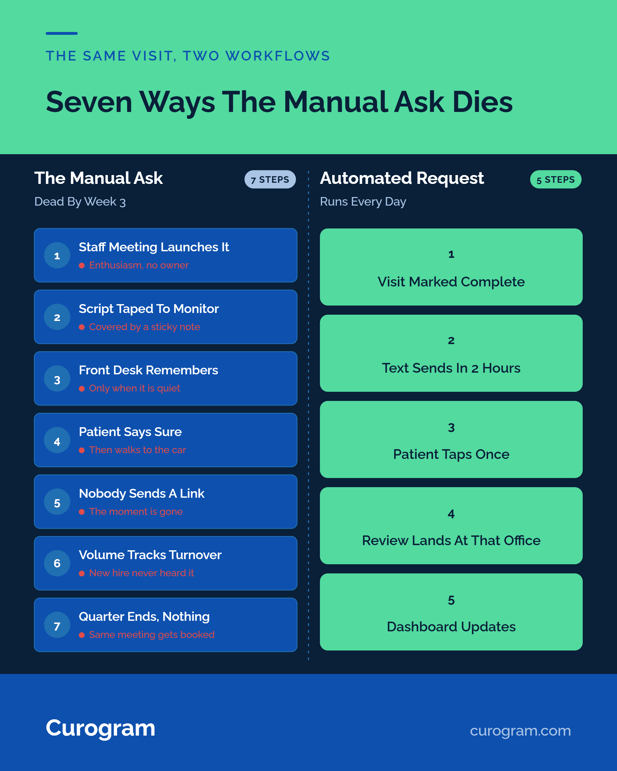

Administrators get request, click, and conversion numbers per office, which turns review volume into a coachable metric instead of a mystery. Google prohibits gating and paid reviews, not automation, so an ungated request sent to every patient stays inside policy. One multi-location group collected 1,064 new 5-star reviews in three months on this workflow, based on our internal data.
Your claims follow-up runs on rules. Statements go out on a schedule. Recalls fire from a report nobody has to open. Then there is reputation, which runs on “remember to mention it.”
That is the gap. A group that automated every other repeatable task left its most visible marketing asset to chance. It now depends on whether a scheduler has ten free seconds after a 40-patient morning.
The initiative always launches the same way. Table tents, a script, a staff meeting. Week one produces a handful of asks at the office where the administrator sits. By week three, the number is zero everywhere, and next quarter the same meeting gets booked again.
We'd argue nobody should own the ask. Reviews belong to the visit, arriving the way a claim goes out when a charge posts.
The Manual Ask
Why week three always wins
Nothing about this is a discipline problem. A front desk forgets the review ask because it competes with a ringing phone, a patient at the window, and a fax needing a signature.
The moment also passes fast. A patient says “sure, happy to” on her way out, then walks to her car and thinks about lunch. Without a link in her hand, that yes evaporates before she reaches the parking lot.
Turnover finishes the job. The person trained in January leaves in April, and her replacement never heard the script. Review volume ends up tracking staffing churn rather than care quality.
What the decay quietly costs
Competitors running automation gain ground every single day yours does not. Their newest office builds a credible count in a quarter while yours sits at 12.
Nobody sees the bill. There is no line item for the patient who compared two listings and picked the other one. The gap only surfaces later, when someone asks why the 2024 office is still not filling.

Requests That Fire Themselves
The trigger is the visit, not a list
Post-visit review request automation keys off appointment activity in AdvancedMD. The visit gets marked complete, and that single event queues the request. No campaign list, no upload, no staff step at any point.
Volume then follows traffic. An office running 400 visits a month generates requests at 400-visit scale, and an office running 90 generates 90. Each site earns reviews in proportion to the care it actually delivers.
Review request timing is a setting, not a guess
Two hours after the visit is the working default. The experience is still specific in the patient's mind, and she is usually home rather than driving.
That window matters more than most groups expect. Majority of patients who leave a review write it within 24 hours of the appointment. Send it late, and you compete with everything else that happened to her that week.
One request per visit. Patients who ignore it hear nothing further, and opt-outs apply permanently across every office.
Curogram Highlight: Automated Review Requests
Automated Review Requests fire on visit completion and route each patient to the Google profile for the office she attended. Two taps from the text to a posted review, with no group-level listing in between.
Per-office reporting shows requests sent, links clicked, and reviews posted. Review volume per office stops being an accident and becomes a number you can compare across sites and coach against. Setup takes one working session, and campaigns tune per location afterward.
The wider strategy sits in why review counts differ so much between your offices.
Reviews as a Byproduct of Care
The gap you have never invoiced
Count last month's completed visits against last month's new reviews, office by office. Most groups have never run those two columns side by side.
|
Office |
Completed visits |
New reviews |
Reviews per 100 visits |
|
Founding office |
620 |
9 |
1.5 |
|
Second location |
410 |
2 |
0.5 |
|
Newest office |
240 |
0 |
0.0 |
Figures are illustrative of a three-site group. Pull the last column for your own offices. It strips out size and shows which sites convert goodwill and which drop it.
Compliant by design, not by luck
Google review automation for a group runs into one real rule. Review gating compliance means every patient gets the same request, with no sentiment screening before the Google link appears.
Filtering for happy patients first breaks Google's prohibited and restricted content policy for reviews and the FTC's rules on deceptive review practices.
Unhappy patients still need somewhere to go. A direct feedback path reaches your team the same day, which gives you a service-recovery window before anything gets posted publicly.
Nothing stops that patient from reviewing you anyway. You simply hear it first, and responses flow through one shared inbox for every location.
Retire the Manual Ask
Anything that depends on a busy person remembering will lose to a system that never has to. That is not a knock on your staff. It is the reason claims follow-up got automated years ago, and nobody argued.
Run the two-column count this week: completed visits against new reviews, per office. Whatever gap shows up is reputation you already earned and never collected.
Book a demo. We configure request timing and per-office routing in one working session, and your front desk gets nothing new to remember.
Frequently Asked Questions
None. Requests fire from completed visits with no human step. Some offices add a verbal “you'll get a text from us” handoff, which lifts response. The system runs fine without it.
Google restricts review gating and incentives, not the act of asking. An automated request that goes to every patient with no sentiment screen and no reward is ungated by design.
Route it to your team the same day and treat it as a service call. You get a recovery window before anything goes public, and the patient keeps every right to post regardless.
Use reviews per 100 completed visits instead of raw counts. That normalizes for size and shows which sites convert goodwill into public proof.
About two hours later. The visit is still specific in her mind and she is usually home. It also lands well inside the 24-hour window where most reviews get written.