
Integrate Greenway With Curogram For Enhance Patient Service
We can integrate Curogram with Greenway in 48 hours or less. Streamline workflows, trim costs, and boost your bottom line with our best-in-class...
8 min read
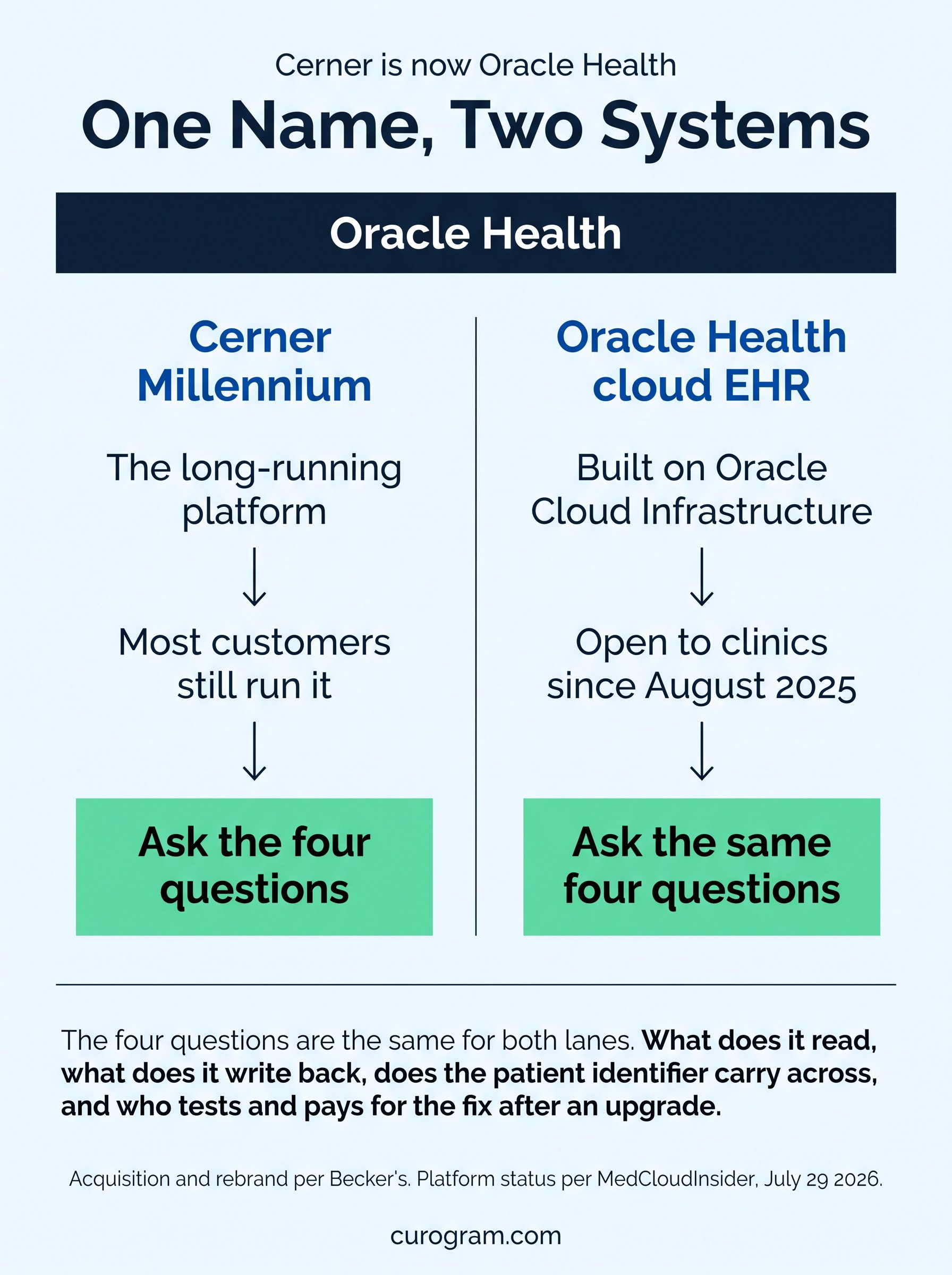
Search for Cerner integration and you find pages written for a product that changed its name years ago. Oracle bought Cerner in June 2022. The brand became Oracle Health, and the software split into two paths.
That split is the practical part. Cerner Millennium still carries most of the install base, and a newer cloud EHR sits beside it. Most vendor pages have not caught up with either fact. They still sell a 2022 story about going paperless.
So the question is no longer whether to add patient messaging. It is which system your messaging will be talking to. A second question sits underneath. Oracle Health has lost hospitals three years running.
About 30% of its customers told KLAS the vendor is not in their long-term plans. Plenty of practices will stay put. Plenty will move. Tools that survive either outcome are worth more than tools tuned to one.
Below: what the rename changes, what an interface has to do, and the features worth checking before you sign anything.
Oracle closed the purchase in June 2022 for $28.4 billion, then retired the Cerner brand.
Staff still say Cerner. Search volume still sits on Cerner. Contracts and support portals say Oracle Health. Keeping both words in play is not pedantry. It decides which support queue picks up your ticket.
The rename moved the paperwork too. Release notes, status pages and developer docs now sit under Oracle Health, and old Cerner links redirect or die.
The platform split matters more. Oracle built a new EHR on its own cloud rather than rewriting Millennium. That cloud version opened to clinics in August 2025, with acute care work planned through 2026.
Two systems now carry the Oracle Health name. A vendor who says they integrate with Cerner has not yet told you which one. Contract movement tells the rest of the story. These are KLAS figures for deals signed through December 2025.
|
Acute care EHR |
Epic |
Oracle Health |
|---|---|---|
|
Share of hospitals |
43.7% |
21.9% |
|
Share of beds |
56.9% |
20.4% |
|
Hospitals gained or lost in 2025 |
Up 77 |
Down 56 |
|
Net change since 2021 |
Up 568 |
Down 173 |
Oracle Health also shed 14,676 beds that year. Overall hospital EHR buying fell about 40% from 2024, so few of those hospitals were replaced by new wins.
Every number a staff member retypes is a number that can go in wrong. A phone digit is the expensive one.
An interface that reads the record once removes the retyping and the typo together.
Ask which fields come across. Name, date of birth, phone and email cover most messaging work. Then ask what happens when a patient corrects a number by reply. If the chart does not update, somebody has to.
Duplicate records are the quiet version of the same problem. Two charts for one patient means two phone numbers on file. The reminder then goes to whichever one the export happened to find first.
Front desk time is the constraint, not clinical time.
Count the outbound calls your desk makes in one week, then multiply by two minutes. That number is your automation budget. Reminder calls, confirmations, recall attempts and closure notices all come off the same clock.
Run the arithmetic once. Eighty reminder calls at two minutes each is about two and a half hours, every week, from one desk. The hours freed go somewhere. New patient intake is the usual answer, and it is the one worth measuring.
Reminders that read the schedule know the visit type and the time. One built from a spreadsheet knows neither. Timing does more than wording. A reminder the day before leaves room to cancel, which is the point of sending it.
Expect a modest effect. Pooled research puts the lift in attendance at roughly 11%, well under the figures vendors tend to quote. Measure your own rate for a month before you change anything. That baseline is what tells you whether the tool worked.
Forms sent by text get completed more often than emailed ones. The link opens where the patient already is.
Forms that come back before the visit shorten the wait at the desk. Transcribing a clipboard at 8 a.m. is the step that goes. Check that answers land in the chart rather than a PDF inbox. A form that still needs retyping has moved the work, not removed it.
Ask which forms can be sent on a schedule. New patient packets, annual updates and consent renewals all run on predictable dates.
Booking that writes back to the schedule is the test. A request that lands in a staff inbox is still a task.
Waitlist backfill is the same mechanic pointed the other way. A canceled 2 p.m. goes to six people at once, and the first reply takes it.
Watch where a confirmation lands. One that updates the appointment status saves a step. One that emails the desk adds a screen. Self-scheduling needs guardrails before it needs features. Decide which visit types a patient may book without a call, and start narrow.
Patients open a link rather than install an app. Fewer calls about downloads is most of the benefit.
Role-based access decides who sees a waiting patient. Front desk sets the status and the clinician joins when ready. Ask whether the visit writes anything back. A video call that leaves no trace in the chart leaves documentation to somebody later.
Check what happens when a patient cannot get in. A one-tap way to fall back to a phone call saves the appointment.
A business associate agreement should come as standard rather than as an upgrade.
Sending a secure link rather than the detail itself limits what a wrong number receives. That is a design choice, not a setting.
Threads belong beside the patient record. A conversation in a separate app is not documentation, however secure the app is. Ask where opt-outs are stored. A patient who replies STOP has to stay opted out through a platform change.
That record is easy to lose and awkward to explain afterward.
One message to a defined group is a different job from one-to-one texting. Closures, recalls, flu clinics and a provider out sick all use it.
We covered health alerts for Elation Health practices. The recipient list there is built from the record rather than a spreadsheet.
Our writeup of mass texting in GE Centricity covers the same job on an older on-premise system. The test is where the list comes from. A list exported to a spreadsheet is out of date the moment it is saved.
Decide who can press send before you need to. A closure notice at 7 a.m. is not the moment to work out who has permission.
Visit type should change the message. A cleaning and a post-op check do not need the same wording or the same lead time. Long treatment plans need the same thing on a longer clock, with each visit depending on the one before it.
We looked at patient notifications in Dolphin for orthodontic practices, where that sequence runs over years rather than months.
Lead time should move with the visit as well. A surgical consult needs more notice than a fifteen-minute adjustment.
Three questions settle most of it. Can it read the schedule, can it write back to the chart, and does the patient identifier carry across? A connection that reads but cannot write leaves the retyping exactly where it was. Demos tend to move past that part quickly.
An EHR integration is only as good as what it writes back. Reading alone makes a nicer dashboard and saves nobody any time.
Ask how often it syncs, in minutes. Near real-time stays a marketing phrase until somebody gives you the interval. Ask who holds the credentials. An interface running on one staff member's login breaks the week they leave.
Add a fourth question about upgrades. When Oracle ships a change, ask who tests the interface and who pays for the fix. Then ask what happens to message history if you change EHRs. The answer separates a tool from a dependency.
None of this assumes Oracle is going anywhere. The VA has asked to extend its Oracle contract to May 2031, which is a long horizon by any measure.
Both things are true at once. The platform has federal work booked for years, and a third of its hospital customers are looking around. Put the questions on the call in this shape, and you will hear the difference inside a minute.
|
Ask this |
A weak answer |
A usable answer |
|---|---|---|
|
Which system? |
We integrate with Cerner. |
Millennium, through your interface engine. |
|
What does it read? |
Patient data. |
Name, date of birth, phone, email, visit type, time. |
|
What writes back? |
It syncs both ways. |
Appointment status, phone changes, form answers. |
|
Who fixes upgrades? |
We monitor releases. |
We test each release, and fixes are in the fee. |
Two or three years of patient threads is a real asset. Practices rarely value it until the week it is at risk.
Ask for the export format in writing. A named file format beats an offer of help at the time. Ask the same about opt-out records and consent dates. Those carry weight that an ordinary message log does not.
Then ask what stays reachable once a contract ends. Read-only access for a year is a reasonable thing to request.
Curogram HighlightCurogram's Mass Text Messaging builds the recipient list from the record rather than from an exported spreadsheet. Replies come back to the same inbox staff already work from, and the thread attaches to the patient chart. The messaging layer is the part that should not have to move. If the record underneath changes, the patient conversation stays where it is. |
Start by naming your system out loud. Cerner Millennium, or the newer Oracle Health cloud EHR.
That one answer changes every vendor conversation you are about to have. Vendors who cannot tell them apart will cost you a rollout. Then put the interface questions in writing. Read, write back, identifier, and who owns the fix after an upgrade.
Ask about message history on a migration before you need the answer. Asking afterward is how practices lose two years of patient threads.
Count your own front desk call minutes for a week before you shop. A real number beats every vendor average, ours included.
Write the answers down as you get them. A vendor call three weeks later sounds different from the notes you took. Nothing here needs deciding this quarter. It needs asking before anyone signs a two-year term.
None of this requires a judgment about Oracle. It requires knowing which of its two systems you are on, and saying so.
Book a Curogram demo. One pass covers the schedule read, the reply writing back to the chart, and a mass message going out.

We can integrate Curogram with Greenway in 48 hours or less. Streamline workflows, trim costs, and boost your bottom line with our best-in-class...

Prime Clinical integrates with Curogram seamlessly to enhance the patient experience and create efficiency and revenue for your medical practice.

Curogram integrates with Epic seamlessly, creating cost-reducing efficiencies and reducing patient no-shows leading to increased revenue.