
Boost Your Google Review Ratings With 5 Simple Steps
Google review ratings help medical practices build a positive online reputation and achieve healthcare business goals.
9 min read

Before a new patient ever calls your front desk, they have probably made up their mind about you. They searched your name, scanned your star rating, and read what other patients had to say. All of that took only a few minutes, and you weren't part of the conversation.
That is the reality of modern healthcare. Your online reputation now carries as much weight as your track record of delivering excellent patient care, and in some cases, it carries even more. A patient who has never met you can only judge you by what they find on a screen.
The research supports this. A 2025 survey by rater8 found that 84% of patients check online reviews before choosing a new provider. Even more revealing, 40% said negative reviews led them to cancel an appointment or avoid booking altogether.
So what happens when your online presence doesn't match the care you actually deliver? A single unhappy patient can post a review that sits at the top of your profile for months. A minor misunderstanding at check-in can turn into a one-star rating that new patients see first. Without a plan, these issues can grow into serious setbacks.
Fortunately, your reputation is not entirely out of your hands. With steady effort and the right approach, you can shape what patients see and give them good reasons to choose you. Most of the work comes down to priorities you already care about, like patient experience and clear communication.
This guide is written for independent medical practices that want to take control of their online image. Below, you'll find six practical tips for building a stronger, more trusted reputation online. Each one is practical to implement and builds on the last, from knowing your audience to using software that handles review requests for you.
Managing your online reputation starts with knowing who your patients are and how they search for care. If you overlook this step, your practice can easily fall behind.
Millennials, born between 1981 and 1996, represent a significant share of today's patient population. There were an estimated 72.26 million Millennials in the United States in 2020, making them one of the largest living generations in the country. Because they grew up with the Internet, they're accustomed to staying connected through email, text messaging, and social media.
Their lifestyle is mobile, too. Many of them shop, manage their finances, and even work remotely from their phones or laptops. It makes sense that they would approach their healthcare the same way.
When today's patients feel sick, they often turn to the Internet first. Many of them:
Since so many patients start their care journey online, your practice needs to pay close attention to how it appears there. Knowing your audience helps you decide where to focus and how to present your practice in a way that earns trust.
It's hard to market your practice online if patients don't have a good experience in person. Patients can't rave about a visit that didn't impress them. In other words, your online reputation will only ever reflect the care and service you actually provide.
That's why the first step toward better reviews is a better patient journey. When your providers and front office staff work as a team, patients notice. And patients who feel cared for are far more likely to give you 5-star ratings.
Here's where you can make the biggest difference:
If you can keep the experience positive from booking to treatment and follow-up, good reviews tend to follow. This is the heart of patient engagement. Pair it with a polite, well-timed request for a review, and you set your practice up for steady, positive feedback.
Online reviews and ratings play an important role in how patients perceive your practice. A strong set of 5-star reviews can do more for your reputation than great care alone, because it lets new patients see that care for themselves.
Patients rely on reviews to evaluate providers before they ever book an appointment.
A 2025 rater8 survey of more than 1,000 U.S. patients shows just how much weight reviews carry:
| What patients said | Share of patients |
|---|---|
| Check online reviews before choosing a new provider | 84% |
| Read at least six reviews before deciding | 51% |
| Would skip a friend's referral if the provider had poor reviews | 61% |
| Canceled or skipped booking because of negative reviews | 40% |
Here's the challenge:
The same survey found that 57% of patients rarely or never leave reviews for their own providers. Unhappy patients, on the other hand, are often motivated to speak up, and their reviews can hurt your reputation.
That imbalance is exactly why you can't leave reviews to chance. You need strategies that generate positive reviews from the satisfied patients you already have. The next section explains how to do it effectively.
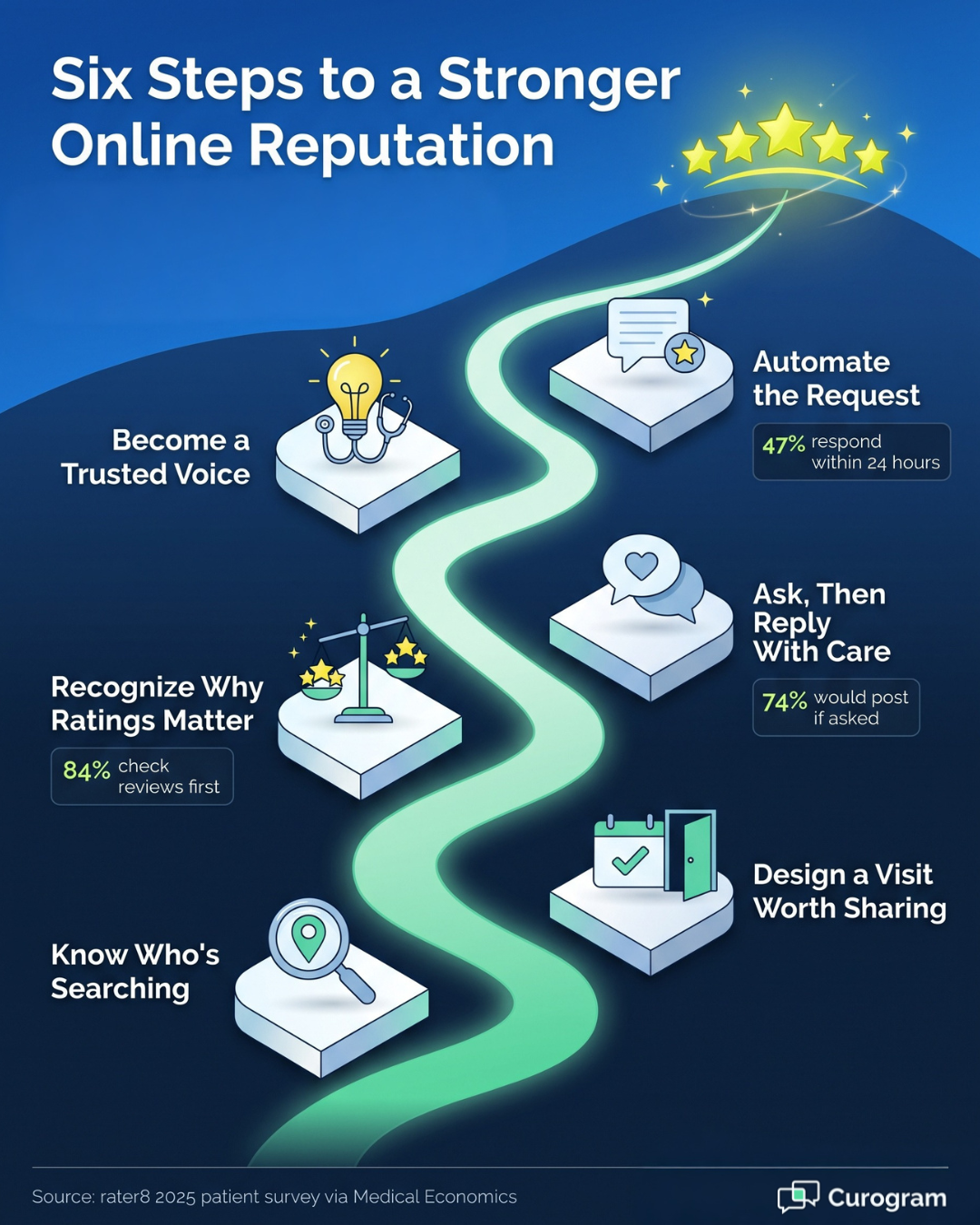
Managing your online reputation means earning more positive reviews, and those can only come from satisfied patients. Great patient engagement is the foundation. Still, even patients who love your practice may never leave a review unless you give them a nudge.
It helps to assume that even your happiest patients need a reminder, since most people mean well but have busy lives. The rater8 survey found that 74% of patients would be more likely to leave a review if their provider asked.
This doesn't mean pressuring anyone. It means building a simple, polite way to ask about each patient's experience at the end of their visit.
A few options that work well:
Timing is important, too. Nearly half of patients (47%) say they're most likely to leave a review within 24 hours of an appointment. Automated text requests make it easy to reach them during that window.

Responding to reviews is just as important as collecting them, because it shows current and potential patients that you're listening. The same survey found that 41% of patients trust a provider more when they see responses to reviews.
When you receive a negative review, resist the urge to ignore it. Reply warmly, say you're sorry to hear about the experience, and invite the reviewer to contact your office so you can make it right. This shows potential patients that you care, even when things don't go perfectly.
Just be careful about what information you share. Keep public replies general, and never confirm that the reviewer is a patient or mention details about their care. Doing so can violate HIPAA. Take the real conversation offline, where you can fix the issue privately and use what you learn to improve the experience for other patients.
| Most satisfied patients won't review you on their own, but many will if you ask at the right moment in their patient journey. In one Curogram case study, a multi-location practice used automated post-appointment surveys tied to Google Reviews. The result was 1,064 new 5-star reviews in just 3 months. A consistent, well-timed request can transform what potential patients discover when they search for you. |
If reviews alone aren't enough to grow your practice, your next move is to become a thought leader. This means building an online presence that demonstrates your expertise and shows patients you genuinely care about their health.
Start with your website. It should clearly highlight the services, specialties, and values that make your practice a great choice for new patients.
From there, you can branch out into other channels:
You don't need to do all of these at once. Not every channel works for every practice, so choose the ones that fit your resources, goals, and capacity. A few channels done well will do more for you than many done poorly.
The more consistently you share useful information, the more patients see your practice as a trusted resource. Over time, that trust becomes part of your online reputation.
All of this takes time, and your staff already has a full plate. That's where technology can help. The right software can support your patient engagement strategy and handle review collection, so your team can stay focused on patients.
Curogram is one example. It's a HIPAA-compliant patient communication platform built to make the patient journey smoother. Its secure 2-way texting lets your staff and patients message each other directly. Its online booking and digital patient intake tools also make visits more convenient for patients.
Curogram also automates the process of asking for reviews.
Here's how it works:
Because the process runs on its own, you collect reviews steadily without adding work for your front desk. You also reach patients while their visit is still fresh in their minds.
Your online reputation isn't something you can set once and forget. It grows, or slips, with every patient interaction and every review left behind. Each visit is an opportunity to earn trust, and each review is an opportunity for that trust to reach someone new.
The six tips in this guide work best together. Knowing your audience tells you where patients are looking. A great patient experience gives them something good to say. Asking for reviews, and responding with care, turns that experience into visible feedback that future patients can rely on.
From there, a strong website, helpful content, and an active social presence help your practice stand out as a trusted voice in your community. The right software keeps the whole process running without wearing down your staff. When all of these pieces come together, your online image starts to reflect the quality of care you actually provide.
The effort is worthwhile. Most patients now check reviews before they ever pick up the phone, and many will skip a provider whose ratings fall short. A steady flow of honest, positive reviews can easily be the deciding factor that brings a new patient to your practice instead of the one down the street.
You don't have to tackle everything right away. Start with one small step, such as asking every satisfied patient for a review this week. Then build from there as your team becomes more comfortable with the process.
If you're ready to make review collection part of your daily routine, Curogram can help. Its automated review requests, secure 2-way texting, and digital intake tools are built to support a better patient experience from start to finish. Book a demo to see how Curogram helps practices collect more patient reviews and find out how it can fit your workflow.

Google review ratings help medical practices build a positive online reputation and achieve healthcare business goals.

 Joshua Inciso : 11/23/22, 12:07 PM
Discover the effective strategies for improving a healthcare practice’s online presence and how it can help attract prospective patients.

Master online review management in 2025. Learn how to monitor, analyze, and respond to reviews to build trust and strengthen your reputation.