Skip to the main content.

6 min read

5 Types of Content Physicians Should Use to Promote Their Practices

5 Types of Content Physicians Should Use to Promote Their Practices
💡Physicians promote their practices best with five content types: short video, blog posts, email newsletters, infographics, and patient testimonials. Video gives new patients a look at the office and the staff before they ever call.

Blog posts answer the health questions people already type into Google. Newsletters keep your name in front of patients between visits. Infographics turn prep steps and local health data into something a patient will actually read.

Testimonials and reviews supply the proof most people check first. Reviews carry unusual weight in health care. A 2025 rater8 survey of more than 1,000 US patients found 84% check online reviews before picking a new provider. Practices that automate the review request after each visit build that proof without adding front desk work. Start with two formats and hold a schedule your staff can keep.

A patient books with your clinic on Tuesday and cancels on Thursday. Nobody at the front desk did anything wrong. She searched your name, found four reviews from 2021, then scrolled to the practice two miles away with 300 reviews and a video tour.

That is a content gap, and it costs real visits.

Google reported in 2019 that health questions make up roughly 7% of its daily searches, close to a billion searches a day. Your patients sit in that pile. So do the people who almost became your patients.

They ask about knee pain, statin side effects, and whether a rash needs a visit. Someone answers them. Today it might be a hospital system three counties over, a Reddit thread, or an AI summary that never names your clinic.

Content marketing sounds like a job for an agency. In most small practices, it lands on whoever has a spare hour, which usually means the office manager. That is workable. A one-hour block each week covers more ground than a big quarterly push nobody repeats.

We have watched clinics try to fix this by posting everywhere at once. Facebook, TikTok, a newsletter, a blog, a YouTube channel. Six weeks later, the whole thing goes quiet, and the abandoned pages sit there looking worse than nothing at all. Two of those clinics still have a TikTok account holding three videos from 2023.

Five formats do most of the work: video, blogs, newsletters, infographics, and patient testimonials. Each one answers a different question at a different moment in a patient's decision. This piece covers what each format is good at, what to publish first, and how to keep the work running once the schedule fills up.

Pick two. Publish them on a rhythm your staff can hold through flu season.

Content That Helps New Patients Find You

Most new patients meet your practice on a screen weeks before they meet your staff. Video and blog posts handle that first introduction. Both pull traffic from search, and both keep working months after you publish them.

1. Short Video That Introduces the Practice

A ninety-second clip of your waiting room, your parking lot, and a medical assistant saying hello answers questions no service page covers. Patients want to know whether the office feels rushed. Video shows them. The same file works on your Google Business Profile, your website, and your first visit confirmation text.

If you're using AI to create educational or promotional videos for your practice, this veo vs kling comparison can help you choose the model that best fits your needs by comparing video quality, motion realism, prompt accuracy, and generation capabilities.

What to Film First

Start with the visit itself. Where to park, which door, what the check in desk looks like, how long intake usually takes. Hold the phone sideways and skip the script. One staff member talking for sixty seconds beats a polished ad nobody finishes.

Where to Post It

Google Business Profiles accept video, and that profile is often the first thing a new patient sees. Add the same clip to your appointment reminder text. Patients who watch it arrive less confused, and the front desk fields fewer calls about parking.

2. Blog Posts That Answer Real Search Questions

Blog posts take longer to pay off. A post on whether a sinus infection needs antibiotics can bring in visits for years. It also gives your staff something to send instead of typing the same explanation for the fifth time this week.

Pull Topics From the Phone Log

Ask your front desk for the five questions they answer most. Prep instructions, insurance coverage, what to bring, how long lab results take. Those are your first five posts, worded the way patients word them on the phone.

One Question, One Page

Keep each post on a single question. Two posts covering the same ground split your own traffic and leave search engines guessing which page to rank. Link the related ones together instead of writing the same advice twice.
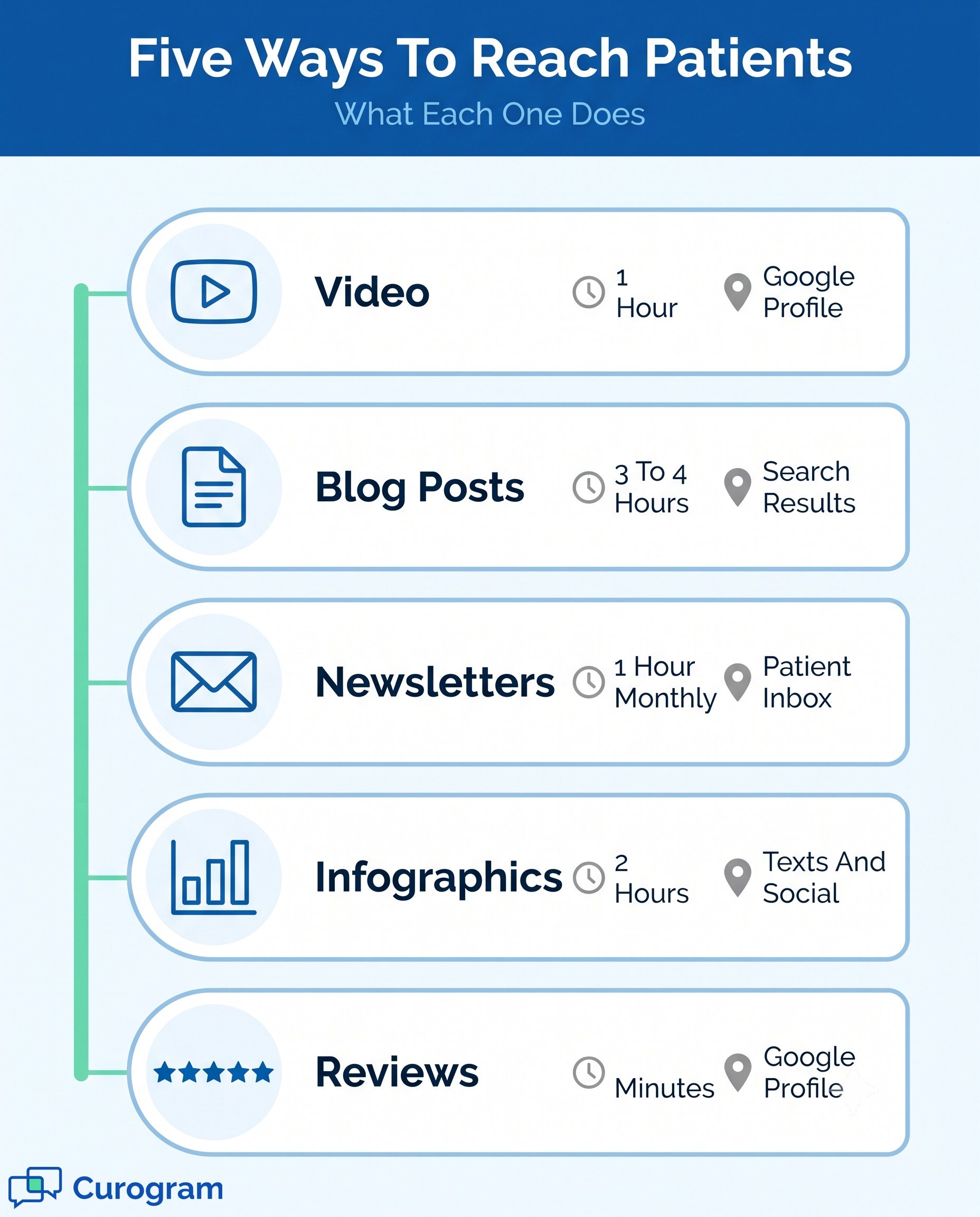
Five ways to reach patients infographic for clinic marketing: video, blogs, newsletters

Content That Keeps Current Patients Close

Existing patients drift. With telehealth in the mix, many of them see you twice a year now instead of four times. Newsletters and infographics fill that quiet stretch without asking anyone to book anything.

3. Newsletters Worth Opening

Email looks dated next to short video. It still delivers, mostly because everyone on your list already chose you once. A monthly note about flu shot supply, a new provider, or holiday hours reads as useful rather than promotional.

What Goes in a Clinic Newsletter

Mix three things: something practical like new hours, something human like a staff introduction, and one link to a recent post. Keep the whole thing to a single screen. Put the signup form in your website footer and your intake packet.

How Often to Send

Monthly is plenty. Weekly burns the list fast. If quarterly is all you can manage, stay on it. A newsletter that shows up twice and vanishes teaches people to ignore the next one.

4. Infographics That Make Data Easy to Scan


Plenty of patients skim rather than read. Infographics move numbers and steps into a form they will finish, and they get shared far more often than a block of text.

Subjects That Work

Prep steps for a colonoscopy. What flu season looks like in your county. A side-by-side of urgent care wait times against your same-day slots. Anything with a sequence or a comparison suits this format.

Design Rules

One idea per graphic. Large type, three colors at most, your logo small in a corner. Export a version sized for text messages, since that is where many patients will see it.

Testimonials and the Proof Patients Check Before They Call

Patient testimonials sit closest to the booking decision. Most practices leave them to chance, which is why plenty of good clinics show four old reviews and a three-star average.

5. Testimonials, Reviews, and the Consent Step

A review is published by the patient on Google or Healthgrades. A testimonial is one you publish yourself, with permission, on your own pages. Get written consent that names where the quote will appear, then keep the signed form on file.

Ask While the Visit Is Fresh

Timing does more work than wording. rater8's 2025 survey of more than 1,000 US patients found 47% are most likely to leave a review within a day of their appointment. Wait a week, and you have lost most of them.

Where to Place Them

Service pages convert better with two short quotes than a testimonial page nobody visits. Put the knee replacement quote on the knee replacement page. One more belongs in your Google Business Profile description.

A clinic patient walking out of the entrance, holding a smartphone with a review request bubble

Turning Routine Visits Into a Steady Review Flow

Volume matters more than polish here. In that same rater8 survey, 84% of patients said they check reviews before choosing a new provider, and 51% read at least six of them. Four reviews from 2021 will not clear that bar.

Automate the Ask

Manual review requests die in a busy week. A text that fires after a completed visit takes the decision away from a staff member juggling three reschedules. One multi-location practice using automated requests collected 1,064 new five-star reviews in three months. 90% of responding patients rated five stars, based on our internal data.

Answer What Comes In

Reply to every review, two-star ones included. A short, non-clinical response shows the next reader how you handle a problem. Never confirm in public that the person was a patient, since that alone can breach HIPAA.

What Each Format Is For

Format

Main job

Effort per piece

Where patients see it

Video

Introduce the office to new patients

About 1 hour

Google Business Profile, reminder texts

Blog posts

Answer the questions people search

3 to 4 hours

Google results, staff email replies

Newsletters

Stay in mind between visits

1 hour a month

Patient inboxes

Infographics

Make steps and data scannable

About 2 hours

Social posts, texts, waiting room

Testimonials and reviews

Supply proof before booking

Minutes, once automated

Google profile, service pages


Start With Two, Then Add

No clinic runs all five formats well in year one. Video and patient testimonials carry the most weight for practices trying to grow, so start there. Blog posts pay off later. Newsletters and infographics fill the gaps between visits.

What usually breaks is consistency, and that is a staffing problem more than a creative one. Automating the review request removes the piece with the fastest return from your team's list entirely.

Curious how automated review requests and appointment reminders run alongside your current EHR? Our team can walk your office manager through it in a short demo, using your own visit volume.

Frequently Asked Questions

How do we decide which content type to start with?

Look at what is weakest right now. If your Google reviews are thin or old, fix that first, because it sits closest to the booking. If reviews look healthy but new patients still call with basic questions, film the office video next.

Why do patient testimonials work better than paid ads for a medical practice?

Ads tell people you are good. Testimonials let another patient say it, and readers weigh that differently. The rater8 survey found 61% of patients would skip a provider with poor online feedback even after a personal recommendation.

How often should a small practice publish new content?

One piece a month is a reasonable floor for a two-provider clinic. Reviews should be continuous, since those come from visits rather than writing time. A steady monthly rhythm beats six posts followed by silence.

How can we collect patient reviews without running into HIPAA problems?

Send the request through a HIPAA-compliant channel with a signed business associate agreement in place. Keep the message free of any clinical detail. In public replies, thank the reviewer without confirming that the person was treated at your practice.

Why should we post video when our website already explains our services?

Service pages answer what you do. Video answers what the visit feels like, which is the question anxious patients actually have. It also gives your Google Business Profile something to show beyond a storefront photo.

3 Strategies That Will Chart Your Practice on the Path to Success

3 Strategies That Will Chart Your Practice on the Path to Success

Many medical practices need to adjust to the increasing power of patient voices, on-demand trends, and the evolving technology. Many people want to...


Read More
Why You Need a Google Business Listing and How To Optimize It

Why You Need a Google Business Listing and How To Optimize It

Healthcare organizations receive outstanding rewards and benefits by leveraging laser-focused, location-based marketing strategies. With Google My...

Read More
How to Use Social Media to Market Your Medical Practice

How to Use Social Media to Market Your Medical Practice

There are many ways organizations can market their businesses, but social media is one of the most effective. A recent report by Statista states that...

Read More