12 min read

Patient Messaging Software for Call Deflection in 2026

Patient Messaging Software for Call Deflection in 2026
 💡 Patient messaging software for call deflection moves routine patient requests off the phone and into secure text threads. Patients text to confirm a visit, ask about a bill, or request a refill. 

They get an answer and skip the hold queue. Curogram is a HIPAA-compliant platform that links to nearly any EMR and runs these "call deflection" workflows, and its clients report 50% fewer inbound calls.


Two lines are blinking on hold. Three patients are waiting at the check-in window. The voicemail box filled up over the weekend, and nobody has had a spare minute for it.

Then the phone rings again, and it is a patient asking what time her appointment is scheduled.

You already sent her that information. Twice.

Think about how many times that exact call repeats in a single week: appointment confirmations, directions to the office, questions about forms, refills, and outstanding balances.

None of these questions are difficult, but each one still consumes three minutes of a staff member's attention and ten minutes of a patient's patience.

Now multiply that across your entire patient panel.

Most practices treat this as a staffing problem. They add a phone line, hire another front desk person, or install a more sophisticated phone tree. The calls keep coming, because the volume was never the real issue. The channel was.

Here is the part that stings. While your team works through the queue, the patient who could not get through is booking an appointment somewhere else. The call you missed at 9:15 never appears on any report, and revenue rarely announces itself on the way out the door.

Patient messaging software for call deflection approaches the problem from the opposite direction. Rather than answering calls faster, you give patients a way to skip the call entirely. They text, they tap a link, and they have an answer in seconds. Your phone never rings.

This guide covers what call deflection is, what ignoring it costs, which features actually move the needle, and what the first 90 days look like. You will also get the questions worth asking any vendor before signing.

Let's start with what the phone actually costs your practice.

Key Takeaways: Patient Messaging Software for Call Deflection

  • Patient messaging software can reduce inbound call volume by 50-68% through automated responses and two-way texting workflows.
  • Curogram's HIPAA-compliant platform integrates with nearly any EMR, enabling practices to deflect routine calls within days of implementation.
  • Effective call deflection requires secure messaging, automated reminders, digital intake forms, and smart routing features working together.
  • Practices should evaluate platforms based on HIPAA compliance, EMR integration depth, and the ability to handle both administrative and clinical messaging.
  • ROI from call deflection software typically shows measurable results within 30-60 days, including reduced hold times and freed staff capacity.

What Is Patient Messaging Software for Call Deflection?

Patient messaging software for call deflection refers to secure communication platforms that redirect routine patient inquiries from phone lines to text-based channels.

Instead of patients waiting on hold to confirm appointments, ask billing questions, or request prescription refills, these systems route those interactions to automated or staff-managed messaging workflows.

The concept is simple:

Give patients a faster, more convenient way to get answers, and they will stop calling.

Research from multiple healthcare organizations shows that 73-80% of patients prefer texting over calling for routine communication. When you meet patients in their preferred channel, you naturally reduce the volume hitting your front desk.

HIPAA-compliant texting platforms like Curogram enable this shift by offering two-way messaging, automated responses, and digital forms that handle common requests without staff intervention.

The result is fewer ringing phones, shorter hold times, and a front desk team that can focus on patients standing in front of them.

Why Medical Practices Need Call Deflection in 2026

The pressure on medical practice phone lines has reached a breaking point. Front desk staff spend hours each day answering the same questions: appointment confirmations, directions to the office, insurance verification requests, and basic billing inquiries.

Each of those calls takes time away from patients who need immediate attention.

The Cost of High Call Volume

Every unanswered call represents a potential missed appointment or lost patient. Studies indicate that 20-30% of calls to medical practices go unanswered during peak hours.

Patients who cannot reach your office may simply book elsewhere, especially when other practices offer text-based communication options.

Staff burnout is another hidden cost. Front desk employees who spend their entire shift on the phone experience higher turnover rates. Replacing and training new staff costs practices thousands of dollars per position, not counting the service gaps during transitions.

Patient Expectations Have Changed

Patients now expect the same communication convenience they get from banks, retailers, and service providers.

They can text their dentist, message their veterinarian, and chat with customer service for almost any business. Healthcare practices that limit patients to phone-only communication feel outdated by comparison.

Younger patients, particularly millennials and Gen Z, actively avoid phone-based interactions.

For these demographics, offering text-based communication is not a nice feature; it is a requirement for patient acquisition and retention.

Core Features That Drive Effective Call Deflection

Not every patient engagement platform delivers meaningful call reduction. Effective call deflection depends on specific features working together to intercept routine inquiries before they become phone traffic.

Two-Way HIPAA-Compliant Texting

One-way messaging platforms that only send outbound texts miss the point. True call deflection requires patients to reply, ask questions, and complete tasks through the same channel.

Curogram enables secure two-way texting that reduces phone volumes by 50% by letting patients confirm, reschedule, or ask follow-up questions without picking up the phone.

The messaging must be HIPAA-compliant, which means encrypted data, access controls, audit trails, and a signed Business Associate Agreement from the vendor. Platforms that cannot meet these requirements put your practice at compliance risk.

Automated Appointment Reminders

Appointment reminder workflows represent one of the highest-impact call deflection opportunities.

When patients receive timely text reminders with easy confirmation options, they no longer need to call to verify their appointment details. Practices using automated text reminders report 75% response rates and 30-40% reductions in no-show rates.

Smart reminder systems allow customization by appointment type, provider, and location. A wellness visit reminder may go out 48 hours before the appointment, while a procedure reminder might include preparation instructions sent a week in advance.

Digital Intake Forms

Pre-visit paperwork creates significant call volume. Patients call to ask what forms they need, whether they should bring insurance cards, and how early to arrive. Digital intake forms sent via text eliminate these calls entirely.

Curogram's mobile-friendly online intake forms let patients complete demographics, medical history, and insurance verification from their phones before arriving. The information flows directly into your system, reducing both call volume and check-in wait times.

Smart Message Routing

Effective call deflection platforms include routing logic that directs messages to the right department or staff member.

A billing question routes to your billing team.

A medication refill request routes to clinical staff.

This prevents bottlenecks and ensures patients get accurate responses quickly.

After-hours auto-responders also play a role. When patients text outside business hours, an automated reply acknowledges their message and sets response expectations. This reduces morning call surges from patients who tried to reach you the night before.

How to Evaluate Patient Messaging Software for Call Deflection

Choosing the right platform requires looking beyond feature lists to understand how well the software fits your practice workflows. The following evaluation framework helps identify solutions that will actually reduce your call volume.

HIPAA Compliance and Security

Start your evaluation with compliance. Any platform handling patient communication must meet HIPAA requirements, including encryption in transit and at rest, role-based access controls, and complete audit trails.

Ask vendors for their SOC 2 certification, Business Associate Agreement, and documentation of their security practices.

Curogram maintains SOC 2 Type 2 certification, verifying the highest standards for data security and availability. The platform retains complete message history for audit purposes, giving practices permanent documentation of patient communication.

EMR Integration Depth

Shallow integrations create more work instead of less. Staff end up toggling between systems, copying patient information, and manually updating records.

Deep EMR integration means the messaging platform pulls patient data, appointment schedules, and contact information automatically while syncing responses back to your records.

Evaluate whether the integration is one-way or bidirectional. One-way feeds push data from the EMR to the messaging tool but do not return updates. Bidirectional sync means a patient who confirms via text shows as confirmed in your EMR without manual entry.

Workflow Automation Capabilities

Manual messaging does not scale. Look for platforms that support automated workflows triggered by events in your practice management system

. A patient books an appointment, and the system automatically sends a confirmation text, a reminder 48 hours before, intake forms 24 hours before, and a follow-up survey after the visit.

The best platforms allow workflow customization without requiring IT support. Practice managers should be able to adjust message timing, content, and routing rules through an intuitive interface.

Patient Experience Considerations

Evaluate the platform from the patient's perspective.

Do patients need to download an app or create an account?

Solutions that require extra steps see lower adoption rates. Curogram enables patients to text directly from their standard messaging app with no downloads or account creation required.

Consider accessibility for your patient population. Older patients and those in rural areas may be less comfortable with complex digital tools. Platforms that work through standard SMS reach the widest audience.

Implementing Call Deflection: A Step-by-Step Approach

Successful implementation requires planning beyond software selection. The following steps help practices achieve measurable call reduction within the first 30-60 days.

Step 1: Baseline Your Current Call Volume

Before launching any new system, document your current state. Track total daily calls, average hold times, call abandonment rates, and the types of calls your staff handles.

This baseline becomes your measurement benchmark for ROI calculations.

Categorize calls by type:

Appointment confirmations, scheduling requests, billing questions, prescription refills, general inquiries, and clinical questions.

This breakdown reveals which call types your messaging platform should target first.

Step 2: Configure Automated Workflows

Start with high-volume, low-complexity interactions. Appointment reminders with two-way confirmation typically deliver the fastest results. Once that workflow runs smoothly, add intake form distribution, post-visit surveys, and payment reminders.

Customize message content to match your practice voice. Generic, robotic messages feel impersonal. Include the patient's name, specific appointment details, and a clear call to action in every automated text.

Step 3: Train Your Team

Staff adoption determines implementation success. Front desk teams need to understand how the messaging platform works, when to respond to patient texts versus when automated replies handle the interaction, and how to escalate complex issues.

Curogram trains staff in under 10 minutes because the interface mirrors standard texting apps. Shorter training times mean faster adoption and quicker time to value.

Step 4: Promote the New Channel to Patients

Patients cannot use what they do not know about. Update your website, voicemail message, and in-office signage to promote text-based communication. Include your text number on appointment reminder cards and email signatures.

Some practices add "text us" options to their phone tree, allowing callers to receive a text link instead of waiting on hold.

This immediate call deflection captures patients at the exact moment they would otherwise add to your queue.

Step 5: Monitor and Optimize

Track key metrics weekly during the first 90 days:

Total call volume, text message volume, response rates, and patient satisfaction scores. Compare these numbers against your baseline to quantify improvement.

Identify workflow gaps where calls still slip through. If patients keep calling about billing despite having text options, your billing communication workflow may need refinement. Continuous optimization ensures sustained call reduction over time.

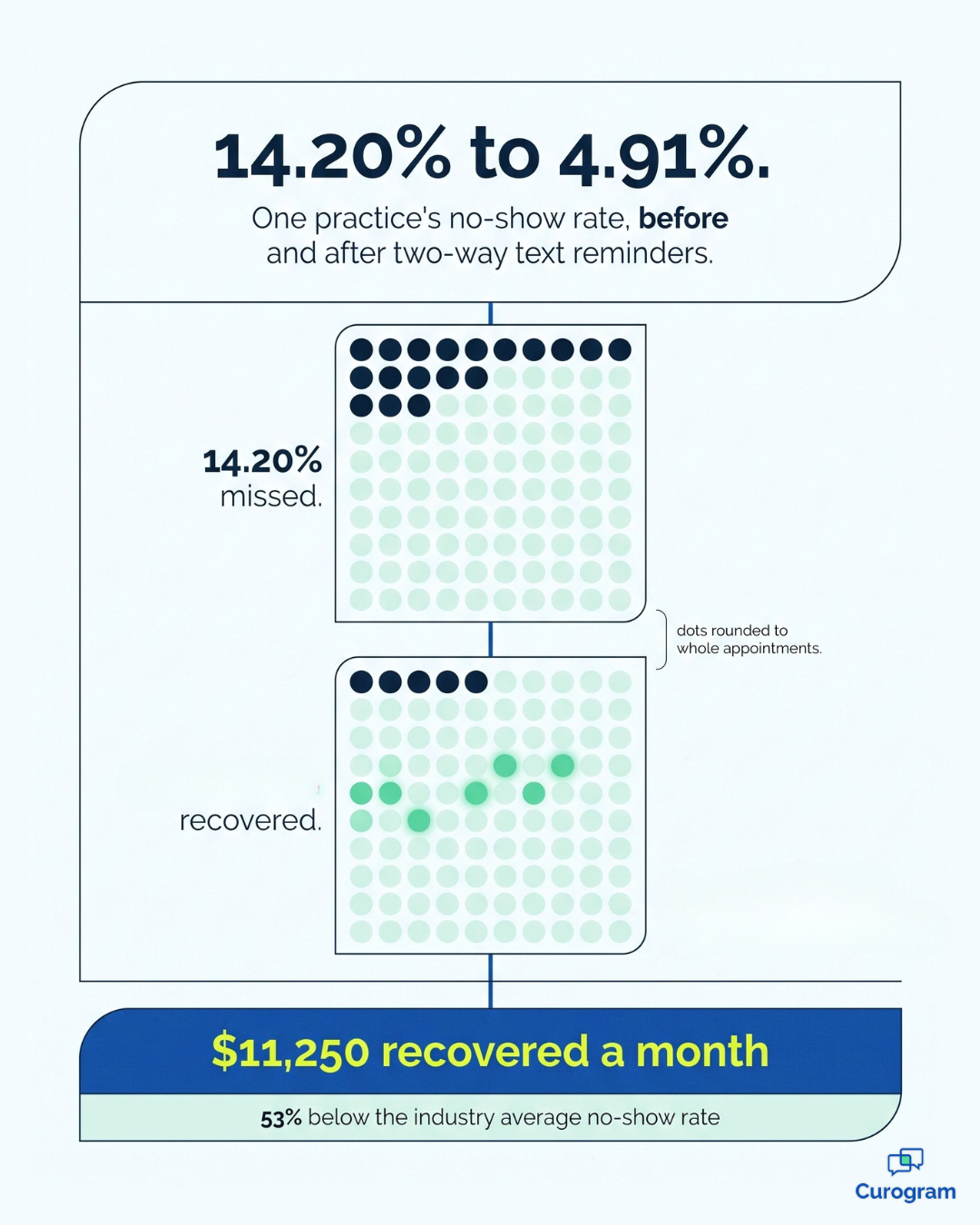
Infographic showing text reminders cutting a practice no-show rate from 14.20% to 4.91%

Measuring Call Deflection ROI

Practices need concrete numbers to justify software investments. Call deflection ROI combines hard savings from reduced staffing needs with soft benefits like improved patient satisfaction and staff morale.

Direct Cost Savings

Calculate the time saved by your front desk team. If your practice receives 100 calls per day and each call averages 3 minutes, that represents 5 hours of staff time daily. Reducing call volume by 50% frees 2.5 hours for other tasks or allows the same team to handle a larger patient panel.

For practices with dedicated phone staff, call deflection may reduce overtime costs or eliminate the need to hire additional team members as the practice grows.

Revenue Recovery from Reduced No-Shows

Automated reminders with two-way confirmation directly impact no-show rates. Case studies show practices reducing no-shows by 30-40% after implementing text-based reminder systems.

At an average appointment value of $100-200, recovering even 2-4 no-shows per provider per day generates significant annual revenue.

Curogram clients report recovering an average of $72,000 per year per doctor in previously lost revenue from no-shows, based on two-way text appointment reminders achieving 75% response rates.

Patient Retention and Acquisition

Practices offering convenient communication options see higher patient retention rates and stronger referral activity. Patients who can text their healthcare provider feel more connected and engaged in their care. That engagement translates to loyalty and word-of-mouth recommendations.

Online reviews also improve when practices make communication easy. Curogram's automated survey and review request features help practices gather positive reviews from satisfied patients, boosting online visibility and attracting new patients.

Common Implementation Challenges and Solutions

Even the best software faces obstacles during rollout. Understanding common challenges helps practices prepare solutions in advance.

Staff Resistance to Change

Some team members prefer familiar phone-based workflows. Address resistance by involving staff early in the evaluation process and emphasizing how the new system makes their jobs easier, not harder. Identify champions who embrace the technology and let them help train their colleagues.

Demonstrate quick wins. When staff see the phone finally stop ringing constantly, their skepticism often converts to enthusiasm.

Patient Adoption Hesitancy

Not every patient immediately embraces text-based communication. Older patients may need gentle encouragement and clear instructions. Provide multiple communication options during the transition period rather than forcing everyone to text.

Most practices find that once patients experience the convenience of texting, they rarely want to return to phone-only communication. Adoption typically reaches 70-80% within the first few months.

Integration Technical Issues

EMR integrations occasionally encounter data mapping problems or sync delays. Work with vendors who have experience integrating with your specific EMR system.

Curogram integrates with nearly any EMR in less than 30 minutes for most practices, with dedicated support for complex configurations.

Build buffer time into your implementation timeline for unexpected technical issues. Rushing the launch often creates problems that take longer to fix than doing it right the first time.

Advanced Call Deflection Strategies

Practices that master basic call deflection can implement advanced strategies to further reduce phone traffic and improve patient experience.

Proactive Outreach Campaigns

Rather than waiting for patients to call with questions, reach out proactively with relevant information. Send seasonal health reminders, preventive care notifications, and appointment recall messages via text. Patients who receive timely outreach have fewer reasons to call your office.

Mass texting capabilities allow practices to reach hundreds of patients with a single broadcast. Segment your patient list to deliver targeted messages to specific populations, such as patients due for annual wellness visits or those managing chronic conditions.

AI-Assisted Triage

Some patient messaging platforms now incorporate AI to handle initial message triage. These systems can answer common questions, route complex inquiries to appropriate staff, and escalate urgent matters for immediate attention.

While AI cannot replace clinical judgment, it can handle a significant portion of administrative inquiries without human intervention. This further reduces the workload on your front desk team.

Payment Integration

Billing calls represent a substantial portion of practice phone traffic. Text-to-pay features let patients receive bills via text and pay instantly from their phones. Curogram's secure online payment processing through text helps practices get paid faster while eliminating billing-related calls.

Practices using text-based payment reminders report collection rates increasing from 20% to over 60%, with significantly fewer calls from patients asking about their balance.

Choosing the Right Platform: Key Questions to Ask Vendors

Use these questions during your vendor evaluation to identify platforms that will deliver meaningful call deflection for your practice.

Compliance and Security Questions

Will you sign a Business Associate Agreement before we go live? What encryption standards do you use for data in transit and at rest? Can you provide your most recent SOC 2 audit report? Have you experienced any data breaches in the past three years?

Integration Questions

Which EMR systems do you integrate with natively? Is your integration bidirectional or one-way? How long does typical integration take? What happens to our data if we cancel service?

Implementation Questions

What does your onboarding process include? How long until we are fully operational? Is staff training included? Do you assign a dedicated account manager to our practice?

Feature Questions

Do patients need to download an app to use your platform? Can we customize automated message content and timing? Does your system support after-hours auto-responses? How do you handle message routing to different departments?

What to Expect in Your First 90 Days

Setting realistic expectations helps practices stay motivated through the implementation period. Here is a typical timeline for call deflection results.

Days 1-30: Initial Setup and Launch

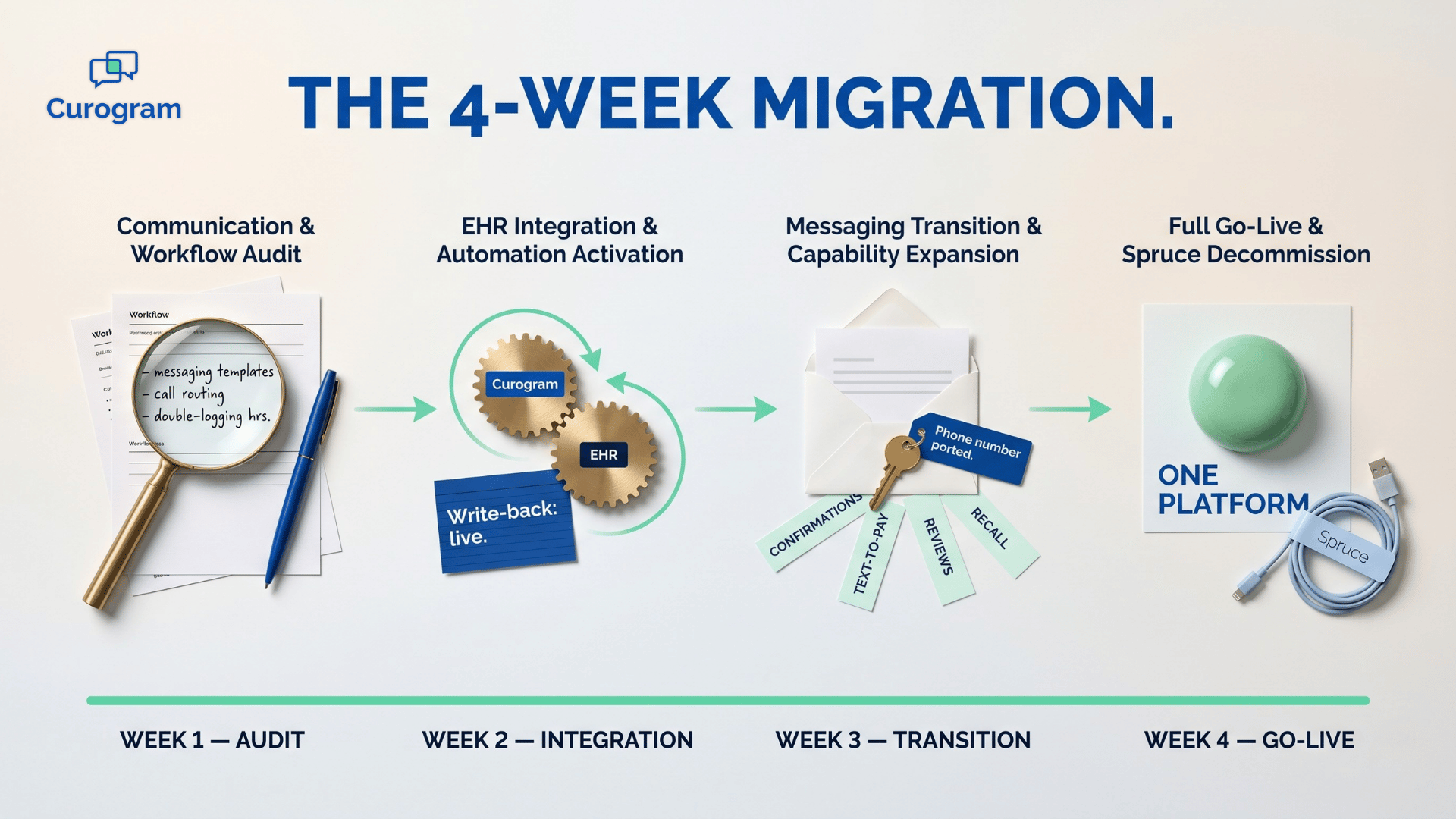
The first month focuses on configuration, integration, and staff training. You will set up automated reminder workflows, configure message templates, and begin promoting text-based communication to patients. Call volume may not change significantly during this period as patients learn about the new option.

Days 31-60: Early Results

By the second month, you should see measurable call reduction, typically 20-30% for practices implementing appointment reminders and two-way texting. Staff will become more comfortable managing the messaging platform, and patient adoption will accelerate.

Days 61-90: Optimization Phase

The third month is when call deflection gains compound.

With most workflows running smoothly, focus shifts to optimization:

Refining message content, adjusting reminder timing, and adding new workflows like digital intake forms or payment reminders.

Call reduction often reaches 40-50% by the end of this period.

Practices that continue optimizing see sustained improvements over the following months. The goal is not just reducing calls but building a communication infrastructure that scales as your practice grows.


Building a Communication System That Reduces Calls

The phone is not going away. But the reason it rings 100 times a day can.

Almost every call your front desk fields is routine: a confirmation, a form, a refill, a balance. None of it needs a live conversation. All of it needs a fast, secure answer.

That is the case for patient messaging software for call deflection, and why it is one of the highest-leverage changes a practice can make in 2026.

The results are not abstract. Curogram clients report cutting inbound call volume by 50% and lifting front desk productivity by over 30%. Text reminders hit a 98% open rate and earn confirmation rates above 75%. One practice took its no-show rate from 14.20% to 4.91%, which lands 53% below the industry average.

Getting there takes three things.

A platform that is genuinely HIPAA-compliant, with a signed Business Associate Agreement and real audit trails. An EMR integration that writes back, so confirmations land in the chart on their own. And a rollout your staff actually adopts, usually meaning a tool that works like the texting app in their pocket.

Curogram brings those together: two-way HIPAA-compliant texting, automated reminders, digital intake forms, text-based payments, and integration with nearly any EMR. Patients text from the app they already use. No downloads, no portal passwords, no hold music.

Start where the volume is. Pick your most repetitive call type, move it to text, and measure it against your baseline for 30 days. That single workflow usually pays for the platform.

Your patients already text everyone else in their lives. Meeting them there is no longer a perk. It is the baseline.

Ready to see what your call volume looks like on the other side? Book a Demo with Curogram and we will map your highest-volume call types to text workflows.


Frequently Asked Questions

How much can patient messaging software reduce call volume?

Most practices see call volume reductions between 50-68% after implementing comprehensive messaging workflows. The exact reduction depends on which call types you target with automation. Curogram clients typically achieve 50% call reduction by focusing on appointment confirmations, scheduling questions, and routine administrative inquiries.

Do patients need to download an app to receive text messages?

With Curogram, patients do not need to download any app. Messages arrive through standard SMS texting, which works on every mobile phone. This accessibility drives higher adoption rates, especially among older patients who may resist app-based solutions.

How long does it take to integrate with my EMR system?

Curogram integrates with most EMR systems in less than 30 minutes. The platform connects with nearly any EMR through API-based integration, pulling patient schedules and contact information automatically. Complex configurations may take slightly longer, but dedicated support ensures smooth implementation.

Is text-based patient communication HIPAA compliant?

Text messaging is HIPAA compliant when using platforms designed for healthcare communication. Curogram encrypts all messages, maintains complete audit trails, and holds SOC 2 Type 2 certification. The platform signs Business Associate Agreements with all practices, ensuring shared compliance responsibility.

Can patient messaging software help reduce no-shows?

Automated text reminders with two-way confirmation are among the most effective tools for reducing no-shows. Curogram's reminder system achieves 75% patient response rates and helps practices reduce no-show rates by 30-40%. This translates to significant revenue recovery, averaging $72,000 per provider annually.