
Each missing feature typically requires a separate tool, adding subscriptions, staff training, and integration overhead. Curogram delivers all of these in one unified platform.
Based on our internal data, Curogram users see a 53% lower no-show rate, 75%+ appointment confirmation rates, and up to 35% patient recall reconversion.
This analysis breaks down the full total cost of ownership for both platforms, including multi-tool stitching, manual labor overhead, and measurable revenue recovery, so you can make a clear, informed decision for your practice.
What if the patient engagement tool you chose for its low price was quietly costing your practice thousands every month?
That question is worth asking. And the answer depends on how you define "cost."
Most practice managers look at subscription fees when choosing a platform. It is a reasonable starting point. But the subscription price is rarely the whole story.
The full cost also includes the tools you need to add, the labor they still require, and the revenue they fail to recover.
OhMD is a recognized name in healthcare messaging. It handles HIPAA-compliant texting and AI call deflection well. For practices that only need messaging, it can be a solid fit. But growing practices typically need much more than that.
When a platform cannot handle telehealth, digital payments, EHR-synced confirmations, and patient recall on its own, those gaps do not disappear. They get filled by other tools, more vendors, and more staff hours.
That layering of solutions is where the real costs start to pile up. Most practices never add it all up until a budget review forces them to.
This article examines the total financial impact of both platforms. We look at direct costs, staff overhead, and the revenue each platform can or cannot recover.
We also draw on real-world data from practices that use Curogram. The goal is to give you a clear picture, not a sales pitch.
Practices lose between $20,000 and $30,000 per month to no-shows alone. That is earned revenue lost each time a patient does not show up.
The right platform can recover a meaningful share of it. Understanding that recovery potential is central to any honest ROI analysis.
The Hidden Economics of Point-Solution Patient Engagement
The most expensive platform is not always the one with the highest price tag. Sometimes it is the one that looks affordable but quietly builds costs as you try to make it work for a full clinical workflow. Before evaluating any patient engagement tool, it helps to understand what "cost" really means in context.
Why Messaging-Only Pricing Can Be Misleading
A messaging platform subscription gives you one number. But that number does not show how many other tools you will need.
It does not reflect the staff hours spent on work the platform cannot automate. And it does not capture the revenue lost when workflow gaps go unfilled.
The Problem with Looking at Subscription Cost Alone
For a platform like OhMD, the subscription price can look very reasonable. And it is, for what it covers. The challenge starts when a practice needs capabilities that go beyond messaging.
Telehealth visits, digital payments, automated Google reviews, and patient recall are not included natively. Each of those needs either a separate tool or a manual process. Both options add cost.
Growing practices face this math more acutely. A solo provider might absorb the overhead of a few add-on tools. A multi-provider clinic cannot.
When five or six disconnected platforms run side by side, the coordination cost alone becomes a burden. What looked affordable as a line item starts to look very different as part of a stack.
When Low Subscription Fees Hide a High Total
The term "point solution" describes a platform built to solve one specific problem. It does that job well. But it was never designed to replace a full clinical workflow on its own. That design gap is where messaging point solution hidden costs accumulate.
Each additional tool comes with its own onboarding, contract, and training cycle. Staff who work across multiple platforms take longer to complete tasks. Errors from manual data transfers add more time to fix.
A practice running a messaging platform alongside several add-ons may be paying far more than a unified platform would cost, even before counting missed revenue.
What a Full Cost Analysis Actually Captures
A real total cost analysis goes beyond subscription fees. It accounts for staff labor, integration maintenance, vendor management, and unrealized revenue.
When all of those are included, the cost gap between a point solution and a unified platform often becomes clear.
Staff Labor as a Hidden Line Item
Manual data entry is one of the most overlooked costs in a medical practice. When a platform lacks native EHR integration, staff must process every form response, confirmation reply, and intake submission by hand.
Across a busy practice, that can mean dozens of hours each week. Those hours carry real dollar costs in wages, benefits, and lost time that could go toward patient care.
Staff efficiency also affects patient experience. When staff are tied up on data entry, response times slow down. Patient questions take longer to answer.
The ripple effect of manual work touches more than just the budget. It shapes how patients feel about the practice as a whole.
Missed Revenue as a Cost of Its Own
Revenue loss is a cost, even if it never shows up on an invoice. Unchecked no-show rates drain monthly income. Inactive patients who never receive recall messages represent revenue that never returns.
Unpaid balances from paper-only billing erode collections over time. A platform that does not actively recover these revenue streams is costing your practice money every day, regardless of what its subscription costs.
The Multi-Tool Stitching Tax
OhMD is a capable messaging platform. It handles key patient communication tasks with solid reliability. But for practices that need a full suite of clinical workflow automation, OhMD's scope has limits. Those limits come at a cost, and that cost compounds as a practice grows.
What OhMD Does Not Include Natively
When you evaluate OhMD on subscription price alone, it looks like a cost-effective choice. The challenge appears when you map out everything your practice needs and compare it to what OhMD actually includes. The gap between those two lists is where the multi-tool stitching cost analysis begins.
The Features That Require Third-Party Tools
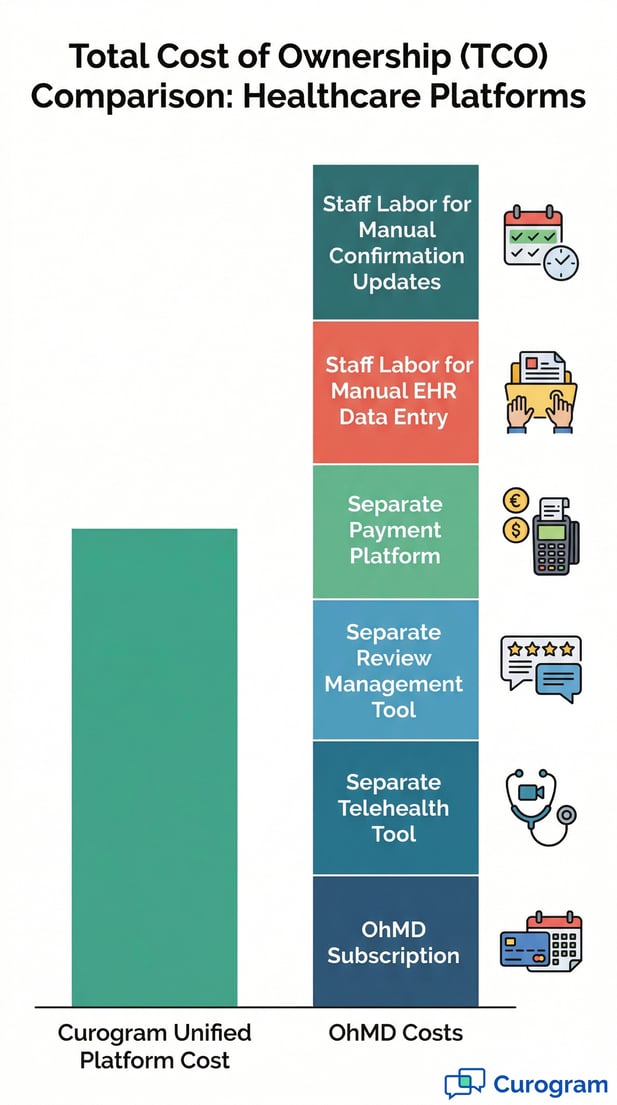
OhMD includes HIPAA-compliant messaging and AI call deflection. What it does not include natively are telehealth with virtual waiting rooms, text-to-pay digital payments, automated Google review generation, EHR-synced appointment confirmations, discrete intake data write-back, and automated patient recall campaigns.
Each of those features is part of Curogram's core platform. In OhMD, each one represents either a gap or a third-party add-on. G2 reviewers who use OhMD have noted the need to stitch together multiple tools to cover tasks that unified platforms handle on their own. That stitching comes with a price, and that price is rarely in one place on a budget.
The Real Cost of Adding Each Tool
Every third-party tool a practice adds comes with its own subscription fee. That is the visible cost. The less visible costs include onboarding time, staff training, ongoing integration maintenance, and the labor required to bridge data between systems that do not communicate natively.
A telehealth platform might cost $100 to $200 per month. A text-to-pay tool could add another $50 to $150. A review management platform runs $100 to $300 per month.
A recall campaign tool adds more on top. Totaled annually, these additions often exceed the cost of a unified platform. And that estimate does not yet include staff labor.
How Curogram Eliminates the Stitching Tax
Curogram includes all of the capabilities above in a single platform. There is one integration with your EHR, one vendor relationship, and one training program for staff. That simplicity has measurable economic value beyond any direct cost comparison.
One Integration Point, One Training Program
A unified platform means staff learn one system. They do not need to switch between tools or manually move data from one platform to another.
That continuity reduces errors, shortens task completion times, and improves the experience for both staff and patients. Training a team on a single platform costs far less than training them on five separate ones.
Onboarding time also drops. New hires join a practice and learn one tool, not a patchwork of platforms. That consistency matters for practices experiencing staff turnover or rapid growth. The less complex the operational stack, the faster new team members can contribute fully.
Eliminating Vendor Management Overhead
Every vendor relationship has overhead. Contracts must be renewed. Support tickets go to different teams. Security reviews cover each platform individually.
When a practice uses four or five tools to replace what a unified platform handles natively, that vendor management overhead becomes a real operational cost.
It consumes management time and, in some cases, requires dedicated IT support to maintain. Curogram replaces that layer with a single point of contact and one integration to manage. That is a category of cost that rarely shows up in a subscription price comparison, but it adds up quickly in practice.

Revenue Recovery Through Unified Automation
Cost reduction is one side of the ROI equation. Revenue recovery is the other. When measuring patient engagement platform ROI in healthcare, revenue recovery is often the most compelling piece of the analysis.
Unified automation creates revenue streams that a messaging-only platform simply cannot generate without adding more tools.
No-Show Reduction as a Direct Revenue Driver
No-shows are one of the most damaging financial problems in medical practice operations. Practices experiencing high no-show rates can lose $20,000 to $30,000 per month in unrealized revenue.
That is income the practice already earned through scheduling, lost the moment a patient does not arrive.
How Automated Confirmations Change the Math
Curogram's appointment confirmation workflow achieves a 75%+ confirmation rate. That rate is backed by automatic EHR synchronization, meaning every confirmation response updates the schedule without staff intervention.
The result is a cycle that runs on its own, filling gaps before they become no-shows and reducing the revenue lost to empty slots.
OhMD sends messaging-based reminders but does not natively sync confirmation responses back to the EHR. That means every response still requires a staff member to review it and manually update the schedule.
At scale, that manual step limits how effective the confirmation process can be. The gap between automated and manual sync is not just a workflow difference. It is a revenue difference.
Real Numbers from Real Practices
Based on our internal data, Atlas Medical reduced its no-show rate from 14.20% to 4.91% within three months of using Curogram.
That is a 65% reduction in missed appointments. Covina Arthritic Clinic processed over 1,100 automated confirmations per month, with no proportional increase in staff time.
These results reflect what is possible when confirmation automation is fully connected to the EHR, not just layered on top of it. The difference is not cosmetic. It is structural, and it shows up directly in monthly revenue figures.
Revenue Streams Beyond No-Show Recovery
No-show reduction is the most visible revenue driver in Curogram's model. But it is not the only one. Patient recall, digital payments, and automated review generation each contribute to revenue in ways that OhMD's messaging-first approach cannot replicate without third-party add-ons.
Patient Recall and Digital Payments
Based on our internal research, Curogram's patient recall campaigns deliver a 35% reconversion rate, with 1,240 patients recovered across documented campaigns.
Those are patients who had lapsed from care and returned because of an automated, targeted outreach. Each returning patient represents direct revenue.
Native text-to-pay addresses a second revenue gap. Paper billing has a collection rate around 20%. Digital payment options that meet patients on their phones close that gap in a meaningful way.
Practices that add text-to-pay report faster payment cycles and stronger collection rates overall. This is a revenue stream that requires a separate tool in OhMD but is built into Curogram from the start.
Reputation Growth and New Patient Acquisition
Based on our internal data, Curogram helped one practice generate 1,064 new five-star Google reviews in three months. More positive reviews lower the cost of acquiring new patients by improving organic search visibility and first impressions. It is a revenue driver that compounds over time.
OhMD does not include a native review automation tool. Achieving this outcome through OhMD would require a third-party addition with its own subscription and integration.
When that cost is included in the comparison, Curogram's unified model shows a clear structural advantage in the revenue column.
Total Cost of Ownership Comparison
Putting the numbers side by side makes the cost story easier to see. A direct comparison across each major cost dimension shows where the differences are largest and what drives them. The table below summarizes the key areas.
|
Cost Dimension |
Curogram |
OhMD |
|---|---|---|
|
Platform Scope |
Unified: messaging, intake, confirm, telehealth, text-to-pay, reviews, recall |
Messaging + AI voice; other features require additional tools |
|
Multi-Tool Subscriptions |
None; all capabilities included |
Required for telehealth, reviews, payments, and recall |
|
Manual Data Entry Labor |
Eliminated via discrete EHR write-back |
Ongoing; push-to-chart requires staff transcription |
|
No-Show Revenue Recovery |
53% lower rate; 75%+ confirmation; auto EHR update |
Messaging-based reminders; no auto EHR sync |
|
Payment Collection |
Native text-to-pay; digital revenue stream |
No native payments; separate billing system required |
|
Patient Recall ROI |
35% reconversion; 1,240 patients recovered (based on internal data) |
Manual or third-party; not natively automated |
|
Vendor Management |
Single vendor, single integration |
Multiple vendors, multiple integrations, multiple contracts |
Breaking Down Each Cost Dimension
Each row in the comparison above represents a real cost or revenue impact. Some are direct and easy to measure. Others are indirect and often overlooked.
Understanding what drives each line item is important for making an accurate OhMD vs Curogram pricing value medical analysis.
Platform Scope and Subscription Costs
Curogram's single subscription covers messaging, intake, appointment confirmation, telehealth, text-to-pay, review generation, and patient recall. OhMD's subscription covers messaging and AI call deflection.
The other capabilities in Curogram's platform are not included in OhMD and must be sourced from other vendors. When those vendor costs are added to OhMD's subscription, the total monthly spend often exceeds Curogram's unified price.
This comparison becomes even clearer when you factor in implementation costs. Setting up multiple tools with separate EHR integrations costs more time and money than a single integration. And every additional integration point is a potential failure point, adding support and maintenance overhead that compounds over time.
Labor, Integration, and Vendor Management
OhMD's push-to-chart feature requires staff to manually transcribe data from the platform into the EHR. That process runs on staff time. Curogram's discrete write-back eliminates that step entirely.
In a practice that handles hundreds of intake forms and confirmation responses each month, the labor savings add up to a significant number across a full year.
Vendor management is the quieter cost. Managing multiple contracts, coordinating support across vendors, and maintaining each integration takes real hours from practice managers and administrators.
Curogram replaces that overhead with a single point of contact and one integration to maintain. The operational relief that comes from that consolidation is hard to put on a spreadsheet, but very easy to feel in day-to-day practice management.
What the Numbers Tell Us
When every dimension is included, the OhMD total cost of ownership medical practices face becomes much higher than the subscription price suggests. Curogram may cost more as a standalone subscription in some cases.
But it replaces the cost of multiple tools, eliminates manual labor overhead, and generates more revenue. The net result is a lower total cost and a higher return.
Where OhMD Falls Short on Total Value
OhMD's value is real for practices that need messaging. But for a complete cost analysis, the gap becomes clear when you consider what OhMD cannot generate natively: automatic EHR-synced confirmations, native digital payments, recall campaign revenue, and review-driven patient acquisition.
Those are not just features. They are measurable revenue streams that go uncaptured when a platform cannot deliver them.
The compounding effect matters here. A practice that cannot recover no-show revenue, cannot run recall campaigns, and cannot collect payments digitally is leaving money on the table across multiple categories at once. The cost of those gaps is not visible in a subscription comparison. It shows up in monthly revenue reports instead.
Where Curogram Delivers a Structural Advantage
Curogram's advantage is not just cost reduction. It is structural. A unified platform with deep EHR integration generates outcomes that a messaging-first platform cannot achieve natively.
The total cost of ownership reflects that structural difference: lower operational overhead, more revenue recovered, and fewer vendors to manage.
That structure also scales. As a practice adds providers and sees more patients, a unified platform grows with it without proportional increases in cost or complexity.
A multi-tool stack built around a messaging point solution does not offer the same scalability, and the gaps only widen as volume increases.
The Economic Case for Unified Clinical Automation
After examining each cost dimension, the case for unified clinical automation becomes clear. For growing medical practices, the question is not just whether a unified platform costs more to subscribe to.
It is whether the total economic outcome, including revenue generated and costs eliminated, justifies the investment. In almost every case, it does.
Three Factors That Define the Real Cost of Patient Engagement
Three things determine how much a patient engagement platform actually costs a practice: how many tools it takes to automate the full clinical workflow, how much manual labor those tools still require, and how much revenue they recover or fail to recover. Messaging-first point solutions score well on affordability but fall short on all three factors when the full scope of clinical automation is considered.
Number of Tools Required
Every additional tool a practice runs adds direct and indirect costs. Subscriptions, training, integration, and vendor coordination all scale with the number of platforms in use.
A unified platform contains those costs from the start. It draws a clear ceiling on how complex the operational stack can become, which has lasting value as the practice evolves.
There is also a focus cost. Every tool staff must learn and manage takes attention away from patient care. Reducing the number of platforms in use is not just a financial decision. It is an operational one that affects how smoothly a practice runs every single day.
Manual Labor Still Required
The best automation is the kind that staff never have to think about. When confirmations sync automatically, intake data writes back to the EHR without staff input, and recall campaigns run on schedule, the operational burden stays low. When those steps require manual follow-through, the cost stays high. Messaging-first platforms tend to leave more manual steps in place by design, because they were not built to replace the full workflow.
Why Unified Automation Is the Right Long-Term Investment
The economics of unified automation improve over time. Each automated workflow compounds its value as the practice grows. More patients mean more confirmations, more recall opportunities, and more payment collections. A unified platform scales with that growth without requiring proportional increases in staff cost or vendor overhead.
Revenue Gains That Point Solutions Cannot Match
A messaging-only platform cannot generate the same revenue outcomes as a unified automation platform. No-show recovery, recall reconversion, digital payment collection, and reputation-driven patient acquisition each require capabilities that go beyond messaging.
When those capabilities live on one platform, the combined revenue impact is significant. When they require separate tools, the combined cost often cancels out the benefit.
The real cost comparison is not subscription vs. subscription. It is total outcome vs. total outcome. On that measure, a unified platform like Curogram delivers a structurally stronger result for practices that need more than messaging.
A Platform That Grows with Your Practice
Practices change. They add providers, expand services, and see patient volume grow. A unified platform designed for clinical workflow automation scales with those changes.
A multi-tool stack built around a messaging point solution does not. At some point, the overhead of managing disconnected tools outweighs any savings from a lower subscription fee.
The curogram ohmd cost comparison roi ultimately comes down to one question: do you want to pay for messaging, or do you want a system that drives revenue, cuts overhead, and grows with your practice? For practices focused on long-term financial health, the economics point clearly in one direction.
Ask an expert | See Curogram in action.
Frequently Asked Questions
OhMD's subscription is competitive for messaging, but practices that need telehealth, text-to-pay, automated reviews, patient recall, and EHR-synced confirmations must add separate tools. Each tool comes with its own subscription, training time, and integration costs.
Curogram includes all of these capabilities natively, which results in a lower total cost when the full clinical workflow is considered. The difference becomes most apparent once you factor in staff labor for manual data entry on top of the added subscriptions.
A messaging-first platform solves one problem well, but was not designed to cover a full clinical workflow. Practices that need more than messaging must either add tools or use manual workarounds to fill the gaps.
Both options add cost in the form of subscriptions, staff time, and vendor management. Those costs are often invisible in a subscription comparison because they fall outside the platform's own line item on the budget.
Revenue recovery depends on a practice's current no-show rate, recall lapse rate, and payment collection gaps. Based on our internal data, practices using Curogram see up to a 53% lower no-show rate and 75%+ confirmation rates.
Patient recall campaigns have delivered a 35% reconversion rate, and text-to-pay improves on the roughly 20% collection rate typical of paper billing. Taken together, these revenue streams can add up to significant monthly gains, especially for higher-volume practices.
Multi-tool stitching means running several separate platforms to cover capabilities that a single unified tool would handle natively. Each platform adds its own subscription, training cycle, and integration to maintain.
The cost is hidden because it shows up across multiple budget lines rather than in one place. When totaled, the combined cost often exceeds what a unified platform would have cost to begin with, and that estimate does not even include the staff time required to manage it all.
Deep EHR integration determines whether a platform's automations actually reduce staff work or just move it around. When confirmation responses, intake forms, and recall campaigns sync automatically with the EHR, staff do not need to manually process each one. That eliminates a significant labor cost. Platforms that lack native EHR write-back, like OhMD's push-to-chart model, leave that manual step in place, which limits the true ROI of the tool and reduces its value over time.