


1 min read
What is the Impact of Online Reviews on Medical Practice Growth & ROI?
💡 The impact of online reviews on medical practice growth shows up in two clear ways: more new patients and better search engine rankings....

6 min read
Carylee Gali
:
Updated on October 14, 2026
A patient gets a referral from a friend. Good practice, good doctor, 10 minutes away. They still look it up. Phone out, name typed, star rating read before the website ever loads.
What they find is not a verdict on the care. It is a sample of whoever felt moved to post, whenever they felt moved to post it.
That sample is the first thing a new patient sees. A practice that asks every patient gets a fair sample. One that waits gets whoever was angriest.
Six reasons to ask, below, with the numbers behind each one and the line you cannot cross while doing it.
BrightLocal surveyed 1,002 US adults for its 2026 local consumer review survey. It found 97% read reviews for local businesses.
The bar has moved up, and fast. In that survey, 31% said they would only use a business rated 4.5 stars or higher. The same question drew 17% a few years earlier.
Another 68% said they need at least 4 stars before they will consider a business at all.
So the question is no longer whether patients read online reviews and ratings. It is whether a 4.1 average removes a practice from the list before anyone calls.
Patients also check the date. In the same survey, 74% wanted to see a review from the last three months. Just under a third wanted one from the last two weeks.
A page with 200 reviews and nothing since last spring reads worse than a page with 30 from this month.
That changes the job. A single review push every year or two builds a wall of dated praise. A standing ask after each visit keeps a fresh date on top, which is the part patients look at.
Star average. Review count. Date of the newest one. Whether the practice ever replies.
Those four sit on the profile before any photo or description. A strong average with eight reviews reads as thin. A 4.8 with 300 reads as settled.
Replies carry more weight than most practices expect. A short, plain answer to a complaint tells the next reader that someone is paying attention.
A reply that confirms the person was a patient is a disclosure. That holds even when the reviewer named themselves first.
The Office for Civil Rights has settled on exactly this. A dental practice paid $50,000 in March 2022 over responses that named patients and gave treatment detail. Another paid $10,000 in 2019 for the same pattern.
The safe reply says nothing about care. It thanks the writer for the feedback, gives one phone number, and stops. Everything specific moves to that call.
Reviews feed the local map results. Google names them among the things that decide which three businesses show in that pack.
They do not rank a blog post or a service page. Those run on different signals.
Worth being blunt about, because the live version of this claim oversells it. Reviews win the map pack and the click that follows. They will not carry a thin website.
Many patients now read the hours, the rating and the recent reviews, then tap to call. The website never opens.
Which makes the Google Business Profile worth the same care as a homepage. Practices on Oracle Health can send the ask from the staff dashboard. We wrote up that review request workflow in detail.
The operational version is simple. Keep hours correct, keep photos current, and keep a review arriving most weeks.

People post after something unusual happened. Great visit, or a bad one. The ordinary visit, which is most of them, goes unmentioned.
So a review page over-reports the extremes. Asking everyone pulls the middle back in, which is where most of the useful detail lives.
Read them for operations, not for mood. Mood tells a practice nothing it can fix by Friday.
Four complaints recur often enough to track. Two are about time: phone hold, and waiting past the appointment. The other two are money and directions, meaning a billing surprise and confusion about parking.
Each of those has an owner and a fix. None of them is about clinical care.
The pattern shows up across practices. Our writeup of reputation management results in Practice Fusion clinics covers what the feedback surfaced. It also covers what changed because of it.
A 2025 review in the journal Healthcare screened 1,317 papers and kept nine, all from US settings. The authors set out the business case for patient experience work and are careful about how thin the base is.
Two findings stand out. Communication training for surgeons was associated with payments rising about 25%. A dedicated patient experience office was associated with operating costs falling 1.4% for each year it had been running.
That second result was weak, at p below 0.10. The authors say so plainly, and so should we.
Read it as direction rather than proof. Boosting patient satisfaction does appear to pay, and nine studies is not enough to tell a practice how much.
Since October 21, 2024 there has been a federal rule on this. 16 CFR Part 465 carries a penalty of up to $53,088 per violation.
Two parts matter for a practice. Section 465.7(a) covers pressure aimed at removing a review. Groundless legal threats, physical threats, intimidation and public false accusations are all named in it.
Section 465.7(b) bars presenting a review display as representative while reviews are being suppressed by rating or sentiment. If a practice withholds reviews, the same basis has to apply to all of them.
Collecting private feedback is still fine, and useful. What the rule reaches is a public display that looks complete while the low ratings are being held back.
Feedback nobody acts on trains patients to ignore the next request. It also trains staff to see the survey as noise.
One rule fixes most of it. Every low score gets a call back inside two business days, from a named person. The call asks one question: what would have made this better?
That call is worth more than the score. It is also the moment a patient decides whether to post publicly.
Pick the complaint that showed up most last month. Change one thing. Note the date in a shared doc so the next person can see what was tried.
Phone hold time is usually the first win, because most of it is appointment changes that can move to text.
The sending side should be automatic by then. Practices on Practice Fusion can trigger review requests from the chart. We covered how that Google review request fires separately.
It's easy to collect patient reviews and feedback with Curogram.Curogram's Reputation Management sends a review request by text after a visit, to every patient, not a chosen subset. Patients can answer a short private survey, or go straight to the public profile. Both come back to one inbox, alongside the rest of that patient's messages. Staff reply from the same screen they use for scheduling, so nothing needs a second login. Text arrives faster than email, which is most of why the response rate holds up. The benefits of collecting positive patient reviews are easier to see once the asking is automatic. |
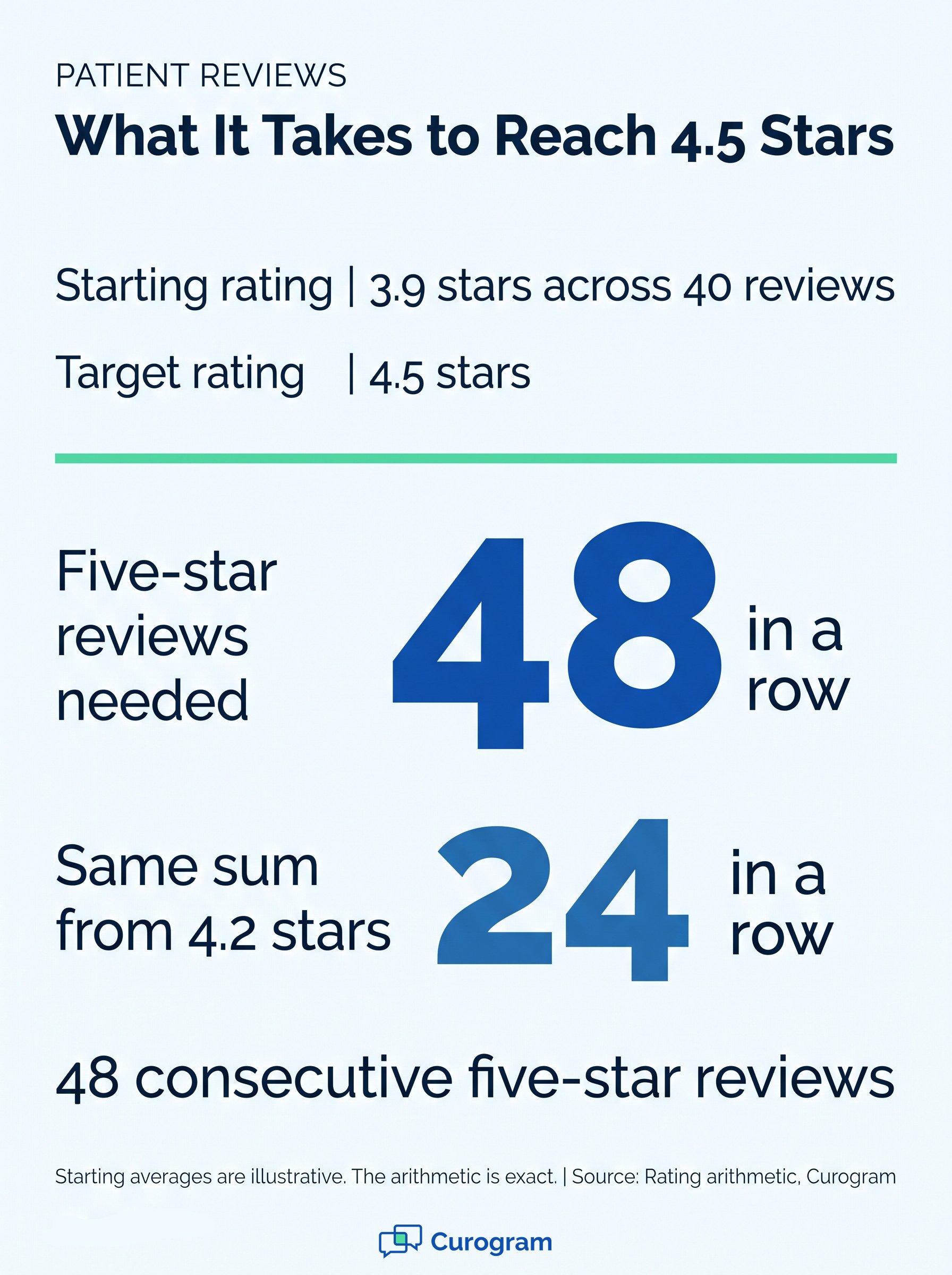
Start with the arithmetic, because it argues for acting now. Take a practice at 3.9 stars across 40 reviews. Reaching a 4.5 average takes 48 more reviews, all at 5 stars.
From 4.2 across the same 40, it takes 24. The gap between those two numbers is the whole case for asking early.
Three things to set up, in order. Turn the ask on for every visit rather than a monthly batch. Give every low score a call back within two business days. Write a reply template that thanks the writer, gives a phone number, and says nothing about care.
Then check the profile the way a patient would. Look at the newest date first, then the average, then whether anyone ever replied. If the newest review is older than three months, the asking is not running yet. That is the fix, and it is a workflow fix rather than a marketing one.
Book a Curogram demo to see the request, the survey, and the inbox in one pass.
1 min read
💡 The impact of online reviews on medical practice growth shows up in two clear ways: more new patients and better search engine rankings....

1 min read
💡Reactivate overdue patients with text recalls for Azalea Health by sending one friendly message they can act on fast. The patient rebooks in a...
1 min read
💡 Medical practices can automate 5-star Google reviews by using an EMR-integrated survey workflow. This system sends a feedback request via SMS...