


Skip to the main content.

11 min read

Documentation Burden in Behavioral Health: How to Reduce Charting Time

Documentation Burden in Behavioral Health: How to Reduce Charting Time
💡 Behavioral health clinicians spend roughly 1 to 2 hours on documentation for every hour of direct patient care. The top three drivers are narrative-heavy therapy notes, insurance medical-necessity rules, and duplicated work between clinical and billing systems.

Most of this work spills into evenings — what clinicians call pajama time. The result is faster burnout, longer waitlists, and lower note quality.

Practices reduce charting time by standardizing templates, shifting intake to patient-completed digital forms, scheduling documentation inside the workday, and adopting AI scribes with strong clinical oversight. 

These steps protect clinician time without compromising compliance or care quality.

It's 9:47 p.m. The kids are asleep. Your therapist is still on the couch with a laptop, finishing notes from a 9 a.m. session.

This is the quiet reality behind behavioral health documentation burden. Across therapy, psychiatry, and SUD treatment, clinicians spend roughly 1 to 2 hours charting for every hour of direct care.

That extra work doesn't get billed. It gets absorbed — after dinner, on weekends, in the gaps that used to be personal time.

If your practice runs on TherapyNotes or Welligent, you already know the platform itself isn't the problem. What breaks is everything around it — duplicate intake questions, medical-necessity language, and constant back-and-forth between clinical and billing teams.

Curogram's TherapyNotes integration and Curogram's Welligent integration were built around exactly this gap. The goal is simple: clinicians spend more of their day in front of patients, not a screen.

Documentation is now the number-one named driver of clinician burnout in behavioral health. It's also one of the most fixable problems on your operations list. Practices that take it seriously are seeing real gains: shorter notes, fewer late nights, lower turnover rates, and faster access for new patients waiting on a first appointment.

This guide breaks down where the time actually goes, why behavioral health charting is heavier than other medical specialties, and six practical changes you can make starting this quarter.

We'll cover the workflow shifts that pay back fastest, the data points worth tracking right now, and the real budget impact of doing nothing this year. We'll also look at where AI documentation tools genuinely help your team — and where they introduce new risks you need to manage carefully before any rollout.

The goal isn't to write fewer notes. It's to stop paying your clinicians in unpaid evening hours week after week.

Where Your Clinicians' Charting Hours Actually Go

Most directors underestimate how much time their teams lose to documentation. The numbers stop being abstract once you map them by role.

Benchmark Data Across Therapy, Psychiatry, and SUD

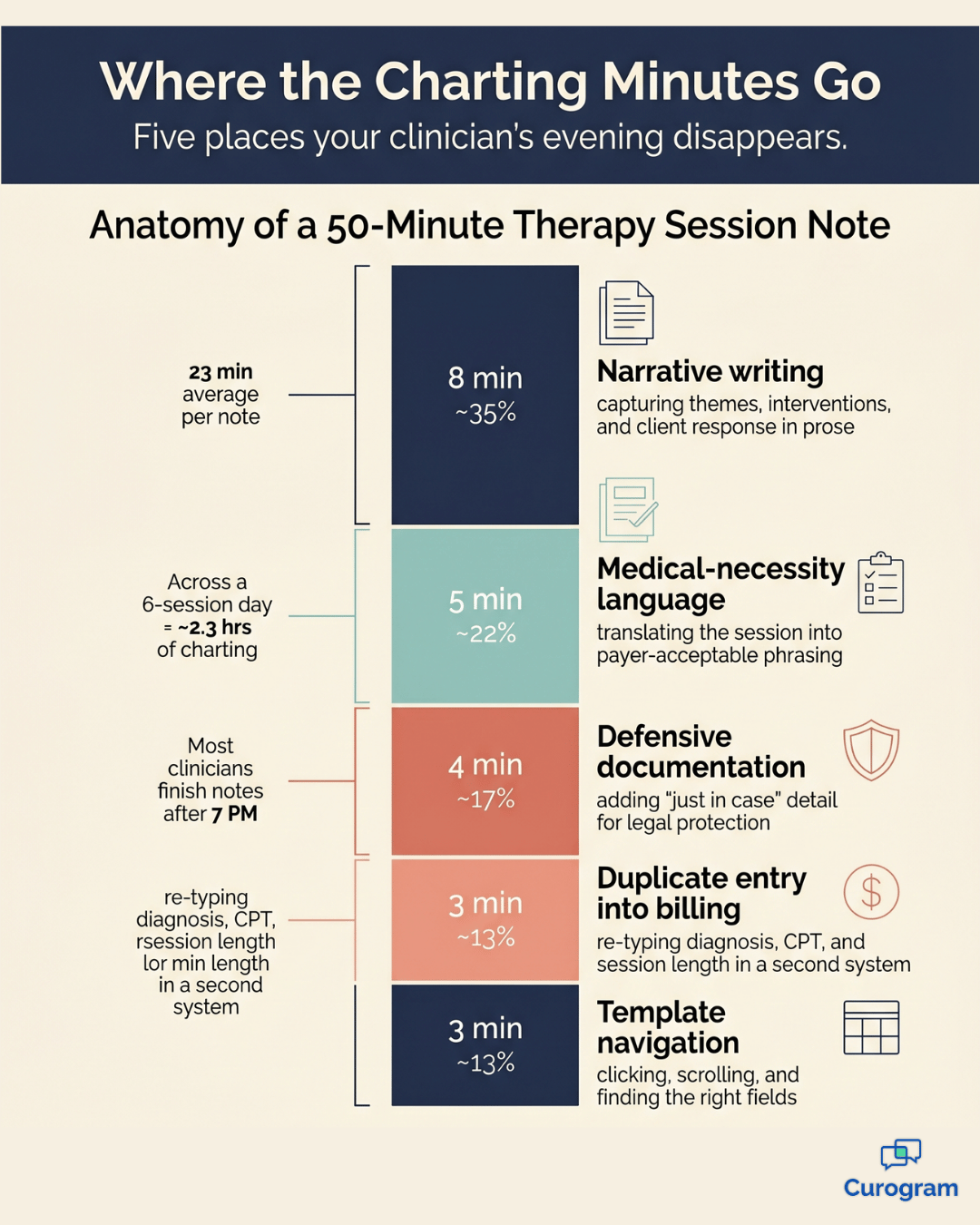
Therapy documentation time runs about 15 to 25 minutes per 50-minute session, depending on note format and insurance complexity. A full caseload of six sessions a day produces 90 to 150 minutes of charting on top of clinical work.

Psychiatry runs lighter per encounter but heavier per shift. Med management visits stack up — 8 to 12 patients a day, 8 to 15 minutes of notes each. SUD programs sit at the top of the curve, where group notes, progress notes, treatment plan updates, and 42 CFR Part 2 handling can push documentation past 25% of the week.

Here's how that translates into a typical work week:

Role Direct care hours / week Documentation hours / week Charting as % of total
Outpatient therapist 25 10–14 ~30%
Outpatient psychiatrist 28 9–12 ~25%
SUD counselor 22 12–16 ~37%

A therapist with a 25-hour clinical load spends the equivalent of a part-time second job typing notes. Every hour cut from that column is an hour edical reand a meaningful step toward reducing clinician charting time.

The ratios also explain why one staffing decision lands so differently across roles. Adding a group session to a SUD counselor's week can double their documentation load. Adding a med management slot to a psychiatrist barely moves it.

What Drives the Variation

Three factors explain why one clinician finishes notes by 5 p.m. and another is still typing at 10 p.m.:

  • Note format — Free-text narratives take longer than structured SOAP notes or DAP notes.
  • Payer mix — Medicaid and managed care often demand more detailed medical-necessity language than commercial plans.
  • Workflow design — Clinicians without protected charting time end up doing it after hours.

The third one is the quiet killer. When charting isn't on the schedule, the work fills the available evening — and your retention numbers pay the price.

What the Hidden Costs Add Up To

Charting time isn't just a clinician quality-of-life issue. It shows up in your P&L, your hiring pipeline, and your patient access.

Burnout and Turnover

Pajama time — clinical work done after hours — is the strongest predictor of burnout in behavioral health. When documentation regularly extends past 7 p.m., clinicians start looking for cash-pay, telehealth-only, or non-clinical roles within 12 to 18 months.

Replacing a single full-time therapist costs $50,000 to $80,000 once you factor in recruiting, credentialing, lost revenue, and ramp-up time.

A practice with 20 clinicians and a 25% turnover rate is spending close to $300,000 a year on churn alone.

Cutting therapy documentation time by even 30 minutes per day is one of the most direct retention levers available.

Quality of Notes and Clinical Accuracy

Tired clinicians write worse notes. When charting slips to 9 p.m., session details fade, copy-paste errors creep in, and medical-necessity language thins out.

That single drop in quality creates two parallel risks for your practice:

  • Audit and revenue risk — weaker notes lead to denied claims and longer accounts-receivable cycles.
  • Clinical risk — risk flags, medication concerns, and treatment plan changes get missed by the next clinician picking up the chart.

Neither risk shows up in a daily dashboard. Both show up six months later — in your denial rate and your incident reports.

Patient Access and Waitlist Expansion

Every hour spent charting after hours is an hour your team can't see new patients. Practices with heavy mental health charting burden often have waitlists stretching 4 to 8 weeks, even when clinicians technically have open calendar blocks.

The math is stark. If 15 therapists each reclaimed 3 charting hours a week and used half for new intakes, that's roughly 90 extra intake slots per month.

At $150 per session, that's $13,500 in monthly revenue — about $162,000 a year.

Why Notes Take Longer in Behavioral Health Than Other Specialties

A primary care visit can often be charted in under 5 minutes. A 50-minute therapy session almost never can. Four structural reasons explain why behavioral health EHR burden runs heavier.

Narrative Nature of Therapy Notes

Behavioral health notes are about meaning, not measurements. You can't reduce a session on grief or trauma to a checkbox. Progress notes need to capture themes, interventions, client response, and clinical reasoning — usually as prose. That's the largest single contributor to therapy documentation time.

Audit standards make this worse. Reviewers look for clinical reasoning — and a thin narrative reads as a thin defense if the chart gets pulled.

Insurance and Medical Necessity Requirements

Payers want proof every session is medically necessary. That means documenting symptoms, functional impairment, treatment goals, and measurable progress in language the payer accepts. Miss the right phrasing and the claim gets denied.

Each payer has its own preferred wording, and the rules shift quietly over time. Clinicians end up writing for an audience of auditors — which adds minutes to every note.

Legal and Risk Management Concerns

Behavioral health carries unique legal exposure — duty-to-warn, mandated reporting, custody disputes, subpoenas. Clinicians often over-document defensively, adding 5 to 10 minutes per note "just in case."

It's rational, but it compounds across a full caseload.

Defensive habits also grow with experience. Without strong template guidance, your senior clinicians often have your slowest charting times.

42 CFR Part 2 Handling for SUD Notes

SUD records carry stricter privacy rules than general health information under 42 CFR Part 2. Releases, consents, and segregation of records add steps that don't exist in other specialties.

For SUD programs this is permanent overhead — but workflow design can keep it from doubling clinician workload.

The biggest time leak is handling consents manually. Practices that move releases into a digital, audit-ready workflow report 2 to 4 fewer admin hours per clinician each week.

Infographic showing how 23 minutes of behavioral health documentation time breaks down per therapy session.

6 Practical Ways to Cut the Charting Load

The goal isn't to write fewer notes. It's to remove the friction that makes each note take longer than it needs to. These six changes are where most practices find the biggest wins.

1. Standardize Templates for Common Visit Types

Build templates for your top 5 to 7 visit types.

Most behavioral health practices need versions for:

  • Initial assessment
  • Follow-up therapy session
  • Med management
  • Crisis or risk check-in
  • Group session
  • Treatment plan update

Pre-populated structure cuts the blank-page problem and helps newer clinicians chart faster. A good template doesn't replace clinical judgment — it scaffolds it.

You're saving clinicians the 90 seconds it takes to remember which sections the payer wants.

2. Use Structured Data Where Prose Isn't Required

Not every field needs a paragraph. Risk flags, medication lists, screener scores, and attendance can all be captured as structured fields. This is the foundation of meaningful EHR optimization in behavioral health.

Structured data is also easier to pull for reporting, audits, and outcome tracking — so the time you save on the front end pays again on the back end.

In most practices, 20% to 30% of typed prose could become structured data without losing clinical fidelity.

3. Schedule Documentation Time Inside the Workday

If charting isn't on the schedule, it happens at home. Block 10 to 15 minutes between sessions and a longer 30-minute block at the end of each clinical half-day.

Practices that protect this time see same-day note completion rates climb from around 40% to 80% within a quarter. That's measurable progress on therapy notes efficiency without changing a single template.

The harder part is defending that block once it's on the calendar. Treat charting time as protected clinical time, not flexible inventory the front desk can fill with add-ons.

4. Move Intake Paperwork to Patient-Completed Digital Forms

This is the single highest-leverage change most practices haven't fully made. Patient history, medications, insurance details, ROIs, and consent forms can all be captured digitally before the first appointment.

Curogram client data from clinical settings shows that patient-completed digital intake reduces administrative time before visits and frees clinicians from re-typing information patients already provided.

Patients usually prefer it too — filling out forms at home produces more accurate answers than rushing through a clipboard in the waiting room, which means cleaner clinical decisions from session one.

5. Cut Duplicate Documentation Between EHR and Billing

Many practices still have clinicians enter the same diagnosis, CPT code, or session length in two systems. Every duplicate entry is a data-entry job dressed up as clinical work.

Audit your workflow for any field a clinician enters more than once, then automate the second entry. Map a single visit from check-in to claim submission and count every place the same data point gets typed — most practices find 3 to 6 duplicate entries per visit. Eliminating half returns hours per clinician per week and reduces billing errors.

6. Use AI-Assisted Documentation Tools (With Appropriate Oversight)

AI scribes can draft progress notes from session audio in seconds.

For practices that adopt them carefully, charting time can drop 30% or more — Curogram client data from clinical settings shows productivity gains in that range when AI documentation is paired with strong clinical oversight.

The word "carefully" is doing a lot of work there.

Before piloting any AI tool, define what success looks like — minutes saved per note, percentage signed same-day, clinician satisfaction. Without baseline numbers, you'll have no way to tell if it's working three months in.

Patient completing digital intake forms on a tablet while a staff member assists at a therapy clinic.

How Pre-Visit Workflows Take Pressure Off the Note

The fastest note is the one you don't have to write from scratch. Pre-visit workflows shift information capture upstream, so the clinician walks into the session with structured context already in the chart.

Patient-Reported Data That Flows Into the Note

When patients complete history, symptoms, goals, and current medications digitally before the appointment, that data populates directly into the intake note.

The clinician's job shifts from typing what the patient said to confirming and clinically interpreting it.

This is where digital intake actually changes the workload — not by saving 5 minutes of front-desk time, but by saving 15 to 20 minutes of clinician charting on every new-patient visit. Patients also tend to disclose more in writing than in a first session, especially around substance use, suicidal ideation, or trauma history.


Screeners Captured Before the Visit

Validated screeners can be sent automatically before each visit, with scores arriving in the chart already calculated and time-stamped.

The most common ones in behavioral health include:

  • PHQ-9 for depression severity
  • GAD-7 for anxiety
  • AUDIT for alcohol use
  • PCL-5 for PTSD symptoms

For your team, this changes three things at once. Sessions start with an actual clinical baseline. Outcome tracking happens automatically.

The clinician documents the score, not transcribes the answers — and that's the time saver that compounds across thousands of visits a year.

What to Watch For When Adopting AI Documentation Tools

AI scribes are the most-discussed solution to behavioral health documentation burden right now. Used well, they help. Used poorly, they create new problems harder to detect than the old ones.

Accuracy, Bias, and Clinical Oversight

AI-generated notes can sound right and still be wrong. They miss nuance, mishear clinical terms, or hallucinate details that were never said. They can also reflect bias in training data — under-documenting symptoms reported by patients from underrepresented groups.

Every AI-drafted note needs clinician review before sign-off. Treat the AI output as a first draft, never a finished record — and pull a random 5% of notes each quarter to spot-check accuracy drift over time.

Consent and Confidentiality

Recording therapy sessions raises questions most medical AI tools weren't built for. Behavioral health conversations include third parties, family members, and content especially sensitive under HIPAA and 42 CFR Part 2.

Patients need clear, explicit consent — ideally in writing — before any session is recorded or processed by AI. Build a clean opt-out path too, since some patients will decline recording, and that decision can't quietly downgrade their care or push them to a different clinician.

Integration Into Existing Workflow

An AI tool that lives outside your EHR creates a third place clinicians have to look. A tool that integrates cleanly into the existing chart creates a single source of truth.

Before rollout, walk through one full clinical day with a real clinician and pressure-test the tool against four questions:

  • Where does the AI sit in the chart workflow?
  • How does it handle late notes, edits, and corrections?
  • What happens when the audio quality is poor or the session runs long?
  • Does it route into the same place clinicians already finalize their notes?

If any answer is awkward, the tool will be abandoned within 90 days regardless of how good the draft quality looks in a demo.


Conclusion

Documentation burden isn't a personality flaw. It isn't a sign your clinicians don't care enough or aren't organized enough. It's a workflow problem — and workflow problems have solutions.

Every hour you cut from after-hours charting is an hour you give back to a clinician's life. That hour shows up in retention numbers, in note quality, in waitlist times, and in the simple fact that your team makes it to dinner.

The practices pulling ahead in 2026 aren't the ones with the strictest documentation policies. They're the ones who removed the small frictions that compound across thousands of visits a year.

Standardized templates. Patient-completed digital intake. Screeners captured before the visit. AI assistance applied with care, not as a shortcut around clinical judgment.

This is exactly the gap Curogram fills. We don't replace TherapyNotes, Welligent, or your existing platform — we automate the surrounding workflows so your clinicians stop doing the administrative work that shouldn't be theirs.

Patient-completed forms flow into the chart. Screeners arrive on schedule. Intake data lands where the note needs it. The result is a clinical day that ends when the last session does, not three hours later.

If you're spending six figures a year on turnover, watching waitlists grow, or hearing the same charting complaints in every staff meeting, the cost of doing nothing is already higher than the cost of fixing it.

Book a demo. with Curogram and we'll walk through your current intake-to-note workflow, show you exactly where the duplication lives, and map a 90-day plan to reduce documentation burden for your team. No clinical disruption. 


Frequently Asked Questions

How much time do therapists spend on notes per session?

Most outpatient therapists spend 15 to 25 minutes documenting a 50-minute session, depending on note format, payer requirements, and EHR design. Across a full caseload, that adds up to 10 to 14 hours of charting per week — much of it after clinical hours.

Can AI tools write therapy notes safely?

AI tools can safely produce a draft, but the clinician is still the legal author of the note. Safe use requires explicit patient consent, clinician review of every note before sign-off, and clear policies on recording, storage, and retention. Used as a draft generator with strong oversight, AI can meaningfully reduce charting time. Used as an unattended autopilot, it creates serious clinical and legal risk.

Do templates make notes worse?

Only when they're used as a substitute for clinical thinking. A good template scaffolds the structure — required sections, payer language, risk flags — and leaves the clinical narrative to the clinician. Practices that audit templates quarterly and update them based on payer feedback usually see note quality improve, not decline.

What's the difference between a progress note and a treatment plan?

Progress notes document a single session: what happened, what the clinician did, how the patient responded. Treatment plans are higher-level documents that define the patient's diagnosis, goals, interventions, and timeline — usually updated every 90 days. Progress notes should reference and reinforce the active treatment plan.

Are digital intake forms reducing documentation time?

Yes, when they're integrated into the chart. Digital intake captures history, medications, insurance, screeners, and consents before the visit, which means the clinician confirms information rather than re-typing it. Practices that fully digitize intake commonly save 15 to 20 minutes of clinician charting per new-patient visit.