
 Jo Galvez

Curogram sends the visit link in the same thread as the patient's reminders. The video opens in the phone's browser. Older adults, anxious therapy patients, and busy parents tend to gain the most.
Ten minutes before her 2:00 video visit, a 74-year-old patient is ready. Phone charged, glasses on, questions written on the back of an envelope.
She taps the link in the email. Her phone says to download an app. The app store asks for a password she set up years ago. By the time she's in, it's 2:09, and she spends the first minute apologizing to her own doctor.
She did everything right. The doorway asked her to be her own IT department. Her doctor, on the other side, watched an empty screen for nine minutes and couldn't help.
We call this the App Handoff, and it decides who gets virtual care and who gives up on it. Those it stops are often the ones telehealth should serve best. Think of older adults managing a chronic condition, anxious patients in therapy, and parents squeezing a visit into a lunch break.
Our position is that a video visit should ask a patient for nothing more than reading a text. If they can tap a link, they can see their provider. That standard matters most in RXNT practices with heavy virtual schedules, like psychiatry and therapy, where one missed join can mean a missed week of care.
This article walks the join from the patient's side and explains how a text-link visit stays private without an app. Then it looks at what changes when the doorway stops turning people away. It's written for the providers who speak up for their patients, and for the managers who field the setup calls.
The App Handoff, as Patients Live It
Patients were promised care from home. What many got was a setup task first.
The Countdown to a Video Visit
From the patient's chair, a typical join runs like this:
- Ten minutes early, ready to go.
- Tap the link in the email.
- "Download the app to join."
- App store, then a forgotten password.
- App installed. Now it wants a meeting ID.
- Typed wrong once. Joined at minute nine.
Every step is a place to stop. Patients search "join video visit without app" the night before for a reason: four of those six steps exist only because of the app.
Who Gets Stopped at the Door
Telehealth access barriers don't fall evenly. A 2025 study of video visit data found patients older than 65 were 102% more likely to have a failed video visit than younger patients.
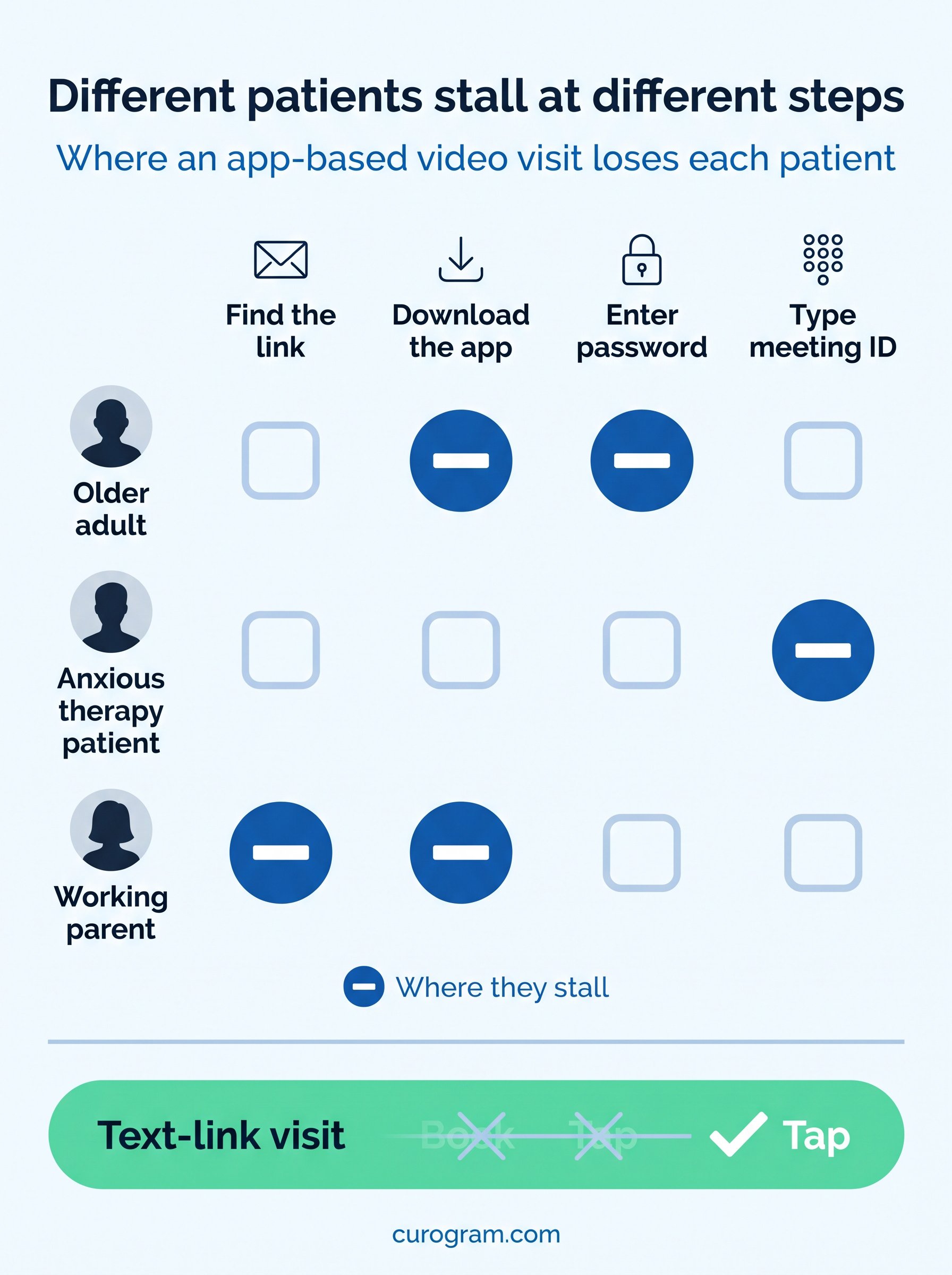
Telehealth for less tech-savvy patients has to work at their skill level, which is tapping a text. Three patients show where the handoff stops people:
|
Patient |
Where the handoff stops them |
What a text link changes |
|---|---|---|
|
Older adult with a chronic condition |
App store and passwords |
One tap in a thread she knows |
|
Anxious therapy patient |
A failed join feels like a sign to quit |
Fewer steps that can fail |
|
Working parent |
No time to install and test |
Joins from a lunch break |
What a Missed Join Costs
In behavioral health, a missed session is more than an empty slot. For a patient already unsure about therapy, a failed connection can be the reason not to rebook.
Older patients tend to quit without saying so. They stop booking virtual visits and go back to the winter drive, or to nothing at all.
The Visit That Comes to the Patient
A text-link visit meets patients where they already are: in their text messages.
A Video Appointment From a Text Message
Visits are booked on the practice's RXNT schedule as usual. Curogram reads that schedule and texts the patient reminders, then a video appointment from text message in the same thread. One tap opens the visit in the phone's browser. Their phone asks for camera access once.
Nearly everyone can get the text. About 98% of U.S. adults own a cellphone, and 91% own a smartphone. Video does need a smartphone with a camera, so patients without one can be booked for a phone visit. Setup details are on Curogram's RXNT integration page.
Private Without an App
Skipping the app doesn't skip the security. HHS guidance says providers must use video vendors that comply with HIPAA and sign business associate agreements.
Curogram is HIPAA-compliant and SOC 2 Type II certified, and it signs a BAA with your practice. Each text carries only a time and a link, never a diagnosis. Patients also never create an account with an outside video company.
Curogram Highlight: Text-Launched Video
Text-Launched Video turns the reminder thread into the doorway. The patient taps once, and a secure video visit opens in the browser. It's a no-download doctor visit: no app, no account, no meeting ID. A "running late" reply reaches a real person at the front desk.
Behavioral health patients join privately. Internal medicine patients handle follow-ups without a drive across town. In family medicine, a parent can do the visit from the kitchen table while the toddler naps. See easy telemedicine for RXNT users.

Care Without the Countdown Panic
When the doorway is one tap, patients stop preparing for visits and start attending them.
The Attendance Baseline
Curogram psychiatry clients average an 11.03% no-show rate across their appointments, based on our internal data. That rate comes from the same text thread that now carries the video link.
A patient who confirmed with one word the day before joins with one tap on the day. That 11.03% covers in-person and virtual visits together, so read it as the baseline the thread already delivers.
From IT Project to Text Message
Each step removed shortens the patient telehealth experience. No inbox search, no password reset, no typed code. For a therapy patient, the hard conversation starts at 2:00, with the full session ahead.
If the connection drops, the same link brings them back. The patient can also text "lost you" in the thread, and staff or the provider can answer right away.
What Patients Do Instead of Setting Up
They spend the full session on care. Many practices pair visits with two-way confirmation texts for RXNT patients, and some send RXNT intake forms by text in the same thread before the visit. Questions the patient forgot to ask go into the thread afterward, where the care team can answer.
For the bigger picture, see one-tap telemedicine for RXNT. For how staff run the day, read about running telehealth alongside RXNT scheduling.
Conclusion: Make Virtual Care Easy to Reach
A video visit a patient can't join doesn't help them. One tap is the standard we'd hold any practice to.
Think of the patients who stopped booking virtual visits. How many were stopped by the doorway, and how many by the doctor?
RXNT keeps the clinical record of the session. The way in is what decides whether the session happens. Make it one tap, in a thread patients already trust, and staff stop fielding setup calls before every virtual block.
Schedule a demo. Tap into a test visit from your own phone and see the whole patient side, from reminder to video, next to your RXNT schedule.
Frequently Asked Questions