
9 min read

BH Clients Pay Faster via Text | Curogram

BH Clients Pay Faster via Text | Curogram
💡Many clients now prefer a behavioral health client payment experience built around mobile text. With Text-to-Pay, a tool like Curogram sends a secure link by SMS right after each session. The client taps, pays, and gets a receipt in under 60 seconds. There is no portal, no login, and no mailed bill to lose.

This simple flow removes the wait for paper statements. It also skips the awkward money talk at the front desk. For clients who manage depression or ADHD, paying in the moment helps. The balance clears before it turns into a forgotten debt.

Payments stay PCI-compliant, and messages stay HIPAA-compliant. The result is faster, calmer billing for your practice and your clients.

A client, who just finished a hard, emotional session, leaves your facility. They feel lighter and ready to move on with their day.

Then, two weeks later, a paper bill lands in their mailbox. By then, the visit feels far away, and the copay is easy to skip.

This gap is common across behavioral health care today. Clients truly want to pay, but the timing works against them.

A small copay competes with rent, gas, and weekly groceries. The bill slowly slips to the bottom of the pile.

The fix here is refreshingly simple. Behavioral health clients pay faster when you text the bill instead of mailing it.

This shift improves the whole behavioral health client payment experience around mobile text. They settle the balance in seconds, right from their phone.

Proven EHR already tracks every balance with clean, real-time dashboards. Yet it has no built-in way to send a payment link to a phone.

Curogram quietly fills that gap. It turns tracked balances into collected revenue, fast.

Paper statements are slow, costly, and easy to ignore. A mailed bill can sit unopened for many weeks at a time.

Meanwhile, the balance keeps growing, and the stress builds for everyone. There is a much better way to close that loop.

Think about how your clients handle money each day. They tap to order food, split rent, and book quick rides.

Their care should fit that same fast, familiar habit. A stamp and an envelope feel out of place now.

In this guide, we explain why texting the bill works so well. You will see how it lowers stress for clients and staff alike.

The goal is steady cash flow without the slow paper chase. Let us walk through how the shift plays out, step by step.

The Villain: The Forgotten Bill – Paper Statements That Pile Up Unopened

Paper bills assume clients will open mail, read it, and act fast. In real life, that rarely happens. A mailed statement is slow, easy to miss, and simple to forget. For many clients, it becomes background noise.

The problem is not that clients refuse to pay. It is that the bill reaches them at the wrong time. Weeks after a session, the moment is gone. The paper sits, and the balance waits.

Why Paper Statements Get Lost

Mail is no longer where people manage money. Most clients live on their phones instead.

A printed bill asks for extra steps that feel like work. People must open it, find a check or card, and reply. Each step adds a chance to stop. That is how good intentions stall.

Mail Goes Unopened

Clients who manage depression or ADHD may not sort mail right away. A bill can sit for days or even weeks. Tight budgets push people to handle urgent costs first. A delayed statement feels easy to set aside.

Some clients rarely check physical mail at all. Bills, ads, and notices blur together in the pile. A therapy copay gets lost in that stack. The balance fades from view, but it does not go away.

Privacy Worries at the Mailbox

A mailed bill from a therapy practice can feel exposing. Many people share a mailbox with family or roommates.

That raises real privacy concerns for sensitive care. The fear of being seen adds friction to paying.

An SMS billing client preference in mental health care is no surprise here. A text feels private and lands only on the client's phone. No one else needs to see it. That privacy makes paying feel safe.

How Small Balances Grow Big

Forgotten bills do not stay small for long. They stack up and start to feel heavy.

Each missed copay seems minor on its own. Together, they form a debt that feels hard to face. Avoidance grows with the total. The longer it waits, the worse it feels.

One Bill Becomes Three

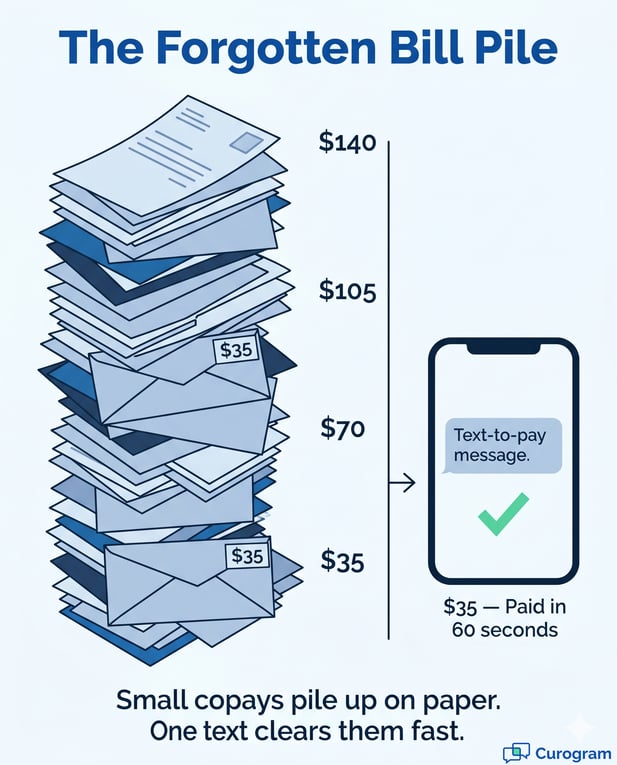
A skipped $35 copay does not simply vanish. Next month brings another, and then another. Soon, the client owes more than they expected. A growing balance feels stressful and hard to face.

Stress and avoidance feed each other in a loop. The bigger the balance, the harder it is to open the envelope. So the client waits, and the total climbs. The practice waits too, unpaid.

Rent Wins, the Copay Loses

A $35 copay is easy to pay by text right after a visit. The same $35 on a mailed bill arrives weeks later. By then, it competes with rent, groceries, and gas. More often than not, the copay loses.

Clients pay what feels urgent and easy first. A delayed paper bill feels like neither one. Timing, not willingness, decides the outcome. Catch the moment, and the copay gets paid.


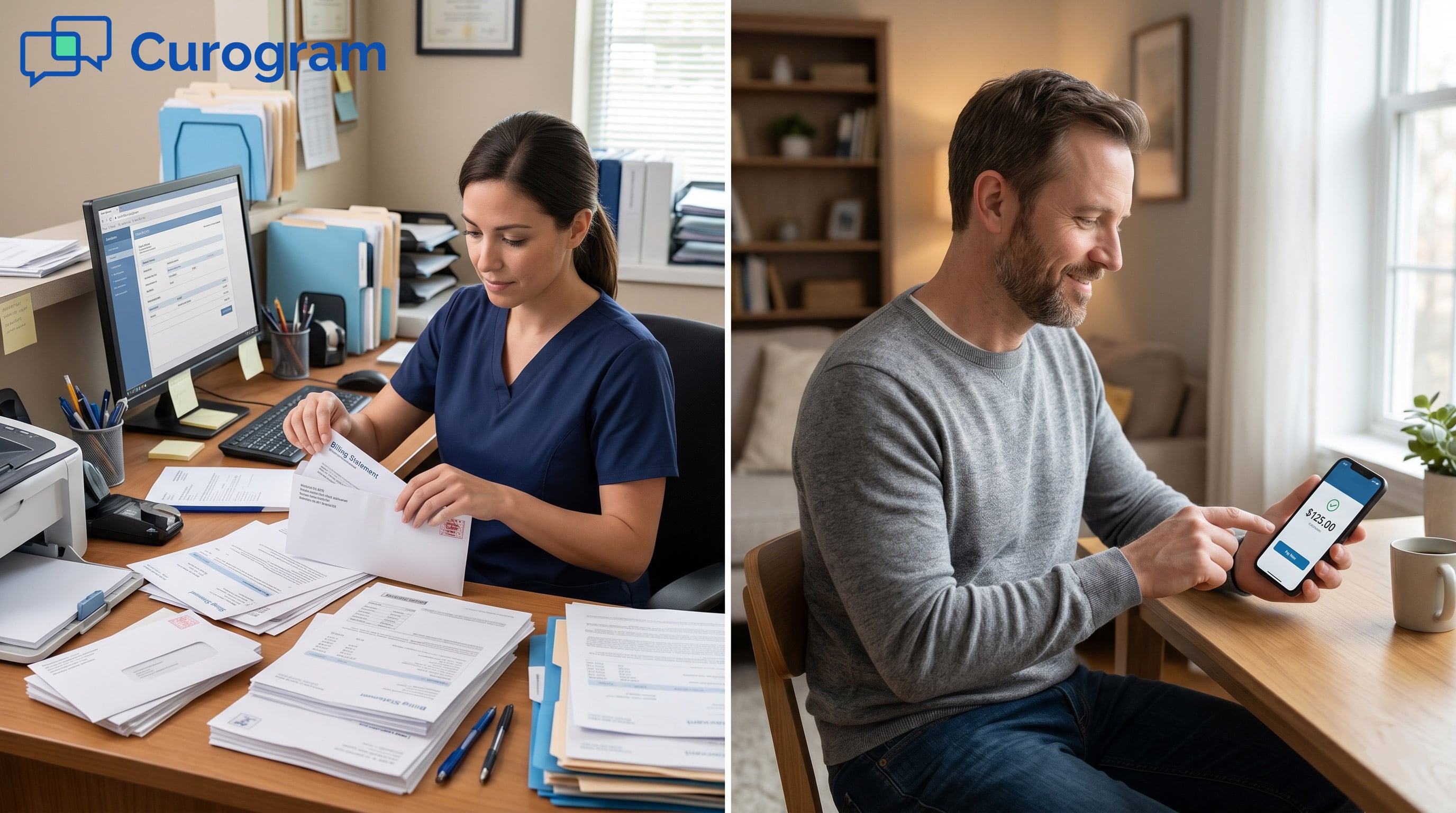
Infographic contrasting a pile of paper medical bills with a fast phone text-to-pay option

The Guide: Curogram – Pay in the Moment, Move On

Curogram does not replace Proven EHR. It completes it. Proven EHR tracks what each client owes with care. Curogram gives clients an easy way to pay it.

The two tools work as a team. Proven EHR is the dashboard that shows the balance. Curogram is the channel that collects it. Together, they close the gap between owed and paid.

Think of Curogram as the missing last step. The money is tracked, but it still needs a path home. A text link is that path. It meets clients where they already are.

How Text-to-Pay Works

The flow is quick and built for phones. Payments run on a PCI-compliant platform. Staff then reconcile each one in Proven EHR. Here is what the client sees.

There are no logins, portals, or paper checks. The whole task lives inside one text thread. That is the point of the design. Less friction means more payments.

A Link Right After the Session

The client gets a text soon after their visit. It reads like a friendly note with the amount due. One tap opens a secure, mobile-ready payment page. There is no app to download and no portal to find.

The message shares only the practice name and the amount. It never lists a diagnosis or treatment type. The client sees a clean, simple request. That keeps the moment calm and clear.

One Tap to Pay

The client enters card details and submits the payment. A confirmation text arrives right away.

The whole task takes under 60 seconds. This smooth mobile payment experience for therapy clients feels effortless.

Both the client and the practice get a receipt. Staff then reconcile the payment in Proven EHR's billing system. The dashboard updates to show collected revenue. Nothing slips through the cracks.

Why It Fits Behavioral Health

Money talk can feel tense in a therapy setting. Text-to-pay removes that strain for everyone.

Behavioral health asks for extra care and trust. The billing flow should protect that trust, not test it. A private text does exactly that. It keeps care and money in separate, comfortable lanes.

No Awkward Money Talk

Staff never have to ask for payment face-to-face. The client pays in private, on their own time. This protects the calm tone of care. It keeps the focus on healing, not billing.

Front-desk money talk can feel cold or rushed. It can also strain a fragile bond with a client. A quiet text request avoids that risk. Everyone keeps their dignity intact.

Stress Leaves With the Balance

Paying right away clears the balance from a client's mind. There is no looming bill to dread later. This text-to-pay client experience for behavioral health stays clean and kind. The relationship feels supportive, not transactional.

An unpaid balance can quietly add to a client's stress. Clearing it fast removes one small weight. That matters most in mental health care. A calm client is a returning client. 


The Success: Paid in 60 Seconds, Not 60 Days

Timing is the secret to getting paid. Catch the client in the moment, and the copay clears fast. Wait weeks, and it fades away. Text-to-Pay puts the bill where attention already lives: the phone.

Speed changes the whole result. A task that takes 60 seconds gets done. A task that takes a stamp and a wait gets skipped. The faster path wins almost every time.

This is the core of the success story. The same client, the same copay, two very different outcomes. One path ends in a forgotten bill. The other ends in a quick, clean payment.

Why Timing Drives Payment

People act when something is fresh and easy. Payment works the same way.

Right after care, the value of the visit is clear. That clarity fades a little more each day. A prompt text uses that window well. A mailed bill misses it entirely.

Pay While the Visit Is Fresh

Right after a session, the value of care is clear. The client is engaged and ready to act. A quick text turns that moment into a payment. Wait too long, and the urge fades.

Memory and intent both fade with time. A bill that arrives weeks later feels distant. The link in hand right now feels simple. Fresh attention is the easiest attention to capture.

Small Copays, Quick Taps

Small balances of $25 to $75 are easy impulse payments by text. The same amounts are easy to forget by mail.

A mobile copay payment in behavioral health takes two taps. That speed is what drives results.

Tiny copays are not worth a trip to the mailbox. They are easy to ignore on paper. But two taps on a phone feel like nothing. So clients clear them on the spot.

From Forgotten to Finished

The shift is simple but powerful. Bills go from ignored to settled.

When you remove friction, behavior changes fast. Clients who would forget a paper bill now pay in seconds. The balance closes while the visit is fresh. That is the whole shift in one line.

Cleaner Billing, Less Stress

When payment is two taps, more clients follow through. Collection rates climb when friction drops. Paying fast also eases client stress. No lingering balance means no quiet worry.

Clean billing helps the practice breathe, too. Fewer overdue notices go out each month. Staff field fewer awkward payment calls. The whole cycle feels lighter on both sides.

Fewer Bills, More Collected

Balances stop piling up month after month. There is no paper, no stamps, and no awkward calls.

The SMS billing client preference in mental health care is clear. Clients pay faster, and the books stay clean.

Less paper also means lower costs for the practice. Printing and postage drop right away. Staff time shifts to claims that truly need it. More gets collected with far less effort.

Paper Statements vs Text-to-Pay

Factor

Paper Statement

Text-to-Pay

Time to pay

Weeks

Under 60 seconds

Where it lands

Shared mailbox

The client's phone

Collection rate

Low (about 20% by industry estimates)

Higher, while the visit is fresh

Privacy

Visible to others at home

Private and secure on the phone

Staff effort

Printing, postage, follow-up calls

Automated SMS link

Collection-rate figures reflect general industry benchmarks for mailed statements, not Curogram client data.

A happy, relaxed patient walking out of a modern Behavioral Health Services clinic

ConclusionYour Clients Pay for Everything on Their Phone. Therapy Should Be No Different.

Your clients already live on their phones. They order food, split rent, and book rides with a tap.

Their therapy copay should work the same way. A mailed bill feels out of step with how they live.

Texting the bill solves the core problem at its root. It catches clients in the moment, when paying is quick.

It removes the paper delay that leads to forgotten balances. It also skips the awkward money talk at the desk.

This is the heart of a strong behavioral health client payment experience built on mobile text. Clients pay faster. Balances do not pile up. The billing relationship stays clean and kind.

Think about what the old way really costs. Printing and postage add up month after month.

Staff lose hours chasing small copays by phone. Worst of all, most mailed bills never get paid.

Text-to-Pay flips that story for the better. Clients pay within hours, not weeks. Paper costs fall away, and follow-up calls shrink. Your team spends time on complex claims, not chasing $35 balances.

The win lands on both sides of the desk. Clients get a calm, private way to settle up. Your practice gets cleaner books and steadier cash flow. No one has to dread the money talk again.

Consider the client side of this shift, too. A quick text fits the rhythm of a busy day. There is no envelope to find and no check to mail. Paying feels as simple as any other phone task.

Faster payment also keeps the care bond strong. Money never crowds out the focus on healing.

The balance clears, and the visit ends on a calm note. That tone matters in behavioral health.

Small copays are where this matters most of all. A $35 balance is not worth a chase by mail.

But it adds up fast across a busy week of sessions. Texting the bill captures it before it slips away.

Your front desk feels the change right away as well. Fewer overdue notices go out each month.

Staff trade billing calls for real client care. The whole workflow simply runs lighter and calmer.

Proven EHR tracks your billing with care and detail. It shows exactly what each client owes, in real time. Curogram helps clients pay it. Together, they turn owed revenue into collected revenue.

So stop mailing bills your clients will ignore. Text the payment link and collect in 60 seconds. Your clients get a calmer way to pay. Your practice gets the revenue it already earned.

See how Curogram completes your Proven EHR practice. Book a demo to watch Text-to-Pay in action.


Frequently Asked Questions

How can texting the bill help behavioral health clients pay faster?

Texting the bill reaches clients while the visit is still fresh. They can pay in seconds, right from their phone. There is no paper to lose and no portal to log into. Catching the moment is what drives faster payment.

Why do paper statements lead to so many unpaid balances?

Mailed bills arrive weeks after the visit, when the moment has passed. By then, a small copay competes with rent and groceries. Some clients also miss or skip mail for many reasons. The delay turns an easy payment into a forgotten one.

How does text-to-pay protect client privacy?

The payment text shows only the practice name and the amount due. It never includes a diagnosis, treatment type, or clinical note. The client sees a simple payment request, not a behavioral health bill. The link opens a secure, private page on their phone.

Why is mobile payment a good fit for behavioral health practices?

Money talk can feel tense in a therapy setting. Mobile payment lets clients pay in private, with no face-to-face ask. This keeps the focus on care, not billing. It also removes the stress of a lingering balance.

How does Curogram work with Proven EHR for billing?

Proven EHR tracks every balance with real-time dashboards. Curogram sends the payment link by SMS to collect it. Payments run on a PCI-compliant platform with instant confirmation. Staff then reconcile each one in Proven EHR's billing system.