9 min read
Text Your Practice Fusion Office — No Portal Login
Mira Gwehn Revilla
:
September 16, 2026
- Any phone works, including older flip phones. No app, no password reset.
- Each location answers from its own number, so the reply lands under a saved contact.
- Staff share one inbox, so whichever office has coverage picks up the message.
- Threads write back to the patient record for the next visit.
- A patient who texts STOP is unsubscribed right away, and the opt out is logged.
Most patient questions take ten seconds to ask. Which building is the Saturday clinic in? Do I fast before the blood draw? Can my son sit with me during the visit? None of them need a chart open.
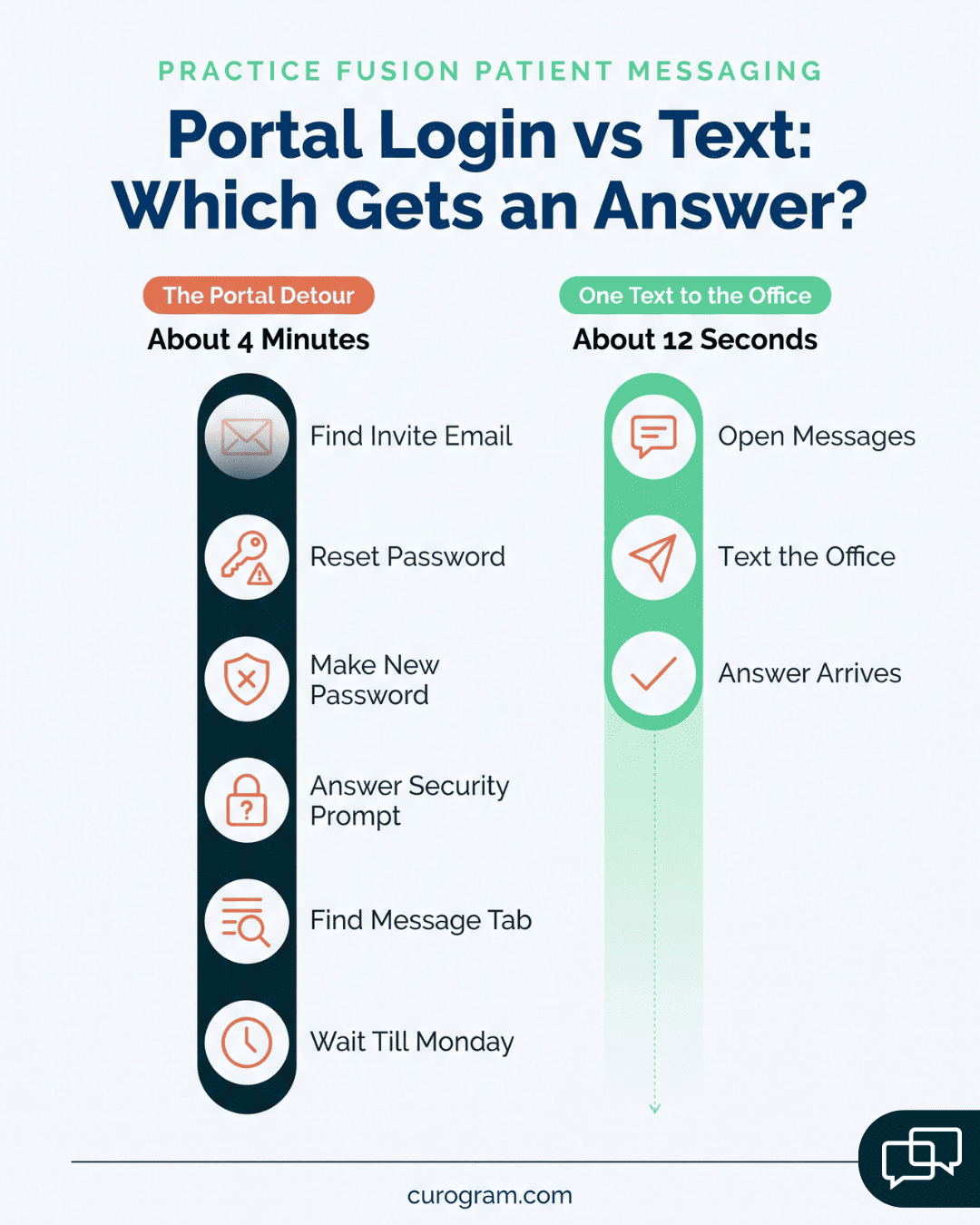
A portal turns each one into a four minute errand. The patient hunts for an old invite email, resets a password, answers a security prompt, then hunts again for the message tab. A reply might not come until the next business day. Plenty of patients quit at step two, and most never try a second time.
That gap is the real problem for a growing medical group on Practice Fusion. Patients book without much trouble. Reaching a person afterward is where it breaks, because the only door for a small question is a login screen.
Texting your Practice Fusion office without a Patient Fusion login closes the gap. The patient texts the same local number saved in their phone. Staff answer from a HIPAA compliant shared inbox. The thread lands on the Practice Fusion chart, so nothing gets lost between offices.
Patient Fusion does records and results well. Quick logistics were never portal work, and pushing them there is how a group ends up with "impossible to reach" sitting under every location on Google.
Missed questions turn into missed visits. Based on our internal data, practices using Curogram run no show rates 53% below the industry average. Patients who get an answer first tend to keep the appointment.
A patient who can't ask often guesses, drives to the wrong building, and becomes a rescheduled slot three weeks out.
The Login Wall Costs More Than It Looks Like
Patient Fusion access starts with an emailed invite. That email went to whatever address sat on the chart the day the patient registered, which might be a work address from three jobs ago. So the reset link goes somewhere they no longer check.
Count the screens between a patient and one address question:
- Search an old inbox for the invite
- Request a password reset
- Build a password with a capital letter and a symbol
- Confirm the new password
- Find the messages tab
- Type the question, then wait for business hours
Six screens and a wait, for something the front desk could answer in a sentence. Most people weigh that against driving over and guessing. Guessing wins more often than any practice would like.
The Recording Ends the Conversation
Patients call the office they know. They get a menu, then a hold tone, then a line telling them to log in to the patient portal for questions about their care. Some hold. Many hang up.
Ask your own front desk how many times a week they say "sorry, we can't receive texts." In most groups the answer is daily, and often several times a day. Each of those is a patient who chose the easiest channel they had and got turned away at the door.
The question doesn't get saved for later. It evaporates, and the patient shows up with it unanswered or doesn't show up at all.
Who Drops Off First
Login walls filter unevenly. A 78 year old with a flip phone cannot open a portal at all, though she has been texting her grandkids for years. Parents in the school pickup line have ninety seconds and one thumb. Standing in a pharmacy aisle, a patient needs a yes or no right then.
Requests for clinic directions and appointment questions make up most of what patients want to ask, and every one of them is time sensitive in a small way. Ask it now or it stops mattering.
Text messaging works on every phone sold in the last twenty years. A portal needs a smartphone or a computer, a working email address, and a password the patient can recover. That's three points of failure before a single word gets typed.
Which Channel Actually Fits Which Message
|
Patient message |
Best channel |
Why |
|
Where do I park at the Saturday clinic? |
Needs a two line answer, not a chart |
|
|
Can I move Thursday to next week? |
Text |
Front desk can confirm in one exchange |
|
Do I fast before this blood draw? |
Text |
Prep instruction, time sensitive |
|
Walk me through my lab results |
Portal or visit |
Clinical detail belongs in the record |
|
Update my full medical history |
Portal or intake form |
Structured data, not conversation |
Reachability Shows Up in Public
The patient experience at a growing medical group gets judged mostly on reachability. Patients write about the phone, the hold time, and the callback that never came. That verdict lands in public, under each location listing, usually in the same paragraph as praise for the doctor.
Based on our internal data, 90% of new patient leads see a Google Business Profile before they ever reach the website. So the review saying "great doctor, impossible to get ahold of" is doing more work on new patient volume than the homepage is.
Each new office multiplies the effect. A group with five locations carries five listings and five separate review histories, and the same complaint about unanswered phones tends to show up on all of them.

Text The Number Patients Already Have
Start with the number already printed on the appointment card, saved in the patient's contacts, and listed on the Google profile. That line gets text enabled. It keeps ringing for calls exactly as it does today, so nothing about the phone system changes for the caller.
When patients text a local office number they have called before, the familiar caller ID does the trust work before anyone reads a word. There is no unknown short code and no 1-800 line that could be a scam, just a reply from the same contact card they used to book last spring.
Each location keeps its own identity in the thread. Rosemead answers as Rosemead, and a text sent to the weekend clinic comes back from the weekend clinic's line. Patients never have to work out which entity in the group they are dealing with, because the number sorts it for them.
One Inbox Behind Every Office Line
Behind those separate numbers sits a single routed inbox. Messages arrive tagged by location. Staff at any office can see the queue, claim a thread, leave an internal note, and hand it off without the patient noticing a single seam.
That routing is what makes coverage work in a group. When the Pasadena front desk is buried at 4:45, someone at a quieter site answers. Nobody waits for one specific person to come back from lunch.
Curogram runs as a Patient Fusion portal alternative messaging channel for everything conversational, while the portal keeps records and results where they belong.
Staff training takes about ten minutes, according to our internal data. Most front desk teams have used text messaging their whole adult lives, so the learning curve is mostly about who claims which thread.
Text Enabling a Line Without Touching Your Phone System
No number changes hands here. The existing office line, landline or VoIP, gets verified for text messaging while voice routing stays exactly where it is. Calls ring the same desk phones. The number on the door sign, the appointment card, and the Google listing all stay correct.
Verification runs per location and usually takes a few business days, which is worth planning around if you are opening a site. Nothing gets ported. Nobody at the front desk learns a new dial plan.
There's nothing for the patient to set up either. With no portal login required, a quick question to the clinic goes out like any other text, and the reply comes back to the same thread. That's the whole onboarding process on their side, and it's why adoption doesn't need a campaign behind it.
The Thread Lands on the Chart
A text exchange that lives only in a phone is a liability. The medical assistant at the next visit has no idea the patient asked about fasting, and the patient has to repeat themselves.
Curogram writes the conversation back to the Practice Fusion chart. So the note about a wheelchair ramp, the confirmation of a rescheduled Thursday, the question about pre visit fasting, all of it sits with the record. Practice Fusion stays the system of record. Nothing becomes a second source of truth.
That matters most across locations. A patient seen at three sites in one year leaves one continuous thread, not three separate memories held by three separate front desks.
Consent, Opt Outs, and What Belongs in a Text
Two separate consent rules apply here. Under the TCPA, informational texts about care need prior express consent. Marketing and recall campaigns need prior express written consent, which is a higher bar. Curogram tracks which one applies to each patient.
STOP unsubscribes instantly and the record is kept, so the group can prove the opt out later. Patients who prefer the phone lose nothing, because the line still rings.
Keep the message itself light. Directions, timing, parking, and confirmations are fine. Diagnoses, results, and clinical detail move to a secure channel or to the visit itself.
Groups handling substance use records have a stricter rule to follow under 42 CFR Part 2, which limits what can be disclosed without written consent.
One Evening Question, Start to Finish
A patient books Saturday morning at the weekend clinic. Friday evening she realizes she has no idea which of the group's five buildings that is. Under the old setup, she would call, hear the portal recording, and decide to guess.
Once the line is textable, the evening goes differently.
|
Time |
What happens |
|
8:02 pm |
She texts the office number in her contacts: "which office is the Saturday clinic?" |
|
8:02 pm |
An auto reply confirms the message landed and gives a response window |
|
8:04 pm |
The covering staffer sees it in the shared inbox, tagged to the weekend site |
|
8:05 pm |
Reply goes out with the address, the cross street, and where to park |
|
8:06 pm |
She saves the address to her maps app and replies "perfect, thank you" |
|
Sat 9:10 am |
She checks in at the right building, on time |
Four minutes of staff attention on a Friday night protected a Saturday slot. That slot would otherwise have been a no show, an apology call, and a rescheduling that pushed her care out three weeks.
Curogram Highlight: No-App 2-Way Texting
No-App 2-Way Texting turns each office line into a working switchboard. On the patient's side it is plain SMS. Messages arrive in the same bubbles as texts from family, with nothing to install and no account to recover.
On the practice side it is a HIPAA compliant inbox. Routing, assignment, saved replies, and a full audit trail sit behind it. Every location keeps its own textable number. Each message threads under the right patient.
Some things it handles that a portal message cannot:
- Answers land in a notification tray patients check dozens of times a day, not an inbox they check monthly.
- Any covering staffer can reply, so evening and weekend questions do not sit until Monday.
- Saved replies cover the questions your group answers hundreds of times, like Saturday clinic parking or fasting windows.
- Threads sync to the Practice Fusion chart, so the next clinician sees the context without asking for it.
- Opt out handling and consent tracking run in the background, so compliance is not a staff memory task.
Patients get an answer to small questions on the first try. Front desk teams trade a phone queue for a text queue, and one person can work three threads at once. Based on our internal data, groups using two way texting cut phone call volume by as much as 50%. Front desk productivity climbs 30% or more.
Conclusion: Meet Patients In Their Messages App
Patients already know how to text. They do it with their pharmacy, their kids' school, and their dentist. Asking them to learn a portal for a parking question is asking for something they won't do.
Patient Fusion holds their records. Curogram carries their conversations. Practice Fusion stays the system of record behind both, and the patient never has to think about how any of it fits together.
Run one audit this week. Ask each front desk how many times a day they tell a patient "we can't receive texts." Then ask how many of those questions took under thirty seconds to answer once the patient finally got through.
Book a demo and text enable your busiest office first. Patients will find it on their own, and the second office will be easier to argue for once the first one has a week of threads to show.
Frequently Asked Questions
Compliance sits on the practice side. Curogram keeps messages in an encrypted, access controlled system with a full audit trail, and tracks consent per patient. Staff keep routine texts to logistics like directions, timing, and confirmations. Clinical detail moves to a secure channel or the visit, which is the same judgment call staff already make on the phone.
They do different jobs. Patient Fusion holds records, results, and history in a structured, permanent place patients can return to. Texting handles the short back and forth that never needed a login. Drop the portal and patients lose record access. Without texting, the ten second questions still have nowhere to go.
Word spreads faster than any announcement. Put one line on the voicemail greeting, one on the appointment card, and have staff say it at checkout. The first patients who try it get an answer in minutes and tell others. Most groups see steady inbound texting within two weeks without running a campaign.
An auto reply confirms receipt and sets expectations right away, which stops the patient from calling three times. The shared inbox holds the thread with its location tag until someone claims it. Groups that rotate light evening coverage answer most questions the same night. Everything else gets worked first thing, in order.
A patient who texts STOP is unsubscribed immediately, and Curogram logs the opt out with a timestamp for compliance. The office line still rings, so nothing is lost for callers. If that patient later wants texting back, staff re collect consent and note it, and the audit trail shows both actions in sequence.