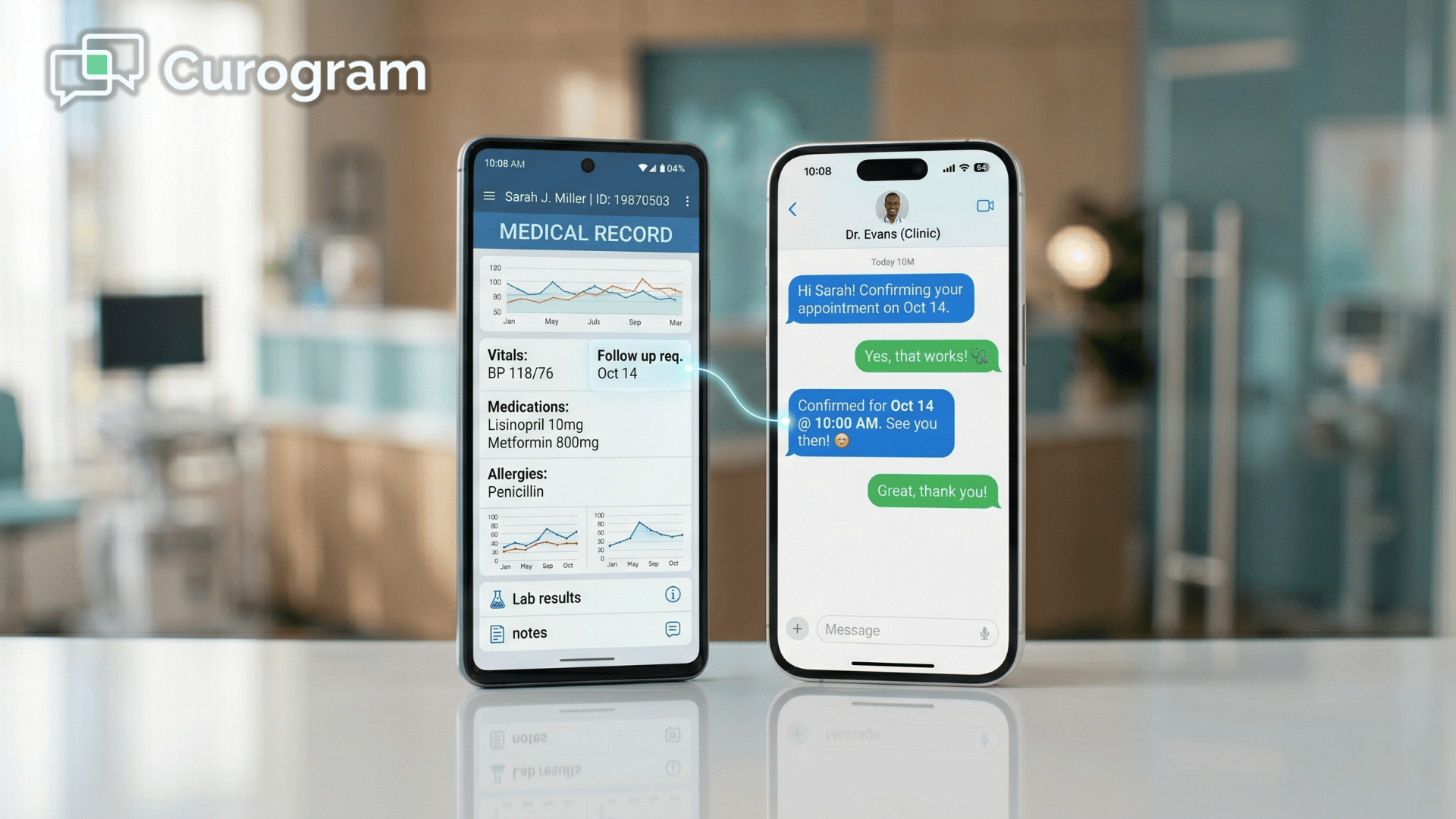
Curogram shows how long patients at each office wait for an answer, then gives your group shared queues and cross-office coverage to shrink that wait everywhere. Practice Fusion holds the record of the visit. Curogram handles what happens between visits.
The villain is the three-day callback. No one designed it. No report flagged it. Once response times are visible per office, they become fixable, and patients feel the change before your numbers do.
Your patients keep a clock on you. It starts the moment they leave a voicemail, send a portal message, or hang up after hearing that someone will get back to them. They never mention it. They just count.
At most multi-office groups, that clock stops in under an hour at the flagship location. At the satellite office across town, it can run for three days.
Same brand. Same providers. Same logo on the door. Completely different experience.
Here is the uncomfortable part.
Nobody in your organization can tell you which office is which, because nothing in your current systems measures the gap between a patient's question and your answer. Practice Fusion records what happened during the visit. It was never built to time what happens after.
So the number goes unwatched. And unwatched numbers drift.
Meanwhile, a patient waits for a callback clinic staff fully intend to make. Monday turns into Wednesday. Wednesday turns into "I'll just ask someone else." That patient never files a complaint or posts a one-star review.
They simply stop coming back, and their chart sits in your system looking perfectly healthy. That is what makes slow replies so expensive. The damage stays invisible in every report you already run.
Measuring patient response experience across Practice Fusion offices changes that. It turns a vague feeling into a number with a name attached to it. Numbers with names attached tend to improve, because someone is finally accountable for them.
This article covers why answer speed has quietly become a loyalty metric, why the fix is not simply telling your staff to work faster, and how growing groups close the gap between their fastest office and their slowest one.
You already suspect one of your locations is slower than it should be. Let's find out by how much.
How a Three-Day Callback Quietly Ends a Relationship
Patients do not experience your group the way your org chart does. They experience it one reply at a time.
And their patience is not calibrated by healthcare norms. It is calibrated by their bank, their pharmacy app, and the retailer that answers a chat message in ninety seconds.
The same-day answer expectation did not come from medicine. It arrived from everywhere else and moved in permanently.
Now watch how a small delay becomes a lost family.
A patient leaves a voicemail Monday morning about a confusing bill. Tuesday passes. Wednesday passes. Thursday they call again, this time annoyed, and someone finally clears it up in about four minutes.
The answer was easy. The delay was the problem.
Four minutes of work. Three days of silence. One relationship dented.
Multiply that across a busy office and the pattern hardens into a reputation. Slow responders rarely receive complaint letters. Patients switch practices over slow communication without ever explaining why, and the office never learns what happened.
The chart stays open. The family is gone.
Worse, families do not grade each office separately. They take their worst single experience and apply it to your whole brand. One office answers in an hour, another takes days, and the entire group inherits the slower number.
Here is what that gap looks like with numbers on it.
The example below models two offices of roughly 4,000 active patients each.
| What you measure | Fast office | Slow office |
|---|---|---|
| Average time to answer a routine question | Under 1 hour | 2–3 days |
| Patients who follow up a second time | 5% | 30% |
| Extra staff touches per 100 messages | 5 | 30 |
| Yearly attrition linked to communication | 2% | 6% |
That 4-point attrition gap works out to 160 patients a year. At an average annual value of $300 per patient, the slower office quietly gives up about $48,000 every 12 months.
These figures are illustrative, but the shape holds across most groups.
The staff cost stacks on top. Those 25 extra touches per 100 messages, applied to roughly 600 messages a month, add about 150 repeat calls. At four minutes each, that is 10 hours a month of work that existed only because the first answer came too late.
In practice, you are paying twice. Once in payroll, once in patients.
Put a Scoreboard on Every Office's Response Time
You cannot manage a number you never see. So the first move is not hiring. It is not a new script taped to the front desk monitor either.
It is visibility. Curogram's medical practice analytics work as a scoreboard for your whole network, turning the wait that patients feel into a number with a name beside it.
Give the Wait Time an Owner
Response-time tracking runs per office and per queue. That lets you compare patient experience by office instead of guessing. Billing questions at the north location. Refill requests at the south one.
That level of detail matters.
"We are slow" is not something a team can act on.
"Billing messages at the Westside office average 31 hours" is something a manager can fix by Friday.
Once leaders can review patient experience by office side by side, the talk shifts from opinion to action.

Stop Messages From Sitting Unclaimed
Most delays are not laziness. They are ownership gaps. A message lands in a general folder, three people assume someone else has it, and it ages.
Shared inboxes fix that. Staff claim and route each thread, so every conversation has exactly one owner.
Cross-office coverage goes a step further. A busy morning at one site gets picked up by staff at another, and your two-person satellite office stops being the weak link.
Keep the Chart Context Attached
Speed only helps when the answer is right. Threads carry Practice Fusion chart context, so the person replying can see who they are talking to and what happened at the last visit.
Fast answers become well-informed answers, and that combination is what patients actually remember.
Use the Channel Where Fast Is Cheap
Phone calls are costly to answer quickly. Text messages are not.
A staff member can clear three text questions in the gaps between other tasks. Texting also carries a 98% open rate, so your reply actually gets read.
One caution belongs here. Standard SMS is not encrypted, so use it for basic logistics only. Anything involving health details moves through Curogram's secure channel, where patients verify who they are first.
The result is a channel where speed is finally cheap for your team and obvious to your patients.
What Changes When Every Office Answers Fast
When answer speed becomes a tracked number, three things tend to move together.
- No-shows drop. Curogram clients run no-show rates 53% below the industry average, because patients who can reach you easily reschedule instead of vanishing.
- Call volume falls. Practices cut phone call volume by as much as 50%, which frees the front desk for the calls that genuinely need a voice.
- Confirmations climb. More than 75% of appointments get confirmed among current clients, turning your schedule from a guess into a plan.
Read those together and a clear pattern shows up. Responsiveness and attendance travel in the same direction, because both depend on whether reaching your office feels easy or exhausting.
The daily change is smaller than the numbers suggest, and more powerful. Your team stops saying "we'll call you back" and starts saying "answered before lunch." At every location, and now verifiably.
There is a reputation effect too. Read your reviews closely and you will notice the phrase patients keep reaching for: easy to reach. Not cutting-edge. Not state of the art.
That phrase does quiet work for you. It is exactly what a family comparing three practices online uses to decide, and it comes straight from how fast you answered someone last Tuesday.
Communication speed shapes retention more than most groups expect, and it compounds. The link between response speed and patient loyalty shows up first in single conversations, then in reviews, then in the number of patients who simply stay.
None of that requires a bigger team. It requires knowing which office is slow, and by how much.
Answer Speed Is a Promise You Are Already Being Graded On
Your patients have been grading your response times all along. The only new thing is that you can finally see the grade.
That is the real shift. Practice Fusion is built to hold your record of the encounter, while Curogram is built for the patient's experience between encounters, which is where loyalty is quietly won or lost.
Try this before you change anything. Call your busiest office this week, leave a routine voicemail question the way a patient would, and time how long the answer takes. Then repeat the exercise at your smallest location. Whatever gap you find, your patients found it first.
Most groups are surprised. Not because their staff are careless, but because nobody ever asked the system to measure this, so nobody could fix it.
The encouraging part is that response speed improves quickly once it gets attention. Give each queue an owner and a target, let a second office absorb the overflow, and move routine questions to a channel where a two-minute reply is realistic. The number usually moves in weeks, not quarters.
You do not need a bigger front desk. You need visibility into where the time goes, then a plan to close the distance between your fastest office and your slowest one.
The payoff lands in numbers you already track. Fewer no-shows, fewer repeat calls from patients chasing an answer, more confirmed appointments, and more reviews mentioning how easy your practice was to reach.
The three-day callback was never anybody's policy. It was a blind spot, and blind spots close the moment somebody turns on the light.
If you want to see your own per-office response times, that is the fastest place to begin. Schedule a Demo and walk through the dashboards mapped to your office structure.
Frequently Asked Questions
Yes, but silently. Communication friction is a leading driver of quiet attrition. Patients rarely complain first. They simply book somewhere else next time, and your chart never records the reason.
For routine text questions, a same-morning reply feels excellent and a same-day reply is the floor most patients accept. Anything past 48 hours starts working against you. The dashboard lets your group set and hold its own standard per queue, so billing can carry a different target than refills.
Yes, and that is exactly what cross-office coverage is designed for. Shared queues let a small front desk deliver the same response experience as your founding office, because teammates elsewhere can claim and answer messages during a rush. Size stops determining speed.
No. Practice Fusion remains your system of record for the encounter itself. Curogram sits alongside it and handles the conversations between visits, pulling chart context into each thread so replies are both fast and accurate.
Not through standard SMS, which is not encrypted and should carry logistics only, such as appointment times and general reminders. Anything involving protected health information moves through Curogram's secure messaging channel, where the patient verifies their identity before viewing the message. Your team gets speed without trading away compliance.