
8 min read
Eliminating $50K/Month Paper Billing for Oracle Health | Curogram
Aubreigh Lee Daculug
:
May 8, 2026
Your EHR and Curogram only handle tokens, never card numbers.
All SMS traffic uses TLS 1.2+ encryption. Payment links are one-time use and expire within 24 hours. Every transaction is logged for HIPAA audits.
Curogram holds a HIPAA BAA and SOC 2 Type II certification. This is how SMS payment security HIPAA PCI DSS healthcare compliance works in practice — without adding new breach risk to your organization.
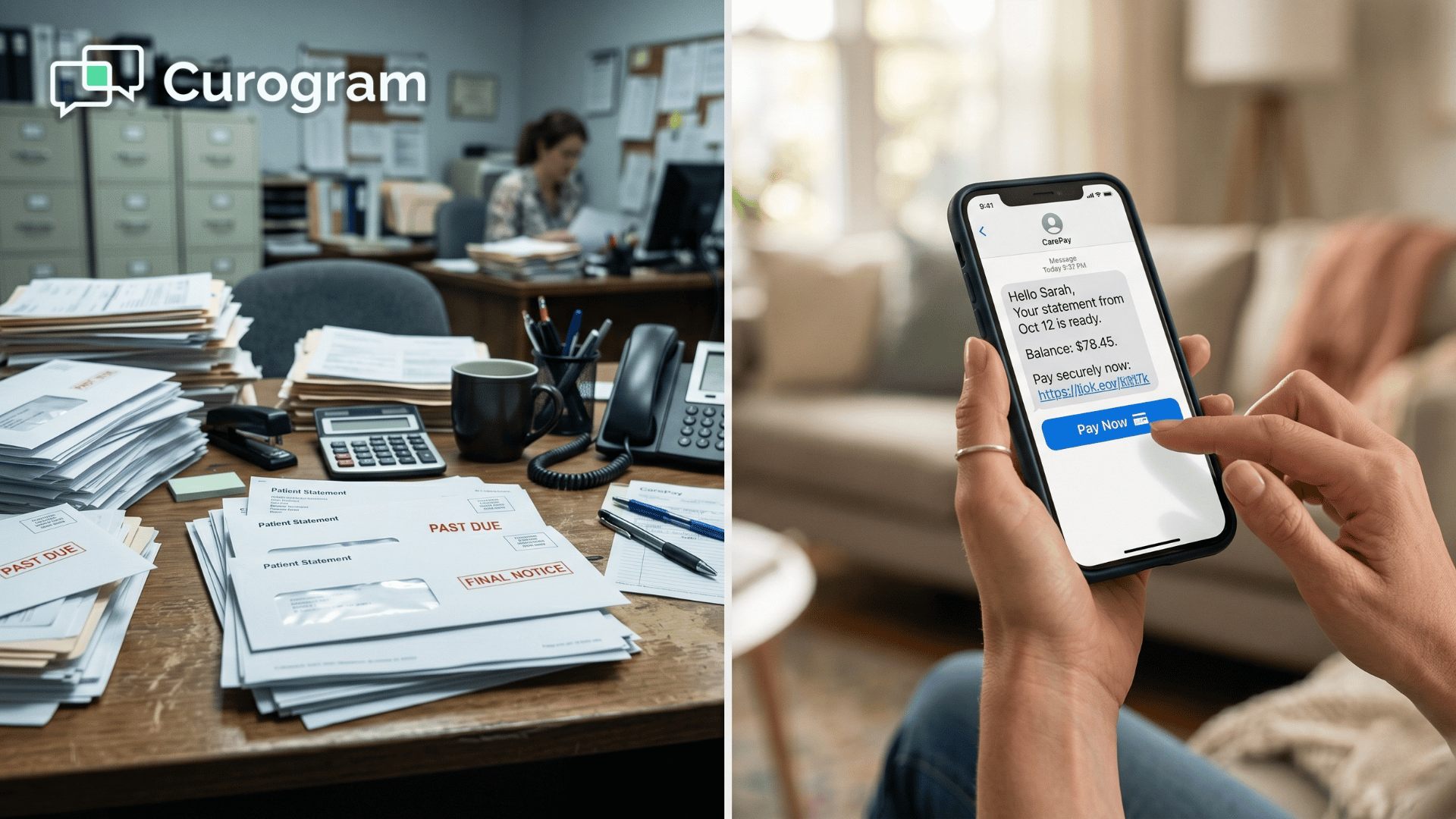
Picture this. It's a Monday morning, and your billing team is stuck on the phone again, manually keying in credit card numbers from patients calling about overdue balances.
One staffer is typing card details into a sticky note. Another is writing a CVC on a printed statement.
You already know where this is heading. Every one of those touchpoints is a breach waiting to happen.
For a medical practice running on Oracle Health, this isn't just a workflow problem. It's a compliance problem with real teeth. A single mishandled card number can trigger a HIPAA investigation, a PCI DSS audit failure, and the kind of headline no health system wants attached to its name.
So when someone suggests sending payment links by text, the IT Director's first reaction makes sense: "Absolutely not." SMS feels casual. Casual feels risky. And risky feels like a fast track to a breach report.
Here's the part most teams miss. The right architecture flips that risk on its head.
A properly designed text-to-pay system can actually reduce your exposure compared to phone-based payments, paper statements, or unencrypted email.
The trick is in how the data flows — what touches your servers, what touches your EHR, and what stays inside a certified payment processor's vault.
This guide is for IT Directors and Compliance Officers who need more than reassurance.
You need architecture diagrams, audit evidence, and a clear answer to one question: can SMS payment security HIPAA PCI DSS healthcare compliance actually coexist?
The short answer is yes. The longer answer involves tokenization, TLS 1.2+ encryption, BAAs, and SOC 2 Type II reports. Let's break it all down so your next compliance meeting goes smoothly.
How PCI DSS Shapes Safe Payment Processing in Healthcare
Payment data is one of the most attractive targets in healthcare. Cybercriminals don't just want medical records — they want anything that converts to cash quickly. Credit card information does exactly that.
That's why the Payment Card Industry Data Security Standard exists. PCI DSS sets the security baseline for any organization that stores, processes, or transmits credit card data.
Get it wrong, and you face fines, forensic audits, and lost merchant privileges.
Why PCI DSS Levels Matter More Than You Think
PCI DSS compliance comes in four tiers based on how many card transactions you process each year.
Here's the quick breakdown:
- Level 1: more than 6 million transactions per year, with the strictest controls and annual third-party audits.
- Level 2: 1 to 6 million transactions per year, with annual self-assessments and quarterly scans.
- Level 3: 20,000 to 1 million e-commerce transactions per year.
- Level 4: fewer than 20,000 e-commerce transactions per year, the lightest tier.
If your medical practice processes credit cards directly through your own systems, you may be on the hook for hefty PCI obligations yourself.
That's expensive. It's also a major operational drag on your IT team, contributing to high administrative healthcare costs seen across the industry.
Curogram's architecture sidesteps this completely. Credit card data never enters Curogram's platform or your Oracle Health environment. It flows straight to a Level 1 certified processor — Stripe, Square, or PayPal — through a process called tokenization.
A token is a stand-in. A meaningless reference code that points back to the real card data sitting safely in the processor's vault. Your systems get the token. The processor keeps the card. Everyone wins.
The Data Flow From Patient to Oracle Health
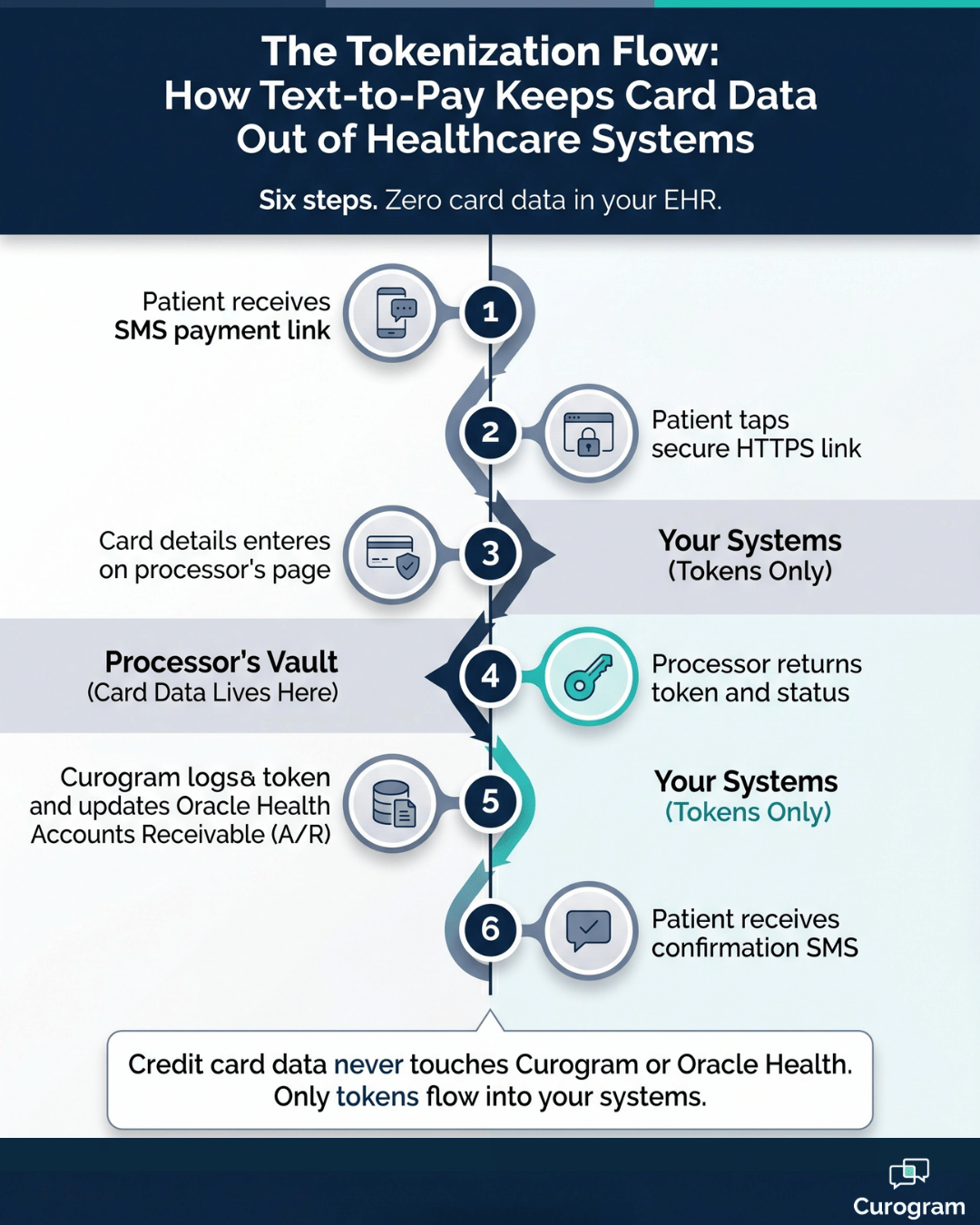
Here's what actually happens when a patient pays a balance through text-to-pay.
The path matters because every step is engineered to keep card data away from your infrastructure.
Step 1:
The patient receives an SMS with a secure payment link. The only data involved at this point is their phone number.
Step 2:
The patient taps the link and lands on a payment page hosted by the processor — not by Curogram, not by your EHR. The URL is HTTPS with a valid SSL certificate, so the connection is encrypted from the moment they arrive. Nothing touches your systems here.
Step 3:
The patient enters their card number, expiration date, CVC, and billing zip directly on the processor's page. That data is encrypted in the browser and sent straight to the processor's backend.
Curogram never sees it. Oracle Health never sees it.
Step 4:
The processor validates the card, charges the account, and returns two things to Curogram:
A status message (success or failure) and a payment token.
No raw card data is ever returned.
Step 5:
Curogram logs the token along with the patient ID, amount, and timestamp. The token is then passed to Oracle Health's A/R module, which updates the patient's account balance automatically.
Step 6:
The patient receives a confirmation SMS:
"Payment of $200 received. Thank you."
Clean, simple, and fully audit-ready.
Notice what's missing. There is no point at which raw credit card data enters Curogram or Oracle Health. The card lives at the processor. You get the receipt.
For your IT team, this means one outbound HTTPS rule in the firewall. No inbound connections. No new credentials to rotate. No EHR modifications to handle card numbers.

Why Tokenization Limits Damage During a Breach
Imagine the worst-case scenario. Curogram is breached tomorrow. What does an attacker walk away with?
Tokens. Just tokens. Strings of characters that mean nothing outside the payment processor's environment.
They cannot be used to charge a card.
They cannot be sold on dark web marketplaces.
They cannot be replayed against another merchant.
Compare that to a phone-based payment workflow where staff jot card numbers into a Slack message or an unencrypted email thread. A breach of that mailbox hands the attacker live, usable card data — instantly monetizable.
Tokenization is endorsed by PCI DSS as a best practice for exactly this reason.
It shrinks your attack surface dramatically while keeping payment workflows fast and patient-friendly, while helping reduce inefficient healthcare billing processes.
How HIPAA Fits Into SMS Payment Workflows
PCI DSS handles the card side. HIPAA handles the patient side. Both need to work together for SMS payment security HIPAA PCI DSS healthcare compliance to hold up under audit.
Business Associate Agreements and What Counts as PHI
When you deploy Curogram, you sign a Business Associate Agreement. The BAA is a legal contract that obligates Curogram to protect any Protected Health Information it handles on your behalf.
Under HIPAA, PHI includes anything that could identify a patient — name, phone number, account balance, date of service, provider name. Your patient's $200 balance tied to their name and last visit? That's PHI.
Credit card numbers themselves are not PHI when handled by a PCI-compliant processor. But the surrounding context — who paid, how much, for what visit — definitely is. Curogram's architecture protects every piece of that context with HIPAA-grade safeguards.
The BAA also gives you a legal lever. If Curogram ever experiences a breach affecting your data, they are contractually required to notify you immediately. Your compliance team gets the documentation it needs to act fast and report properly.

Encryption in Transit and at Rest
Every SMS sent through Curogram travels across encrypted channels. The platform-to-carrier connection uses TLS 1.2 or higher, so anyone intercepting traffic between Curogram and the cellular network sees scrambled data.
Standard SMS itself isn't encrypted on the carrier-to-phone leg.
That's why Curogram's payment messages are designed to contain zero PHI in the text body.
They simply say something like, "You have a balance due. Tap here to pay."
All the sensitive context lives behind the secure link.
At rest, every record in Curogram's database — phone numbers, transaction logs, tokens — is encrypted with AES-256. Even physical access to the servers wouldn't expose readable data.
Oracle Health integration uses OAuth 2.0. Access tokens expire automatically and are never stored long-term. All API calls run over HTTPS. Even if a Curogram credential were stolen, it would be useless within hours.
Put simply, you're working with three overlapping layers of protection:
- TLS 1.2+ for every message Curogram sends to carriers
- AES-256 for everything stored in Curogram's database
- OAuth 2.0 for every API call between Curogram and Oracle Health
That layered approach is what compliance officers mean when they talk about defense in depth.
No single point of failure carries the whole system.
Audit Logging That Holds Up Under Review
Compliance Officers love this part. Every action in Curogram's text-to-pay system is logged with a timestamp, patient ID, amount, status, and provider. These logs are retained for at least 6 years to meet HIPAA standards.
Need to pull every payment captured on March 15? It takes seconds. Need to trace every SMS sent to a specific patient? Also seconds. Need to flag every transaction over $1,000 for a CMS audit? Done.
When a regulator comes knocking, you can show the full chain of custody: when the SMS went out, when the payment link was clicked, when the charge cleared, and when Oracle Health's A/R balance updated.
That kind of traceability turns audits from stressful events into routine paperwork.
Ready to See Secure Text-to-Pay in Action? Schedule a Demo
You've seen the architecture. You've seen the safeguards. Now it's time to see it work inside your environment.
A demo is the fastest way to confirm that text-to-pay fits cleanly into your Oracle Health setup without adding compliance debt. In about 30 minutes, you and your IT team can walk through the data flow, see the audit logs in action, and ask the hard questions about encryption, token handling, and breach response.
Bring your toughest compliance scenarios. Ask about edge cases. Push on the architecture. Curogram's security team is built for this conversation, and your team deserves real answers — not marketing slides.
Here's what most IT Directors tell us after a demo. The mental model shifts.
What started as "SMS payment sounds risky" becomes "this is actually safer than what we're doing today."
Tokenization, certified processors, encrypted channels, and clean audit trails replace sticky notes, phone-based card entry, and unencrypted email threads.
Your compliance officer gets documentation that holds up under scrutiny. Your billing team gets faster collections. Your patients get a payment experience that feels modern and trustworthy.
Everyone wins, and your IT team spends less than 5 hours a year managing the whole thing.
Phone-based payments are a slow drain on staff time and a quiet liability on your security posture. Paper statements are even worse — they cost more and collect less.
Text-to-pay isn't just a billing upgrade. It's a security upgrade.
Schedule a demo with Curogram today. Bring your IT Director, your Compliance Officer, and your toughest questions. We'll walk through the architecture, the SOC 2 findings, and the exact integration steps for your Oracle Health environment.
Frequently Asked Questions
The risk is extremely low. Payment links are one-time use and expire within 24 hours, so a stolen link has a short window of usefulness. An attacker would also need to know the patient's outstanding balance to confirm the payment looked legitimate. In practice, fraudsters target far easier wins — phishing emails and stolen cards used at retail. Paying off a stranger's medical bill isn't a profitable attack vector.
No. Curogram never stores credit card data, period. For recurring payments like monthly payment plans, the processor stores a token representing the patient's payment method. Curogram simply tells the processor, "Charge this token for $50 on the first of the month." The card itself stays with the processor. This keeps your organization out of the card-storage business entirely.
You can present a complete evidence package: Curogram's SOC 2 Type II audit report, the signed HIPAA BAA, the payment processor's PCI DSS Level 1 attestation, transaction and audit logs exported from Curogram, and any penetration testing results your team commissions. Together, these documents give regulators a clear, defensible picture of your security posture.
No major modifications. Curogram integrates with Oracle Health through standard API connections using OAuth 2.0. The only network requirement is allowing outbound HTTPS traffic from Curogram to the payment processor. Your EHR continues to function as the source of truth for balances and account data.
Most IT teams complete their internal review in 2 to 4 weeks. Curogram provides architecture documentation, the SOC 2 report, and the BAA upfront. After that, your team usually only spends about 5 hours per year on ongoing security management for text-to-pay, since the heavy compliance lifting sits with the certified processors.