8 min read

Overdue for Your Modmed Specialist? Schedule Via Text in Seconds

Overdue for Your Modmed Specialist? Schedule Via Text in Seconds
💡 Modmed patients who are overdue for follow-ups or annual exams can receive a recall text from their specialty practice and schedule an appointment by replying to the message — no phone call, no portal login, no hold music.       

Curogram works alongside Modmed to send friendly, personal reminders from the practice's familiar number. The text names the type of care that is due and invites a reply.


For practices, this is the gentle nudge that turns months of patient procrastination into a confirmed visit, often within the same week — and reactivates revenue that was quietly slipping away.


A dermatology patient meant to book her annual skin check in January. Then February slid past. Spring filled up with the kids. By August, she still has not called — not because she does not want the appointment, but because picking up the phone keeps falling to next week.

She is not alone. Across your panel, dozens of patients are doing the same quiet thing right now.

Modmed's EMA already knows who they are. It tracks the visit dates, the recommended intervals, the surveillance schedules.

The system can tell you, in seconds, which patients are overdue. The question is what happens after that report runs.

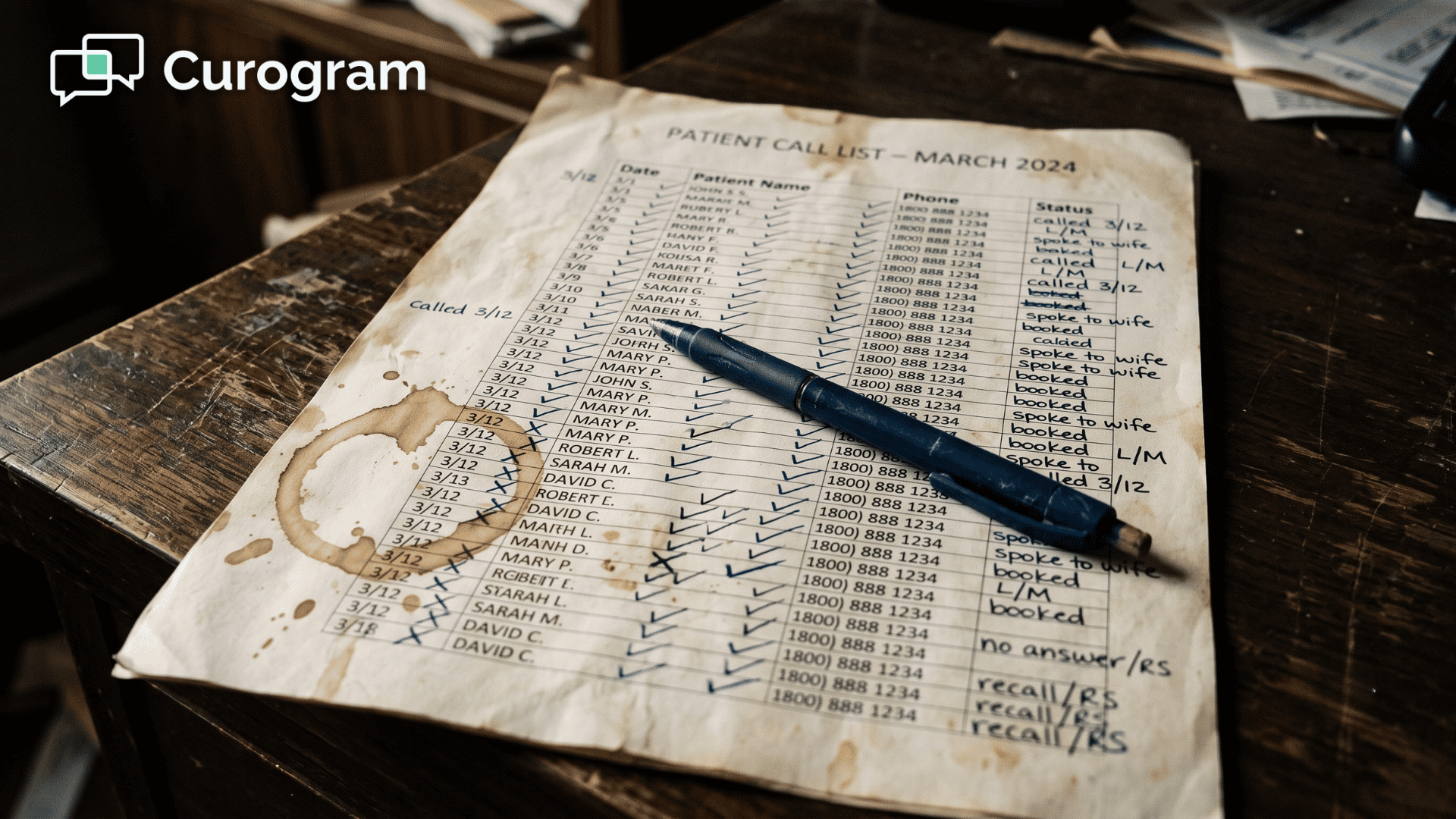
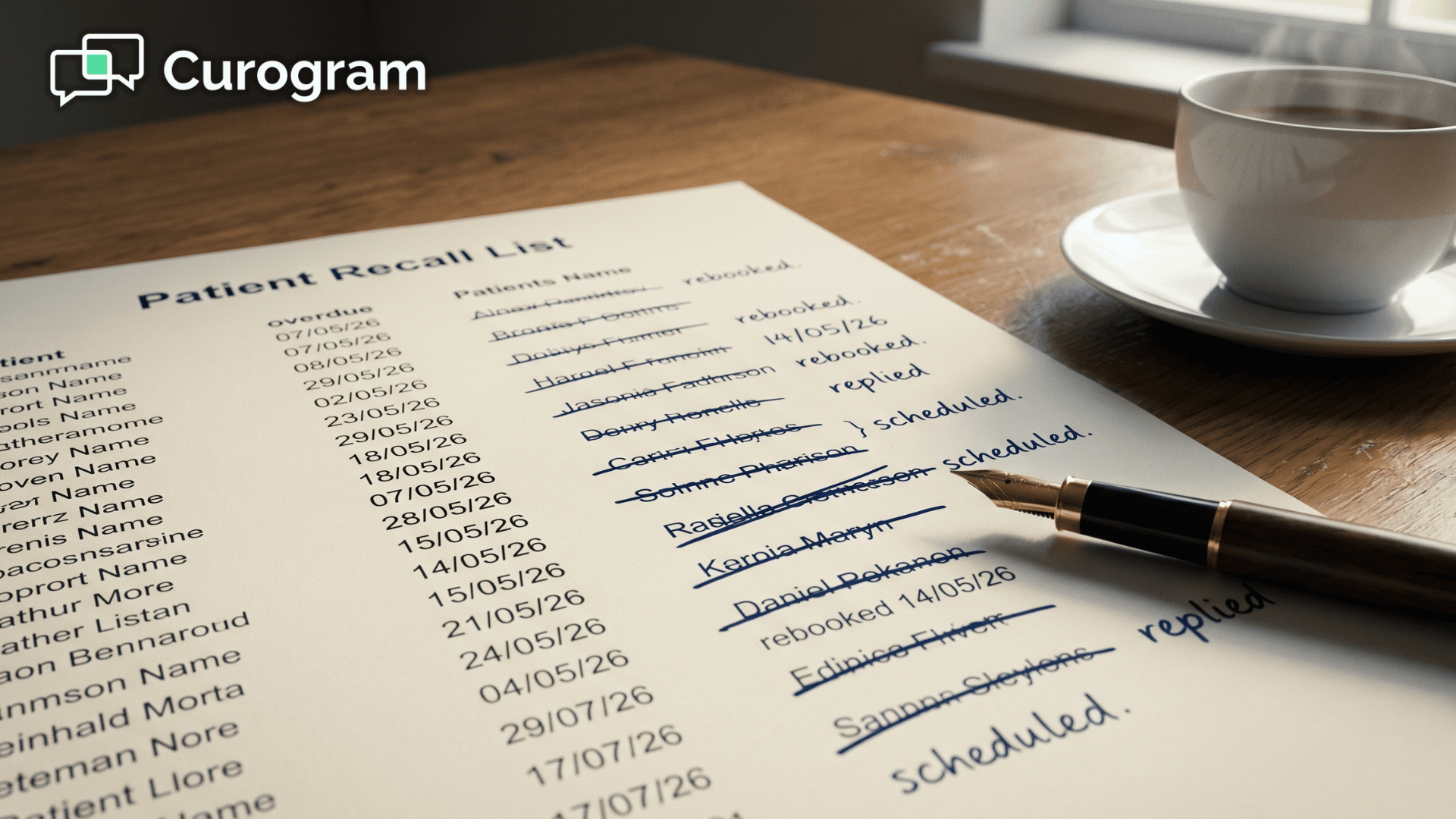
For most practices, the honest answer is: not much. The list gets exported. Someone makes a few calls. Voicemails go unreturned. The list gets buried under more urgent work. The patients stay overdue.

That is where the leak lives. Not in your clinical workflow. Not in your providers' schedules. In the gap between knowing a patient is overdue and giving them an easy way to come back.

This is the entire premise behind the patient recall text message experience Modmed specialty practices are starting to lean on. A friendly text from your practice's own number, sent to the right person at the right time, with a simple invitation to reply.

That single change — replacing a phone call you cannot fit into the day with a text the patient can answer in 10 seconds — is what reopens the door.

The rest of this article walks through exactly what that looks like, from the patient's side.

Why Overdue Patients Are Not Avoiding You — They Are Just Busy

Here is what the data and the front desk both agree on: most overdue patients are not unhappy with your practice.

They have not switched providers. They have not lost interest in their health. They are simply busy.

A dermatology patient knows she needs her annual skin check. She has even said it out loud — to her partner, to a friend at dinner, to herself in the car. The intention is there. What is missing is the moment when calling the office actually fits into her day.

By the time she has a quiet 15 minutes, your phones are already busy with someone else's emergency.

The barrier is not resistance to care. It is friction. And friction, combined with the easy inertia of "I'll do it next week," is what builds a 6-month gap into a 2-year one.

The Phone Call Is Doing More Damage Than You Think

Think about what it actually takes to schedule a follow-up with a specialty practice today. The patient calls.

They navigate an automated menu. They wait on hold for 3 to 10 minutes. They explain why they are calling. They wait again while staff pull up provider availability. They negotiate times. They confirm.

Total time: 8 to 15 minutes of active effort.

For a patient who is already procrastinating, that is the difference between booking today and "I'll try again tomorrow." Tomorrow rarely comes.

A text reply, by contrast, takes about 10 seconds. The effort barrier drops from 15 minutes to a few taps. That is not a small improvement — it is a different category of experience.

What the Care Gap Costs the Patient

Behind every overdue appointment is a small clinical risk that grows quietly.

The dermatology patient overdue for a skin check could be carrying an early melanoma.

The post-cataract ophthalmology patient with slightly worsening vision could have a treatable condition that is progressing without monitoring.

The orthopedic patient who skipped a 6-week follow-up could have a complication that is not being watched.

None of these patients are thinking about that in their daily life. They are thinking about getting through the week.

A recall text is not designed to scare them. It is designed to remove the one thing standing between intention and action.

How a Recall Text Actually Lands on the Patient's Phone

This is where it gets concrete. The overdue appointment reminder text Modmed ophthalmology dermatology and other specialty practices are sending through Curogram does not look like a marketing blast. It does not arrive from a 5-digit short code or a generic "do not reply" number.

It comes from the practice's own phone number — the same number already saved in the patient's contacts.

A Sample Recall Text, Word for Word

Here is what the patient sees on their lock screen:

"Hi Sarah, this is Westside Dermatology. It's been over a year since your last skin check. We'd love to get you scheduled. Reply here or call us at (555) 123-4567."

That is the whole message. First name. Practice name. Specific reason. Open invitation to reply. No links. No portal. No code to enter.

Sarah replies:

"Yes, I've been meaning to schedule. Anything next week?"

Your staff respond from the same conversation thread with two or three open times. Sarah picks one. Staff confirm. The appointment is on the books.

Total elapsed effort on Sarah's side:

Four text messages over about three minutes.

What Two-Way Scheduling Looks Like in Curogram

This is the easy scheduling from text message for Modmed patients now expect from every business they interact with — and increasingly from their doctor's office.

The flow is short. The patient receives the recall text instantly. They reply to schedule in about 10 seconds. Your staff send open times back within 30 seconds. The patient picks a slot, and the appointment is confirmed in roughly a minute.

No phone tree. No hold time. No voicemail tag. The conversation lives in one thread, which both the patient and the staff can scroll back through whenever needed.

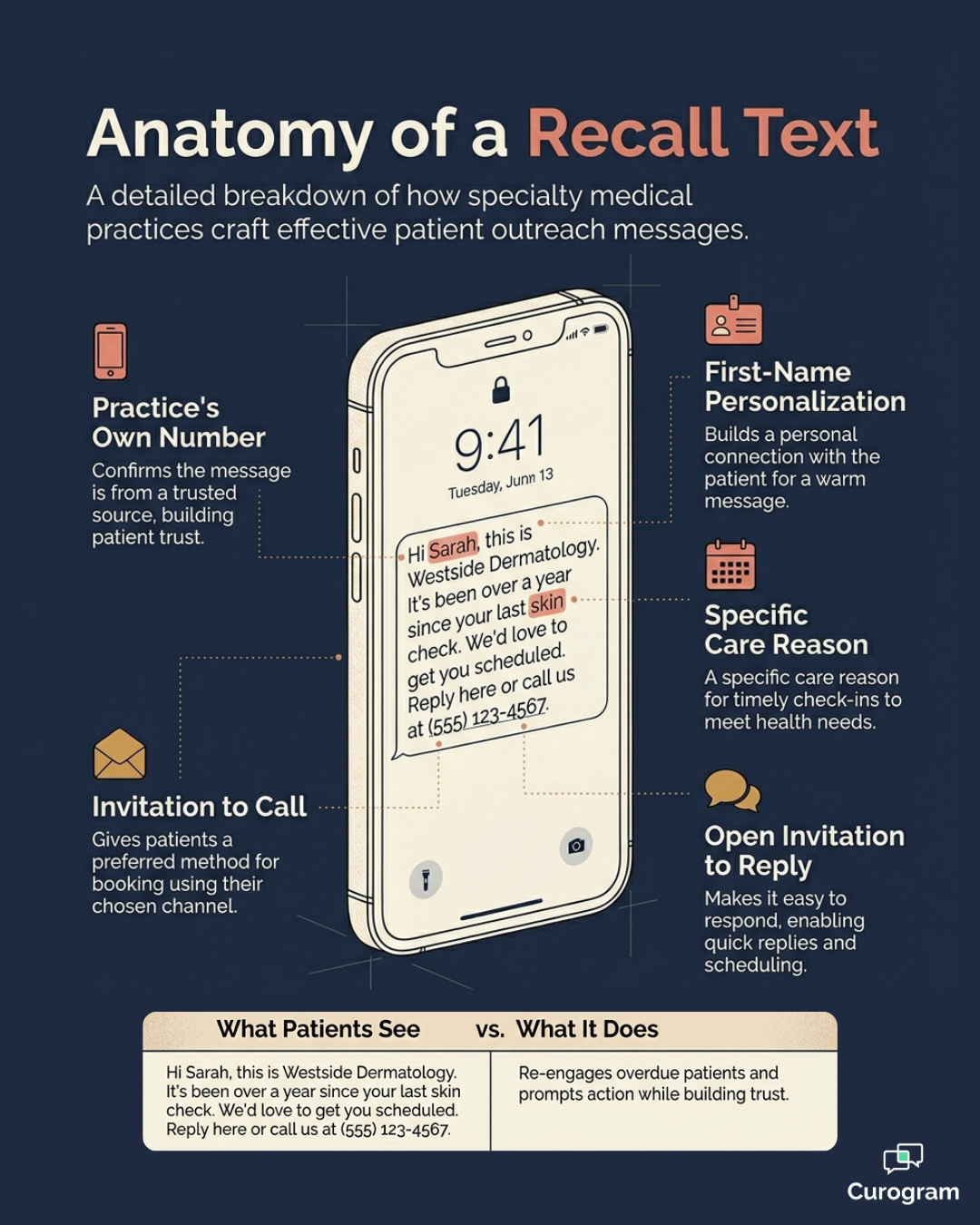
Anatomy of a Modmed patient recall text infographic showing personalized SMS appointment reminder elements.

Why the Tone Matters as Much as the Tech

A recall text feels personal because it is built to feel personal. It uses the patient's first name. It names the specific type of care that is due. It comes from a number the patient already recognizes. It invites a response instead of demanding a click.

The patient feels like someone at the practice noticed they had not been in and cared enough to reach out. Which is exactly what is happening — just at the scale of your entire overdue list, not one patient at a time.

What This Looks Like Across Different Specialties

The Curogram patient recall experience Modmed practices roll out is not one-size-fits-all.

The wording, timing, and cadence shift based on what the specialty actually needs. A skin check reminder should not read like a post-op orthopedic follow-up, and a pain management re-engagement message needs a softer tone than an annual eye exam nudge.

Here is how the same recall framework adapts across the most common Modmed specialties:

  • Ophthalmology: Annual reminders for post-cataract and glaucoma monitoring patients who need long-term surveillance.
  • Dermatology: Yearly skin cancer screening prompts that double as a gentle clinical cue.
  • Orthopedics: Post-surgical follow-ups for patients who quietly skipped their 6-week or 3-month visit.
  • Pain management: Compassionate re-engagement texts for patients who stopped coming and feel awkward calling back.

What ties these together is not the wording. It is the principle behind it: the lower the friction, the more patients respond. And the more specialty-relevant the message, the more it feels like care instead of marketing.

What Happens to Your Numbers When the Friction Drops

Here is where this becomes a business case, not just a patient story.

Across Curogram specialty practice deployments, about 35% of patients who receive a recall text respond.

The majority of those responses come within the first 1 to 2 hours. Of the patients who reply, more than 60% end up scheduling an appointment.

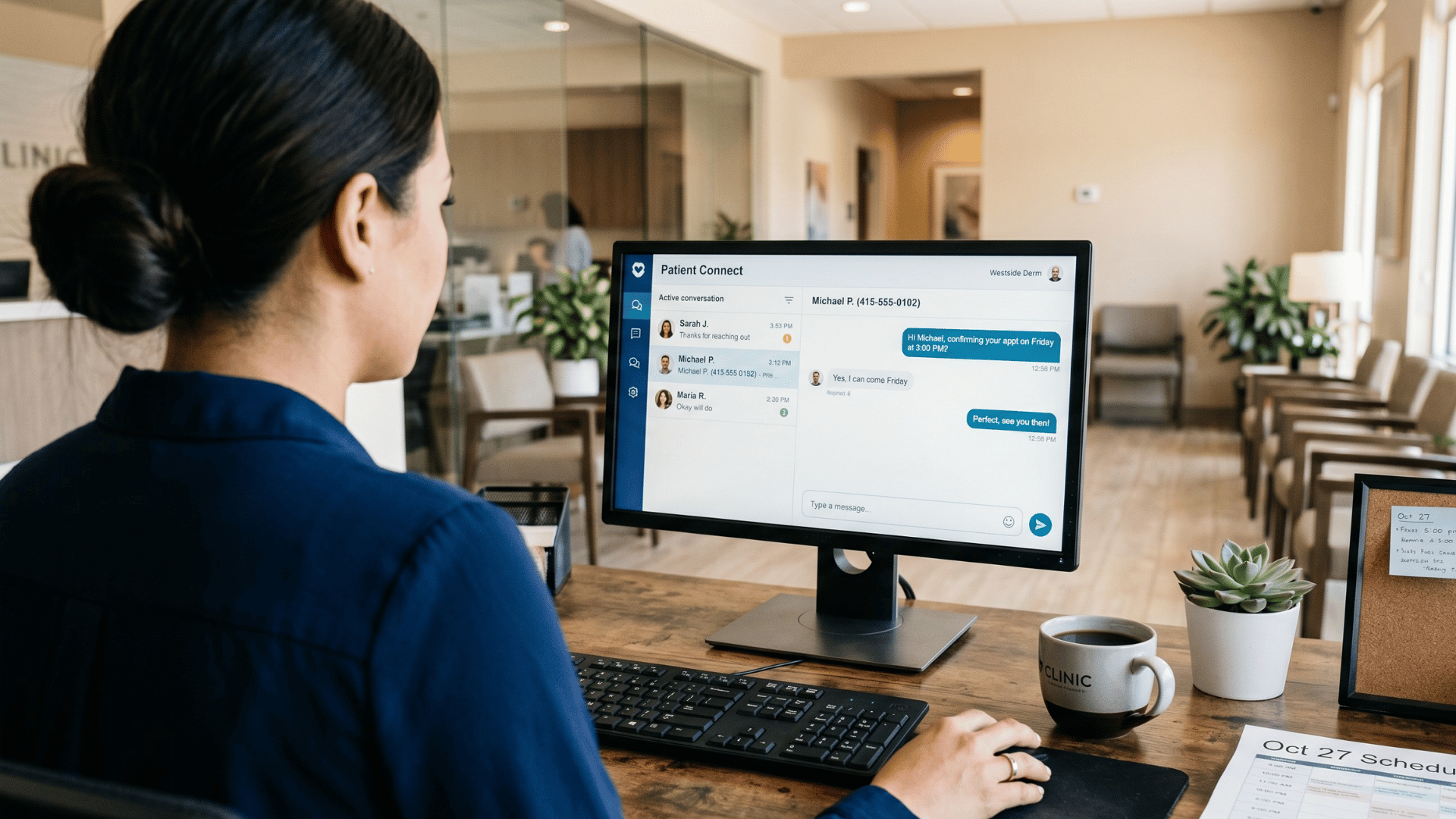
Front-desk staff reviewing two-way patient recall text replies on a Curogram messaging dashboard.

The Conversion Math on a 1,000-Patient List

Translate those response rates into a real campaign. Imagine your overdue list has 1,000 patients on it and you send the recall text to all of them.

The math plays out in three quick steps:

  • 350 patients reply to the text (about 35% response rate).
  • 210+ replies turn into scheduled appointments (60%+ of responders).
  • $52,500 to $84,000 in recovered revenue, based on an average specialty visit of $250 to $400.

That is more than 200 reactivated visits from a single recall campaign — without your staff making a single outbound phone call. Not over a year. From one cycle of texts.

For your team, the math is even simpler. The same 1,000-patient list, worked by phone, would take a single staff member roughly 3 to 5 minutes per call, plus voicemails, callbacks, and follow-up.

That is 50 to 80 hours of work — more than a full workweek for one person — to attempt the outreach the texts complete in an afternoon.

From Guilt to Gratitude

The numbers matter. The emotional shift matters too.

How patients respond to recall texts Modmed specialty practice teams have been surprised by, in a good way. Patients do not feel nagged. They feel cared for.

The text reframes the overdue appointment from something the patient feels guilty about — "I should have called months ago" — to something the practice made easy.

Reach every patient in seconds. Use mass messaging for urgent closures, health alerts, or clinic news with a 98% open rate with Curogram.

Staff regularly hear lines like

"Thank you so much for reaching out, I had been meaning to call."

That is the patient reactivation text experience Modmed EHR practices are building toward: not a recovery campaign, but a relationship cue.

A Story That Plays Out Every Week

A dermatology patient is 8 months overdue for a skin check. She gets a recall text on a Tuesday morning. She reads it during her coffee break. She replies: "Yes, I've been meaning to call. Can I come in Friday?"

Staff respond with a Friday opening. She confirms. Friday arrives. During the exam, the dermatologist flags a suspicious mole and biopsies it. The result comes back as an early-stage melanoma — caught before it grew, because a text turned an indefinite delay into a same-week appointment.

The patient tells her friends, "My doctor's office texted me to remind me. So easy. Best practice ever."

One recall text. One filled slot. One clinical finding. One new advocate for the practice.

This is what the modmed patients recall text overdue reminder rebooked appointment cycle actually does when it works.

Bring Your Overdue Patients Back Before the Next Quarter Closes

Your overdue list is not a problem of patient loyalty. It is a problem of friction. Your patients want to come back. They are waiting for the easiest possible way to say yes.

A phone call is not that. A patient portal login is not that. A 10-second text reply is.

Modmed already knows who is due. Curogram is what reaches them — a friendly, personal text from your own number that turns 8 months of procrastination into a Friday morning appointment.

No new staff. No extra hours on the phone. No awkward outreach scripts.

If a single campaign can reactivate more than 200 patients out of every 1,000 — and recover tens of thousands of dollars in visits your team had already given up on — the question is not whether recall texts work. The question is how many cycles you have already missed.

The fastest way to see it is from the patient's side. Watch how a recall text lands. See the reply come in. Watch staff respond from the same thread. Watch the appointment confirm — all in the time it takes to finish a cup of coffee.

That is the demo. It takes 15 minutes, and you will leave knowing exactly what your overdue list is worth.

Schedule a Demo with Curogram and see the patient recall experience the way your patients will. We will walk you through the workflow with your specialty in mind — ophthalmology, dermatology, orthopedics, pain management, or anything else where overdue patients are quietly stacking up.


Frequently Asked Questions

Will patients find the recall text intrusive or spammy?

No. Recall texts are sent from the practice's own phone number, personalized with the patient's first name, and reference the specific type of care they are due for. Patients recognize the message as coming from their doctor's office, not a marketing service. The tone is personal and caring, not promotional. Most practices report that patients thank them for the reminder, often saying they had been meaning to schedule and were grateful for the nudge.

Can patients opt out of recall texts if they no longer want to receive them?

Yes. Patients can reply STOP to any text message to opt out of future communications. Curogram automatically removes opted-out patients from all future messaging, including recall campaigns. Your practice respects patient preferences while still reaching the patients who welcome the reminders.

What if a patient has changed their phone number since their last visit?

Texts sent to disconnected or reassigned numbers are flagged in Curogram's dashboard as undeliverable. Those patients can be routed to alternative outreach — email, mail, or a quick phone number update at their next contact. For the vast majority of patients whose numbers have not changed, the recall text reaches them instantly, with no staff time wasted dialing dead lines.

How is this different from a regular automated appointment reminder?

A standard reminder confirms an appointment the patient already has. A recall text reaches patients who do not have one — and should. It is built specifically for reactivation, with two-way replies, specialty-specific wording, and a tone designed to invite a response rather than demand a click.

Does this require my staff to learn a new system on top of Modmed?

No. Curogram runs alongside Modmed and is designed for the front desk team that is already managing patient communication. The recall conversations live in a simple inbox that anyone on the team can pick up, and the integration with your Modmed data means you are not entering anything twice.