10 min read

Why Vascular Patients Need Follow-Up Imaging Reminder SMS Texts

Why Vascular Patients Need Follow-Up Imaging Reminder SMS Texts
💡 A vascular patient follow-up imaging reminder SMS text recall is a short, automated text from your clinic. It tells you when your next scan is due so you don't miss it.
  • Arrives on your phone, not in a stack of mail
  • Reminds you to schedule a duplex ultrasound or other scan
  • Lets you reply or call back in seconds
  • Helps catch quiet problems with grafts or stents
  • Works well for older adults who don't use patient portals
These texts make follow-up care simple. One short message keeps your care on track.

Six months ago, your surgeon fixed the blocked artery. Today, you feel great. You walk farther, sleep better, and you even forgot the name of the medication you used to dread taking. So when a letter comes from the clinic about another scan, it's easy to set it aside.

That's the problem. Feeling fine and being fine are not always the same thing.

After a graft, stent, or artery repair, your blood vessels need regular check-ins. A scan called a duplex ultrasound looks at how blood moves through the area your doctor fixed. It can spot trouble long before you feel anything wrong.

But here's the catch. Many older adults miss these scans. Mail piles up. Voicemails get full. Life gets busy with other doctor visits, medications, and grandkids. By the time you remember, weeks or months have passed.

That's where a simple text message changes things. A vascular patient follow-up imaging reminder SMS text recall is just a short note from your clinic. It pops up on your phone when your scan is due. You read it in seconds, then call to book.

No mail to lose. No portal to log into. No password to remember.

This guide will walk you through why follow-up imaging matters, why so many people miss it, and how text reminders make it easy to stay on track. You'll also learn what to do when one of these texts arrives, how your private health information stays safe, and how to opt in or out anytime.

If you've had a vascular procedure, this guide is for you. If you help care for a parent or loved one who has, it's for you too. Let's start with the most important question.

Why Your Follow-Up Imaging Matters

Your vascular procedure was a fix, not a cure. Arteries, grafts, and stents need to be checked over time. They can shift, narrow, or wear down. The only way to know is to look inside with a scan.

It's Not Optional, It's Part of Your Care

Think of your repaired artery like a new tire on a car. The tire is fine when you drive off the lot. But you still need to check the pressure and look for slow leaks. Your arteries work the same way.

After a procedure, your doctor will order scans on a set schedule. The most common one is a duplex ultrasound. It uses sound waves to watch blood flow through the area that was treated. It does not hurt, and there is no needle or dye.

Other scans your doctor may order include:

  • A carotid ultrasound to check the arteries in your neck
  • A CT scan to look at an aortic repair or stent
  • An ankle-brachial index test to check blood flow in your legs

Each scan watches for one thing: are things still working the way they should?

What Your Doctor Is Watching For

Vascular problems often start small. A graft can begin to clog. A stent can shift. An aneurysm can grow by just a few millimeters. None of this hurts at first.

Here's a simple example:

Say you had a leg bypass graft two years ago. The graft is open and blood is flowing. But over time, scar tissue starts to build up inside it. That buildup slows the flow, bit by bit. A duplex ultrasound catches that slowdown early. Your doctor can then plan a small repair before the graft closes off.


If you skip the scan, the graft may close while you're sleeping or walking the dog. That turns a planned outpatient visit into an emergency room trip.

Why This Matters to You

There are three big reasons to keep up with your scans:

  • Silent problems get caught early. Most vascular issues don't cause pain or symptoms in the early stages. The scan sees what your body can't tell you.

  • Treatment is easier when caught early. A small repair done in an outpatient clinic might take an hour. The same problem caught late may need open surgery, a hospital stay, and weeks of recovery.

  • Costs stay lower. A planned duplex ultrasound recall patient visit might cost around $600. An emergency thrombectomy, where doctors remove a blood clot, can run $8,000 or more. That's before counting hospital fees, time off work for family, and rehab.

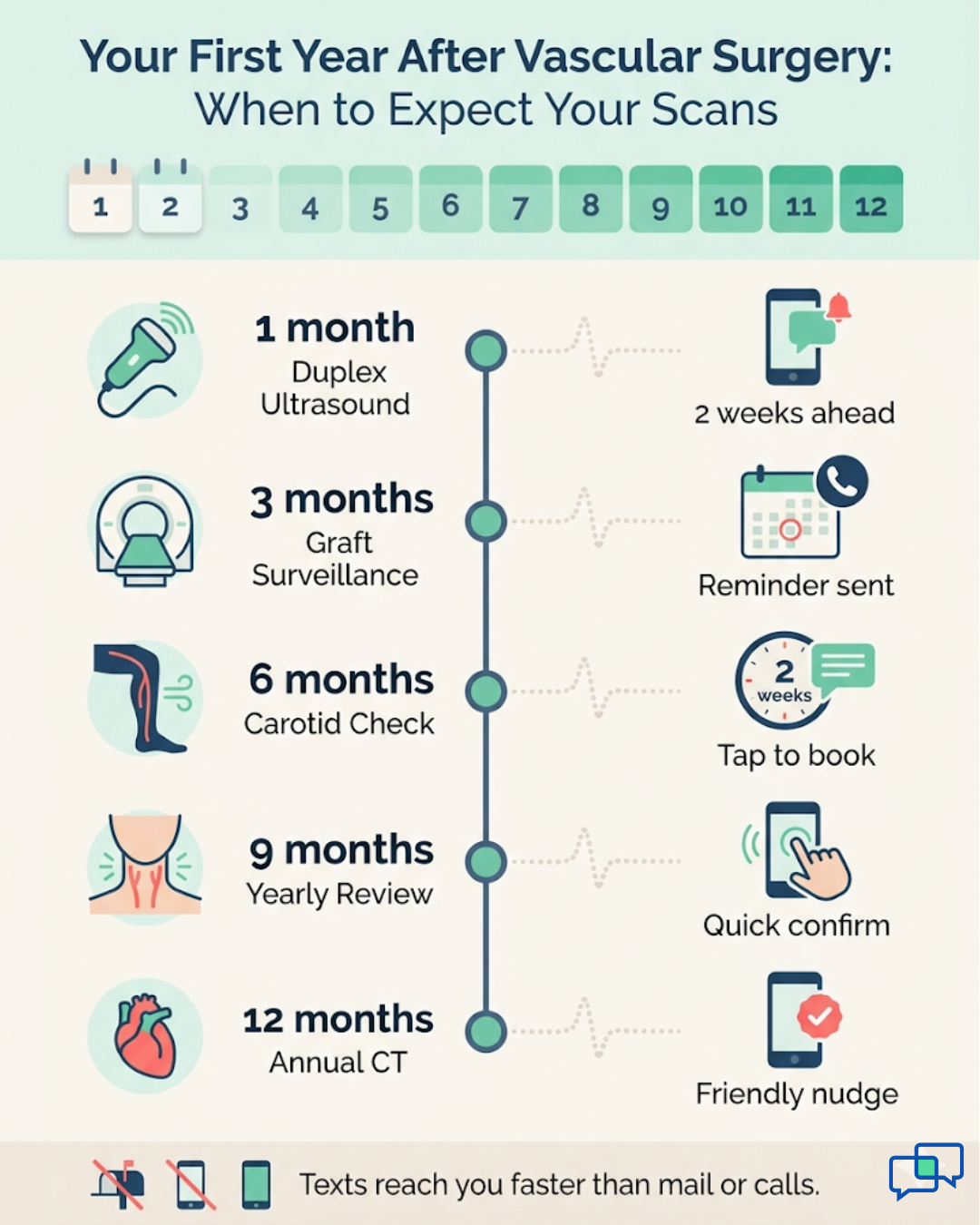
Infographic showing 12-month vascular follow-up scan timeline with SMS text reminder alerts at each milestone

Why Patients Miss Follow-Up Appointments

If follow-up scans are so important, why do so many people miss them? The honest answer: life gets in the way. And the systems clinics have used for years don't work well for older adults.

Missing a follow-up scan is not a sign that you don't care about your health. It happens to careful, smart people every day. Based on our internal research, many practices find that a large share of their patients fall behind on recommended follow-ups within a year.

There are a few common reasons:

Forgotten Mail and Missed Calls

The clinic mails you a postcard. It lands on the kitchen counter with the gas bill and a flyer for new windows. By the time you sort the mail, the card is gone or buried. A week later, you don't remember it ever came.

Phone calls have the same problem. The clinic calls during the day. You're at the store, the doctor, or with a grandchild. The voicemail fills up. The clinic moves on to the next patient on the list.

This is the biggest hole in old-school reminders. They depend on you being in the right place at the right time.

No Symptoms, No Sense of Urgency

This is the trickiest reason. You feel great. Your leg doesn't hurt. The chest pressure is gone. So booking another scan feels like a chore that can wait until next month.

Then next month becomes next quarter. Quarter becomes year. By the time the next scan happens, two years have passed and a small problem has become a big one.

Doctors call this the "silent killer" pattern. It shows up most often in elderly patient surveillance recall programs, where folks feel fine and don't sense the risk.

A Lot of Other Health to Manage

Many vascular patients are 65 or older. You may also be tracking diabetes, blood pressure, eye visits, and dental work. Each of those comes with its own calls, papers, and forms.

When everything fights for your attention, the scan that doesn't hurt and feels far away tends to lose. That's not your fault. It's just how a busy life works.

Changed Phones, Changed Addresses

If you moved or got a new number, the clinic's records may be old. Their reminder call goes to a phone you no longer use. Their letter goes to a house you moved out of two years ago.

You think the clinic forgot about you. They think you no longer want care. Both sides lose.

Patient Portals Don't Help Most Older Adults

Some clinics send reminders through a patient portal. You log in to see your scan dates. The problem? Many older adults never set the portal up.

Based on our internal data, portal use among patients in the 65–75 age range stays low at most vascular practices. People don't remember the password, don't trust the website, or just prefer simpler tools. That means portal-only reminders reach a small slice of the people who need them most.

The Real Cost of a Missed Scan

A missed scan is not just a missed visit. It's a missed chance to catch a problem when it's small. Here's how the costs stack up:

  • Planned duplex ultrasound: about $600
  • Emergency thrombectomy: $8,000 or more
  • Hospital stay after a stroke from a missed carotid scan: $20,000 or more
  • Limb loss after a missed graft check: lifelong cost in care, mobility, and quality of life

The good news is that one well-timed message can fix most of this. A simple text reminder, sent to a phone that's already in your pocket, can put you back on track in under a minute.

Elderly man reading a vascular follow-up imaging text reminder while reaching for his landline phone to call the clinic

How Text Reminders Help

Text messages work where mail and phone calls fall short. They show up where you already look — on the phone in your pocket. They take seconds to read and seconds to act on.

Simple, Direct, Hard to Miss

When you leave the hospital or clinic after your procedure, the staff asks if you'd like reminders by text. If you say yes, your phone number is saved and linked to a secure system. Your clinic now has your permission to send short notes about your care.

Here's how a typical text recall works.

  • Step 1: The system knows you're due. Your clinic's software tracks your last scan date and your doctor's recommended schedule. When you get close to the due date, the system flags your record.

  • Step 2: A short text goes out. The text is brief. It might say: "Hi [first name], your vascular check-up is due. Call [clinic] to schedule, or reply C to confirm your number."

  • Step 3: You take 30 seconds to act. You read the text. You tap the phone number to call. You set the appointment. Done.

That's it. No password. No portal. No mail to open. No callback to remember.

Why Texts Beat Mail and Phone Calls

A piece of mail sits in a pile. A phone call goes to voicemail. A text sits in your phone, with a little number on the message icon, until you read it. It does not get lost.

Here's a side-by-side look:

Reminder Type

Reach Rate

Time to Respond

Easy for Older Adults?

Mailed postcard

Low

Days or weeks

Yes, but easy to miss

Phone call

Low

Depends on availability

Hard if hearing or voicemail issues

Patient portal

Very low (under 30%)

Minutes (if logged in)

No, most don't use it

Text message

High

Seconds

Yes


Based on our internal data, practices that use SMS recalls see 35% of patients book an appointment within a month of the reminder. That's a big jump from the slow trickle most mail-and-phone systems get.

For a clinic with 1,000 overdue patients, that 35% means about 350 people back on schedule. That's 350 silent problems caught early. Based on our internal data, one multi-location practice brought back 1,240 patients from recall texts alone.

What a Good Text Reminder Looks Like

Not all texts are made the same. A good vascular reminder is short, clear, and easy to act on. It should:

  • Use your first name so you know it's for you
  • Say what kind of visit is due (without sharing private health details)
  • Give a phone number you can tap to call
  • Tell you how to reply (like "C to confirm" or "STOP to opt out")
  • Come from a number you can save in your contacts

A bad text is long, packed with medical words, or asks you to log in somewhere. If your clinic's texts feel hard to use, tell them. Good practices listen to feedback.

Text recalls are not just for vascular patients. The same setup helps with a cardiac follow-up reminder patient program, a post-stent imaging follow-up text schedule, or any other surveillance care. If you've had a heart procedure, a stent placed, or a stroke risk scan, you may get similar texts from those teams too.

Some clinics call this a vascular patient reactivation SMS program because it brings back patients who fell off the schedule. The word "reactivation" just means waking up a record that went quiet.

What Happens After You Reply

When you reply to a text reminder, a real person at the clinic sees it. They are trained to handle short replies fast. If you write back "Can I come Tuesday morning?" they can book it on the spot or call you to find a slot that works.

Two-way texting is the part most patients love. You're not just getting a one-way blast. You're having a quick chat with the clinic, on your time, at your pace.

This works well if you have:

  • A hearing issue that makes phone calls tough
  • A busy day where you can't take a long call
  • A simple question you don't want to make an appointment to ask


How Curogram Powers Your Clinic's Text Reminders

Behind the simple text on your phone is a system your clinic uses to keep care on track. Many vascular practices in the U.S. use Curogram, a HIPAA-compliant two-way texting platform built for medical offices. It plugs into most electronic medical record systems, including Medstreaming, so your clinic doesn't have to build something new from scratch.

Here's what that means for you as a patient.

Your phone number stays safe. Curogram uses hospital-grade encryption to protect your information. The text you get does not share private details like your medical history or test results. It just says it's time to book and gives a number to call.

You can reply, and a real person reads it. Curogram supports two-way texting, so your reply goes to your clinic's staff in real time. They can answer questions, set appointments, and update your records without you waiting on hold.

The reminders go out on time, every time. Based on our internal data, Curogram's automated system handles thousands of reminders without staff having to send each one by hand. This is why some clinics see no-show rates 53% lower than the industry average.

Your clinic also uses Curogram to send other helpful texts. These might include appointment confirmations, intake forms before your visit, or a friendly note asking how you're feeling after a procedure. Each one is built to be short, clear, and easy to act on.

In short, Curogram is the quiet engine running behind the scenes. Your clinic uses it so you don't have to track your own follow-up scans. You get one short text, you take one quick action, and your care stays on track. That's the whole point.

Conclusion

Your vascular procedure did its job. Now your follow-up scans need to do theirs. The hardest part is just showing up on time.

That's where text reminders come in. They turn a confusing system of mail, calls, and missed messages into one short note on your phone. You read it, you act, and your care stays on track. No portal, no password, no piles of paper.

If your clinic already sends these texts, save the clinic's number in your phone. That way you know the message is real when it comes. If you've moved or changed your number, call the clinic and update your record today. A reminder can only help if it reaches you.

If your clinic doesn't yet send text reminders, ask about it at your next visit. Many vascular practices, including ones that use Medstreaming, can add a recall texting program quickly. Your voice as a patient matters, and asking is often the nudge a clinic needs.

For family members and caregivers reading along, this is a small step you can take with a loved one. Make sure their phone number is up to date.

Help them save the clinic's number. Watch for the next reminder and offer to help them book the visit. These tiny actions can prevent a major emergency.

Want to make sure your vascular patients never miss another follow-up scan? Schedule a demo and see how SMS recalls bring overdue patients back in under a month.


Frequently Asked Questions

How do I know the text reminder is really from my clinic?

Real reminders come from a steady phone number your clinic will share with you. Save that number in your contacts when you opt in. If a text asks for money, a Social Security number, or a password, it is not from your clinic.

Why does my clinic send a text instead of a letter or phone call?

Texts arrive on the phone you already use, so they don't get lost in the mail or missed at home. Based on our internal data, practices using SMS recalls bring back 35% of overdue patients within a month. Letters and calls rarely match that.

How safe is my health information in a text?

Your clinic uses encryption to protect your phone number and records. The text itself does not include private details like test results or your full medical history. It only says a visit is due and gives a number to call.

What should I do as soon as I get a text reminder?

Read the message and look for the clinic's phone number inside. Tap to call and book your scan right away, or reply with a confirmation if the text asks. If you're not sure when works, ask the clinic for the next open slot.

Why is follow-up imaging still needed if I feel fine after my procedure?

Vascular problems usually start without pain or symptoms. A scan like a duplex ultrasound can spot a slow clog or a shifting stent before you feel anything. Catching trouble early means smaller fixes, lower costs, and less risk of emergency surgery.