9 min read

The ROI of Text-to-Pay for GE Centricity Clinics

The ROI of Text-to-Pay for GE Centricity Clinics
💡 EMR-integrated payment workflows help GE Centricity clinics improve cash flow and reduce billing costs through HIPAA-compliant text payments.
  • Speeds up collections and lowers accounts receivable days
  • Sends automated patient balance collection requests based on appointments
  • Reduces manual billing work and staff time on payment calls
  • Cuts paper statement and postage costs significantly
For radiology and specialty departments, text to pay for clinics accelerates co-pay and imaging fee collection. Multi-location systems achieve standardized billing workflows and more predictable revenue cycle automation.


Every day, billing teams at specialty clinics are stuck in the same cycle: call after call, statement after statement, watching unpaid balances pile up. It’s frustrating, costly, and pulls time away from what really matters—caring for patients.

The problem keeps growing. Deductibles and co-pays are bigger than ever, leaving patients with higher balances after each visit. By the time a clinic follows up weeks later, the money is harder to collect—and the stress on staff only grows.

For GE Centricity specialty clinics, the challenge is even bigger. Radiology departments juggle high-cost imaging with layered fees, and multi-location practices need billing that works the same everywhere. One missed step can delay thousands in revenue.

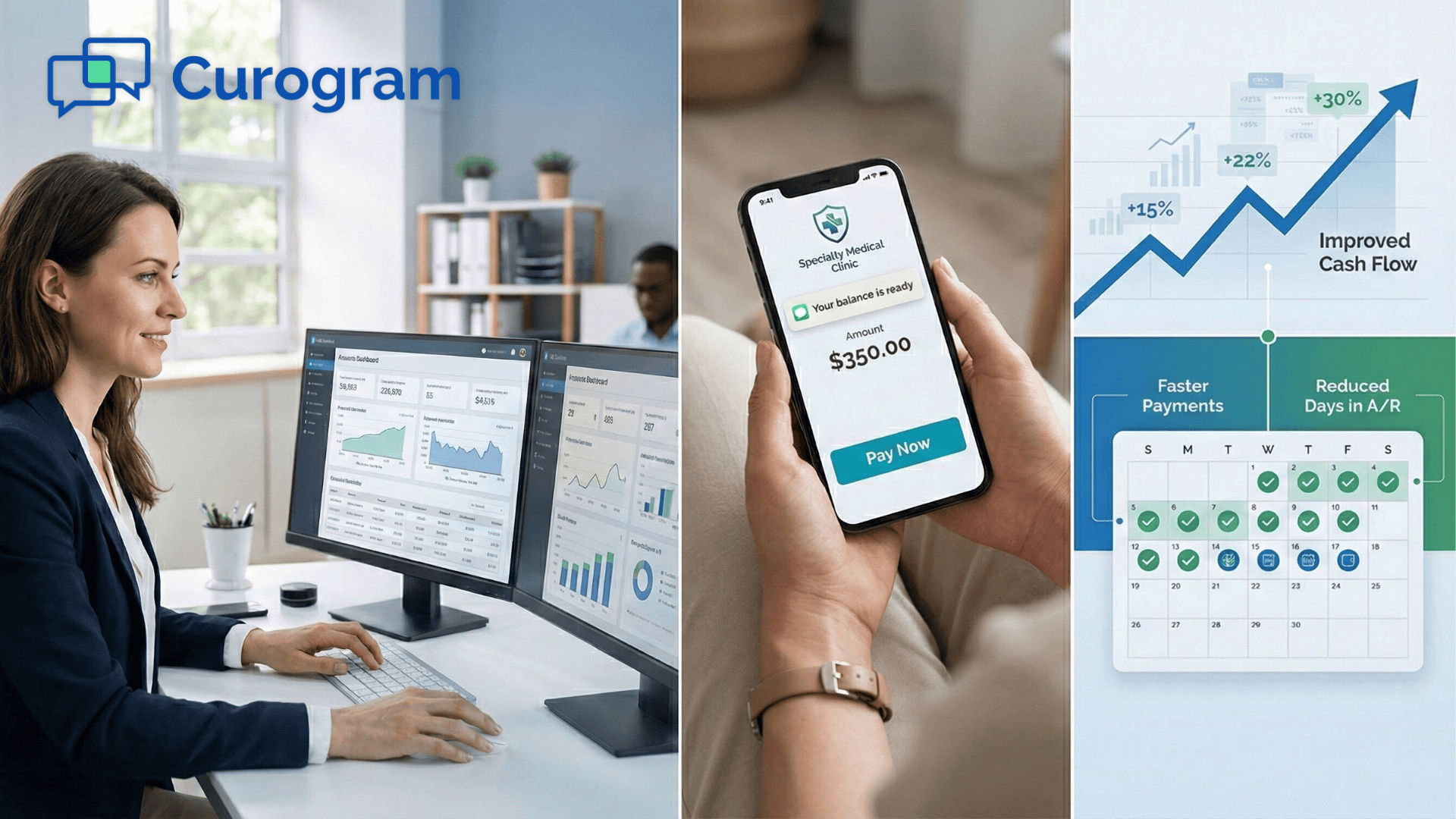
Text-to-Pay flips the script. Instead of waiting and hoping patients pay, clinics can send a HIPAA-compliant text with a secure payment link. Patients tap, pay, and move on in under a minute. Payments arrive faster, staff make fewer calls, and paper costs drop.

When Text-to-Pay integrates directly with GE Centricity, it gets even smarter. The system knows who had an appointment, what procedure they had, and when to send reminders—all automatically. Faster collections, lower costs, happier staff, and more satisfied patients—without extra work.

For clinic leaders watching the bottom line, the question isn’t if you should automate—it’s how soon you can start seeing results. This guide walks through how HIPAA-compliant Text-to-Pay boosts cash flow and delivers the highest ROI for GE Centricity specialty clinics.

Why Payment Efficiency Directly Impacts GE Centricity Clinic Revenue

Patient payment patterns have changed significantly. Higher deductibles and larger co-pays now shift more costs to patients. What was once a small front-desk payment can now mean hundreds or even thousands of dollars owed.

According to recent healthcare finance data, patients now pay an average of 30% to 35% of their total medical bills out of pocket. For specialty services like advanced imaging or outpatient procedures, that percentage can climb even higher.

The timing of patient payments matters just as much as the amount. Every day that payment sits uncollected costs the clinic money. Cash that should be working in the business stays trapped in accounts receivable.

Traditional billing methods create long delays. A patient visits on Monday. The billing team generates a statement on Friday. The mail delivers it the following week. The patient might pay it two weeks later. That adds up to nearly a month between service and payment.

These delays add up quickly. A radiology department seeing 200 patients a week at $300 each carries $60,000 in weekly patient responsibility. If payments take a month, the clinic is effectively floating $240,000 with no return.

Administrative labor creates hidden costs that drain clinic resources:

  • Billing staff spend 40% to 50% of their time on payment-related tasks
  • Phone calls about bills consume hours each day without generating revenue
  • Paper statements and postage expenses add up to tens of thousands annually
  • Follow-up work on past-due accounts diverts staff from higher-value activities

Industry research shows 20–25% of patient balances over 90 days become bad debt. For GE Centricity clinics with multiple departments, the risk grows when one visit generates charges from radiology, labs, and specialty care.

Faster collection through automated patient payments reduces money tied up in receivables. The result is higher monthly revenue, lower operating costs, and more predictable cash flow for growth.

The Financial Impact of Manual Billing and Collection Workflows

Walk into any clinic billing office and the scene looks familiar. Staff hunch over computers, phones ring with billing questions, and printers churn out stacks of statements.

This manual approach causes real financial damage. Each paper statement costs $1.50–$3.00 in printing, postage, and staff time. A clinic sending 500 statements weekly can spend $75,000–$150,000 a year on paper billing alone.

Phone calls add even more expense. The average billing-related call takes 8 to 12 minutes of staff time. At $18 to $25 per hour for billing staff, those interruptions add up quickly.

Manual workflows create slow payment turnaround. The whole process can take a week or more from the date of service. Then patients need another week or two to receive the bill and respond. By the time payment arrives, 30 to 45 days have passed.

When accounts receivable for patient responsibility averages 45 days, the clinic is essentially providing an interest-free loan to patients. That money could be earning returns in the bank or paying down higher-interest debt.

Multi-location clinics face additional challenges that compound these problems:

  • Each site might handle billing differently, creating inconsistent patient experiences
  • One location calls patients proactively while another waits for patients to call them
  • Different statement schedules confuse patients and slow collections organization-wide
  • Lack of standardization makes it impossible to measure true performance

Repetitive payment calls eat up huge amounts of staff time. A billing specialist might spend three hours each morning calling patients, with most calls going to voicemail.

That time could be spent on higher-value tasks, like resolving insurance denials with bigger dollar impact. Manual work crowds out important priorities.

For specialty departments handling costly procedures, the effect is even bigger. Waiting 60 days to collect a $1,200 MRI balance strains cash flow. Text-to-Pay automation protects the financial health of the entire practice.

How Text-to-Pay Increases Payment Speed and Completion Rates

Text-to-Pay transforms the patient payment experience. Instead of waiting for a mailed bill, patients get a HIPAA-compliant text within hours of their visit. The message includes a secure link, letting them pay in under two minutes.

The speed difference is huge. Traditional billing can take 7–10 days just to reach the patient, while text payments are instant.

Timing matters. Research shows patients are 3–4 times more likely to pay immediately when the request arrives within 24 hours of service, compared to weeks later.

SMS-based secure payment links remove friction from the payment process in several key ways:

  • No need to find a checkbook, address an envelope, or remember to mail anything
  • No requirement to call the billing office during business hours
  • Simple tap-and-pay from the device already in their hand
  • Secure encryption protects sensitive payment information

Payment reminders are key to consistent collections. If a patient doesn’t pay after the first text, the system sends a gentle follow-up automatically, boosting payment rates without staff effort.

These reminders are effective because they reach patients where they spend the most time—via text, which has open rates over 95%. Clinics using EMR-integrated payments often collect 60–70% of balances in the first week, compared to 60–70% still unpaid after 30 days with traditional billing.

For higher-cost procedures, the impact is even greater. An outpatient MRI with a $1,500 balance can bring in $1,050 within a week through automated collection. Faster payments also reduce the risk of accounts aging beyond 90 days, which have only a 20–30% chance of collection.

HIPAA-compliant text payments can support installment plans, letting patients pay over time from their phone. Multi-location clinics gain consistent processes across all sites. Speed, convenience, and automation make Text-to-Pay a highly effective tool for boosting cash flow.

Improve Cash Flow GE Centricity Text-To-Pay - mid

GE Centricity Integration Advantages That Improve ROI

When Text-to-Pay integrates directly with GE Centricity, the benefits multiply. Automatic workflows replace manual tasks, improving accuracy and driving higher ROI than standalone payment systems.

Accurate patient and visit matching

GE Centricity stores complete patient demographics and visit details. The automated payment system uses this data to ensure every request reaches the right person, matching name, phone number, and account accurately.

By knowing exactly which services a patient received, the system calculates the correct balance, factoring in insurance adjustments and prior payments. This reduces disputes and back-and-forth about what’s owed.

Automated request timing based on appointment data

GE Centricity tracks appointment schedules across departments. The EMR-integrated payment system uses this data to send reminders at the optimal time, like a pre-visit co-pay request the day before.

Automatic timing ensures no patient is missed. Every completed visit triggers a payment workflow without relying on staff.

For high-volume clinics, this saves huge amounts of staff time. A radiology department with 150 weekly procedures no longer needs manual account reviews—every request goes out automatically.

Reduced manual billing coordination

Manual billing requires coordination across people and systems. Data must be exported from the EMR, formatted for the billing system, and each handoff adds risk of errors and delays.

Integrating GE Centricity with revenue cycle automation eliminates most handoffs. The system pulls data directly from the source and processes payment requests automatically, reducing errors and ensuring consistency every time.

Revenue Impact for Radiology and Specialty Departments

Radiology and specialty departments face unique revenue challenges. Their procedures cost more than routine primary care visits. Patient responsibility often runs into thousands of dollars. These higher balances make efficient collection even more critical.

Faster co-pay and imaging fee collection

HIPAA-compliant text payments let radiology departments collect co-pays and imaging fees instantly. Patients can pay within minutes, preventing balances from aging and harder recovery.

Reduced repeat billing cycles

Specialty procedures often generate multiple charges at different times, creating confusion for patients and extra work for staff. Text-to-Pay can bundle these charges into a single request, simplifying billing and making it easier for patients to pay.

Improved throughput for high-cost procedures

When radiology departments can collect payments quickly through automation, they improve throughput for expensive procedures. Scheduling isn’t delayed, patients move through faster, and revenue increases. Efficient collection supports higher-volume operations.

Cost Savings from Reduced Administrative Burden

The financial benefits of EMR-integrated payments extend beyond faster revenue collection. The system also delivers substantial cost savings by reducing the administrative work required to manage patient payments.

Billing staff at a typical specialty clinic spend 15 to 20 hours per week on payment-related calls. Revenue cycle automation eliminates most of these calls by providing clear information and easy payment options upfront.

When patients receive a HIPAA-compliant text message with their exact balance and a link to pay, they do not need to call and ask how much they owe. The self-service nature of text to pay for clinics removes the need for staff intervention in routine payment transactions.

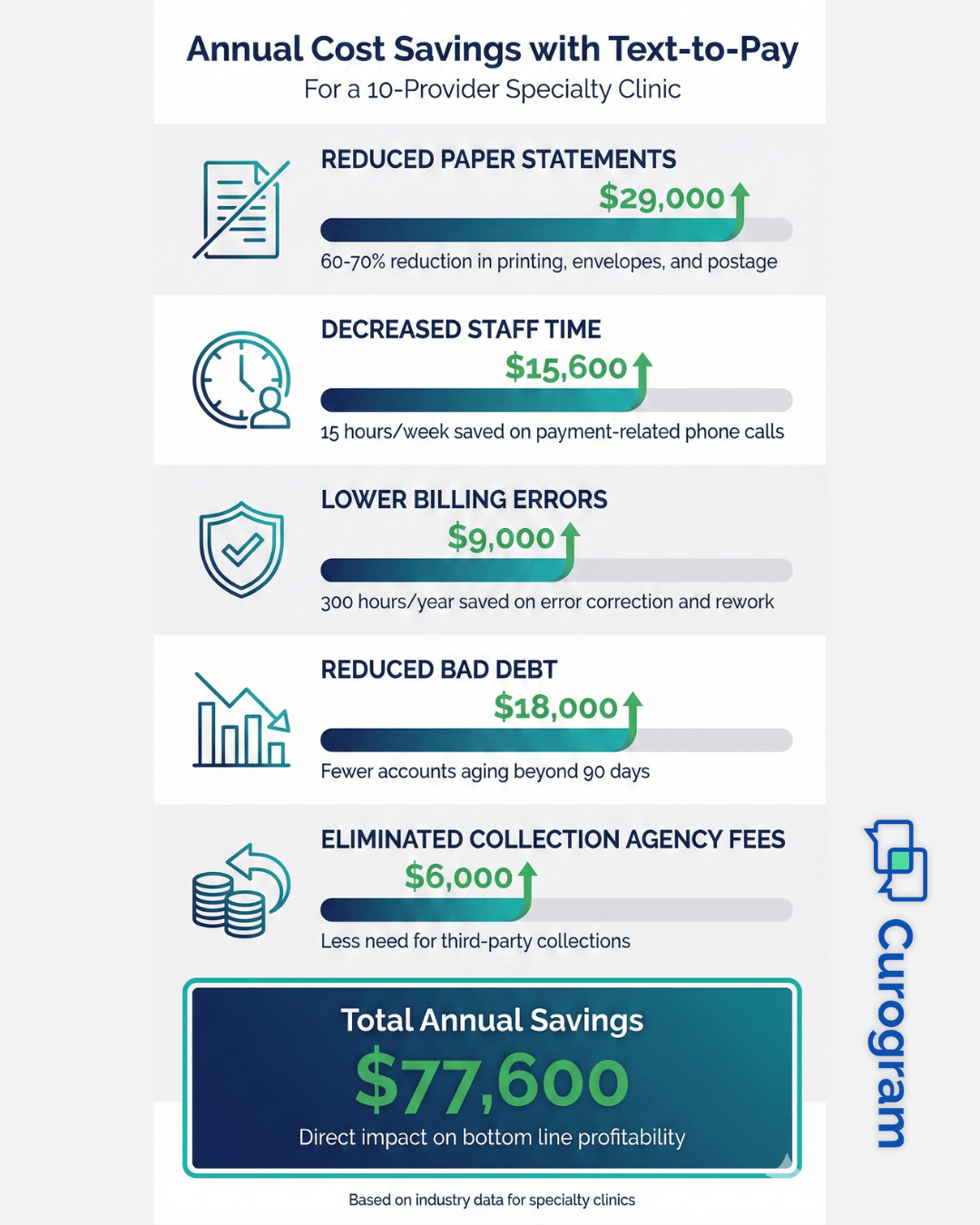
At $20 per hour for billing staff, saving 15 hours per week represents $300 in weekly savings, or about $15,600 annually. For larger clinics with multiple billing specialists, the savings multiply accordingly.

Paper and postage costs drop dramatically with automated patient balance collection. A clinic sending 400 statements per week at $2 each spends $41,600 annually on paper billing. Switching to text-based requests can save $25,000 to $29,000 per year.

Billing errors decrease because the integration with GE Centricity ensures accurate data from the start. When information flows automatically from the EMR to the payment system, there is less chance of someone entering the wrong amount or applying payment to the wrong account.

Higher staff productivity comes from redirecting time away from repetitive tasks. When billing specialists do not have to make collection calls all morning, they can work on insurance denials that represent larger dollar amounts.

For clinic administrators, these cost savings add up to significant financial impact. A mid-sized specialty clinic might save $50,000 to $75,000 annually through reduced staff time, lower paper costs, and fewer billing errors.

Enterprise-Level ROI for Multi-Location Clinics

Multi-location clinics face coordination challenges that single-site practices rarely see. Different sites may use varied billing methods, and staff responsiveness can differ.

EMR-integrated payments with GE Centricity standardize workflows across all locations. Every patient gets the same experience, making it easier for leadership to track performance and enforce best practices.

Consistency also helps patients. They recognize the text format and know what to expect, building trust and simplifying payment.

Enterprise-wide automation reduces operational waste and accelerates collections. Predictable cash flow allows finance teams to forecast revenue more accurately, adding major value for clinics managing multiple providers and specialties.


Why Curogram Is the Highest-ROI Text-to-Pay Solution for GE Centricity Clinics

Curogram delivers strong ROI with deep GE Centricity integration and features built for specialty clinics. It goes beyond basic Text-to-Pay, offering full revenue cycle automation.

EMR integration ensures patient info is pulled accurately, visits are matched correctly, and payments post automatically—no manual work needed.

The platform scales from single locations to large multi-site organizations, growing with your clinic. HIPAA-compliant text payments keep patient data secure throughout the process.

Integrated workflows link automated balance collection to the broader revenue cycle, helping clinics track payment patterns, find improvements, and optimize operations.

Together, these features drive faster payments, lower costs, happier patients, and stronger financial performance—the highest ROI available today.

Conclusion

Financial pressures on specialty clinics aren’t going away. Patient responsibility keeps rising, administrative costs climb, and competition intensifies. Clinics relying on manual billing and slow collections risk shrinking margins.

HIPAA-compliant text payments provide a clear solution. Integrated with GE Centricity, they help clinics collect faster, reduce costs, and improve patient satisfaction. The question isn’t whether this works—it’s how quickly clinics can capture the benefits.

Implementation is smooth. Solutions like Curogram fit existing workflows, require minimal staff training, and can deliver results within weeks. ROI shows quickly through better cash flow and lower administrative burden.

For GE Centricity clinics, EMR-integrated payments are a high-impact investment. Faster payments, reduced costs, and improved patient experience create sustainable financial gains over time.

Book your demo to See Curogram + GE Centricity in Action.


Frequently Asked Questions

How does text-to-pay integration with GE Centricity improve cash flow?

EMR-integrated payments pull data from GE Centricity and send payment requests immediately. Clinics often collect 60–70% of balances in the first week, compared to most unpaid after 30 days with traditional billing, freeing up working capital faster.

Why do patients respond better to text payment requests than paper statements?

Text messages reach patients immediately on devices they check constantly throughout the day. The open rate for text messages exceeds 95% compared to much lower rates for postal mail. HIPAA-compliant text payments remove friction by letting patients pay instantly without finding stamps, writing checks, or calling during business hours. The convenience and immediacy drive higher response rates. Additionally, sending payment requests within 24 hours of service means patients still remember their visit clearly, making them more willing to pay right away.

How much staff time does text-to-pay automation save for billing departments?

Billing staff spend 15–20 hours weekly on calls and statements. Automated reminders and self-service payments free staff to focus on complex cases and higher-value tasks.

What specific advantages does GE Centricity integration provide for radiology departments?

Radiology departments handle costly procedures, so fast collection is vital. GE Centricity integration lets Text-to-Pay access imaging orders, codes, and insurance info to calculate balances immediately. Payment requests can go out on-site or shortly after, improving cash flow. Automated payment plans help patients manage larger balances.

How does text-to-pay reduce bad debt for specialty clinics?

Revenue cycle automation accelerates payments and sends timely reminders, preventing balances from aging past 90 days. Fewer accounts reach high-risk status, reducing uncollectible amounts and protecting clinic revenue.


GE Centricity Clinics Improve Billing with HIPAA Text-to-Pay

GE Centricity Clinics Improve Billing with HIPAA Text-to-Pay

💡 GE Centricity clinics struggle with manual payment collection. Staff spend hours calling patients about overdue balances while paper processes...
Read More
Text-to-Pay for GE Centricity: Faster Collections With Curogram

Text-to-Pay for GE Centricity: Faster Collections With Curogram

💡 Text-to-Pay for GE Centricity helps multi-location specialty and radiology clinics accelerate patient payment collection through automated SMS...

Read More
Improving Cash Flow and Reducing Billing Costs with InSync Text-to-Pay

Improving Cash Flow and Reducing Billing Costs with InSync Text-to-Pay

💡 Text-to-pay technology is changing how behavioral health practices handle billing. For organizations using InSync EMR, adding this payment method...

Read More