13 min read

The ROI of HIPAA-Compliant Texting for GE Centricity Clinics

The ROI of HIPAA-Compliant Texting for GE Centricity Clinics
💡 GE Centricity practices use compliance texting GE Centricity solutions to solve workflow problems in specialty clinics and radiology departments. 
  • Secure messaging coordinates complex requirements like medication holds and fasting instructions for imaging procedures.
  • Staff manage multiple patients through automation, reducing phone time by 2-4 hours daily.
  • Results include 20-30% fewer no-shows, better preparation, and reduced costs.
Audit trail messaging keeps PHI secure while modernizing patient communication. Most clinics see full HIPAA ROI healthcare benefits within 3-6 months.

Every phone call your front desk answers costs money. Every missed appointment leaves an empty slot that could have generated revenue. For GE Centricity clinics managing specialty care across multiple locations, these daily inefficiencies add up fast.

Your staff spends hours each day making confirmation calls. Patients miss appointments because they forgot or arrived unprepared. Radiology departments lose revenue when imaging studies need to be rescheduled due to poor patient preparation.

The problem is not just operational. It is financial. Manual communication methods drain your budget while leaving gaps in patient care that hurt your bottom line.

HIPAA-compliant texting changes this equation completely. Instead of your team chasing down patients, automated messages reach them instantly on the device they check most. Appointment reminders, preparation instructions, and follow-up messages all happen without staff intervention.

This is not just about convenience. It is about return on investment. Clinics using patient communication GE Centricity integration through secure 2-way messaging report dramatic improvements in key financial metrics. No-show rates drop by 50-75%. Phone call volume decreases by half. Staff can handle more patients without burning out.

For specialty clinics and imaging centers, where each appointment represents significant revenue, these improvements translate directly to your financial statements. Fewer missed appointments mean more billable encounters. Better patient preparation means fewer repeated procedures. More efficient staff means lower labor costs per patient visit.

The ROI is measurable, proven, and available to clinics ready to modernize their patient communication. Let us look at exactly how HIPAA-compliant texting delivers these financial results for GE Centricity operations.

Why GE Centricity Clinics Need to Optimize Operational Costs

Healthcare costs keep climbing while reimbursement rates stay flat or decline. For multi-location specialty clinics running GE Centricity, this pressure creates an urgent need to do more with less. Every dollar saved on operations goes straight to your bottom line.

Staffing represents your largest expense category. Front desk teams, schedulers, and medical assistants spend significant time on phone-based patient communication. A single confirmation call takes 3-5 minutes when you include dialing, waiting, leaving messages, and documenting the attempt. Multiply that across hundreds of appointments weekly, and the labor costs become substantial.

Multi-location operations face even steeper challenges. Each site needs adequate staffing to handle peak call volumes. You cannot easily shift staff between locations when one gets busy. This creates inefficiency where some sites have idle staff while others are overwhelmed.

The financial impact extends beyond direct labor costs. High turnover in front desk roles creates constant training expenses. Burned-out staff make more errors, which can lead to scheduling mistakes that cost real money. Poor patient communication also damages your reputation, making it harder to attract new patients.

No-shows represent another major cost center. When a patient misses a specialty appointment, you lose the revenue from that slot. The specialist or imaging equipment sits idle. You cannot easily fill last-minute openings, especially for procedures requiring preparation. Industry data shows no-show rates ranging from 15-30% in specialty practices, translating to thousands in lost revenue monthly.

Incomplete visits create hidden costs too. Patients who arrive unprepared for imaging studies often cannot proceed with the scheduled exam. Radiology departments waste expensive equipment time. The patient needs rescheduling, which doubles the administrative work. These incomplete encounters hurt revenue per available slot.

Administrative inefficiency compounds these problems. Manual processes for appointment reminders, follow-up communication, and patient education all require staff time. Paper-based workflows slow everything down. Lack of standardization across locations means each site operates differently, making it hard to identify and fix systemic issues.

The financial impact ripples through your entire operation. Lower throughput means you need more appointment slots to see the same number of patients. Higher staffing needs reduce profit margins. Poor patient satisfaction affects retention and referrals. These factors combine to squeeze profitability from multiple directions.

Technology offers a solution, but only if it integrates properly with existing systems. GE Centricity clinics need solutions that work with their current workflows rather than creating more complexity. The right patient communication platform can address all these cost drivers while improving care quality.

Optimizing operational costs is not optional anymore. It is essential for financial survival in modern healthcare. Clinics that reduce waste, improve efficiency, and maximize revenue from existing capacity will thrive. Those that continue with manual, inefficient processes will struggle to compete.

The Financial Impact of Communication Delays and Manual Work

Manual patient communication creates a cycle of waste that directly impacts your financial performance. Every hour your staff spends on the phone is an hour they cannot spend on higher-value activities. This opportunity cost adds up quickly when you calculate it across your entire team.

Consider the math on phone-based appointment confirmations. A typical medical assistant makes 20-30 confirmation calls per day. Each call attempt takes 3-5 minutes including dialing, waiting, leaving voicemails, and documentation. That is 60-150 minutes daily per staff member spent just on confirmations.

Scale that across a multi-location practice and the numbers become staggering. If you have five sites with three staff members each making confirmation calls, that is 15 hours of labor daily. At $20 per hour including benefits, you are spending $300 every day just on appointment confirmations. That is $6,000 monthly or $72,000 annually on a single repetitive task.

The financial impact extends beyond labor costs. Phone-based communication has a low success rate. Most calls go to voicemail. Patients often do not return calls in time. This creates uncertainty in your schedule that prevents efficient clinical coordination and resource planning.

Communication delays also contribute to no-shows. When patients do not receive timely reminders, they forget appointments. When preparation instructions arrive too late, patients show up unprepared. Both scenarios reduce billable throughput and waste expensive clinical resources.

For radiology and specialty departments, unprepared patients represent significant lost revenue. An MRI appointment typically generates $500-2,000 in revenue depending on the study type. When a patient arrives without proper fasting or medication holds, you cannot proceed. The equipment sits idle during that slot, and revenue is lost.

Manual processes create documentation gaps that hurt compliance and billing. Staff forget to note important details in patient charts. Communication about insurance verification gets lost. These oversights can delay or prevent payment for services already rendered.

The downstream effects are equally costly. Missed follow-ups lead to poor patient outcomes, which can trigger penalties under value-based care contracts. Patients who fall through the cracks may need emergency care later, which is more expensive and harder to manage. Poor communication also generates patient complaints that damage your reputation.

Multi-location operations face additional challenges with manual workflows. Different sites develop different processes. This inconsistency makes it impossible to measure performance accurately or implement improvements systematically. You cannot optimize what you cannot measure.

Staff burnout from repetitive manual work also carries financial costs. High turnover means constant recruitment and training expenses. Temporary staff and overtime to cover gaps cost more than regular wages. Quality suffers when experienced team members leave and new staff need time to get up to speed.

These financial impacts are preventable. Automating patient communication eliminates most manual work while improving effectiveness. The question is not whether to upgrade your communication systems. The question is how much longer you can afford to wait while competitors gain the efficiency advantages that drive better financial performance.

How HIPAA-Compliant Texting Drives Direct Revenue Gains

HIPAA-compliant texting delivers measurable revenue improvements through three primary mechanisms. First, it increases appointment confirmations by reaching patients on their preferred communication channel. Second, it dramatically reduces no-shows through timely automated reminders. Third, it ensures more patients arrive properly prepared, leading to higher rates of completed billable encounters.

Text message open rates average 98% compared to 20% for emails and 30% for phone calls that actually get answered. When you send appointment reminders via secure 2-way messaging, patients see them within minutes. This immediate visibility translates directly to higher confirmation rates.

Clinics report confirmation rates jumping from 60-70% with phone calls to 85-95% with text reminders. This improvement means fewer appointment slots sitting in limbo. Your schedulers can fill openings faster because they know sooner which patients will not show up. Better visibility into your schedule leads to higher capacity utilization.

The impact on no-show rates is even more dramatic. Industry data shows text-based reminder systems reducing no-shows by 50-75%. For a specialty clinic seeing 500 appointments monthly with a 20% no-show rate, that is 100 missed appointments. Cutting that rate to 5% through text reminders means recovering 75 appointment slots monthly.

Calculate the revenue impact. If each specialty visit generates $200 in revenue on average, recovering 75 appointments monthly adds $15,000 in revenue. That is $180,000 annually from a single improvement. For imaging centers where each study averages $800-1,500, the revenue gains are substantially higher.

Automated reminders also work better because they go out at optimal times. You can schedule reminders 48 hours before appointments with preparation instructions, then send a final reminder the morning of the visit. This two-stage approach keeps your appointment top-of-mind for patients without requiring any staff time.

Patient preparation represents another major revenue driver. Radiology departments lose thousands monthly when patients arrive improperly prepared for imaging studies. MRI studies require metal screening and sometimes fasting. CT scans need specific medication holds. Ultrasounds require full bladders or empty stomachs depending on the study type.

When patients do not follow preparation instructions, you face difficult choices. Proceed with suboptimal imaging that may need repeating. Reschedule and lose the revenue from that slot. Either way, you waste resources and frustrate both patients and clinical staff.

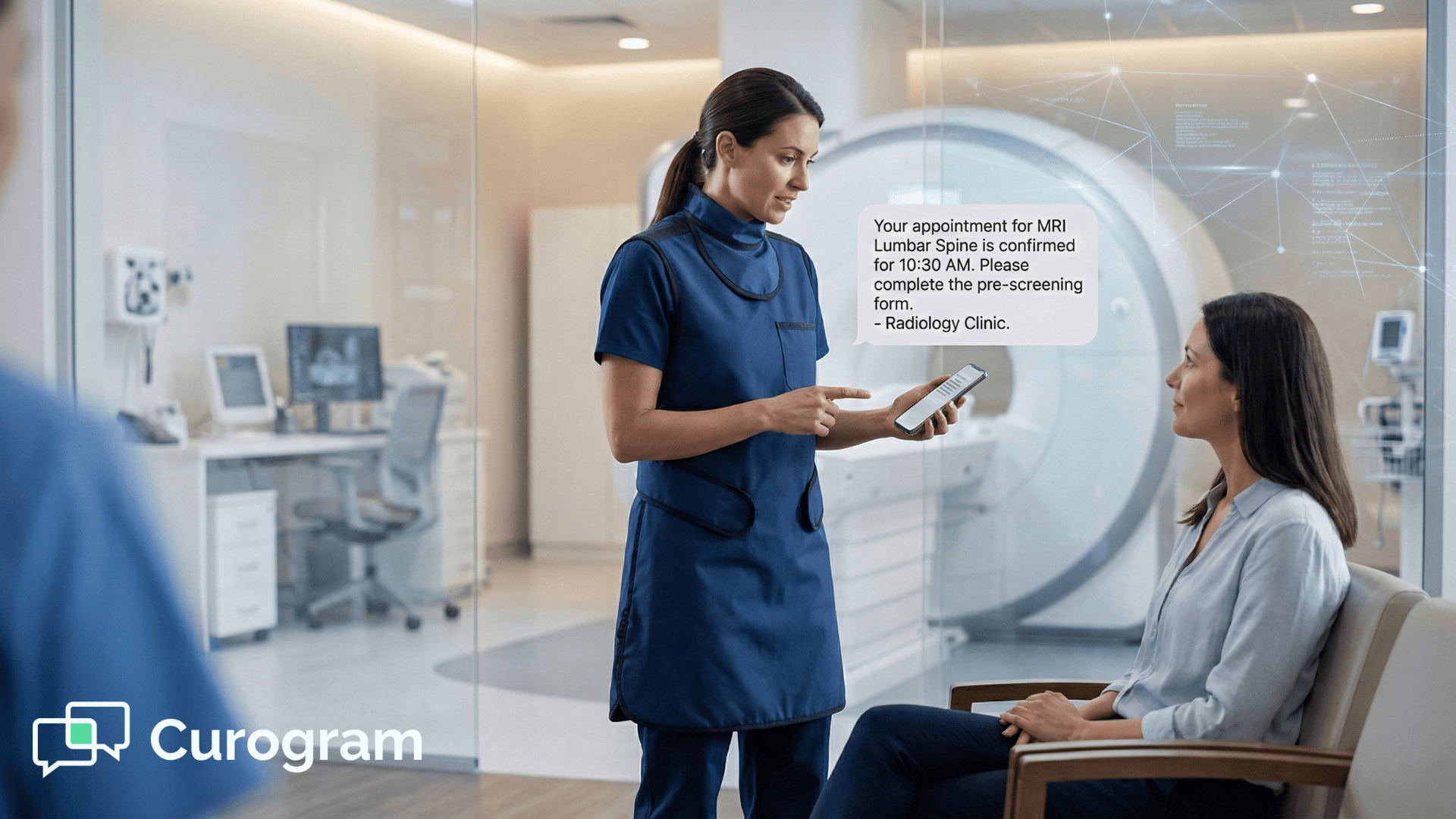
Text-based preparation instructions solve this problem. You can send detailed prep guidelines with the appointment reminder. Include links to visual guides if needed. Patients can review instructions multiple times on their phones. They can text back questions if anything is unclear.

This improved preparation leads to higher rates of completed, billable encounters. Imaging centers report 30-40% fewer incomplete studies after implementing text-based prep instructions. Each prevented incomplete study protects $500-2,000 in revenue depending on the exam type.

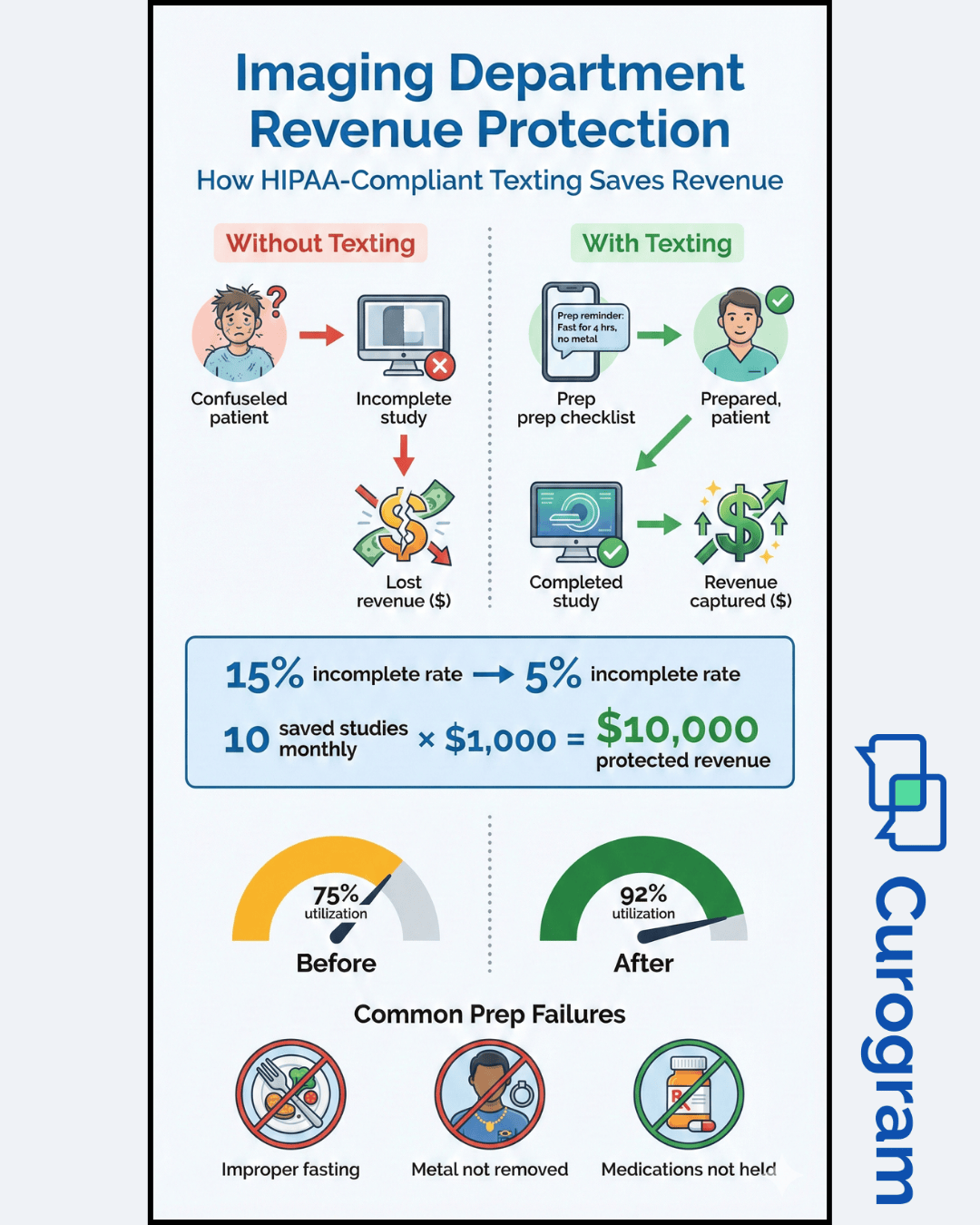
For a busy imaging center doing 100 complex studies monthly, reducing incomplete exams from 15% to 5% saves 10 procedures. At $1,000 average revenue per study, that is $10,000 monthly in protected revenue or $120,000 annually. These are real dollars that would otherwise be lost.

The revenue benefits extend to specialty procedures as well. Endoscopy requires bowel prep. Cardiac stress tests need medication adjustments. Pain management procedures have specific pre-treatment protocols. In every case, proper patient preparation improves procedure success rates and reduces complications.

Better preparation also improves throughput. When every patient arrives ready, your clinical team can stay on schedule. No delays waiting for patients to drink contrast or empty bladders. No canceled procedures that throw off the entire day. Consistent throughput means you can schedule more appointments per day without adding clinical hours.

Patient communication GE Centricity integration makes all this automatic. The system pulls appointment data from your schedule. It sends reminders at the right time with procedure-specific instructions. Patients can confirm their appointments with a single text reply. Everything happens without staff intervention.

Last-minute appointment filling represents another revenue opportunity. When cancellations occur, text messaging helps you fill those slots quickly. Send offers to patients on your waiting list. They respond within minutes instead of hours. You can fill same-day openings that would otherwise go to waste.

For procedures with long wait lists like colonoscopies or specialty consults, this quick-fill capability is valuable. Every filled slot is revenue that would have been lost. Over time, better slot utilization adds significant income without requiring more clinical capacity.

The cumulative revenue impact from all these improvements can exceed $300,000 annually for a mid-sized specialty practice. Larger multi-location operations see proportionally higher gains. These are not theoretical benefits. They are measurable improvements that show up in your financial statements within months of implementation.

Compliance Texting GE Centricity - mid

Cost Savings Through Workflow Automation and Staff Efficiency

Workflow automation delivers cost savings that are just as important as revenue gains. By eliminating repetitive manual tasks, you free staff to focus on work that actually requires human judgment and expertise. This shift improves both efficiency and job satisfaction.

Automated appointment reminders remove the biggest time sink in most front offices. Instead of spending 2-3 hours daily making confirmation calls, your staff can greet patients, answer complex questions, and handle insurance issues. These tasks cannot be automated and directly impact patient satisfaction.

The labor cost savings are substantial. A practice saving 15 hours weekly of manual confirmation work saves roughly $15,000 annually in labor costs at $20/hour loaded rates. Multiply that across multiple locations, and the savings easily reach $50,000-100,000 for mid-sized operations.

Staff can handle higher patient volumes without feeling overwhelmed. When routine communication happens automatically, your team has capacity for more patient interactions. You can add appointments without adding headcount, which directly improves your revenue-to-labor ratio.

This scalability is crucial for growing practices. Traditional models require adding front desk staff as appointment volume increases. With automated communication, you can often serve 30-50% more patients with the same team size. That efficiency gain flows straight to your bottom line.

Revenue Protection for Radiology and Specialty Departments

Radiology and specialty departments face unique revenue protection challenges. Expensive equipment and specialized staff create high fixed costs. Revenue depends on maximizing utilization while maintaining quality. Any inefficiency in patient flow directly impacts profitability.

Fewer incomplete imaging studies due to improved prep

Proper patient preparation is critical for imaging quality. When patients arrive unprepared, you face a difficult choice between proceeding with suboptimal studies or rescheduling. Either option wastes resources and frustrates everyone involved.

Text-based prep instructions dramatically reduce incomplete studies. Patients receive clear, written guidelines they can reference multiple times. They can ask clarifying questions via secure 2-way messaging. This two-way communication ensures understanding before the appointment day.

The financial impact is immediate. Each prevented incomplete study protects $500-2,000 in revenue. For busy imaging centers, reducing incomplete exams from 15% to 5% of monthly volume can save $50,000-150,000 annually depending on case mix.

Reduction in repeat scans caused by confusion or non-compliance

Repeat scans represent pure cost with no additional revenue. When initial studies fail due to patient error, you absorb the expense of repeating the exam. This doubles your costs while irritating patients and referring physicians.

Clear communication prevents most repeat scans. When patients understand why fasting matters or how to hold still during imaging, they comply better. Success rates improve, and repeat scans decline.

The savings compound over time. If your facility does 1,000 imaging studies monthly and reduces repeat rates from 8% to 3%, you prevent 50 repeat scans. At $300 average cost per repeat, that is $15,000 monthly in saved expenses or $180,000 annually.

Higher patient readiness improves per-day throughput

Throughput directly drives revenue in imaging departments. Each hour of scanner time has a revenue capacity. Delays from unprepared patients reduce daily throughput and limit revenue potential.

When every patient arrives ready, your schedule runs smoothly. No waiting for bladders to fill or contrast to be consumed. No explaining prep requirements that should have been communicated earlier. You complete more studies per day with the same equipment and staff.

Even small throughput improvements generate significant revenue. Completing one additional study per day may seem minor. Over 250 operating days annually at $800 per study, that single extra slot generates $200,000 in additional revenue without any increase in fixed costs.

How Curogram Delivers These Benefits

Curogram integrates directly with GE Centricity to automate all patient communication workflows. The platform sends procedure-specific preparation instructions automatically based on appointment types in your schedule. Patients receive reminders at optimal times without any manual staff intervention.

The system supports true two-way conversation. Patients can ask questions about their prep instructions and receive answers within the secure messaging platform. This interactive communication improves understanding and compliance far better than one-way automated calls.

For multi-location imaging centers and specialty clinics, Curogram provides enterprise-level visibility across all sites. You can track communication effectiveness, monitor no-show rates, and measure patient preparation compliance from a single dashboard. This data-driven approach lets you continuously improve financial performance.

The platform is also remarkably easy to deploy. Staff training takes about 10 minutes because the interface is intuitive. Implementation happens in days, not months. You start seeing ROI within the first billing cycle as no-shows drop and throughput improves.

Most importantly, Curogram is HIPAA-compliant from the ground up. All messages are encrypted. Audit trails track every communication. You get the efficiency benefits of modern texting without any compliance risk to your practice.

GE Centricity + Curogram Integration and Its Financial Benefits

Direct integration between GE Centricity and HIPAA-compliant texting platforms eliminates double data entry, which saves time and prevents errors. When patient appointments sync automatically, your staff does not need to manually input data into multiple systems. This automation prevents scheduling mistakes that can cost real money.

Integration also enables sophisticated clinical coordination workflows. You can trigger specific message sequences based on appointment types pulled directly from Centricity. Imaging studies get prep instructions. Follow-up appointments get outcome surveys. Everything happens automatically based on the data already in your system.

For multi-location operations, standardization is worth its weight in gold. Every site uses the same communication templates, same reminder schedules, and same workflows. This consistency makes it easy to measure performance across locations and identify opportunities for improvement.

The time savings from eliminating double entry add up quickly. If each appointment requires 1-2 minutes of manual data entry, and you handle 500 appointments weekly, that is 500-1,000 minutes saved. Over a year, that is 400-800 hours of staff time that can be redeployed to revenue-generating activities.

Integration also improves data accuracy, which protects revenue. Billing errors from incorrect appointment details cost money. Insurance verification delays from missing information slow payment. Automated data sync from GE Centricity ensures accuracy while reducing administrative burden.

Conclusion

The financial case for HIPAA-compliant texting is clear. You reduce labor costs while improving revenue per appointment slot. Staff become more productive. Patients receive better service. Compliance risks decrease.

For GE Centricity clinics managing specialty care and imaging services, the ROI is especially strong. These departments have high fixed costs and depend on maximizing throughput. Any improvement in schedule utilization or patient preparation directly impacts profitability.

The technology is proven and easy to implement. Thousands of healthcare organizations use secure 2-way messaging successfully. Implementation takes days, not months. Staff training is minimal. The typical payback period is under 6 months.

Multi-location operations gain additional benefits from standardization and enterprise visibility. You can implement best practices across all sites and monitor performance centrally.

Healthcare economics will continue pressuring margins. The only path to better profitability is improving operational efficiency while maintaining care quality. HIPAA-compliant texting delivers both.

See how much your clinic can save while improving patient care. Book your demo today to explore Curogram's financial impact for your operation.


Frequently Asked Questions

How does HIPAA-compliant texting reduce no-show rates in specialty clinics?

HIPAA-compliant texting reduces no-show rates by reaching patients on their preferred communication channel with a 98% open rate. Automated reminders go out at optimal times, such as 48 hours before and the morning of appointments, keeping visits top-of-mind without requiring staff intervention. Patients can confirm with a single text reply, and two-way messaging lets them ask questions about preparation or directions. This convenience and clarity help patients remember and prepare for appointments, typically reducing no-shows by 50-75% compared to phone-based reminder systems.

Why is patient communication GE Centricity integration important for ROI?

Direct integration between texting platforms and GE Centricity eliminates double data entry, which saves time and prevents costly scheduling errors. When appointment data syncs automatically, staff does not need to manually input information into multiple systems. The integration also enables sophisticated workflows where specific message sequences trigger based on appointment types, ensuring patients receive procedure-specific instructions without manual effort. For multi-location operations, this standardization across all sites improves performance measurement and cost control, directly impacting ROI through labor savings and reduced errors.

How does secure 2-way messaging improve imaging department revenue?

Secure 2-way messaging improves imaging revenue by ensuring patients arrive properly prepared for studies. Clear prep instructions sent via text reduce incomplete exams from 15% to 5% or less, protecting $500-2,000 in revenue per prevented incomplete study. Patients can ask clarifying questions about fasting, medication holds, or other requirements through the messaging platform, improving compliance. Better preparation also reduces repeat scans caused by patient error, saving costs while improving throughput. When every patient arrives ready, scanners stay on schedule and complete more studies per day without adding equipment or staff hours.

Why do multi-location specialty clinics need enterprise-level communication visibility?

Enterprise visibility helps multi-location operations standardize processes, reduce compliance risk, and optimize performance across all sites. Centralized dashboards let administrators monitor communication effectiveness, track no-show rates by location, and identify sites needing additional training or support. This visibility prevents the chaos that happens when different sites use different communication methods, some compliant and some not. Standardized workflows also make it easier to scale successful practices across the organization and ensure consistent patient experience regardless of which location they visit, improving both efficiency and brand reputation.

How quickly can GE Centricity clinics see ROI from implementing HIPAA-compliant texting?

Most clinics see measurable ROI within the first billing cycle after implementation, typically 30-60 days. No-show rates begin dropping immediately as automated reminders go out, creating revenue gains from better slot utilization within weeks. Labor savings from reduced manual confirmation work also start immediately, with staff redirected to higher-value activities. The typical payback period for the technology investment is under 6 months when you account for both revenue gains from reduced no-shows and cost savings from workflow automation. ROI continues improving over time as patient retention increases and operational efficiency compounds across the organization.


GE Centricity Workflow Improvements With HIPAA-Compliant Texting

GE Centricity Workflow Improvements With HIPAA-Compliant Texting

💡 GE Centricity practices use HIPAA-compliant texting to solve radiology workflow problems. Instead of managing hundreds of daily phone calls,...

Read More
Veradigm HIPAA Texting ROI for Imaging Centers | Curogram

Veradigm HIPAA Texting ROI for Imaging Centers | Curogram

💡 Compliance texting with Veradigm brings secure, automated messaging that improves both operations and revenue. This approach reduces no-shows and...

Read More
Mass Texting for Veradigm Imaging Centers with Curogram

Mass Texting for Veradigm Imaging Centers with Curogram

💡 Mass texting in Veradigm helps imaging centers reach thousands of patients quickly while staying HIPAA-compliant. This communication tool...

Read More