
 Aubreigh Lee Daculug

A warm, judgment-free text changes that dynamic. Curogram sends it from the clinic's own familiar number, using context from the plan of care, so a parent can simply reply YES to book. There's no phone call, no explanation, and no pressure.
Curogram calls the problem "The Silent Goodbye," and its answer is an open door. On average, 35% of families who receive a recall text book a session again.
Nobody ends speech therapy with a phone call.
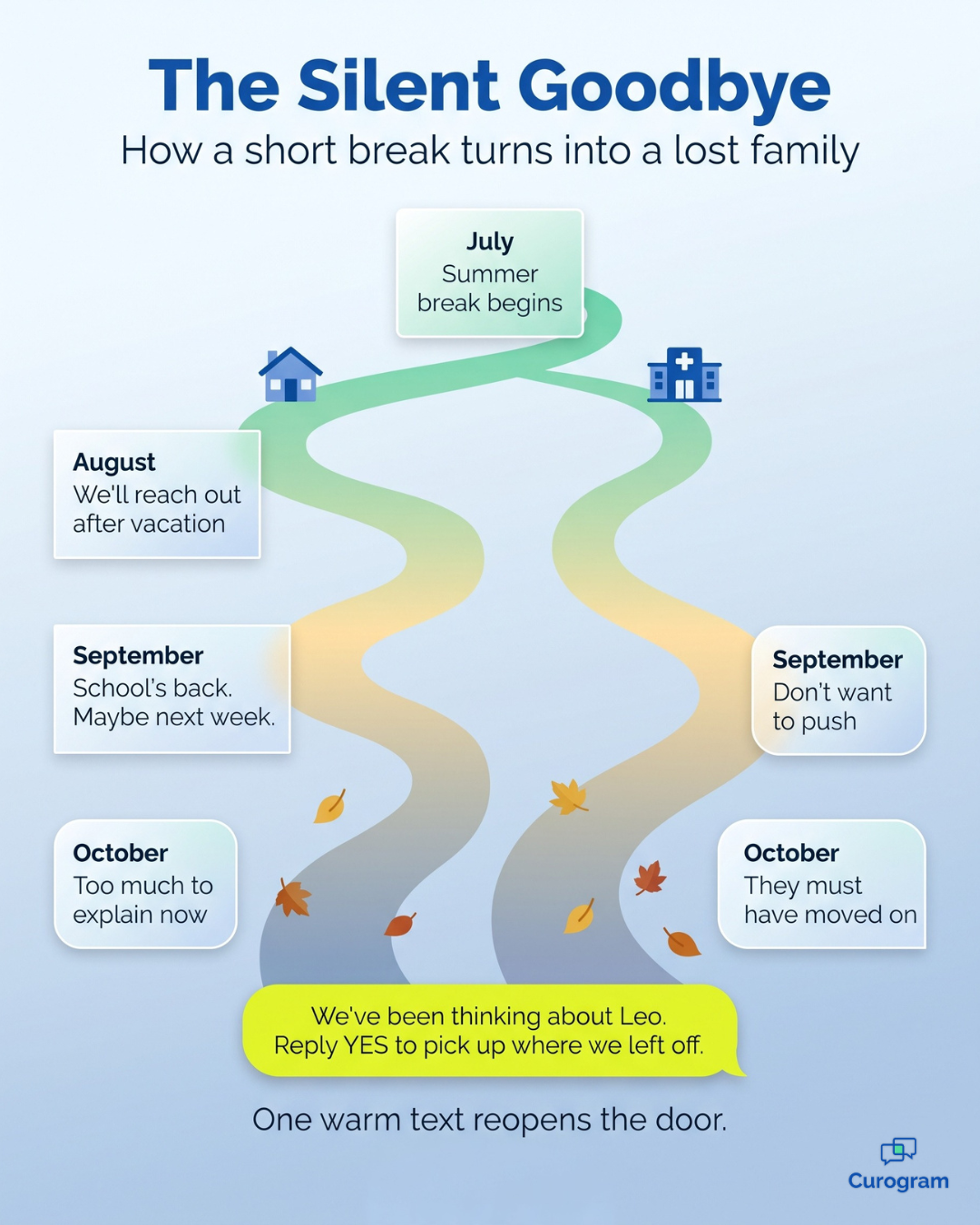
There's no goodbye email and no final session marked on the calendar. A family simply stops showing up, usually after something ordinary like a summer break, a new school schedule, or a few chaotic weeks at work.
Then autumn arrives, and the parent fully intends to call. They think about it when their son struggles with a word at dinner, or when his teacher mentions speech during a conference.
But calling means explaining why they disappeared for three months, and that conversation feels uncomfortable. So they decide to wait one more week, and then another.
Here's the difficult part: your clinic is waiting too.
Your team doesn't want to seem pushy, and nobody wants to chase a family who may have chosen to leave. So both sides stay quiet, and that quiet gradually turns a temporary pause into a permanent ending.
A summer pause never restarted is one of the most common ways therapy practices lose families. It rarely appears as a cancellation in any report, because the family just fades quietly from the schedule.
The consequences affect everyone involved. The child loses skills they spent months developing, and the family loses the time and money they already invested. Meanwhile, your therapist loses a slot that could have helped another child.
It doesn't have to happen this way, because most paused families genuinely want to come back. What they're missing is an easy, low-pressure way to return, and someone willing to make the first move.
In this guide, you'll learn why families go silent and why that silence grows heavier over time. You'll also see how a warm text from Curogram breaks the cycle for Ensora Fusion clinics, along with a sample message and practical numbers to help plan your own outreach.
How a Short Break Quietly Becomes a Lost Family
Therapy pauses rarely end with a deliberate decision. Instead, they end with silence on both sides. The family feels guilty, the clinic feels awkward, and every week without contact raises the emotional cost of reaching out.
Why the Guilt Keeps Growing
Consider a mother whose daughter stopped occupational therapy in July. Every time her daughter struggles on the stairs, she thinks about calling the clinic. But that call would mean explaining August, September, and October to the front desk.
That's the guilt barrier returning to therapy places in front of a parent. It usually isn't about money or scheduling at all. It's about the fear of being judged for the gap.
So she keeps putting off the call. And the longer she waits, the bigger the explanation seems to become.
Why Clinics Stay Quiet Too
From your side of the front desk, silence feels respectful. Your staff doesn't want to pressure anyone, and there's always a chance the family had a good reason to stop or found another provider.
Phone outreach also takes time your team rarely has. A single call can turn into days of voicemail tag. Multiply that by dozens of paused families across several locations, and outreach naturally slides to the bottom of the priority list.
How Silence Gets Misread
Here's the trap that catches both sides. Silence reads as indifference in either direction.
The family assumes the clinic has moved on, while the clinic assumes the family has. Neither belief is true, yet both sides behave as though it is.
What the Silent Goodbye Really Costs
The consequences reach everyone. A child who was steadily gaining skills begins to lose ground. Child progress continuity matters in therapy because each new skill builds on the last, and a long gap can mean weeks of review before real progress resumes.
The family loses the effort and money they already invested. Your therapist loses a valuable slot in their schedule. And all of it could have been prevented with one thoughtful, well-timed message.
How Curogram Opens the Door Again
Curogram acts as the Panel Recovery Engine for Ensora Fusion clinics. Instead of waiting for families to work up the courage to call, your clinic reaches out first. Every message is warm, specific, and completely free of judgment.
This is what bringing paused therapy families back to Ensora Fusion clinics with text outreach looks like in daily practice.
Here's how the process works, step by step:
- Context comes from the plan of care. Curogram draws on the child's clinic, therapist, therapy discipline, and where the plan left off. No clinical details ever appear in the text itself.
- A personalized recall text goes out. The message comes from your clinic's own familiar number, so families immediately recognize who's reaching out. It's never a generic blast, and it's never a guilt trip.
- The family replies. A simple YES is all it takes, with no phone call, no apology, and no lengthy explanation required.
- Your team books the session. The reply flows directly into booking, so your staff can quickly find a time that fits the family's schedule.
- Reminders protect the restart. Once the family is back on the calendar, Curogram's automated reminder sequence helps keep those appointments on track.
Each step is designed to remove one more reason for a family to stay away. By the time a parent replies, the hardest part of returning is already behind them.
What an Effective Message Sounds Like
A strong family win-back message therapy teams can send should sound like a friendly neighbor, not a billing department.
Here's a simple example:
"Hi! We've been thinking about Leo. If you'd like to pick up his speech sessions where we left off, just reply YES and we'll find a time that works."
That single text functions as a resume plan of care invitation. It mentions the child by name, connects back to the existing plan, and asks for nothing more than a one-word reply.
Notice what the message deliberately leaves out. There's no "we noticed you missed several appointments" and no "it's been a while." The family has nothing to explain and nothing to defend.
Why the Reply Makes All the Difference
For a parent carrying pause guilt, replying to a text is the easiest possible path back. Rebooking by text reply family members can complete from a school pickup line removes nearly every obstacle that kept them away.
It also helps that text messages actually get read. SMS messages see a 98% open rate, so your invitation won't sit unopened in a crowded inbox. For your team, that translates into fewer phone calls, less voicemail tag, and more booked sessions.
Why a Graceful Way Back Turns Into Booked Sessions
When families receive an easy, respectful way to return, many of them take it. Across Curogram recall campaigns, 35% of recipients book a session.
That number tells you something important about paused families. The desire to return was there all along, waiting quietly in the background. Families didn't need a sales pitch; they simply needed permission.
To make that figure easier to picture, the table below uses sample numbers for a three-clinic Ensora Fusion group.
These are illustrative figures, not real client data.
| Illustrative Example | Figure |
|---|---|
| Paused families contacted | 120 |
| Families who book (35%) | 42 |
| Weekly sessions per family over 8 weeks | 8 |
| Sessions returned to the schedule | 336 |
| Value at a sample rate of $100 per session | $33,600 |
In practice, this means 42 children are back on track and more than 300 previously empty slots are filled within two months. Over a full plan of care, the value grows even more.
The outreach also repairs the relationship itself. Before the text, your practice was "the clinic we ghosted." Afterward, you become "the clinic that welcomed us back."
That emotional shift matters beyond a single appointment. Families who feel truly welcome are more likely to finish their plan of care and recommend your practice to other parents.

Most importantly, children pick up right where they paused. They don't have to start over with an unfamiliar provider who needs to learn their history from scratch. Their therapist already knows their goals, their past wins, and what comes next.
Families let go of the guilt, and therapists get their caseloads back. Best of all, progress keeps moving forward instead of starting over.
Practical Ways to Make Every Recall Text Feel Personal
A recall campaign works best when every message feels like it came from someone who genuinely remembers the child. A few small choices can separate a text that earns a warm reply from one that families quietly ignore.
Before you send your first batch of messages, keep these tips in mind:
- Lead with the child, not the absence. Mention the child's name and their therapy discipline, and avoid any reference to missed appointments or time away.
- Keep the message brief. Two or three sentences is usually enough, because longer messages quickly start to feel like form letters.
- Make the next step obvious. Ask for one simple reply, such as YES, so the family never has to wonder what happens next.
- Use a number families recognize. A familiar clinic number builds trust right away, while an unknown number can easily look like spam.
- Respect every "no" graciously. If a family says they've moved on, thank them warmly and close the loop.
Timing matters too. A message that arrives a few weeks after a planned break, such as the beginning of the school year, reaches families while their old routine still feels fresh.Families who paused several months ago are still worth contacting, since the right words can make even a long gap feel manageable.
It also helps to group families by situation. A family that paused for summer vacation needs different wording than one that stopped after a move or a new work schedule.
With Curogram, your team can organize paused-family segments by clinic, therapist, or therapy discipline, so each message feels individual even when dozens go out together.
Finally, track the results after every campaign. Note which families booked, which requested more time, and which have permanently moved on. Over time, that information helps you refine your messaging and see exactly how many families your outreach brings back.
Reach Out First and Welcome Families Home
Every therapy practice has a familiar list of families like these. They paused for summer vacation, a relocation, or a hectic season, and they simply never returned.
They didn't leave because they were dissatisfied with your care. They left because returning felt more difficult with each passing week, and the longer the silence lasted, the more there seemed to explain.
You can interrupt that cycle with a single, thoughtful message.
A warm, judgment-free text gives paused families exactly what they've been hoping for. It's an unmistakable signal that they're welcome back, with no questions asked and no awkward conversation required. Above all, it allows them to accept with a single word.
Here's a helpful way to think about the partnership. Ensora Fusion holds your clinic's memory of the plan, including where each child left off and which goals come next. Curogram gives families a graceful way back to that plan.
Together, the two systems turn a list of lost families into a schedule of returning ones. Your clinic handles the outreach, so parents don't have to work up the nerve to call. Your staff dedicates less time to phone calls, and children return to the progress they worked so hard to earn.
Now consider one specific family that paused last summer and never came back. There's a good chance they still think about your clinic, quietly waiting for a sign that coming back is okay.
Be the practice that reaches out first.
Your team doesn't need to write every message manually or spend hours chasing voicemails. Curogram automatically manages the outreach, the replies, and the reminders that keep families on schedule once they're back.
Schedule a Demo to see exactly how a recall campaign moves from a paused-family list to a confirmed booking in about 15 minutes.