
Reducing No-Shows in SUD Treatment Centers on Opus EHR
💡 Reducing no-shows in SUD treatment centers takes more than clinical care. It takes automated, two-way patient communication that fits inside your...
Your schedule looked full this morning. By noon, three chairs sit empty.
Nobody called to cancel. Nobody answered the reminder. The appointments simply vanished, and your front desk is left scrambling to fill the gaps.
Here's the frustrating part.
Your practice did send a reminder. eClinicalWorks fired off a robocall the day before, right on schedule.
The patient half-heard a voicemail, meant to call back, and forgot. That reminder didn't fail because your team dropped the ball. It failed because it asked the patient to do the hardest thing possible — call the office back during business hours.
Think about how you handle your own appointments. When was the last time you returned a robocall from a number you didn't recognize? You probably let it roll to voicemail and moved on.
Your patients do the same. They screen calls, delete voicemails, and skip numbers they don't know. But they read their texts within minutes.
This is the gap that quietly drains revenue from busy eClinicalWorks practices. The system sends reminders, but the reminders reach patients through a channel they've already tuned out.
A missed appointment isn't just an empty chair. It's lost revenue, a wasted slot another patient wanted, and staff time spent chasing people who never meant to skip. Multiply that by a few patients a day, and the cost adds up fast.
The fix isn't more reminders. It's a smarter one — a reminder patients won't ignore eClinicalWorks practices can send without adding a single task to the front desk.
Small change, big payoff. That's the pattern worth understanding here.
In this article, you'll see why one-way reminders fall flat, how confirmable texts change patient behavior, and what that shift does to your show rate. The change on your end is smaller than you'd expect, and the return is bigger.
A robocall asks nothing of your patient. It plays a message, hangs up, and hopes for the best.
Think about the last unknown number that called you. You probably let it ring and moved on. Your patients do the exact same thing.
A one-way robocall breaks down in a few quiet ways. Line them up and the pattern is hard to miss.
| Where the robocall breaks | What it means for the patient |
|---|---|
| Nothing to tap or reply to | They can't confirm, even if they want to |
| Arrives as a screened call | Your reminder is never really heard |
| Leaves no thread behind | A quick "yes" or "reschedule" has nowhere to go |
None of these feels like a big deal on its own. Stacked together, they turn your reminder into background noise.
Your patient half-hears the voicemail while making dinner.
They think,
"I'll call back tomorrow." Tomorrow comes, life gets busy, and the appointment slips their mind entirely.
Technically, a reminder happened. But nothing was confirmed, and nobody had a simple way to say
"yes, I'll be there" — or "actually, I need to move it."
| A reminder that can't be answered doesn't prevent a no-show. It just documents that a reminder was sent. |
That's the quiet failure hiding in most reminder systems. They log the attempt, close the ticket, and call it done. Meanwhile, the patient who would have happily confirmed by text never got the chance.
Here's how it feels from both sides.
Patients feel nagged by calls they didn't answer, yet still miss the visit. Your practice feels the sting of the empty chair anyway — and eats the cost.
14% or higher.
That's the no-show rate many eClinicalWorks practices quietly treat as normal.
On a busy 40-appointment day, that works out to five or six empty chairs before lunch. For your front desk, it's an afternoon spent chasing callbacks that never had to happen.
This pattern shows up everywhere: primary care, pediatrics, OB/GYN, and behavioral health. The specialty changes, but the villain stays the same. It's the one-way robocall patients tune out completely, no matter how many you send.
You don't need louder reminders. You need reminders that let the patient answer in the same breath they read them.

Curogram works like a virtual front-desk assistant that lives inside your patients' text messages. It meets them on the channel they actually open, then makes confirming effortless.
Instead of a call they'll skip, patients get patient appointment reminder texts eCW practices can trust — timed, professional, and ready to answer with a single reply.
The reminder arrives as a normal text, not a jarring automated voice. It reads like a note from the office, so patients treat it like one.
Because it's a text, it waits patiently in their inbox until they have a free second. No missed call, no voicemail, no callback required.
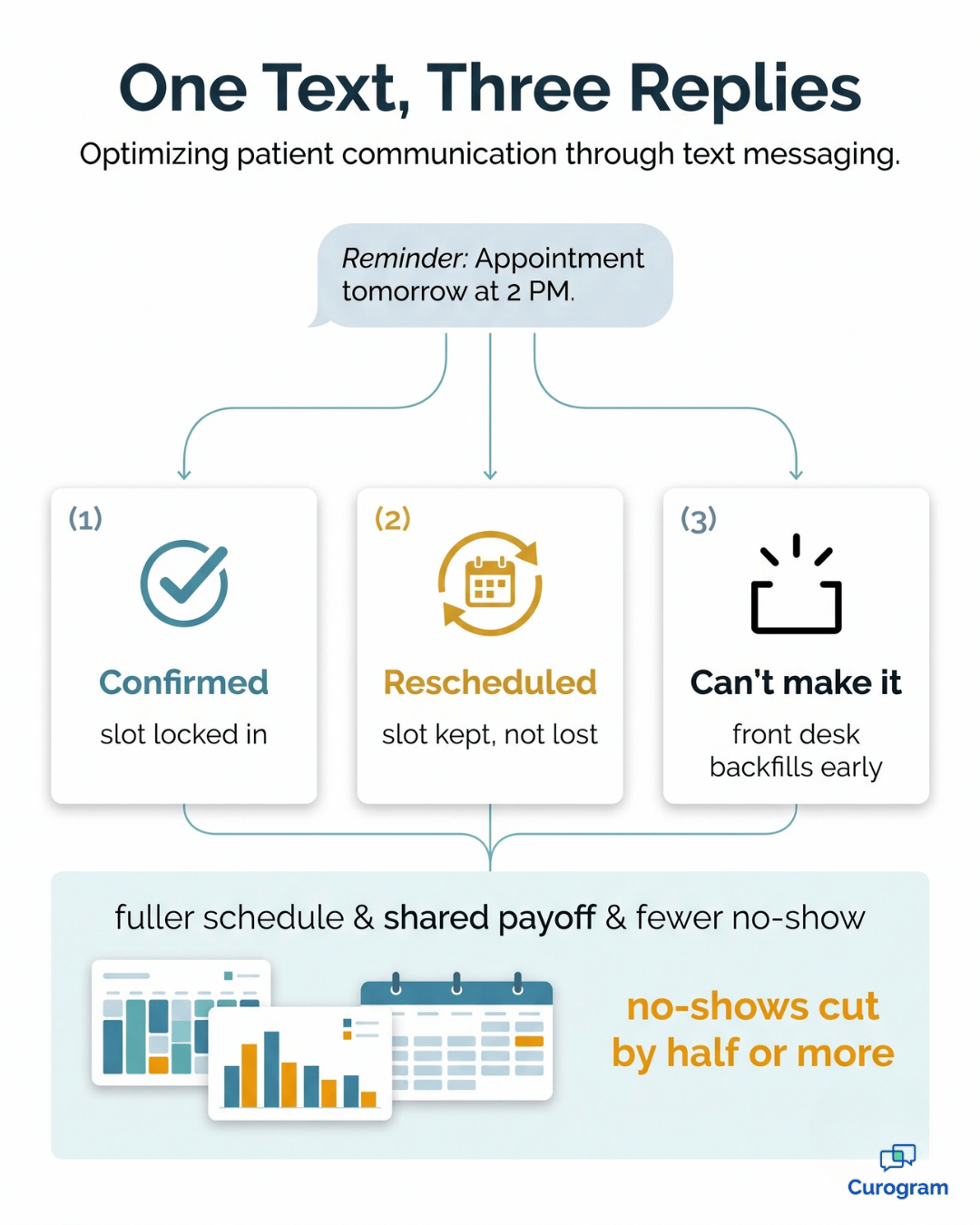
This is where the magic happens. Two-way confirmation lets the patient reply right in the thread, turning a passive reminder into a live conversation.
That last point matters more than it sounds. Every extra step is a reason for patients to give up, and every removed step lifts your confirmation rate.
One tap. That's the entire ask.
53% below the industry average.
That's where Curogram clients land on no-shows — less than half the norm. Removing friction is the whole reason patients keep showing up.
In practice, that's the gap between a schedule that holds and one that leaks all day.

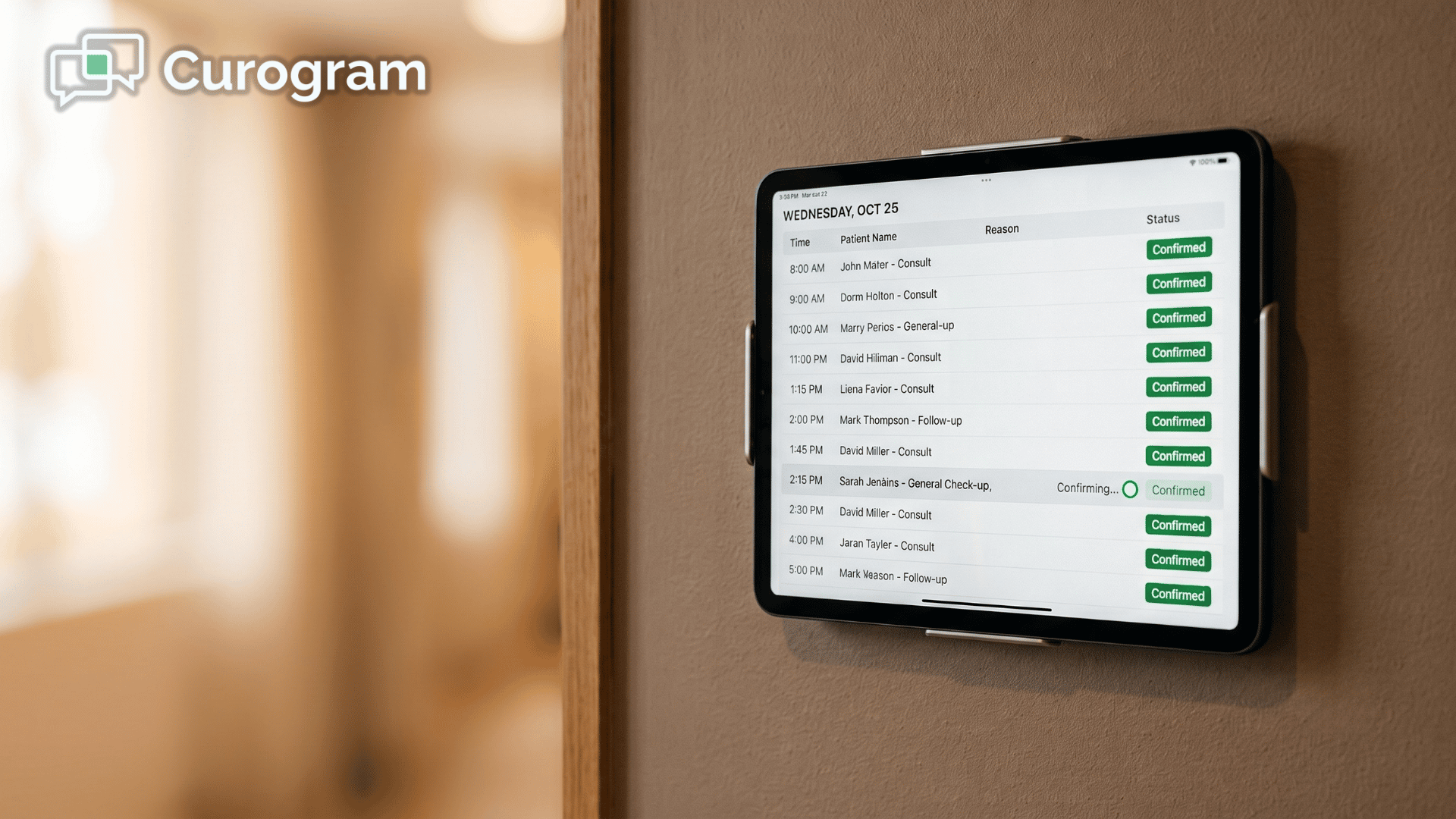
Curogram doesn't replace eClinicalWorks — it complements it. The appointment still lives in eCW, while the patient simply taps to confirm on their phone.
The experience stays effortless for them and accurate for you. Nothing changes in your existing workflow, and no IT project is required to get started.
For sensitive specialties, this quiet channel is a gift.
A behavioral-health patient confirms a session privately by text instead of an awkward phone call.
A busy parent confirms a pediatric visit from the grocery line, and an OB/GYN patient reschedules a prenatal appointment in seconds.
Here's what changes when patients can actually answer their reminders. The shift is bigger than most practices expect.
Comparable practices have driven no-shows from over 14% down to under 5% after switching to confirmable texts. Let's put real dollars on that with a simple example.
Think about this. Your practice books 40 visits a day and loses 14% to no-shows — about five or six empty slots. Switch to confirmable texts and that rate drops toward 5%, closer to two. Do the math across a month, and you win back roughly 72 slots.
~$130,000 a year.
At an average visit value of $150, those recovered slots add up to about $10,800 a month — near $130,000 over a year. (Sample figures; swap in your own averages.)
Here's what that means for your team.
Each recovered slot is a patient seen, a bill sent, and a chair that didn't go to waste — filled either by the confirming patient or by someone your team backfills after an early cancellation.
The experience changes for patients too. It moves from an ignored robocall to a one-tap "confirmed," matching how they handle every other appointment in their life.
Patients show up because confirming was easy and rescheduling was easier.
And the few who truly can't make it tell you in time to fill the slot, so you reduce forgotten appointments eClinicalWorks practices used to just absorb.
A reminder only prevents a no-show if the patient can confirm it. And patients confirm texts — not robocalls they never picked up.
That's the whole idea in one sentence. eClinicalWorks holds your appointment record. Curogram delivers their one-tap confirmation. Together, they turn reminders into attendance.
Think back to those three empty chairs from this morning.
Most of them weren't lost to patients who didn't care. They were lost to a reminder that never gave anyone a way to answer.
When you close that gap, the change ripples through your whole day. Your schedule holds steady, your front desk stops chasing callbacks, and your revenue stops leaking through slots that quietly went unfilled.
You're not adding work to do this. You're removing it. The reminders send themselves, the confirmations flow back automatically, and your team spends less time on the phone playing appointment detective.
Patients notice the difference too. A discreet text feels helpful, not naggy — especially for anyone confirming a sensitive visit they'd rather not discuss out loud. That goodwill shows up as loyalty over time, and loyal patients keep your schedule full month after month.
The best part is how little has to change on your end. There's no new system to learn, no disruption to your eCW workflows, and no IT department required. Curogram sits on top of what you already use.
So here's the simple next step. Stop sending reminders into the same voicemail void your patients already ignore.
See the one-tap text confirmation in action for yourself, and watch what it does to your show rate over the course of a single busy week.
Schedule a Demo today, and discover how quickly a reminder patients will actually answer can steady your schedule and recover the revenue that keeps slipping away one empty chair at a time.
No — reminders are timed, professional, and easy to act on, which patients consistently prefer over repeated phone calls. They can confirm in one tap and opt out anytime, so the experience feels helpful rather than nagging.
Yes. Curogram keeps patient texting HIPAA-compliant, and a discreet text is often more comfortable than a phone call. That's especially true in behavioral health, where a private confirmation reduces the friction and stigma of a voice call.
Both. Patients can confirm or reschedule right in the thread, so the ones who can't make it tell you early. That early notice is exactly what lets your team backfill the slot instead of losing it.
No. That's the point of no robocall appointment reminders eCW patients can answer instantly — everything happens in a normal text thread. There's no app to install and no password to remember, which is why confirmation rates climb.
Not at all. The appointment still lives in eCW while Curogram handles the text conversation on top of it. There's no rip-and-replace project and no IT department required to get started.
💡 Reducing no-shows in SUD treatment centers takes more than clinical care. It takes automated, two-way patient communication that fits inside your...
💡 To confirm a Cloud 9 orthodontic appointment via text, parents simply reply YES to an automated SMS reminder — no link to tap, no app to open,...
💡 SMS reminders support treatment protocol adherence for ketamine and TMS patients at Osmind practices by sending automated, HIPAA-compliant texts...