
HIPAA Texting Governance for eCW Networks | Curogram
 Jo Galvez : Aug 25, 2026, 8:00:04 AM
Staff already text patients — often from personal phones. Curogram gives eCW networks a SOC 2 Type II-governed channel with full audit trails and...

A float nurse covers Westgate on Tuesday and Northside on Thursday. Give her the access she needs for those two shifts. In most patient texting tools, you've just handed her every conversation at all twelve locations, permanently.
That's the trade most multi-site groups are making without ever naming it. We think it's the wrong one, and it isn't the only option on the table.
Chart permissions in eCW already reflect your org chart. Facilities, departments, provider groups, security roles — that structure exists, and your team maintains it.
The texting layer bolted on beside the chart usually ignores all of it. One permission level, one shared login per site, or a spreadsheet somebody updates when they remember.
Unauthorized access and disclosure breaches rose 17.4% in 2025, based on OCR breach portal data. Over-broad access is how a small mistake becomes a reportable one. A front-desk hire opens a behavioral health thread she had no reason to see, and now the network owes a breach determination.
Three things follow: what all-or-nothing access costs across a network, how a permission model gets administered day to day, and what an access review looks like when the log is complete.
Multi-location groups centralize communication so a patient can call any site and get help. That's the whole return on the project.
Without scoping, the same design that makes coverage possible makes every account a doorway into every conversation in the network.
An auditor asks why a scheduler hired six weeks ago at your Lakeview clinic could read behavioral health threads at Westgate. "The tool only has one permission level" satisfies nobody — not the auditor, not the patient, not your board.
Under the minimum necessary standard (45 CFR §164.502(b)), access should stop at what the role requires. An RBAC healthcare communication platform is how that standard gets enforced instead of assumed.
Every resignation turns into a manual lockout across every tool that person touched. Offboarding access revocation in healthcare rarely fails at the EHR — it fails at the fourteenth system nobody kept a list of.
IT then faces two bad choices: accept the exposure, or split back into per-location tools and recreate the silo the network just paid to eliminate.
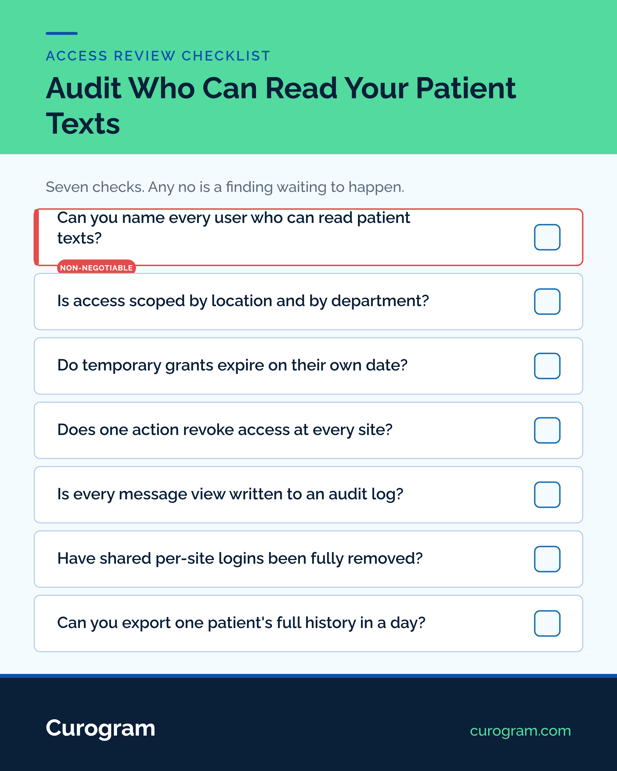
Curogram works as the compliance backbone by scoping staff access by location and department, then layering role on top. The three dimensions compose rather than stack into presets, which is what lets one model cover a 12-site group without fifty custom roles.
Granular RBAC builds each user's view from location, department, and role together, administered from one console. A worked example, using the float nurse from the opening:
|
Setting |
Value |
|---|---|
|
Locations |
Westgate, Northside |
|
Departments |
Primary Care |
|
Role |
Clinical — send, reply, view chart context |
|
Grant window |
Mar 3 – Mar 17 |
|
Behavioral health threads |
Excluded |
On March 18, the grant expires on its own. Nobody files a ticket, and her two weeks of activity stays in the log where an access review can see it.
Central permission management for clinics means one console handles all twelve sites. A site manager can be given queue assignment without being handed permission editing.
Audit logs for patient texting by staff record sends, views, permission changes, and exports with timestamps. That satisfies the Audit Controls standard at 45 CFR §164.312(b).
It also makes offboarding one action. Deactivate the user, and access ends everywhere while the history stays intact. Both belong in the wider policy we set out in our guide to HIPAA-compliant texting governance.

Every message access scoped and logged. That's the audit posture change one migration buys, and it's the difference between explaining a permission model and showing one.
Floats, cross-site help, holiday coverage — all of it flexes without leaving residue. Least-privilege patient messages stay least-privilege in June because the March grant already expired.
One deactivation, all locations, immediate. The historical record stays available for review, which is exactly what an access reviewer wants to find. The same permission model is what makes a shared inbox across every location safe to actually share.
Centralized communication earns its keep only when access is scoped — and only scoped access lets a network centralize with confidence.
eCW governs your chart permissions. Curogram governs their conversation permissions, with the same discipline and the same logs.
Run one list this week: everyone who can currently read patient messages at a location they've never worked. Then shrink that list to zero.
Book a demo and bring your org chart. We'll map it to a permission model in the session, including how floats and delegated site admins are handled.
 Jo Galvez : Aug 25, 2026, 8:00:04 AM
Staff already text patients — often from personal phones. Curogram gives eCW networks a SOC 2 Type II-governed channel with full audit trails and...
 Jo Galvez : Aug 31, 2026, 12:00:00 PM
All-or-nothing access fails growing groups. Curogram scopes Practice Fusion patient messaging by office and role — managed by your admin, fully...

.jpg?width=30&name=square-formal-photo%20(1).jpg) Mira Gwehn Revilla : Oct 12, 2026, 1:00:00 PM
Mira Gwehn Revilla : Oct 12, 2026, 1:00:00 PM
All-or-nothing access fails growing groups. Curogram scopes Tebra patient messaging by location and role — admin-managed, fully logged,...