
1 min read
Benchmarking Front Desk Performance Across athenahealth Locations
💡Benchmarking front desk performance across athenahealth locations extends a network's benchmark culture to the teams it has never covered. The...
6 min read
Jo Galvez
:
September 18, 2026
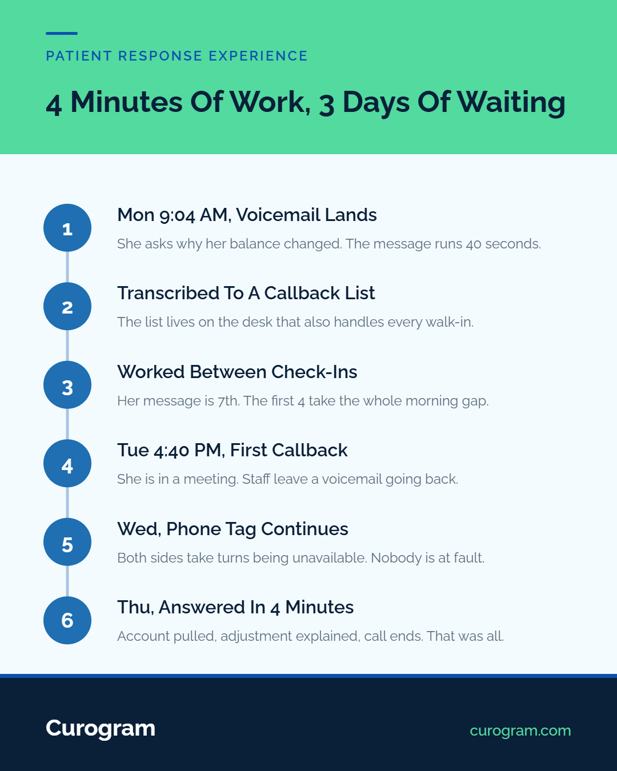
A patient leaves a voicemail Monday morning about a bill she doesn't understand.
Tuesday, nothing. Wednesday, nothing. Thursday, she calls again, and this time she opens with an edge in her voice. Someone pulls the account, reads the note, explains the adjustment, and the call ends in four minutes.
Four minutes of work. Three days of waiting. The answer was never the hard part.
Nobody in that clinic did anything wrong, which is what makes the pattern durable. The voicemail was transcribed to a list. The list got worked through between walk-ins. The callback went out at 4:40 on Tuesday and she was in a meeting. Phone tag ran its course.
Patients calibrate their expectations on retail and banking apps, not on healthcare norms, and their tolerance has moved. Our position: response speed is now a retention variable at every location. Most networks cannot name their own number for it at any site.
Measuring it matters as much as fixing it, because of how slow responders lose patients. Nobody writes a complaint letter about a callback. They book somewhere else next time, and the location never learns why.
Below: where the three days actually go, what patients accept as fast, the routing that closes the gap, and how a small site keeps pace with your flagship.
No single step in that Monday-to-Thursday chain takes long. That is the whole trap.
Transcription happens the same morning. The list sits on a desk that also handles check-ins, so it gets worked in gaps. The first callback attempt lands mid-afternoon, when working patients are least reachable.
A voicemail goes back the other way. Two more days pass while both parties take turns being unavailable.
Every stage holds up on its own. Added together they make a wait no manager would sign off on, if anyone showed her the total.
Silent attrition is the hardest kind to act on. Its only signal is an absence.
She never calls to say she's leaving. Her annual comes due and she books with the practice her neighbor mentioned. Your schedule shows one unfilled slot among many, credited to nothing. Twelve months later she's a lapsed patient in a recall list, and the reason sits in a voicemail nobody timed.
We can't tell you what share of attrition traces back to response speed, and anyone who quotes you a precise figure is guessing. From our own client work, we can say this much: patients who call a network easy to reach are describing response speed, and they say so in reviews.
Patients draw no line between your sites the way your org chart does.
She sees one brand on two buildings. A cardiology question answered in an hour and a billing question answered in three days average into one impression.
The slow one weighs more, because it cost her something. Patient experience by location is an internal concept. Externally there's one network with one reputation for reachability.
Ask a network for its median response time to a patient question and watch the room.
Phone systems report call volume and abandonment rates. Case queues report open and closed counts. Neither reports how long one patient waited between asking and being answered. Neither was built for a wait that spans two systems and a callback attempt.
Same-day answer expectations are now the floor patients accept. Most networks have no instrument that says whether they clear it.

Numbers without owners drift. Give the median an owner, and it gets managed.
Response-time tracking runs per location and per queue. Median first response becomes a standing figure a regional manager reviews weekly, alongside everything else.
Threads carry athenahealth record context, which means the person answering can see the appointment and the account without opening a second system.
Faster answers end up better informed, because context arrives with the question rather than after it.
Measuring a wait leaves it exactly as long. Four pieces of queue machinery shorten it:
|
Move |
What it fixes |
|---|---|
|
Claiming |
Two people working the same thread while a third sits untouched |
|
Department routing |
Billing questions landing in the scheduling queue and waiting there |
|
Cross-location coverage |
A two-person desk going dark at lunch and on Fridays |
|
Saved replies |
The 15 questions that make up most of the volume being retyped daily |
Claiming and routing usually produce the largest single drop. Most delay in a shared queue comes from unclear ownership rather than from too few people.
Speed on the phone costs staff time. Speed by text costs almost nothing, which is what makes it a standard holdable across every site.
A billing question answered by text takes 40 seconds between two check-ins. By phone, the same answer needs both people free at the same moment.
That's how it becomes a callback, and how a callback becomes three days. Response speed and patient loyalty travel together. Text is the one channel where being fast stops competing with everything else on the desk.
Patients feel it immediately. Staff feel it as fewer repeat calls from people chasing an answer they were already promised, which is a meaningful share of inbound volume at a slow site.
Response-Time Tracking reports how long patients at each location wait for a human answer, broken out by queue and trended over time.
The measurement sits next to the tools that improve it. Threads can be claimed, so ownership is clear. They route by department, so questions reach the right desk first.
Coverage spans locations, so a small site inherits a larger one's hours. Saved replies handle the recurring questions that make up most of the volume.
Because these numbers are generated from the communication work already happening, there's no separate reporting project and no analyst in the chain.
Network leadership sees every location ranked; a regional manager sees her own. Everything runs on a HIPAA-compliant, SOC 2 Type II certified platform, with conversation access controlled and auditable.
"We'll call you back" is a promise with no time attached, which is why it decays.
Replace it with a standard the network can check, and a front desk can commit to something real. Same-morning feels excellent to a patient.
Same-day is the floor most will accept without noticing. Set that per queue, watch it weekly, and the promise stops depending on how busy Tuesday turned out to be.
Practices that move routine questions to managed text see no-shows fall 53% below the industry average, based on our internal data. Read that carefully.
Those practices are typically running two-way reminders too, so the reminder effect and the response effect arrive together. Responsiveness alone does not account for the drop.
Patients rarely praise communication in general terms. They name the specific thing that worked.
"Easy to reach" and "they got back to me the same day" show up once response times are managed. Those are also the lines other patients read when choosing between two clinics.
One multi-location practice generated 1,064 new 5-star reviews in three months, with 90% of surveyed patients leaving five stars, from our internal case data.
Reachability is what those reviews tend to describe, in the patient's own words rather than in yours. Review velocity belongs on the same scoreboard for that reason.
A two-person front desk cannot match a twelve-person one on raw hours, and it doesn't need to.
With cross-location coverage, a question arriving at the small clinic at 12:10 gets answered by whoever is free anywhere in the network, with full record context. Shared queues turn network scale into a resource the smallest site draws on rather than a comparison it loses.
Measure per location, staff per network. The metric stays local while the capacity behind it spans every site.
Your patients have already graded every location on this. The grade exists whether or not anyone in the network has seen it.
Leave your own busiest location a voicemail question this week and time the answer honestly, from message to resolution. That number is your patients' reality at your best-resourced site, and the sites you didn't test are probably slower.
Book a demo and see per-location response dashboards on live-style data, alongside the routing that brings the numbers down.
It works through silence rather than complaint. Patients rarely say why they left; they book elsewhere at the next annual, so the location learns nothing and the pattern continues unmeasured.
For routine text questions, same-morning reads as excellent, and same-day is the baseline most accept. Set your own standard per queue, since billing questions and scheduling threads carry different urgency.
Cross-location coverage lets any available person in the network answer with full record context. The small site's metric stays local while the capacity behind it is network-wide.
A text answer takes about 40 seconds between other tasks and needs only one person available. A callback needs both parties free at the same moment, which is how a four-minute answer becomes a three-day wait.
Ambiguity about ownership, more often than headcount. Claiming and department routing typically produce the largest single improvement because threads stop sitting while everyone assumes someone else has them.
1 min read
💡Benchmarking front desk performance across athenahealth locations extends a network's benchmark culture to the teams it has never covered. The...
1 min read
💡 Measuring patient response experience across eClinicalWorks locations matters because patients are already measuring it themselves. Every...
1 min read
💡 HIPAA-compliant texting governance for athenahealth enterprise networks closes one gap: staff who text patients from personal phones. Curogram...