

6 min read
Get Site Leaders to Own the Rollout | athenahealth
Aubreigh Lee Daculug
:
September 29, 2026
The obstacle has a name: "The Headquarters Memo." Announcements buy a week of compliance. They rarely buy adoption. Because athenaOne workflows stay exactly as they are, leaders can check that promise with their own team in an afternoon.
Locations with enrolled leaders clear the 75% appointment confirmation benchmark faster, and each wave's results recruit the next wave's leaders.
The memo lands at 8:04 on a Monday. Subject line: exciting news about a new patient communication platform, network-wide, starting next quarter.
By Thursday, thirty-eight of your forty site managers have read it, filed it, and gone back to their real jobs.
Nobody argued. That is the part that fools people.
Site leaders rarely push back on network initiatives. They absorb them. Every announcement from the center gets filtered through one quiet question: does this help my Tuesday?
Most rollouts never answer it. So the leader runs the math anyone would run. Training hours her team does not have, spent on numbers that belong to headquarters, for a project that may not outlast the next reorg.
Minimal compliance is the rational choice. And historically, waiting it out has worked just fine.
Six months later your dashboard says twenty locations are live. The front desk at most of those twenty is still texting patients from personal phones, because nobody at that location ever decided the new way was better. You are paying full price for software half your network barely opens.
That gap never shows up in a status report. It shows up at renewal, phrased as three words: we never really used it.
Here is the uncomfortable truth underneath it. Adoption is not decided in the boardroom where you signed the contract. It is decided at forty front desks, by people who read one paragraph about the decision and were never asked what they thought of it.
Which means the work is not technical. It is forty separate conversions — forty leaders moving from "one more corporate initiative" to "the thing I run at my location."
That sounds soft. It isn't. It is the single highest-leverage thing you will do this year, and there is a repeatable way to do it.
What Your Site Leaders Actually Hear When Corporate Announces a Platform
There is a translation happening, and it is worth reading closely. The memo you send and the message that arrives are two different documents.
| What the memo says | What the site leader hears |
|---|---|
| "Exciting new platform" | "Training hours my team doesn't have" |
| "Network-wide rollout" | "Headquarters' metrics, not my Tuesday" |
| "Launching next quarter" | "This may not survive the reorg" |
| "Full support provided" | "Support that sits four states away" |
None of those reactions are unreasonable. In a network that launches something new every quarter, waiting is a skill people have earned.
The trouble is that passive resistance is invisible. The location is live. Logins exist. Usage is nominal, personal-phone texting continues underneath, and every status report stays green.
Now put a number on it. Say a mid-sized location books 1,000 appointments a month. Curogram client data shows no-show rates falling from 14.20% to 4.91% where the platform is genuinely used — roughly 93 appointments recovered per location, per month.
Twenty half-adopted locations means about 1,860 recovered appointments a month you never collected. Call it 22,000 appointments a year, sitting inside a contract you are already paying for. (Appointment volume here is illustrative; the no-show figures come from verified Curogram client results.)
That is the real cost of the memo. Not rejection — silence.
A Playbook Each Site Leader Can Actually Run
The fix is not a better announcement. Change management for athenahealth patient communication rollout comes down to handing each go-live to the person who decides whether it happens.
Curogram's rollout playbook makes each site leader the protagonist. Their data makes the case. Their staff carries the floor. The last wave's results answer the skepticism before you have to.
Start With Their Numbers, Not Yours
Network averages persuade nobody. A site leader believes her own call log.
Before you ask for anything, spend thirty minutes showing her three figures from her location alone:
Monthly call volume, no-show rate, and the size of her callback backlog.
Then stop talking. Site manager buy-in in an enterprise deployment almost always begins in that silence, when a leader recognizes her own Tuesday in the data.

Train One Person the Floor Already Trusts
Adoption is not decided in a training webinar. It is decided at 11:15 on a busy morning, when someone at the front desk has a question and needs an answer in ten seconds.
So train one respected staffer per location early and make her the answer. Running the super-user model network-wide means every site has an in-house expert who speaks the local dialect — which shifts is short-staffed, which patients call twice, which provider runs late.
Consultants leave on Friday. The super-user is there Monday.
Keep athenaOne Exactly Where It Is
This is the promise that lowers the temperature fastest, and the one leaders test hardest. Nothing about athenahealth workflows changes. Scheduling, charting, and billing stay where your staff already knows them.
What changes is that patient messages arrive in one shared inbox instead of scattering across personal phones. Training front desk staff on the new platform takes hours, not days — and any leader can verify that claim by asking her own super-user after week one.
That verifiability matters. It turns your promise into her evidence.
Hand Them a Checklist Built for a Clinic Day
Give each leader a location go-live checklist that assumes interruptions, because there will be interruptions.
Five items, sized for real clinic hours:
- Name the super-user two weeks out, and protect three hours of her time.
- Pull the location's baseline numbers and post them where staff can see them.
- Run a 45-minute team walkthrough, not an all-day training.
- Go live on a Tuesday or Wednesday — never a Monday.
- Check confirmation rate on day three and day ten, then coach.
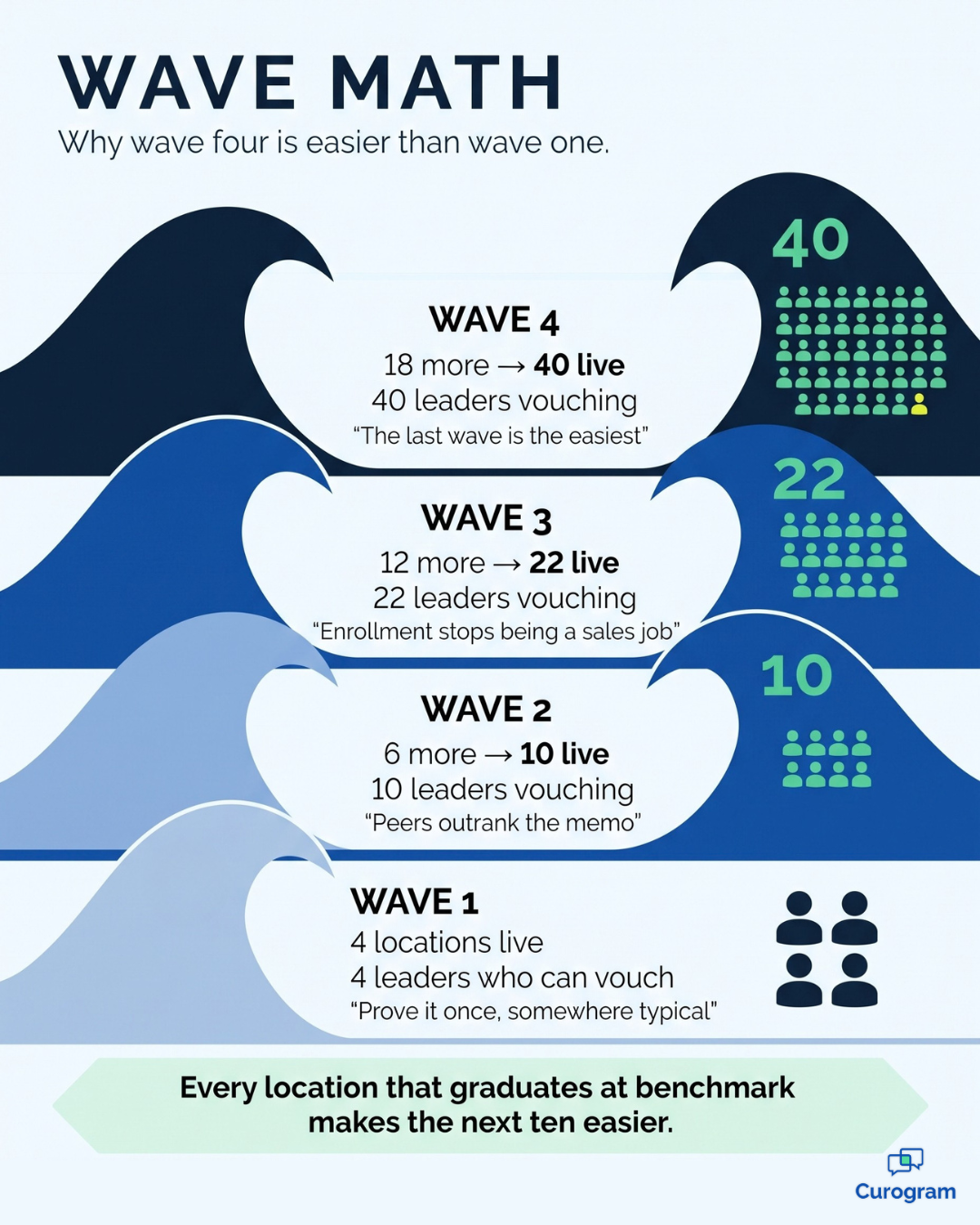
Then let momentum do the rest. Each wave's graduated locations present their own before-and-after numbers to the next wave. Enrollment gets powered by peers, which is the only recommendation site leaders have never had a reason to discount.
When "Corporate's Project" Becomes "Our Upgrade"
You will hear the change before you measure it. Somebody at the front desk says "our system" instead of "the new thing corporate is making us use," and the rollout has quietly turned a corner.
Measurement follows close behind. Locations led by enrolled leaders reach the 75%+ appointment confirmation benchmark faster than locations that were simply switched on. Staff at those sites describe the platform as help, not homework.
Three leading indicators tell you a site has crossed over:
- Staff answer each other's questions instead of routing them to the super-user.
- The leader quotes her own numbers in ops meetings without being asked.
- Personal-phone texting stops, because the shared inbox is genuinely faster.
Watch that first one. When peers coach peers, you have done more than overcome staff resistance in a rollout — you have replaced it with ownership, and ownership does not decay when your attention moves on.
Frontline adoption network-wide compounds from there. Wave three is easier than wave two because ten leaders now vouch for it, and their vouching costs you nothing.
Every location that graduates at benchmark makes the next ten cheaper, faster, and far less argumentative.
That is the whole difference between a rollout that builds momentum and one that burns it.
Enroll Your Leaders Before You Announce Anything
Adoption is decided at forty front desks, by people a memo was never going to persuade. Treat that as the design constraint rather than the complaint, and the whole project changes shape.
Your leaders do not need convincing that patient communication is broken.
They live inside the broken part. They answer the calls, absorb the no-shows, and carry the callback list home in their heads. What they need is proof that this particular fix is theirs — built around their numbers, staffed by their people, and small enough to survive a normal week.
That is a very different ask than the one in most rollout emails. It is also a much easier yes.
The mechanics stay reassuringly boring. athenaOne remains their familiar system, untouched. Curogram arrives as the relief valve, carrying the prior wave's verified results as its introduction. Nothing about the clinical day gets reinvented, which is precisely why the front desk stops treating it as a threat.
So before your next wave, run one experiment. Spend thirty minutes with each site leader, alone, on her own baseline numbers. No slides, no roadmap, no talk of network standards. Just her call volume, her no-show rate, her backlog.
Watch her posture change when the conversation stops being about compliance and starts being about her Tuesday. That shift is the entire program in miniature, and it costs you half an hour.
Then give her the three things that make it real: a super-user, a checklist, and a firm go-live date.
Ready to build the first one? Schedule a consultation with Curogram and we will assemble your leader-enrollment kit — baseline data pulls, the go-live checklist, and the super-user curriculum — for the locations in your first wave.
Frequently Asked Questions
A few hours, not a few days. The shared inbox is deliberately simple, and athenahealth workflows do not change, so staff are learning one new habit rather than a new system. The super-user handles the long tail of questions in the flow of work, which is where most real learning happens anyway.
Representative, not exceptional. You want average staffing and average chaos — a location your other leaders will recognize as normal. A pilot that succeeds at your best-run site proves nothing; a pilot that succeeds at a typical one gives you both a template and evidence the rest of the network believes.
Put per-location usage and outcome metrics into your normal ops cadence, not a special rollout report. When confirmation rates and message volume sit beside the numbers leaders already review, decay shows up in week one instead of at renewal. Early coaching is cheap. Rescuing a site eight months in is not.
The person staff already walk over to with questions — which is rarely the most senior person on the org chart. Look for informal authority and patience over job title. Tell them clearly that this is a recognized role with protected time, because an unpaid extra duty gets treated like one.
Most networks find that four to six locations per wave, spaced three to four weeks apart, gives enough room to gather clean results before the next group starts. Smaller waves move slower on paper but faster overall, because each one produces graduates who can speak to the next group from experience.