

Skip to the main content.

7 min read

The Complete Guide to Clinic Texting Workflow Gaps

The Complete Guide to Clinic Texting Workflow Gaps
💡 A clinic texting workflow gap is any point where a patient message stops short of the system or person that needed it. Three gaps do the most visible damage: the schedule doesn't hear the confirmation, the chart doesn't hear the conversation, and the team doesn't hear each other.

Each one leaves a symptom you can spot by watching the front desk for an afternoon, such as staff calling a patient who already replied to confirm. Clinic texting workflow gaps close best in order, starting with write-back of appointment status to the EHR schedule.


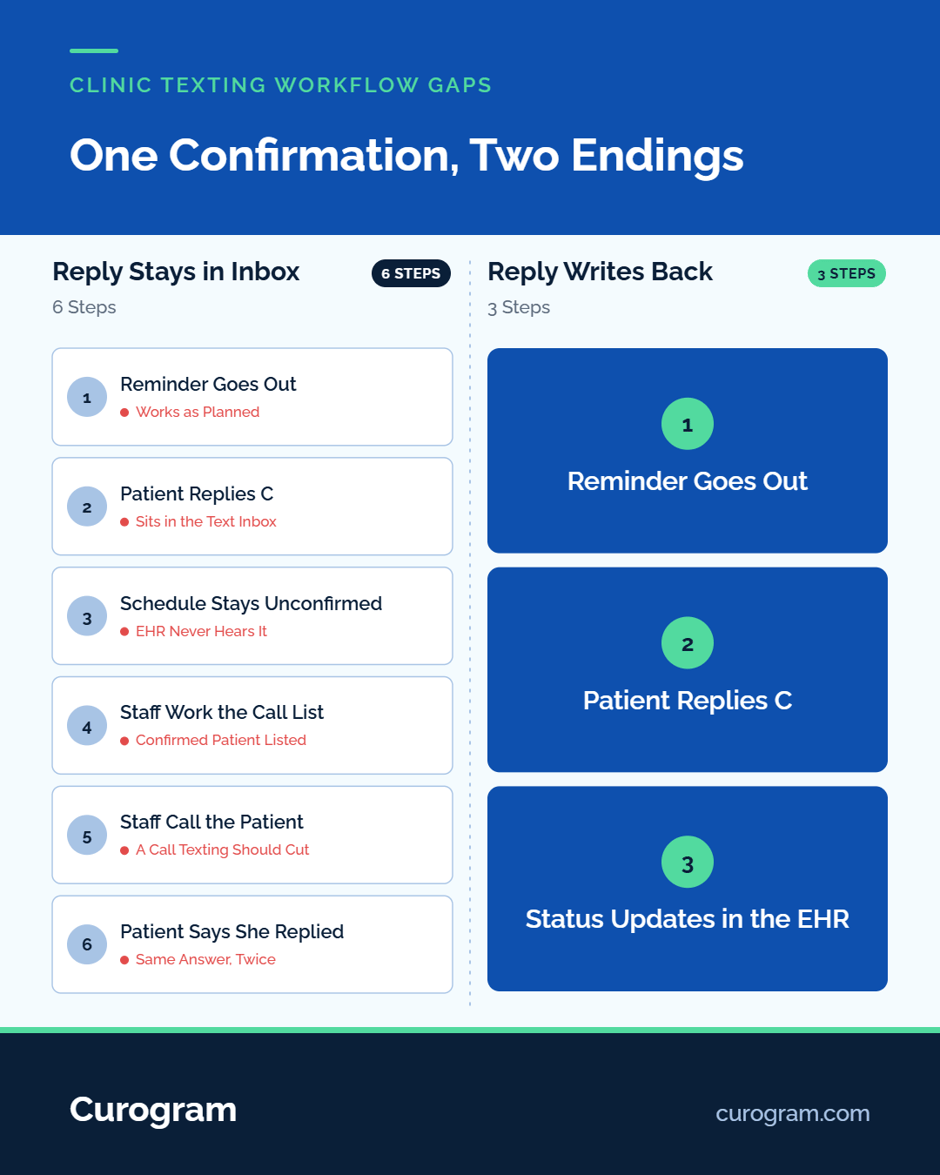
A patient replies C to confirm her Tuesday visit. On Monday afternoon, a medical assistant working the unconfirmed list calls her anyway, because the EHR still shows the slot as unconfirmed. The patient picks up at work and says she already texted back.

Nobody would file that exchange as a problem. The reminder went out, the patient answered, and the call took two minutes. Multiply it across a week of confirmations, and the desk is back to making the calls texting was bought to remove.

That call comes from one of several clinic texting workflow gaps. We think the gaps that cost the most staff time sit in handoffs between the front desk, the schedule, and the chart. They're easy to miss because each one looks like a small, sensible workaround: a quick call, a retyped time, a sticky note for the next shift. The symptom tends to show up first as phone volume that didn't drop after launch.

This guide maps five handoffs and shows how to find yours in one afternoon. It then walks through the three gaps that tend to cost the most: the schedule, the chart, and the team. Each comes with the symptom to look for, a worked example, and who at the practice owns the fix.

It ends with the order to close them and one number to watch after each fix, so you can tell whether the fix held. Order matters here, because staff who keep calling confirmed patients won't adopt new documentation habits on top of that work.

Where the Gaps Live

A handoff is any point where information moves from one person, screen, or system to another, and every clinic communication runs through several of them.

The Five Handoffs Between Front Desk and EHR

Five handoffs connect the front desk to the EHR, and a gap can open at any of them.

  1. Schedule to message: a visit booked in the EHR has to trigger the right text.
  2. Reply to schedule: the patient's answer has to change appointment status.
  3. Thread to chart: clinical content from the conversation has to reach the record.
  4. Staff to staff: a question one person can't answer has to reach someone who can.
  5. Shift to shift: open threads have to pass to the next person on the desk.

How Do You Map Your Gaps in One Afternoon?

Shadow one front desk staff member for two hours and tally every retype. A retype is any time they copy information from one screen to another, or say it aloud to someone who then types it. Mark each tally under one of the five handoffs.

Scheduling deserves a close watch. In the MGMA Stat poll on phone bottlenecks in medical practices (294 responses, March 10, 2026), 31% of leaders named it their biggest staff-time drain on the phones. The tally turns vague clinic communication challenges into counts you can act on.

Gap, symptom and owner

Gap

What you will see

Who fixes it

Reply does not reach the schedule

Staff call confirmed patients anyway

Vendor or IT

Thread lives outside the chart

Provider asks what the patient said

Practice policy

Thread has no owner

Messages answered twice, or not at all

Front desk lead

Shift handoff loses context

Morning staff re-read yesterday's queue

Front desk lead

No template control

Every staff member words it differently

Administrator


Diagram comparing a 6-step manual clinic texting workflow to a 3-step EHR integration

The Schedule Does Not Hear the Reply

Appointment status is the EHR field that says whether a visit is confirmed, and it's where the first gap shows up.

Why Do Confirmations Never Post?

A confirmation never posts when a reply stays in the texting tool and nothing updates appointment status. The path runs from reminder to reply to message inbox, and stops there. Staff on the EHR's unconfirmed list see the old status and call.

Based on our internal data, Covina Arthritic Clinic confirms more than 1,100 appointments a month. At that volume, unposted confirmations would fill a call list. Ask patient texting communication platforms to show a C reply changing status through their EMR integrations. If yours can't, the limit is the tool, covered in why clinics outgrow basic patient texting tools.

Reschedules Typed Twice

A reschedule gets typed twice when the patient's new time arrives by text but has to be entered by hand. Count the touches in one version. The patient texts "Can I do Thursday at 2?" One staff member reads it, checks the EHR, and books the new slot.

A second staff member, who didn't see the first, texts the patient to confirm the time. Someone then updates the reminder so the old date doesn't go out. That's four staff touches for one change, and two chances to enter the wrong day.

The Chart Does Not Hear the Thread

A thread is the running text conversation between one patient and the practice.

Conversations That Live Outside the Record

A conversation lives outside the record when agreements made by text never reach the chart. At the next visit, a patient says she stopped the new medication two weeks ago, as the nurse told her by text.

The provider opens the note and finds no trace of that instruction. Now the provider has to find the nurse, and the nurse has to scroll the message inbox on another screen while the next patient waits. A decision made by text shaped the patient's care, and the chart can't show it.

What Belongs in the Note and What Belongs in the Thread?

Anything clinical belongs in the chart note, and logistics can stay in the thread. The test: if a covering provider read only the chart, would they miss something that changes care? Symptoms, medication changes, and nurse instructions pass. Parking, forms, and visit times don't.

The thread keeps its own audit log, and HHS guidance on the HIPAA Security Rule covers the audit controls that record activity in systems holding patient data. When content moves to the chart, add a one-line note that points back to the thread date.

The Team Does Not Hear Each Other

The third gap is between people, and healthcare texting makes it easier to miss, since nobody hears the phone ring.

Threads With No Owner

A thread has no owner when it lands in a shared inbox and nobody is assigned to it. Two things follow. Two staff answer the same patient with slightly different details, or nobody answers, because each assumed a colleague had it.

Medical messaging platforms can route threads, but the assignment rule has to come from the practice. Write it down and post it at the desk: a new thread goes to whoever works that task queue and stays with them until it closes or passes by name. More on this failure is in what makes clinic patient texting break down.

Coverage Holes at Lunch and Close

Replies pile up in two windows: the lunch hour and the last half hour before close. At lunch, the desk thins out just as patients on their own breaks text back. Near close, late-day messages draw replies after staff logs off.

The rule that covers both has two parts. Stagger lunches so one named person always owns the inbox, and set an automatic reply for closed hours that tells patients when the office will answer. Put the coverage name on the shift schedule beside each lunch slot.

Curogram Highlight: Missed Calls, Lunch Hours, and Internal Notes

Curogram is a HIPAA-compliant, SOC 2 Type II patient communication platform. Missed Call to Text Automation sends a text when a call isn't answered, so patients can reply, ask a question, or book. Lunch-hour messaging sends a set reply to anyone who texts during each location's lunch period.

Internal notes stay visible only to staff inside the patient thread, and forwarding a note assigns it as a task.

Closing the Gaps in Order

Closing clinic texting workflow gaps in the wrong order spends staff effort on fixes that don't hold.

Sequencing Fixes for Clinic Texting Workflow Gaps

Close the gaps in this order, and don't start the next fix until the last one holds for two weeks.

  1. Write-back first, because every later fix gets undone by calls to patients who already confirmed.
  2. Ownership second, since documentation habits need a named person to follow them.
  3. Documentation third, once owners exist to add the chart note.
  4. Templates fourth, because wording only matters after replies reach the right place.

A practice that starts with templates ends up rewriting messages whose replies still land in the wrong place.

What to Measure After Each Fix

Track clinic texting workflow gaps with one number per gap, measured for two weeks before the fix and two weeks after. Two weeks covers busy Mondays and slow Fridays, so one odd day doesn't swing the result. Use the same method both times, and record who counted. Keep the counts in one shared sheet the whole team can see.

One metric per gap

Gap

Metric

Where to find it

Reply does not reach the schedule

Calls made to patients who already confirmed by text

Unconfirmed call list checked against the message inbox

Reschedules typed twice

Staff touches per reschedule

Two-hour shadow tally

Thread lives outside the chart

Visits where the provider asks what was said by text

Provider tally at end of day

Thread has no owner

Threads answered twice or not at all

Message inbox review

Coverage holes

Replies waiting past lunch or close

Message timestamps

No template control

Different wordings of the same message

Sample of 20 sent messages


If calls to confirmed patients don't fall after the write-back fix, test the integration again with a live reply before moving to ownership.


Fix the Handoff Before the Habit

A texting rollout pays off when the schedule, the chart, and the next shift all hear what the patient said. Patient engagement can look strong on a vendor report while the desk still makes the calls.

Start with one afternoon of shadowing and a tally sheet. If write-back sits at the top of the tally, fix it first, even when the chart gap feels more urgent.

Book a Curogram demo and bring your tally sheet. We'll walk through where each handoff breaks and what would close it.

Frequently Asked Questions

What is a texting workflow gap in a clinic?

A texting workflow gap is any point where a patient message stops short of the system that needed it. Common ones are confirmations that never reach the schedule, threads kept out of the chart, and threads with no owner.

Why do staff still call patients who already confirmed by text?

The schedule never received the confirmation. The patient's reply stayed in the texting tool, appointment status in the EHR never changed, and staff working the unconfirmed list saw an open slot and picked up the phone.

What parts of a patient text conversation belong in the medical record?

Anything clinical belongs in the chart: symptoms, medication changes, and instructions a nurse gave. Logistics like parking, forms, and visit times can stay in the thread, with a one-line chart note pointing back to it.

How can a practice find its texting gaps without new software?

Shadow one front desk staff member for two hours and tally every time they retype information or relay it aloud. Sort each tally under a handoff, and the highest counts show where rework sits.

Why should write-back be fixed before documentation?

Calls to patients who already confirmed eat the staff time any new habit needs. Once confirmations post to the schedule, those calls stop, and staff have room to add chart notes and follow assignment rules.