
 Jo Galvez

Two separate compliance gates apply: HIPAA, where penalties now start at $145 per violation, and A2P 10DLC carrier registration, which decides whether messages get delivered at all.
Curogram texts from your existing office number, connects with 150+ EMR and practice management systems at depths that vary by system, and holds SOC 2 Type II certification alongside HIPAA compliance.
Clinics rarely abandon a texting platform because it broke. They abandon it because the rollout stalled somewhere that had nothing to do with the product.
Four places account for most of it. Legal never cleared the compliance question, or the EMR connection turned out to be read-only.
Staff kept one browser tab open and then stopped opening it. Patients got a message, hit a login screen, and called instead.
None of those is a feature gap, which is why comparing feature lists does not prevent any of them. They are questions you ask before signing, and steps you take in the first month.
Below, each barrier gets the same treatment: what it looks like from the front desk, what it costs you, and the one question that surfaces it in a demo. One of the four is a rule most practices never hear about until their texts stop landing.
What Are Patient Texting Communication Platforms?
What they do
These tools let a practice send and receive secure messages with patients. Reminders, two-way chats, intake forms and payment links, all in one text thread. Unlike the apps on your own phone, they carry encryption, audit trails and consent records, and they connect to the EMR you already run.
Why clinics buy them
Three goals come up almost every time: fewer no-shows, lighter phone volume, faster replies.
How Does HIPAA Compliance Uncertainty Freeze Texting Rollouts?
The three questions that stall projects
Does a business associate agreement cover text messages? What counts as valid consent? Can staff send PHI over text at all? Projects sit for months waiting on answers that a vendor should be able to give in one call.
What the penalties actually are now
Most articles still quote the 2009 HITECH figures. HHS adjusts them for inflation, and the schedule effective 28 January 2026 sets the Tier 1 minimum at $145 per violation with an annual cap of $2,190,294 for repeated violations of the same provision. A single unencrypted message carrying PHI can start that clock.
What makes a platform compliant
Five things, all handled by the tool rather than by staff. Encryption in transit and at rest, role-based access, a full audit log, a signed BAA, and consent kept in the platform rather than on a spreadsheet. HHS publishes its own guidance on mobile and remote access to ePHI, which is worth reading before you write your policy.
How Do A2P 10DLC Requirements Affect Clinic Texting?
The gate nobody mentions in the demo
HIPAA governs what you may send. Carrier rules govern whether it lands. Texting patients from a 10-digit business number means signing up your campaign with The Campaign Registry first, or the carriers will not pass it on.
Unregistered traffic gets throttled, filtered, or dropped. Reminders that never land look identical to reminders patients ignored, which is why this one goes undiagnosed for months.
Who should be doing the registration
Your vendor, as part of onboarding. Ask directly during the demo. A platform that expects your office manager to file with The Campaign Registry is telling you something about how much healthcare work it has actually done.
How Does Poor EHR Integration Create Workflow Friction?
Where the second keystroke comes from
A patient confirms by text and still shows unconfirmed in the schedule. Someone opens the chart and fixes it by hand. Do that across 40 interactions a day at three minutes each and it is ten hours a week, which is illustrative arithmetic rather than a case study figure, so run your own count.
Depth, not presence
Every vendor says they integrate. Some EMRs connect through APIs with real-time sync; others go through HL7 or database-level methods that behave differently. Our EMR and EHR integration page lists what connects. Ask which tier your specific system falls into, and ask them to demo one reschedule end to end.
Why Do Staff Members Resist Using New Texting Tools?
A second inbox is a tax
Nobody monitors one more screen when they are already behind. If the texting tool sits outside the workflow, staff drift back to the phone within weeks. A single inbox that holds text, chat and voicemail avoids that, and clear ownership rules keep messages from sitting unclaimed.
The workaround is the security gap
When the official channel feels heavy, people use their own phones. Those messages live on devices IT cannot manage or wipe, there is no audit trail, and staff hand out personal numbers they cannot take back. Centralising messages on the practice number solves the security problem and the staffing problem at the same time.
What automation removes
Sending by hand does not survive a busy week. Automated workflows send reminders, recalls and post-visit follow-ups on schedule regardless of how the front desk is doing, so staff only step in when a real conversation needs judgment.
What Patient Adoption Barriers Block Texting Success?
Portals and apps both leak responses
Every step between receiving a message and replying to it costs responses. Portals need credentials most people forget within weeks. Apps ask for a download nobody makes for a clinic they visit twice a year.
Patients are clear about the preference. They want texting as the primary mode of communication.
What app-free actually means
The message lands in the standard text thread patients already use, and replying takes no login, no download and no account. That is the whole mechanism, and it is why HIPAA-compliant texting on a familiar number outperforms a better-featured tool behind a sign-in page.
How Can Clinics Evaluate Texting Platforms Effectively?
The questions that separate vendors
-
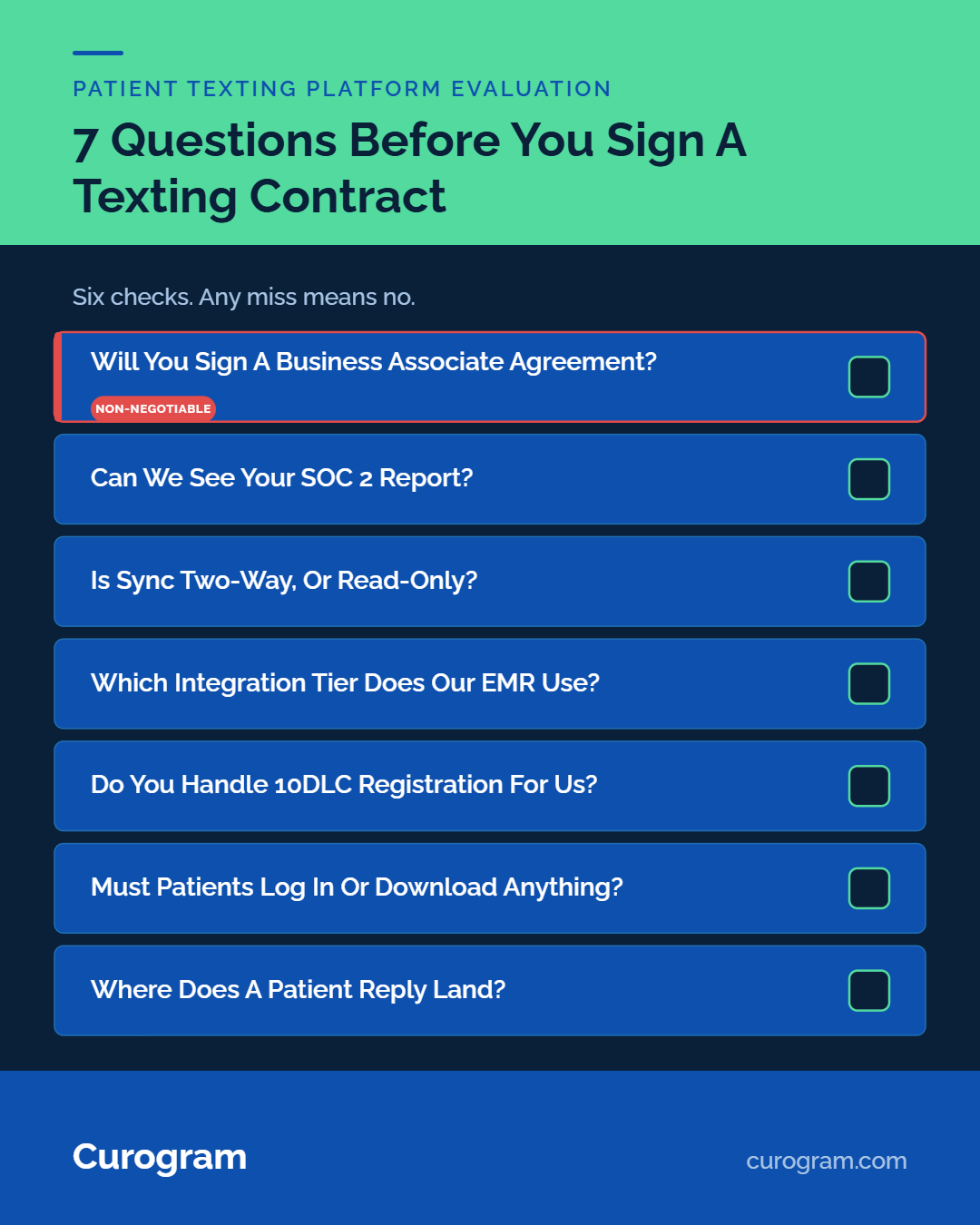
Will you sign a BAA, and can we see your SOC 2 report?
-
Is sync two-way or read-only, and which tier does our EMR use?
-
Do you handle 10DLC registration, or is that on us?
-
Must patients log in to reply, and where does that reply land?
Warning signs
Vague compliance answers end the conversation. A vendor who cannot name their safeguards in specific terms has not built them. Long implementation timelines usually signal integration trouble, and a roadmap answer to a live-feature question means it is not built yet.
What Does Successful Implementation Look Like?
Order of operations
Compliance first. Get the BAA signed, check the encryption, set up consent capture. Integration second, tested before a single patient message goes out. Try the reschedule path in particular, because that is where a read-only link shows itself.
Training and ownership
Keep training short and hands-on; a good platform gets a front desk fluent in about 10 minutes because it works like texting already does. Then assign the inbox. Name who monitors it, the response window, and the escalation path for clinical questions.
How Can Clinics Measure Texting Platform ROI?
Three numbers, measured before and after
No-show rate, inbound call volume, and reply rate against send rate. Take two weeks of baseline before launch, because after launch you will be arguing from impressions.
Reply rate is the leading indicator. High sends with low replies means friction is still in the path, whatever the platform reports about delivery.
What each one tells you, and when
Confirmation traffic moves inside one reminder cycle. Intake and after-hours calls settle around 30 days. No-show effects need a full quarter before the numbers are stable enough to present to anyone.

How Does Curogram Address These Patient Texting Challenges?
Two-Way HIPAA-Compliant Texting runs on the main office number your patients already have saved, and works alongside the EMR you already run rather than replacing it. Patients reply from a standard text thread with no app and no account.
Against the four barriers: compliance is standing rather than optional, with SOC 2 Type II alongside HIPAA and full message history kept for audit.
Integration runs across 150+ EMR and practice management systems at depths that vary by system. One inbox with routing rules removes the second screen. Automated appointment reminders, online patient forms, and text-to-pay run without staff involvement.
More than 14,000 healthcare professionals use the platform. Across our client base, phone volume drops by as much as 50% and front desk productivity rises more than 30%, based on our internal data. Atlas Medical Center's no-show rate fell from 14.20% to 4.91% in three months.
In Conclusion: How To Fix Patient Texting Gaps At Your Clinic
The four barriers are predictable enough to handle in advance, and three of them are settled before you sign anything. Get the BAA and the SOC 2 report. Confirm which integration tier your EMR uses. Confirm who files the 10DLC registration.
The fourth is settled in the first month. Remove every step between your message and the patient's reply, then watch reply rate rather than send rate to see whether you actually did.
Practices that succeed here treat the rollout as an operations project with a compliance dependency, not a software purchase. The platform is the easy part.
Book a demo and bring the seven questions above. We'll answer them on the call, including which tier your EMR sits in and who files your 10DLC paperwork.
Frequently Asked Questions