
Klara vs. Curogram: The 2026 Pricing Showdown
Wondering about the Klara cost and its app vs. Curogram? Our 2026 guide compares Klara pricing, features, and app functionality to find the best...
7 min read

Pricing pages rarely match invoices. OhMD lists $300 a month to start. Add AI call handling and per-minute calling usage, and the real number climbs well past that.
We have sat through enough vendor calls to know the pattern. Two platforms look nearly identical on a feature grid. Then one of them bills separately for the three things the practice actually needed.
OhMD reworked its plans in 2026. The free Basic tier no longer appears on the published pricing page, and the lineup now sorts around AI voice rather than texting alone. That shifts the comparison with Curogram away from where it stood a year ago.
Our read: if inbound call volume is your single biggest problem, OhMD's AI tier deserves a demo. If reminders, intake forms, payments, and reviews all need to work together, Curogram usually costs less and involves fewer moving parts.
Both platforms send HIPAA-compliant texts that patients can answer without downloading an app. Past that, they solve different problems.
OhMD built its 2026 lineup around a single bottleneck: the phone. Its AI agent answers routine calls, handles refill requests, and books visits. Staff takes over when a person is needed. More than 40,000 providers use OhMD, and the pitch lands hardest at practices fielding hundreds of calls a day with no budget to hire.
Curogram sits closer to the whole front desk workflow. Reminders, intake forms, payment requests, review prompts, and recall campaigns run out of the same inbox as patient texts. Most clinics find us after stacking three vendors and discovering none of them share a patient record.
Neither product replaces your EMR. Both read from it.

Feature grids in this category go stale fast. OhMD has since shipped a developer API and AI voice, so two rows that once favored Curogram no longer do. Below is this detailed breakdown of where the two platforms line up as of July 2026, drawn from each vendor's published plan pages.
|
Feature |
OhMD |
Curogram |
|---|---|---|
|
Two-way HIPAA-compliant SMS |
Yes, all plans |
Yes |
|
Text-enabled landline |
Yes, all plans |
Yes |
|
Video visits |
Yes |
Yes |
|
Virtual waiting room |
Not published |
Yes |
|
Appointment reminders |
Standard workflows on Core |
Yes |
|
Appointment scheduling |
Automate tier only |
Yes |
|
EMR / EHR integration |
Automate tier only |
Yes, standard build |
|
Online patient forms |
Yes |
Yes |
|
Text-to-pay |
Not published |
Yes |
|
Reputation management |
Not published |
Yes |
|
Broadcast messages |
Yes |
|
|
AI voice call automation |
Yes, billed separately |
Not offered |
|
Developer API |
Yes |
Yes |
|
SOC 2 Type II |
Not published |
Yes |
Rows marked "not published" mean the feature does not appear on the vendor's public plan pages. It may exist under a custom agreement, so ask.
A checkmark confirms a feature exists somewhere in the product. It says nothing about which tier holds it, or whether usage gets metered on top of the plan fee.
Appointment scheduling makes the point. OhMD includes it, but only on the Automate plan at $500 a month. EHR integration sits on that same tier. A clinic that wanted texting plus scheduling plus its EMR connected cannot get there on the $300 Core plan.
Ask both vendors the same three questions before you sign: which tier holds each feature, what gets billed by usage, and what setup costs.
Monthly fees are the easy part to compare. What varies between these two is how much sits outside the fee.
OhMD publishes three plans, plus a separate developer API tier aimed at teams building HIPAA-compliant messaging into their own software.
Core starts at $300 per month. It covers two-way SMS with patients, a text-enabled landline, voice and video calling, voicemail transcription, call handoff to text, and multi-factor authentication. Website chat, team messaging, standard automated workflows, and a Business Associate Agreement sit at this level too.
What Core leaves out matters more than what it includes. Appointment scheduling, EHR integration, and customized workflows all sit on higher tiers. The free Basic plan that used to anchor the lineup is gone from the published pricing page.
Automate starts at $500 per month and adds patient call automation, automatic message routing, customized automated workflows, broadcast voice calling, and appointment scheduling. EHR integration arrives at this tier.
Two lines deserve a close look. Patient call automation is billed separately, and so is calling usage. OhMD does not publish per-minute rates, so anyone asking how much does OhMD cost in practice needs a quote first. Enterprise pricing is custom, carries minimums, and bills calling usage separately as well.
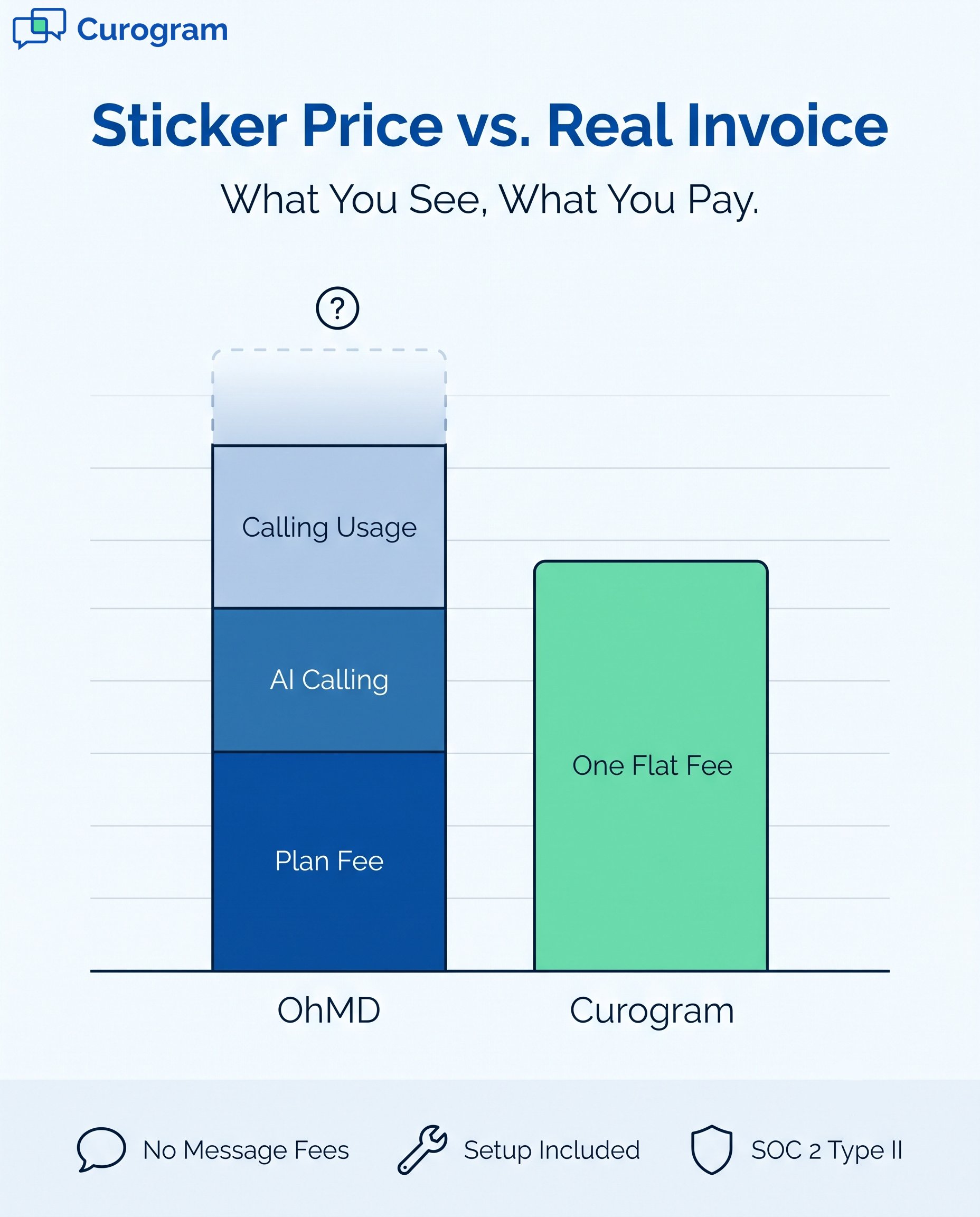
Curogram publishes a range instead of a quote-only model.
Curogram plans run $200 to $400 per month with per-provider pricing. There are no per-message fees. A three-provider clinic pays for three providers, and the bill moves in step as the practice adds staff or opens a second site.
Setup is included in that number. Most practices go live in two to four weeks.
Two-way HIPAA-compliant texting, automated appointment reminders, secure online patient forms, mass texting, text-to-pay, reputation management, telemedicine with a virtual waiting room, and patient recall all sit inside the platform. EMR integration is part of the standard build, not a tier upgrade.
Curogram is SOC 2 Type II certified and HIPAA-compliant. Ask any vendor for a current report while you shop. A signed BAA on its own does not cover the same ground.
Sticker price is one number. The three-year total is the one your office manager will be asked about.
|
Cost line |
OhMD |
Curogram |
|---|---|---|
|
Published starting price |
$300/mo Core, $500/mo Automate |
$200 to $400/mo |
|
Pricing basis |
Flat practice fee by tier |
Per provider |
|
Per-message fees |
Not published |
None |
|
Calling usage |
Billed separately |
Not applicable |
|
AI call automation |
Billed separately |
Not offered |
|
Setup and onboarding |
Quote required |
Included |
|
Typical go-live |
Days to weeks |
Two to four weeks |
|
Three-year cost, five providers |
Depends on usage and add-ons |
$7,200 to $14,400 |
Curogram can publish a three-year range because nothing in it is metered. OhMD's total resists a published range because two of its most-used lines get quoted separately. So ask OhMD for a usage estimate first, based on your real monthly call volume.
Value tends to show up in what a practice stops paying for elsewhere. Three areas account for most of the gap.
Curogram connects with most EMR and practice management systems, including CollaborateMD, athenahealth, GE Centricity, TherapyNotes, and Azalea Health. That connection is part of the standard build.
OhMD lists EHR integration on its Automate plan. A clinic sitting on Core that wants chart-level sync pays $200 more per month to reach it.
Curogram complements your EMR and never replaces it. Scheduling, charting, and billing stay exactly where they are. Appointment data flows into the platform, and confirmations post back to the chart.
Reputation management and patient recall do not appear on OhMD's published plan pages. Practices that want either one usually buy a second tool and manage a second login.
Based on our internal data, one multi-location practice collected 1,064 new five-star reviews in three months after switching on automated post-visit surveys, with 90% of responding patients leaving five stars. A separate recall campaign at another multi-location client brought back 1,240 patients, and 35% of everyone who received a recall text booked within a month.
Both campaigns ran against the same patient list, from the same inbox, with no data export in between.
The measurable change shows up on the schedule. Based on our internal data, one medical center cut no-shows from 14.20% to 4.91% inside three months using automated reminders and confirmations. Across our client base, confirmation rates average above 75%, and no-show rates run roughly 53% below the industry average.
One arthritis clinic now confirms more than 1,100 appointments a month without a staff member dialing a single number. Confirmation calls drop off the daily task list entirely.
Fewer calls also means fewer interruptions at check-in. Staff answer texts between patients instead of holding a receiver in one hand while another patient stands at the window waiting to be checked in.
Both platforms do real work. The question is which problem you are paying to solve.
OhMD suits practices whose main pain is call volume and who want AI answering the phone. Its $300 entry point is clear enough, though appointment scheduling, EHR integration, and AI calling all sit above it.
Curogram suits practices cutting down on tools. Reminders, forms, payments, reviews, recall, and telemedicine arrive in one platform at $200 to $400 per provider per month, with setup included and no per-message fees. SOC 2 Type II and HIPAA compliance come standard.
Write down the three features you would cancel another vendor to get. Price both platforms against that list, usage lines included. Then ask each one what a five-provider practice pays in year three.
See what Curogram costs for your practice. Book a demo and we will price it against your provider count, your EMR, and the tools you are already paying for.

Wondering about the Klara cost and its app vs. Curogram? Our 2026 guide compares Klara pricing, features, and app functionality to find the best...
 Jo Galvez : 3/15/26, 1:00 PM
Honest comparison: Curogram vs Luma Health, Klara, and Artera. Features, pricing, integration, and which platform is right for your medical practice.
.jpg?width=30&name=square-formal-photo%20(1).jpg) Mira Gwehn Revilla : 3/15/26, 11:00 AM
Mira Gwehn Revilla : 3/15/26, 11:00 AM
Find the right fit with our appointment reminder software comparison. We break down features, pricing, and EMR support for medical practices in 2026.