



Skip to the main content.

12 min read

Reducing Clinician Burnout: A Behavioral Health Guide

Reducing Clinician Burnout: A Behavioral Health Guide
💡 Behavioral health clinician burnout is the chronic emotional, physical, and operational exhaustion that mental health providers experience from sustained workplace stress. The biggest drivers are documentation overload, oversized panels, insurance friction, and the emotional weight of high-acuity caseloads.

It now sits at the top of the operational risk list for most mental and behavioral health clinics. Surveys from the AMA and Medscape consistently rank psychiatry and behavioral health among the highest-burnout specialties in medicine.

The fix is not a wellness webinar. It is a system redesign — lighter documentation, smarter scheduling, fewer phone calls hitting clinicians, and stronger peer support.

This guide walks practice leaders through the drivers, the warning signs, and the operational moves that actually move the needle.

You can feel it before anyone says it out loud.

A senior therapist cancels two days of sessions. A psychiatrist quietly drops their panel size. Notes are running 48 hours behind. The waitlist keeps growing, and your best clinician is updating their LinkedIn at 11 p.m.

This is what behavioral health clinician burnout looks like from the operations side. Not a single dramatic moment. A slow erosion of capacity, energy, and retention — until your schedule, your revenue, and your patient outcomes start to slip together.

And here is the hard part. Most leaders are still treating it like a personal problem

. A wellness email. A free meditation app. A pizza Friday. Meanwhile, the actual drivers — documentation load, panel design, insurance friction, isolation — keep grinding away at the people you cannot afford to lose.

This guide is for the practice administrators, clinic directors, and operations leaders running mental and behavioral health clinics who already know the wellness-day approach is not enough. We will walk through what burnout actually means in this field, the data behind it, the six biggest drivers, the early warning signs you can spot in your own operations, and the system-level changes that actually reduce it.

You will also see where workflow technology fits in — and where it does not.

The goal is simple.Give you a clear, honest playbook for protecting your workforce, your patients, and your practice at the same time.

Let's start with the definition, because the language matters more than people think.

What Behavioral Health Clinician Burnout Actually Means

Burnout has become a catch-all term, which makes it harder to solve. In behavioral health, the precision of language matters. The interventions that work for one type of distress will not work for another.

Behavioral health clinician burnout is the long-term result of unmanaged workplace stress. The World Health Organization defines it through three signs: emotional exhaustion, cynicism or detachment from work, and a sense of reduced effectiveness. It is occupational. It is systemic. It is not a personality flaw.

That distinction matters because the fix is not "be more resilient." The fix is changing the system that is producing the exhaustion in the first place.

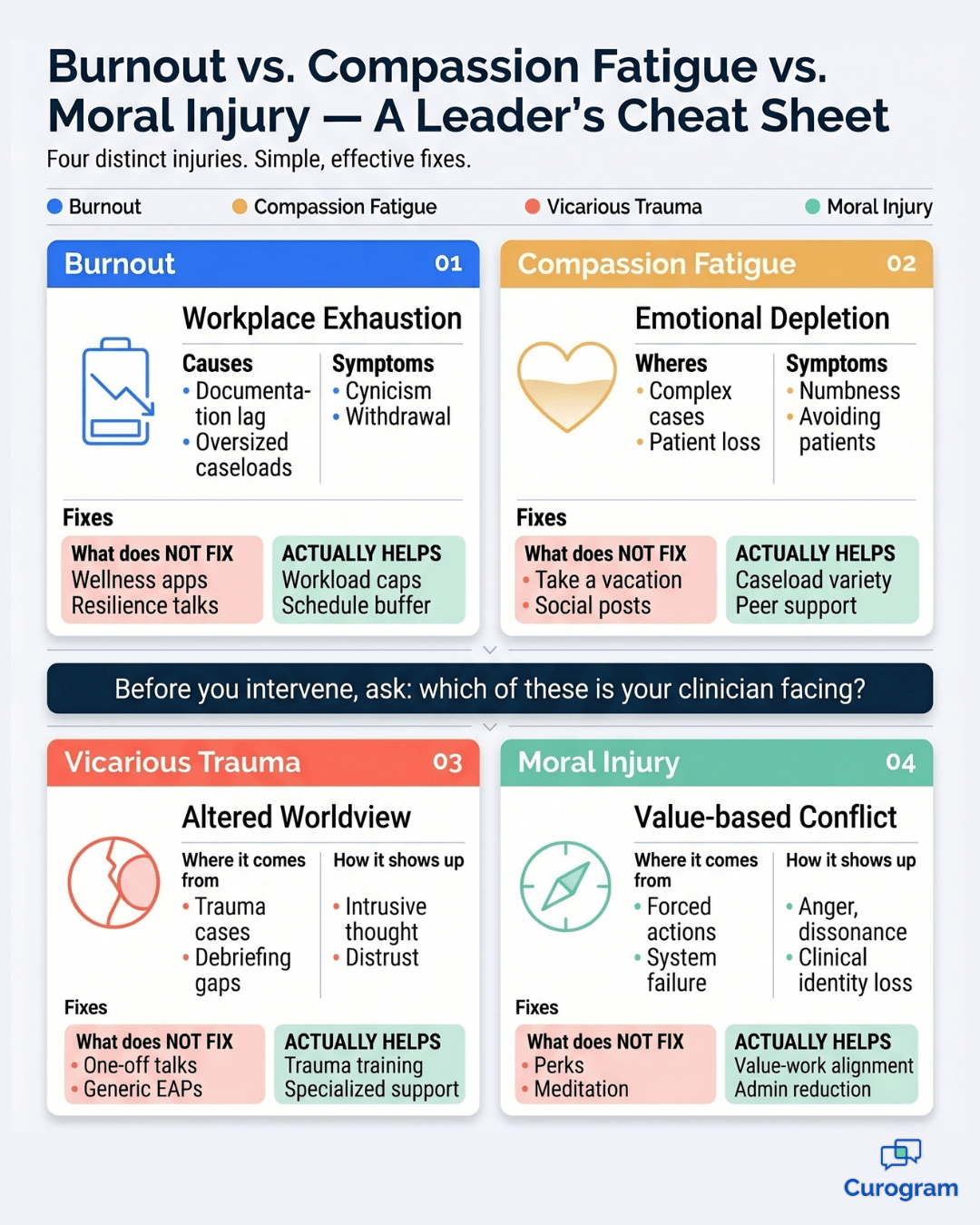
Burnout vs. compassion fatigue vs. moral injury

These three terms get used interchangeably, but they describe different injuries. The interventions that fix one will not fix the others.

Term What it is Where it comes from
Burnout Chronic exhaustion from workload and workplace conditions Documentation, panel size, scheduling, admin load
Compassion fatigue Emotional residue from absorbing patients' pain over time Trauma exposure, high-acuity caseloads, lack of recovery time
Vicarious trauma A shift in worldview from repeated exposure to others' trauma Working with abuse, violence, or severe trauma survivors
Moral injury Distress from being forced to act against your professional values Insurance denials, productivity quotas, ethical compromises

A clinician suffering moral injury from constant prior auth fights does not need a yoga class.

They need fewer prior auth fights. A clinician with vicarious trauma from a heavy trauma caseload needs supervision and caseload mixing, not a gratitude journal. Getting the diagnosis right is what makes the intervention work.

How burnout in behavioral health differs from other specialties

Therapist burnout and psychiatrist burnout share something most other specialties do not face at the same intensity. Your clinicians are the instrument. Their attention, presence, and emotional regulation are the treatment.

That changes the math. A burned-out cardiologist can still read an EKG accurately. A burned-out therapist cannot show up the same way for a patient in crisis. The product of the work degrades as the worker degrades, and your patients feel it first.

Add the unique stressors — sustained emotional load, no clear endpoints to treatment, suicide risk, and a documentation system not built for narrative therapy notes — and you have a workforce facing burnout from angles other specialties simply do not see.

What the Data Says About Clinician Burnout in Mental Health

The numbers have been moving in the wrong direction for years, and the pandemic did not cause the problem. It just made it impossible to ignore.

Prevalence and trends

The 2024 Medscape Physician Burnout Report ranked psychiatrists among the top-five specialties for burnout, with nearly half reporting symptoms. The AMA's national surveys have consistently shown that psychiatry, family medicine, and emergency medicine sit at the high end of the burnout curve. The American Psychological Association has reported that more than 4 in 10 psychologists feel unable to meet the demand for their services.

For non-physician clinicians — LCSWs, LPCs, LMFTs, psychologists — large-scale workforce surveys show similar or worse rates. The behavioral health workforce burnout problem is not a physician problem. It is a workforce-wide problem.

The takeaway for you:

If you employ behavioral health clinicians, you are operating in a labor market where roughly half your workforce is showing burnout symptoms at any given time.

That is not an HR issue. That is an operational risk profile.

Downstream effects on patient care and practice sustainability

Burnout does not stay in one lane. Once it sets in, it pulls everything else with it. Research consistently links clinician burnout to higher medical errors, lower patient satisfaction, longer documentation lag, and increased turnover.

In behavioral health, the effects show up faster.

Therapeutic alliance — the most reliable predictor of treatment outcome — depends on a clinician who is present and engaged. Burnout erodes it.

The financial picture is just as direct. Replacing a single mental health provider can cost between $200,000 and $400,000 when you include recruitment, lost revenue during the vacancy, onboarding, and the productivity ramp of a new hire.

For a 20-clinician group losing four providers a year, that is roughly $1 million in annual turnover cost.

This means workforce retention is not a soft metric. It is one of the largest line items most behavioral health practices never track.

Turnover rate (clinical staff, rolling 12 months)

Your single most important lagging indicator. Review monthly. A rolling 12-month view smooths out hiring lumpiness and shows the real direction of your workforce health.

The Six Biggest Drivers of Burnout in Your Behavioral Health Clinicians

If you only have time to address a few things, these are the ones with the highest return. The first three are about workload. The last three are about meaning.

1. Documentation and administrative burden

This is consistently the number one driver across surveys. Behavioral health clinicians often spend 1 to 2 hours documenting for every clinical hour. A full caseload plus a documentation tail means a 9-hour clinical day becomes a 12-hour total day.

The kicker:

Most of that documentation is for billing and compliance, not clinical utility.

Clinicians know it. That gap between what the work should be and what the work actually is fuels moral injury.

2. Unsustainable panel sizes and back-to-back scheduling

Many behavioral health practices schedule clinicians at 90% to 100% of theoretical capacity. There is no buffer for crisis sessions, no time for notes between visits, no recovery between high-acuity cases. The schedule itself is the problem.

A clinician seeing eight patients back-to-back has no actual choice but to fall behind on notes. The system is designed to fail.

Sessions per clinician per week (vs. their own baseline)

Use each clinician as their own benchmark — not the team average.

A 10–15% drop sustained over 4 to 6 weeks is an early capacity signal worth acting on. Review weekly.

3. High-acuity patients without adequate support

Insurance economics push clinicians toward higher-acuity caseloads — that is where the reimbursement is.

But a panel weighted heavily toward trauma, severe SUD, or active suicidality without supervision, peer consultation, or caseload mixing is a recipe for compassion fatigue and vicarious trauma.

4. Insurance and prior authorization friction

Few things drain a clinician faster than fighting an insurer to approve treatment they know their patient needs. Each denial is a small moral injury. Multiply that by 30 patients and a few hours of phone calls per week, and you have a clinician spending real clinical energy on administrative combat.

5. Isolation and lack of peer consultation

Behavioral health work is intimate, often emotionally heavy, and largely invisible to colleagues. Without structured peer consultation, clinicians can go weeks without meaningfully discussing a difficult case.

That isolation is not just lonely — it is clinically risky.

6. Misalignment between mission and daily work

Most clinicians entered the field to help people. When the daily reality is documentation, billing codes, and prior auth fights, the gap between mission and work widens. Over time, that gap is what people mean when they say "I just do not feel like a clinician anymore."

This is where moral injury and burnout overlap most clearly, and it is the hardest one to fix with policy alone.

Cheat sheet comparing burnout, compassion fatigue, vicarious trauma, and moral injury in behavioral health.

The Early Warning Signs Leaders Should Watch For

You do not have to wait for a resignation letter. The signals are visible in your operations months before someone walks out the door.

Behavioral cues in your clinicians

Most early signals are quiet. They show up as small departures from a clinician's normal pattern — the kind of thing a manager notices but rarely names.

Common cues to watch for:

  • Pulling back in team meetings or staying on mute
  • No longer volunteering for case consults or quality projects
  • A pattern of Monday or Friday sick days
  • Notes that are getting shorter, flatter, or more templated
  • Drop in informal hallway communication with peers

None of these alone is proof. Together, they form a pattern, and the pattern is what matters. Keep an eye out for two or three appearing together over a 4 to 6 week stretch.

Operational signals

Operations data tells the same story without anyone having to disclose anything personal. The advantage here is that the numbers are already in your systems — you just have to look at them through this lens.

Documentation lag (avg hours from session to signed note)

The single best operational canary for burnout. When notes start running more than 48 hours behind, your clinicians are either out of time or out of energy. Review weekly.

Documentation lag is not the only signal. Growing waitlists alongside flat or declining session volume per clinician is another tell — capacity is leaking somewhere. Rising cancellation and reschedule rates initiated by the clinician, not the patient, often signal early withdrawal.

By the time turnover spikes, the leak has been growing for 6 to 12 months. The operational signals show up first.

What Practice Leaders Can Actually Do About It

This is the section that matters. Burnout is not solved by individual willpower or a wellness perk. It is solved by leadership decisions that change how the work happens.

Reduce the documentation load

Audit what you are actually requiring. A surprising amount of behavioral health documentation is template inertia, not regulatory necessity. Push for AI-assisted note tools, structured templates, and clear "good enough" standards.

Every 15 minutes you take off a clinician's documentation tail is 15 minutes back in their life.

Redesign your scheduling

Build buffer into the day. A 50-minute session with 10 minutes for notes is more sustainable than 60-minute sessions back-to-back. Cap consecutive high-acuity sessions. Protect documentation blocks the same way you protect clinical blocks. The schedule is a leadership tool — use it.

Invest in clinical support and supervision

Real supervision, not paperwork supervision. Structured case consultation, accessible peer review, and protected time for both. This is one of the fastest ways to reduce vicarious trauma and isolation in your team.

Shift administrative burden off your clinicians

Phone tag, scheduling back-and-forth, intake follow-ups, prior auth coordination — none of this needs to live with the clinician. Centralizing patient communication and admin functions through your front office and modern workflow tools clears hours of low-value work off the clinical team's plate every week.

Build a peer consultation culture

Make consultation the default, not the exception. Weekly case conferences, an open Slack or messaging channel for clinical questions, paired clinicians on complex cases.

The cost is hours per week. The return is retention and clinical quality.

Build wellbeing into your measurement

If you measure productivity but not clinician wellbeing, you are telling your team what you actually value. Add wellbeing metrics — turnover, documentation lag, clinician-reported workload, exit interview themes — to the dashboards your leadership team reviews monthly.

Individual interventions vs. system-level changes — what the evidence says

The literature on this is consistent. Individual wellness programs are useful as supports, but they do not move burnout numbers on their own. System-level changes do.

Approach Examples Evidence on burnout
Individual wellness Mindfulness apps, yoga, resilience training, EAP referrals Small, short-term effects. Does not address root causes.
System-level changes Workload caps, documentation reform, supervision investment, admin offloading Largest and most durable reductions in burnout symptoms.
Combined approach System changes plus optional wellbeing support Best outcomes when system changes lead and wellness supports

The pattern is clear. Wellness programs are fine. They are not the lever. The lever is the system.

Clinician wellbeing is one of the recurring themes at NatCon and other major behavioral health conferences for exactly this reason. Leaders are realizing they cannot wellness their way out of a workload problem.

Patient checking in by text at a behavioral health clinic, easing front-desk and clinician workload.

Where Technology and Workflow Design Fit In

Technology will not fix burnout. Used well, it removes the conditions that produce it. Used poorly, it adds new ones. The goal is to take low-value, high-volume work off your clinicians and your front desk so the clinical day is actually clinical.

Moving the communication burden off clinicians

Every voicemail, every "can you call this patient back," every scheduling chase that lands on a clinician is a small drain. HIPAA-compliant 2-way patient texting handles most of it asynchronously and without involving the clinician at all.

According to Curogram client data from clinical settings, practices using 2-way texting report up to a 50% reduction in inbound phone call volume and 30%+ gains in staff productivity.

For your team, that means hours each week of voicemail and phone tag get replaced by quick, structured text exchanges handled by the front office.

Time spent on admin work per clinician

Sample it through a 1-week time audit each quarter — clinicians log non-clinical minutes by category. The goal is a downward trend over time. Even shaving 30 minutes a day per clinician adds up to 125+ hours a year, per person.

For groups scaling past 10 clinicians on TherapyNotes,

Curogram's TherapyNotes integration keeps that communication layer connected to the EMR you already use, so messages, reminders, and intake flow into the chart without manual data entry. For mid-to-large psychiatry and therapy practices,

Curogram's Valant integration does the same on the Valant side. The point is not the tool. The point is that communication friction is one of the most fixable contributors to clinician burnout in healthcare, and it is sitting in front of you.


Smarter intake that respects clinician time

When patients arrive with incomplete information, the clinician absorbs the cost. They spend the first 10 minutes of a 50-minute session collecting data the front office could have gathered the day before.

A smarter intake process moves that work upstream:

  • Digital intake forms sent and completed by text before the visit
  • Structured screeners (PHQ-9, GAD-7, AUDIT) delivered in advance
  • Insurance and demographic data captured once and pre-populated into the EMR
  • ID and consent forms uploaded by the patient, not scanned at the front desk

A clinician walking into a session with a complete record can actually start the session. That is 10 minutes, every visit, for every clinician — and it adds up fast across a full schedule.

Patient no-show and same-day cancellation rate

A clean proxy for system friction. High no-show rates usually mean weak reminders, weak intake, or both — and they directly waste clinician capacity. Review weekly. Industry benchmarks for behavioral health hover around 15–20%; under 10% is achievable with strong reminders.

Hybrid scheduling that fits your clinician's life

Telehealth was the obvious shift. The less obvious shift is letting clinicians choose hybrid patterns that fit their lives — three telehealth days, two in-office, with consistent blocks.

Predictability matters as much as flexibility. Tools that let your team manage their own availability inside guardrails reduce the constant scheduling drain that fuels exhaustion.

How to Know if Your Burnout-Reduction Efforts are Actually Working

If you cannot measure it, you cannot improve it. And if your only metric is "did anyone quit this quarter," you are measuring the wrong thing far too late.

Pick three or four metrics and stay with them

Throughout this guide, we have flagged six operational metrics that, taken together, give you a clear read on clinician burnout — documentation lag, sessions per clinician, turnover, wellbeing pulse, admin time, and no-show rate. You do not need to track all of them. You need to pick three or four that fit your practice and watch them every month.

The discipline matters more than the tooling. Most of these data points already live in your EMR, your scheduling system, or a five-minute survey. The act of pulling them every month, sharing the trend with your leadership team, and acting on what you see is the entire program.

Reading the trend lines together

Individual numbers can mislead. The story is in how they move together.

When documentation lag is dropping, wellbeing pulse scores are stable or rising, and turnover is flat or down — your interventions are working. When wellbeing scores stay flat while sessions per clinician drop, you may be looking at quiet quitting before it becomes loud quitting.

When documentation lag rises while patient no-shows fall, your scheduling fixes may be helping patients but quietly increasing clinician burden.

This is what mature workforce retention looks like in behavioral health. Not a perk program. A measured, system-level discipline.


Conclusion

Behavioral health clinician burnout is not a clinician problem. It is an operational design problem, and the leaders who solve it are the ones who treat it that way.

You already know the levers. Lighter documentation. Sustainable panels. Real supervision. Less low-value work hitting your clinical team. Measurement that takes wellbeing seriously. None of these require a heroic transformation. They require leadership willing to redesign the work itself.

Technology does not do the leadership for you. But the right workflow tools clear the noise that makes the leadership job harder.

When 50% of your inbound phone calls disappear because patients are texting your front office instead of pulling clinicians out of session, the math of your day changes. When intake forms arrive complete in the chart before the visit, your clinicians get their first 10 minutes back. When messaging, reminders, and recalls run themselves through your EMR, your team's energy goes back to clinical work.

That is what we built Curogram to do for mental and behavioral health clinics. HIPAA-compliant 2-way patient texting, automated reminders, digital intake, and tight integrations with the EMRs your clinicians already use.

The outcome is not flashy. It is quiet — fewer phone calls, fewer manual touches, fewer hours of admin grinding against your clinical workforce.

If you are leading a behavioral health practice and you want to see what that looks like inside your specific workflow, book a demo. We will walk through your current communication and intake patterns, show you where the friction is hiding, and map out a realistic path to clearing it.


Frequently Asked Questions

What's the burnout rate in behavioral health clinicians?

Recent national data places burnout symptom rates among psychiatrists and psychologists between 40% and 50%, with non-physician clinicians like LCSWs, LMFTs, and LPCs reporting similar or higher rates. The pandemic accelerated the trend, but the underlying drivers — workload, documentation, and demand exceeding supply — were already in place. Treat 40–50% as your operating baseline and plan accordingly.

Is burnout worse in mental health than in other specialties?

It is consistently among the highest. Psychiatry has ranked in the top tier of the AMA and Medscape burnout surveys for years. Mental health provider burnout is uniquely intense because the clinician's emotional and cognitive presence is the treatment itself, so workload pressure shows up in the patient experience faster than it does in many procedural specialties.

What's the single most effective intervention for burnout?

Reducing workload, especially documentation and administrative burden. Multiple peer-reviewed studies and AMA reports show that system-level changes — lighter documentation requirements, sustainable panels, admin offloading — produce larger and more durable reductions in burnout than any individual wellness program. Start where the time is being lost.re common.

How do you measure clinician wellbeing?

Use a mix of subjective and objective measures. A short, validated burnout scale (the Maslach Burnout Inventory or the simpler Mini-Z) on a quarterly cadence gives you the subjective signal. Pair it with operational metrics — documentation lag, turnover, sessions per week per clinician, admin hours — for the objective picture. Together they tell you both how your clinicians feel and what they are experiencing.

Do wellness programs actually reduce burnout?

Modestly, and only when paired with system-level changes. Wellness programs alone show small, short-lived effects. They function as supports, not solutions. If you have not yet redesigned workload, documentation, and scheduling, a wellness program is unlikely to move your numbers. After the system work is done, wellbeing supports become more useful.