
 Jo Galvez

Each client balance goes out as a secure Curogram text-to-pay link the day it posts, in place of the month-end statement batch.
Billing staff enter the client's share from Welligent, whether it's a sliding-scale fee, an IOP copay, or a family's share for an I/DD program.
The client pays by card from a PCI-compliant mobile checkout. Automated reminders handle follow-up, and staff post the payment in Welligent.
Curogram is HIPAA-compliant and SOC 2 Type II certified. Welligent stays the billing system of record.
At many community mental health centers, the first week of every month belongs to the statement batch. A billing clerk exports the balance list from Welligent and prints it. Then come the stuffing, the stamps, and the trip to the post office.
Two weeks later, the returns arrive. Each one means a message to a case manager asking whether the client moved, and case managers already carry full caseloads.
Other envelopes never come back at all, and no payment follows them. Meanwhile, the Welligent Connect invoices sit unopened in accounts that were never activated.
By the time a balance hits 60 days, it lands on a call list next to dozens of others. The clerk dials, reaches a full voicemail box or a number that changed, and marks the account for another try next week.
We think the fastest collections gain open to a Welligent billing office is retiring that batch. Send each balance as a text-to-pay link the day it posts.
Nothing about Welligent's billing changes. Claims, eligibility, funding streams, and the sliding-scale math all stay where they are. What changes is the last step, where the client's share leaves the building.
Done well, that step takes a few minutes per client in place of a full week per month. Billing staff send links between other tasks, the same way the front desk sends reminders.
Calls shrink to a short list of clients who prefer the phone. The aging report stops filling with $15 and $20 balances nobody could reach.
Where the Billing Office's Month Goes
The Statement Batch, Step by Step
Most Welligent billing teams run some version of this cycle every month:
- Export the client balance list from Welligent.
- Print, fold, stuff, and stamp the batch.
- Log the return-to-sender pile as it comes back.
- Ask case managers to confirm new addresses.
- Watch portal invoices sit unviewed.
- Work the 60-day list by phone.
Every step is staff time. The postage alone runs 82 cents per letter at the retail stamp rate in effect since July 2026.
What It Costs Beyond Postage
Staff time is the larger bill. The National Council for Mental Wellbeing asked about this in its 2023 workforce survey. About a third of behavioral health workers said most of their time goes to administrative tasks.
That same survey found 83% of the workforce expects organizations can't meet demand without policy changes. Agencies working under that pressure can't spare a clerk for a week of envelopes. A paper statement alternative for human services agencies has to give that week back.
Why the Aging Report Keeps Growing
Small balances age fastest. A $20 sliding-scale fee doesn't justify three phone calls, so it waits. By the time it reaches collections, the client has moved twice.
Program staff get pulled in too. A foster care program coordinator gets asked to chase a family's balance after the address changed with the placement. That isn't billing work, and it takes time from the case.
Replacing the Batch With Same-Day Texts
Setting the Amount and Sending the Link
After a session posts in Welligent, staff open Curogram and send the client a payment request for that amount. The text holds the amount and a secure link, with no program name. That matters for SUD services, where a lock screen can be seen by others.
A billing office workflow for CMHC self-pay balances runs best on a daily rhythm. Send the day's links before close, and the batch never builds. Staff can attach a PDF of the bill when a client wants line items.
Following Up Without the Call List
Automated reminders go out on unpaid balances, so the second and third ask happen without a phone call. For text payment reminders for sliding-scale agencies, this replaces most of the 60-day list.
Clients with a question about a charge reply in the same thread. Curogram routes billing questions to the right staff member, which helps reduce billing phone calls in community mental health centers. Client balance follow-up texting in behavioral health keeps each account's history in one place.
Posting the Payment in Welligent
Welligent connects to Curogram through a private API that syncs appointments. Payments don't write back to the Welligent ledger on their own. Staff posts each payment in Welligent the way they post any client payment today.
That's a two-screen routine: send in Curogram, post in Welligent. Curogram's Welligent integration already runs mass texting for Welligent users and appointment reminder texts for Welligent users on the same connection.
A Cadence for Each Program
|
Program |
Amount Source |
Send Cadence |
|---|---|---|
|
Outpatient mental health |
Sliding-scale fee per session |
Daily |
|
SUD IOP |
Copay per week |
Weekly batch of texts |
|
I/DD day program |
Family's monthly share |
Monthly, to the caregiver |
|
Foster care related self-pay |
Case by case |
As balances post |
For the full overview, see text-to-pay copay collection for Welligent behavioral health organizations. The client's view is in paying behavioral health copays by text without portal login.
Curogram Highlight: Text-to-Pay for the Billing Office
Text-to-Pay gives billing staff one place to send payment links by SMS or email. Each link opens an encrypted mobile checkout backed by PCI-compliant processors.
Automated reminders chase unpaid balances on a schedule. Billing questions sent by text route to the right person, and every request leaves an audit trail for your auditors.
For setup on a Welligent agency, see our page on Text-to-Pay for Welligent users.
From Statement Batch to Same-Day Text
One Billing Week Under the New Workflow
This is an illustrative example, not a client case.
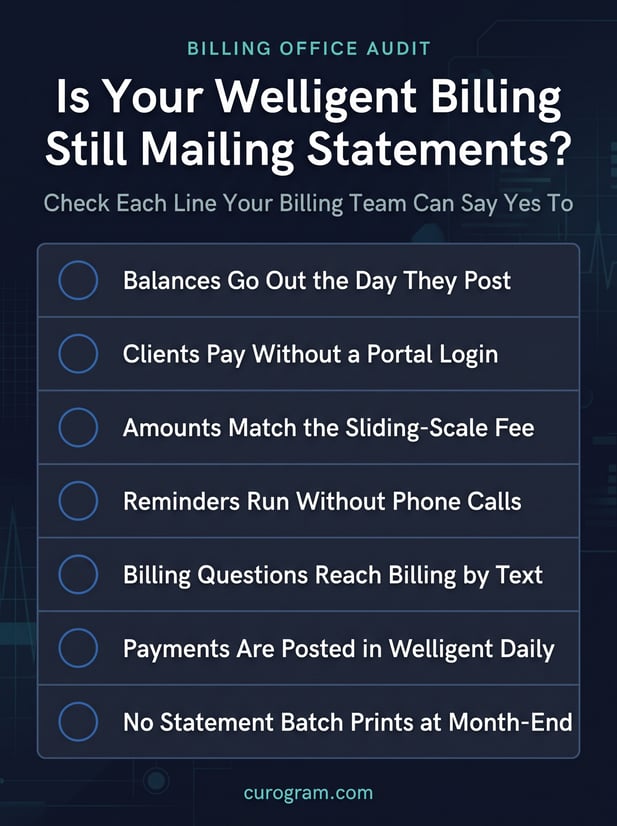
- Monday through Friday, each session's balance gets a text link before close.
- Reminders go out automatically on anything unpaid after a few days.
- Each afternoon, staff post the day's payments in Welligent.
- On Friday, billing reviews the short list of clients who asked for a call.
- No batch prints at month-end.
Welligent revenue cycle client payments now arrive in a steady daily flow. The first week of the month goes back to claims and denials.
What to Measure in the First 90 Days
Track three numbers by program. First, the share of balances paid within seven days of the text. Second, the count of statements still mailed each month. Third, the dollar total sitting past 60 days on the aging report.
Those three show whether the workflow is working before anyone argues about it. They also tell you which program needs a different send cadence.
Why Clients Will Respond
Clients already answer texts from their care team. Covina Arthritic Clinic, a Curogram client, handles more than 1,100 appointment confirmations a month by text.
Atlas Medical Center cut no-shows from 14.20% to 4.91% in three months with automated reminders. Neither is a behavioral health agency, and neither figure involves payments.
What carries over is the habit. Pair the payment link with automated SMS appointment reminders, and clients see one familiar number for both.
Agencies that collect financial consents through digital client intake forms for Welligent behavioral health organizations add a third reason to watch that thread.
Conclusion: Retire the Statement Batch
Welligent is where your claims, eligibility, and funding streams live, and that should stay true. Curogram takes the last step, getting the client's share to a phone that still works.
That's the core of a Welligent client balance collection workflow without paper statements. The batch goes away, the calls shrink, and the aging report gets shorter.
Pull last month's statement costs and the payments they brought in. Then picture the same balances going out as texts before lunch.
Schedule a demo, and we'll map the text-to-pay workflow to your programs and payer mix live. Bring your aging report and your monthly statement spend.
Frequently Asked Questions