
 Aubreigh Lee Daculug

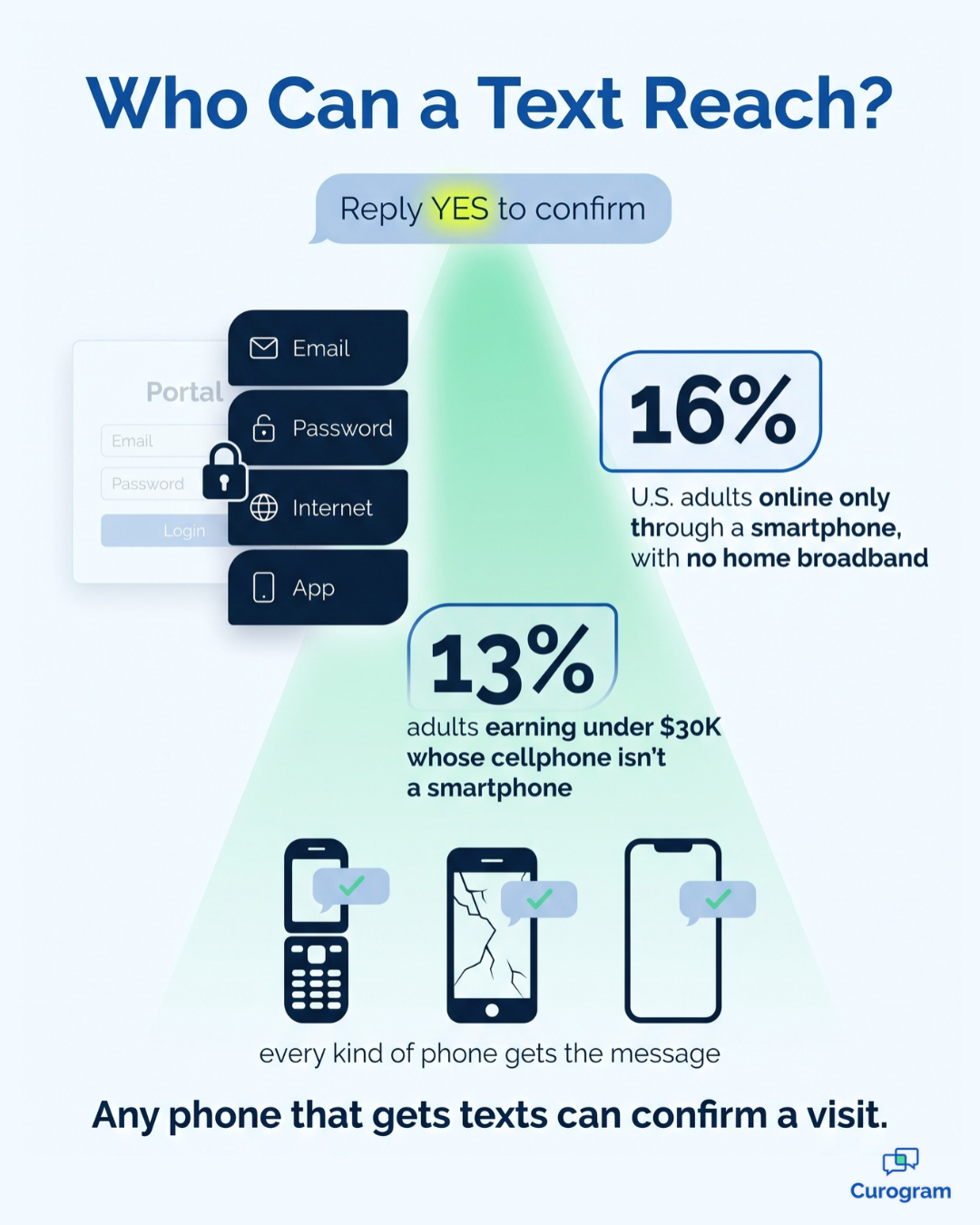
Curogram sends the text to any phone that can receive one, and the client simply replies YES. There is no account, password, app, or email to manage.
Welligent Connect works well for clients who use it. But many behavioral health clients hit "The Portal Wall": lost email access, changed numbers, or no home internet. For them, a text is the reminder that actually arrives.
The results are measurable. Curogram clients average a confirmation rate above 75%, and their no-show rates run 53% below the industry average.
Three words can keep a client in treatment: "Reply YES to confirm."
That sounds too simple to matter, but consider how your reminders reach clients today. If a reminder lives inside a portal, it only works for clients who can get into that portal, and many of your clients can't.
A teen in foster care may have a phone but no email account. A client in early recovery may be on their third phone number this year, while a caregiver may manage every visit for an adult with an intellectual or developmental disability (I/DD). Some households have no reliable home internet at all.
Each of these people is a real name on your calendar, and each one is easy to lose when the reminder never arrives.
This is the quiet problem behind so many empty seats in group therapy. It isn't always about motivation; more often, it's about access. The client never saw the message, so they never showed up.
For clinical and executive directors, that gap matters a great deal. You advocate for clients who already face serious barriers to care, and a reminder system that requires a login adds one more barrier that lands hardest on the people who can least afford it.
Text appointment confirmations for Welligent clients without portal access close that gap. Curogram sends a short text to the phone a client already carries, and the client replies YES. There is nothing to download and nothing to remember.
In this article, you'll see why portal-only reminders miss your highest-risk clients. You'll learn how two-way texting works alongside Welligent, what the integration does and doesn't do, and what results Curogram clients have seen. You'll also get one practical question to introduce to your next leadership meeting.
Let's begin with the wall your clients keep running into.
The Portal Wall, Seen Through Your Client's Eyes
A capable portal built on big assumptions
Welligent Connect is a solid tool, and for clients who use it regularly, it does its job well. But every portal depends on a few assumptions: that the client has an email account, remembers a password, has reliable internet, and routinely checks for notifications.
Many behavioral health clients are missing at least one of those pieces. That isn't a personal failing; it's the everyday reality of the people your programs exist to serve.
One client's week, undone by a login screen
Consider a client in an intensive outpatient program (IOP). Early in recovery, they get a new phone and a new number, then try to reset their portal password, only to find the reset link goes to an email they lost access to two placements ago.
Tuesday's reminder posts to an account they can't open, so they miss group. By Wednesday, shame sets in, and by Friday the entire treatment episode feels at risk because of a login screen.
Down the hall, a foster caregiver misses a family-session reminder for exactly the same reason.
What the numbers say
Missed visits were already a bigger problem in behavioral health than in most areas of care.
A Michigan State University quality improvement project, citing research by Milicevic and colleagues, notes that missed appointment rates in behavioral health can exceed 50%, compared with about 10% in primary care.
The digital divide adds weight to that problem. Pew Research Center reports that 16% of U.S. adults are "smartphone-only" internet users without home broadband, and that this reliance is most common among adults with lower household incomes.
As a result, portal-only reminders tend to reach the clients who need them least.
For IOP and group programs, every missed session also interrupts the consistent attendance that both clinical progress and reimbursement depend on.
The view from the advocate's chair
Clinical directors often know the real story behind these no-shows. The client didn't relapse or disengage; they simply never received the message.
Case managers see the consequences up close when a motivated client gets labeled "non-compliant" because the reminder system required a portal the client couldn't use. That is the true cost of the digital divide: behavioral health communication that only reaches the people who were already connected.
A Text Reminder Every Client Can Actually Answer
Curogram works like a virtual access center assistant, built on one principle: the clients who face the most barriers deserve the most accessible communication. That means a plain text message, readable on any phone and answered in about five seconds.
Here's how it works.
Curogram sends automated SMS reminders before each appointment, and the client can reply YES to confirm. Replies can also flag a cancellation or reschedule request, so staff know exactly who needs a follow-up call.
Messages can stay discreet, too. A reminder can show only the time, location, and reply options, without any diagnosis or program name, so a text glanced at in a workplace, a school hallway, or a group home reveals nothing private.
No-app appointment confirmations remove every step except the reply. Here's how the two approaches compare from the client's side.
| What the client needs | Portal-based reminder | Curogram text reminder |
|---|---|---|
| An email account | Usually | No |
| A password to remember | Yes | No |
| Home internet or a data plan | Usually | No |
| A smartphone | Usually | No, any phone that gets texts works |
| Time to respond | Log in, find the alert, click | One reply |
That point about phones matters more than it might seem. Pew found that 13% of adults earning under $30,000 a year own a cellphone that isn't a smartphone, and while a portal struggles to reach them, a text message can.
So how does this fit with Welligent?
elligent remains your system of record for scheduling, clinical documentation, and claims. Curogram connects through an integration engine that pulls appointment data from Welligent, and setup uses a Welligent user login.
Because Welligent has no public API, the connection runs through a private API, and no one should promise you seamless two-way syncing.
Here's the honest limitation.
Curogram does not write confirmation status back into Welligent; instead, replies appear in Curogram, where staff can see who confirmed and who needs a call.
For a closer look at that workflow, see our guide to Welligent automated appointment reminders. For your clients, nothing changes except that the reminder finally reaches them.
Now think about who this serves. Foster youth appointment reminders reach a teen whose phone has no email attached, and a caregiver for an adult in an I/DD day program can reply YES the evening before.
A school-based client can read the text between classes, while a client in early recovery may keep a phone number but would never keep track of another password.
This is why text appointment confirmations for Welligent clients without portal access, and SMS reminders for Medicaid clients more broadly, tend to work where portals stall. "Reply YES to this text" versus "download our app and create an account" is the entire equity argument in a single line.
When Every Client Gets the Message, the Chairs Fill Up
Curogram's results come from clients in clinical settings across many fields, not just behavioral health. Still, the delivery works the same way everywhere: a text reaches a phone, and a person replies.
- 53%: how far Curogram clients' no-show rates fall below the industry average
- 14.20% to 4.91%: Atlas Medical Center's drop in no-show rate in just three months
- 11.03% vs. 23.00%: the average no-show rate for Curogram's psychiatry clients compared with the industry benchmark
- More than 75%: the average appointment confirmation rate among Curogram clients
The bigger change is in what a reminder actually means. It shifts from a portal notification to a pocket confirmation, from something your organization sent to something your client truly received. Confirming an appointment becomes as easy as answering any other text.
Here's what that can look like day to day.
The IOP group room is full, the group dynamic holds, and attendance streaks survive phone changes and placement moves.
Caregivers and foster families stay in the loop without making accounts. Clients who were drifting toward a "non-compliant" discharge summary are simply present. That is what portal-free client engagement looks like in practice.
Why Communication Equity Belongs in Your Census Plan
For Welligent organizations, clients without portal access aren't an edge case. In many programs, they are the core population, and text appointment confirmations for Welligent clients without portal access are the reminder system designed for them.
Here's a simple way to frame it.
Welligent is for your documentation, compliance, and claims. Curogram is for your clients' reality: a five-second YES from whatever phone they have today, with no password, no app, and no barrier.
That division matters. When reminders depend on a portal, your best-connected clients receive the most support while your highest-risk clients receive the least. Appointment reminders without patient portal logins reverse that pattern, so the people who need the most contact get the kind they can actually use.
The payoff shows up in measures you already track: fuller groups, steadier attendance, and fewer motivated clients written off as "non-compliant." Your staff also spend less time chasing people who were never reached.
It changes how your team talks about no-shows, too. Instead of asking why a client didn't come, you can ask whether they ever received the message, which is a fairer question and one you can actually fix.
So here is one question to raise at your next leadership meeting. What percentage of our active clients have ever logged into the portal, and what are the rest of them missing?
If the answer surprises you, you're not alone; most organizations have never measured it. Fortunately, closing the gap doesn't require a new EHR, a new app, or a single extra step from your clients.
Ready to reach the clients your portal can't? Schedule a Demo to see how Curogram sends text reminders that work alongside Welligent, with zero setup required from any client. Your clients already have the phone, so let's make sure the message gets there.