
 Jo Galvez

Curogram sends these links for agencies running Welligent. Welligent Connect takes payments too, but only after a client registers and logs in, which many clients never do.
A text reaches the person with no email, no fixed address, or a caregiver handling their bills.
Agencies can keep each message to an amount and a link, so nothing on the screen names a program.
An unpaid $40 balance usually tells you more about the payment route than about the client. Clients who owe small balances usually want to pay them. Often the bill never reached them in a form they could use.
Consider who sits on a typical caseload. A woman on a sliding scale hasn't opened her email in a year. A man three weeks into recovery is staying at a friend's place.
An adult with an intellectual disability relies on his sister to handle anything with a login. Each of them has a phone that receives texts.
Welligent Connect's payment screen works as designed for clients who register, verify an email, and remember a password. Paper statements work for clients who stay at one address. Plenty of behavioral health clients fit neither group, and many drift out of both within a single year.
We see payment access as part of care access. An agency that texts appointment reminders can text a balance the same way, and the client can pay in a few seconds without a login.
For executive directors and program leads, this lands in equity work as much as billing. Boards ask how the agency reaches people who live with instability. A billing route that only works for clients with a stable address and an inbox is hard to defend in that room.
Texting the balance also protects the therapeutic relationship. When billing happens by text, the front desk stops being the place where balances get raised.
Why Portal and Paper Billing Shut Clients Out
What a Portal Payment Assumes
A portal payment assumes an email inbox the client checks, a password they remember, and the confidence to click through a billing screen. A mailed statement assumes the client still lives where they lived at intake.
Behavioral health clients often lack one or both. That's why agencies need a no portal payment option for behavioral health clients that works from the device people already carry. Copay payment without a mailing address is a daily need here, well beyond an edge case.
One Balance, From the Client's Side
A small balance can go wrong for one client in four steps. This is an illustrative example.
- A portal invoice notice goes to an email she hasn't opened in a year.
- Her paper statement goes to the apartment she left in March.
- At her next check-in, the front desk mentions the balance in a full lobby.
- She feels singled out and skips the following session.
A $40 collections problem has turned into a gap in care.
Who Gets Reached and Who Doesn't
Phones are the main way online for many of these clients. In Pew Research Center survey data from 2025, 34% of adults in households earning under $30,000 relied on a smartphone with no home broadband.
That's the digital divide in payment access for behavioral health. Caregivers feel it too. A parent of an I/DD consumer may keep track of three provider portals, each with its own password, to keep a family's bills straight.
How a Payment Text Works for the Client
One Text, One Tap
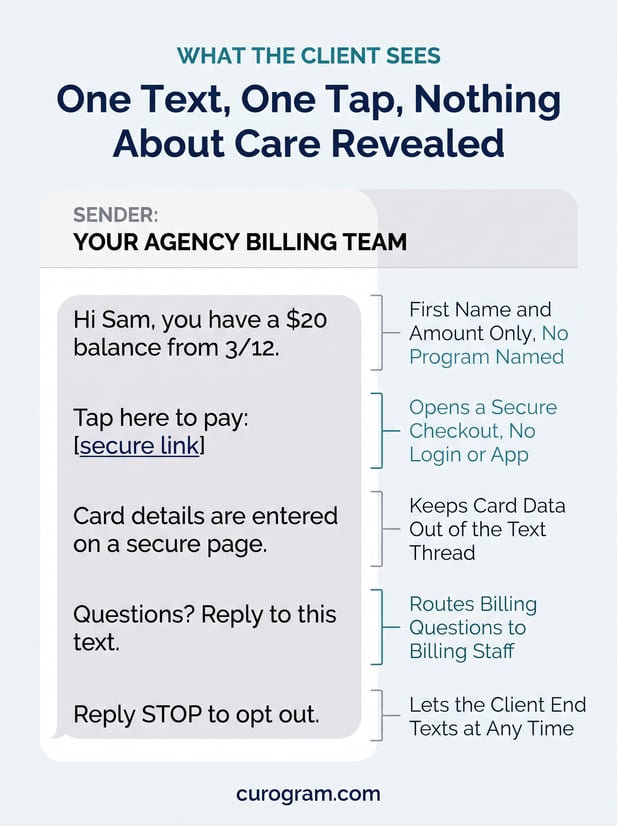
Clients get a short text with the amount due and a link. One tap opens a mobile checkout, and they pay by card. Their whole exchange looks like any other text on their phone.
That is the core of a text payment link for mental health copays. There's nothing to download and nothing to remember. If the client wants the details, the agency can attach a PDF of the bill.
Privacy on a Shared Phone
Some clients share a phone or live in shared housing. Agencies write the message, so it can stay at an amount and a link with no diagnosis or program name. For SUD programs covered by 42 CFR Part 2, that keeps treatment out of view on a lock screen.
Card details go into a PCI-compliant checkout. Nothing about the card sits in the text thread.
When a Caregiver Pays
For many I/DD clients, a parent, guardian, or support coordinator handles money. That person's phone can receive the link. They pay the family's share without logging into anything.
That's client-friendly payment collection for I/DD services in practice. Foster families can handle related self-pay balances the same way, from their own phones.
What Happens on the Agency's Side
Welligent connects to Curogram through a private API that syncs appointments. Payments don't write back to Welligent on their own.
Billing staff send each link from Curogram and post the payment in Welligent, which stays the record. Clients see none of this.
That same Welligent integration already runs mass texting for Welligent users and appointment reminder texts for Welligent users.
Billing leads can read the Welligent client balance collection workflow without paper statements. The full overview lives in text-to-pay copay collection for Welligent behavioral health organizations.
Curogram Highlight: Text-to-Pay That Needs No Login
Text-to-Pay sends an encrypted payment link by text, or by email for clients who prefer it. Clients pay copays, balances, and other fees from a phone browser with no account.
Automated reminders nudge unpaid balances, so staff don't have to call. Clients can reply with billing questions, and those route to the right person. As secure SMS bill pay for human services clients, it adds a channel and takes nothing away.
Learn more on our page for Text-to-Pay for Welligent users.
Payment Without the Lobby Conversation
Four Clients, Four Payments
These are illustrative examples, not client cases.
|
Client |
How the Link Arrives |
What Changes |
|---|---|---|
|
Sliding-scale outpatient client |
Text after each session |
Pays $20 before reaching the car |
|
Client in SUD IOP |
Neutral weekly text |
Copay stays private in shared housing |
|
I/DD consumer |
Link goes to his sister |
Family's share paid with no portal |
|
Older adult in outpatient care |
Text to the phone she always uses |
Never resets a password |
In each case, the balance never reaches the front desk. Nobody brings it up in the lobby.
Evidence That Clients Act on Texts
Clients already respond to texts from their care team. Atlas Medical Center, a Curogram client, cut no-shows from 14.20% to 4.91% in three months with automated SMS reminders. Atlas isn't a behavioral health agency, and payments weren't part of that result.
Payment links ride the same thread. Questions about a charge go through 2-way HIPAA texting, so clients don't wait on hold. The same tap-a-link idea runs virtual sessions through easy telemedicine, with no app to install.
Conclusion: Payment Access Is Access
An agency that texts appointment reminders can text a balance too. Welligent keeps your clinical record and your billing integrity. Curogram meets clients where their lives are: a phone in a pocket, a link that works, and no password.
Paying behavioral health copays by text without portal login takes a barrier out of care that most agencies never meant to build.
Ask your billing team how many of last quarter's unpaid balances belong to clients who were never actually reached. That number shows how much of the problem is the route.
Schedule a demo to see the client side end to end, from reminder to payment link, exactly as your clients would see it.
Frequently Asked Questions