
 Aubreigh Lee Daculug

Portal announcements only reach clients who register and log in. That leaves out many people Welligent agencies serve, including I/DD consumers, foster families, and clients in early recovery. "The One-by-One Phone Tree" eats up staff hours and still misses people.
Curogram's "One-Click Broadcast" sends a closure or schedule change to every client on the Welligent schedule at once, on any phone that receives texts. Text messages have a 98% open rate.
Nearly every adult in the United States carries a cellphone, and Pew Research Center puts the share at 98%. Far fewer of those adults will log in to a client portal before breakfast to find out whether their afternoon group is still happening.
That gap matters enormously to behavioral health organizations serving vulnerable communities. When a storm closes a site or a clinician calls in sick, the update has to reach people quickly. An announcement that sits behind a login tends to skip the clients who most need to hear it.
Welligent does the heavy lifting for large agencies, holding the clinical record, tracking programs, and keeping billing moving across many locations. Client alerts are a different job, though.
A portal quietly assumes things many clients can't count on: an email address, a password they remember, and the habit of checking in regularly.
Consider who your agency serves. There are adults with intellectual and developmental disabilities (I/DD), foster parents managing crowded households, and people in early recovery who may be between phones, apartments, or both. There are also older adults in outpatient mental health care who have never installed an app.
When the portal misses them, staff fall back on "The One-by-One Phone Tree." A single coordinator works through a long list of voicemails and still loses track of a few clients.
This guide explains how no-app text alerts for Welligent behavioral health clients close that gap.
You'll see where portal announcements break down, how Curogram's broadcast texting operates alongside Welligent, and what changes when every client with a phone receives the same message at the same time.
We'll also be direct about what the integration does and doesn't do, so you can plan with facts instead of assumptions. For these clients, a missed alert is never a minor inconvenience.
Where Portal Announcements Fall Short for Your Most Vulnerable Clients
Built for Clients Who Log In
Welligent Connect does what it was designed to do, and clients who register and log in can see what the agency posts. The trouble is the fine print behind that design.
It assumes every client has an email address, remembers a password, and checks the portal often, and those assumptions fail precisely where the need is greatest.
One Closure Morning, Three Missed Messages
Here's how a weather closure unfolds on the client side.
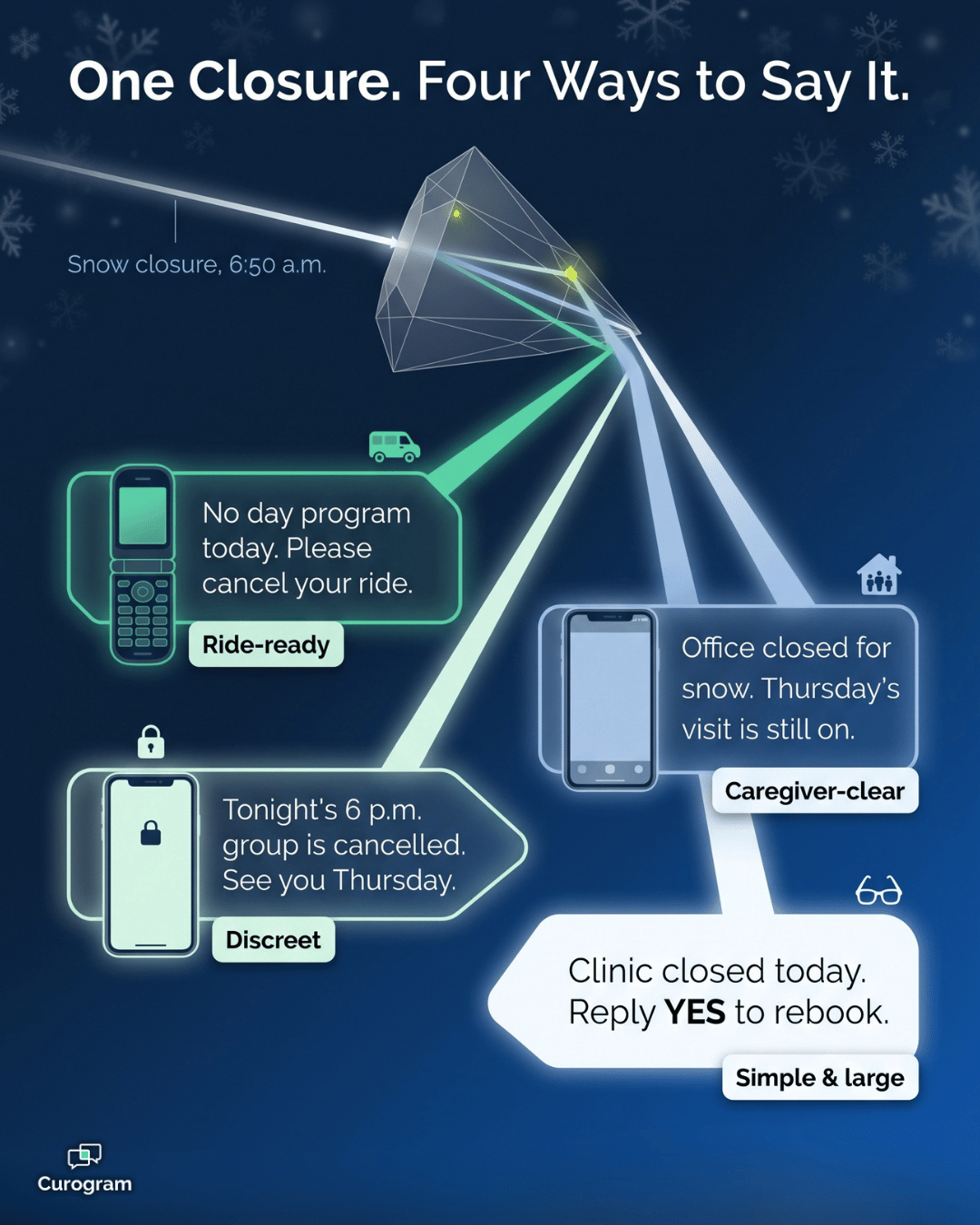
The notice goes up on the portal at 6:50 a.m., but a foster parent caring for three placements is packing lunches and never sees it.
Meanwhile, a man with an intellectual disability gets picked up by paratransit right on schedule for a day program that isn't running.
Across town, a woman eight weeks into recovery takes two buses to her intensive outpatient program (IOP). She finds a dark building and a locked door, and to her it feels like one more system that forgot she exists.
The Digital Divide Shows Up in Your Client List
The digital divide isn't distributed evenly. Pew Research Center finds that relying on a smartphone for internet access is especially common among Americans with lower household incomes and less formal education.
Many behavioral health clients also face housing instability, cognitive disabilities, or unreliable internet at home, and some still carry basic phones that can't run an app at all.
A plain text gets past all of those barriers. Text messages have a 98% open rate, and they don't require the reader to remember anything. A portal-only alert, by contrast, quietly sorts your panel into two groups: the informed and the stranded.
Missed notices also feed a problem you already know well. Research on outpatient mental health care finds that patients miss about 20% of scheduled appointments, and one university psychiatric clinic measured a 31% no-show rate. Every alert that never lands makes those numbers harder to improve.
What It Costs on the Receiving End
These losses are concrete.
A wasted bus fare is real money on a fixed income, and an unexplained locked door can unsettle someone in early recovery.
A foster family that keeps missing updates may gradually disengage from the agency altogether.
That is what weak digital divide client communication feels like from the other side of the door.
How Curogram Puts One Alert on Every Client's Phone
Curogram treats accessible communication as part of the mission rather than an extra feature.
Its principle is simple:
Send alerts where clients already are, which is their text thread, not where the system wishes they were.
Curogram's mass messaging sends one message to many clients within seconds. Each alert arrives as a standard text, so it works on a smartphone, a prepaid phone, or a basic flip phone. These text alerts without portal login require no app, no account, and no password.
Your team can tailor the wording for each program:
- I/DD day programs: SMS closure notifications for I/DD consumers should be brief and easy to pass along to a caregiver or transportation provider. "No day program today. Please cancel your pickup" does the job.
- Foster care: Foster family text updates from agencies work best when they answer three questions quickly: what changed, when it happens, and what to do next.
- SUD programs: Keep messages discreet. "Tonight's 6 p.m. group is cancelled" says enough without naming the program or revealing treatment details.
- Clients without email: Program alerts for clients without email reach the exact people a portal leaves out.
The same tool also gives you a dependable channel for crisis outreach texting for client panels. A sudden site closure or a safety notice can go out without a single phone call.
Here's how the pieces fit together.
Curogram connects to Welligent through a private API connection, using a Welligent user login that your agency provides.
Appointment data flows from Welligent into Curogram, so staff can build an alert list directly from the schedule, such as everyone booked at one location today.
The connection runs in one direction. Curogram doesn't write data back into Welligent, so Welligent remains your clinical system of record, and staff continue documenting there as usual.
Curogram's published guides on Welligent mass messaging and Welligent automated appointment reminders walk through this setup, and the Welligent integration page covers the rest.

For these clients, the request itself makes all the difference. "Reply YES to this text" usually gets an answer, while "Download our app and create an account" often gets silence.
That's why operational texting complements CaredFor, ContinuumCloud's app-based alumni and engagement platform, rather than competing with it. Community building can live in an app, but a closure alert can't wait for someone to open one.
What an Informed Client Panel Looks Like in Practice
The first and most important change is reach. Text messages have a 98% open rate, and anyone with a phone can receive one, so no client's access to important information depends on digital literacy, an email address, or a password.
| Moment | Portal plus phone tree | One-click broadcast |
|---|---|---|
| Closure notice goes out at dawn | Seen only by clients who log in | Sent as a text to every client on the list |
| Staff workload | Calls placed one by one, voicemail after voicemail | One message, typed once |
| Device the client needs | Smartphone or computer, plus a login | Any phone that receives texts |
| What the client experiences | Discovers the closure at a locked door | Knows before leaving home |
The foster family, the day-program participant, and the IOP client all receive identical information through the same familiar channel. That's the shift from a stranded panel to an informed one.
Outreach that actually arrives can also bring people back. In Curogram client data from clinical settings, a multi-location medical practice texted recall messages to patients who were overdue for follow-up care. Of those patients, 35% scheduled an appointment within a month, and 1,240 patients were seen from recall messages alone.
That result came from a medical practice rather than a behavioral health agency, so treat it as evidence of what reachable outreach can do, not as a forecast.
The everyday difference is immediately visible. Nobody rides paratransit to a closed building, and the client in recovery reads "Tonight's 6 p.m. group is cancelled — see you Thursday" and feels supported instead of forgotten. Clients who drifted from care can also receive a friendly text inviting them back before a lapse becomes a loss.
When clients reply, 2-way HIPAA texting keeps their question and your answer in the same thread.
For clients with smartphones, a closure text can also include a link to an Easy Telemedicine visit, so care continues even when the building can't open.
Getting Your Agency Ready to Send Its First Broadcast
Launching broadcast alerts doesn't require a major technology project, but a little preparation makes the first message land smoothly.
Here's a practical sequence most agencies can follow.
- Provide Welligent access. Curogram connects through a private API connection, so your agency supplies a Welligent user ID and password for the integration.
- Review client phone numbers and consent. Numbers change often for clients in transition, so confirm them at intake and at regular visits, and record each client's permission to receive texts.
- Write templates for each program before you need them. Draft discreet, plain-language versions of your most common alerts, such as weather closures, cancelled groups, and day-program changes.
- Choose who sends alerts and when. Name one or two staff members per site, and agree on how early a closure notice should go out.
- Start with a single location. Send a low-stakes update first, review the replies, and adjust your wording before expanding agency-wide.
- Keep documenting in Welligent. Because the integration doesn't write data back, staff should record any clinically meaningful reply in the client's chart as usual.
Before launch, ask Curogram to confirm your setup timeline and any integration costs for your agency. Getting those answers early keeps the rollout predictable for leadership and program staff.
Reach the Clients the Portal Was Never Going to Reach
Every agency composes its closure announcements carefully. The real test is who reads them in time, and when alerts live behind a portal login, the answer too often excludes the people who depend on you most.
Curogram gives Welligent agencies a broadcast channel that reaches every client on the list who has a phone. There's no application to download, no portal to navigate, and no password to reset, so nobody discovers a closure at a locked door.
The division of responsibilities is straightforward. Welligent handles your documentation and program management, while Curogram handles your clients' access: a plain text that serves the individuals a portal was never going to serve.
Because the connection pulls appointment data from Welligent and writes nothing back, your clinical record stays where it lives today.
Ask one honest question about your alert system: who doesn't it reach? Then ask a more difficult one. Are those the clients who can least afford to be missed?
For most agencies, the answer identifies the same populations. It's the I/DD consumer who relies on a dependable ride and a predictable routine, the foster parent with too many responsibilities and too little time, and the client in early recovery whose trust is still fragile.
These clients aren't requesting anything complicated. They need a brief, clear message on the device they already carry, delivered before they leave home. That's what no-app text alerts for Welligent behavioral health clients provide.
Ready to see it working today? Schedule a Demo and watch a closure alert travel from your screen to a client's phone in the time it takes to type it.