
 Aubreigh Lee Daculug

Curogram sends one SMS to an entire client panel or a filtered segment of it, such as a single location or one day's schedule. Clients get a plain text, with no portal login, app, or email needed.
Text messages see a 98% open rate. In Curogram client data, 35% of a multi-location practice's patients who received an SMS recall scheduled within a month, and 1,240 patients were seen.
Most behavioral health agencies have a written emergency communication plan. Ask to see it, though, and someone may open a supply cabinet and point to a laminated call sheet.
That sheet is the real system. When an evening group is canceled or a winter storm closes three locations, coordinators quickly divide the list and start dialing, one client and one voicemail at a time.
Welligent is a strong foundation for the work behind those calls. It manages clinical documentation, scheduling, and billing across multiple programs and funding streams better than most behavioral health platforms. What it cannot do is deliver one announcement to every client at the same moment.
Its client portal, Welligent Connect, can post an announcement. However, clients must register and log in before they ever see it, and many never complete that step.
That gap hits hardest at agencies operating several programs under one roof: outpatient therapy, substance use intensive outpatient (IOP), I/DD day programs, foster care, and school-based services.
Each population has its own schedule, its own locations, and its own communication habits. Mass texting for community mental health centers has to reach all of them, not only the clients who regularly check a portal.
This is where a text message outperforms a phone call. According to the Pew Research Center, 98% of U.S. adults own a cellphone. A text arrives on that phone whether or not the client has a smartphone, an email address, or a portal password.
In this guide, you'll see why the phone tree keeps winning by default and what it quietly costs your staff. You'll learn how Curogram adds broadcast texting alongside Welligent without changing how your team documents or bills.
You'll also discover what changes when a single message can reach an entire program, one location, or the whole agency.
Why the Phone Tree Still Runs Your Emergency Plan
Credit where it's due:
Few behavioral health EHRs handle multiple programs and funding streams the way Welligent does.
That's why large agencies choose it.
But there is no broadcast tool anywhere in the platform. The closest option is a Welligent Connect announcement, which sits behind a wall of sign-ups and logins. CMHC clients, I/DD consumers, foster families, and people in early recovery are the least likely to get past it.
How One Sick Call Becomes a Lost Day
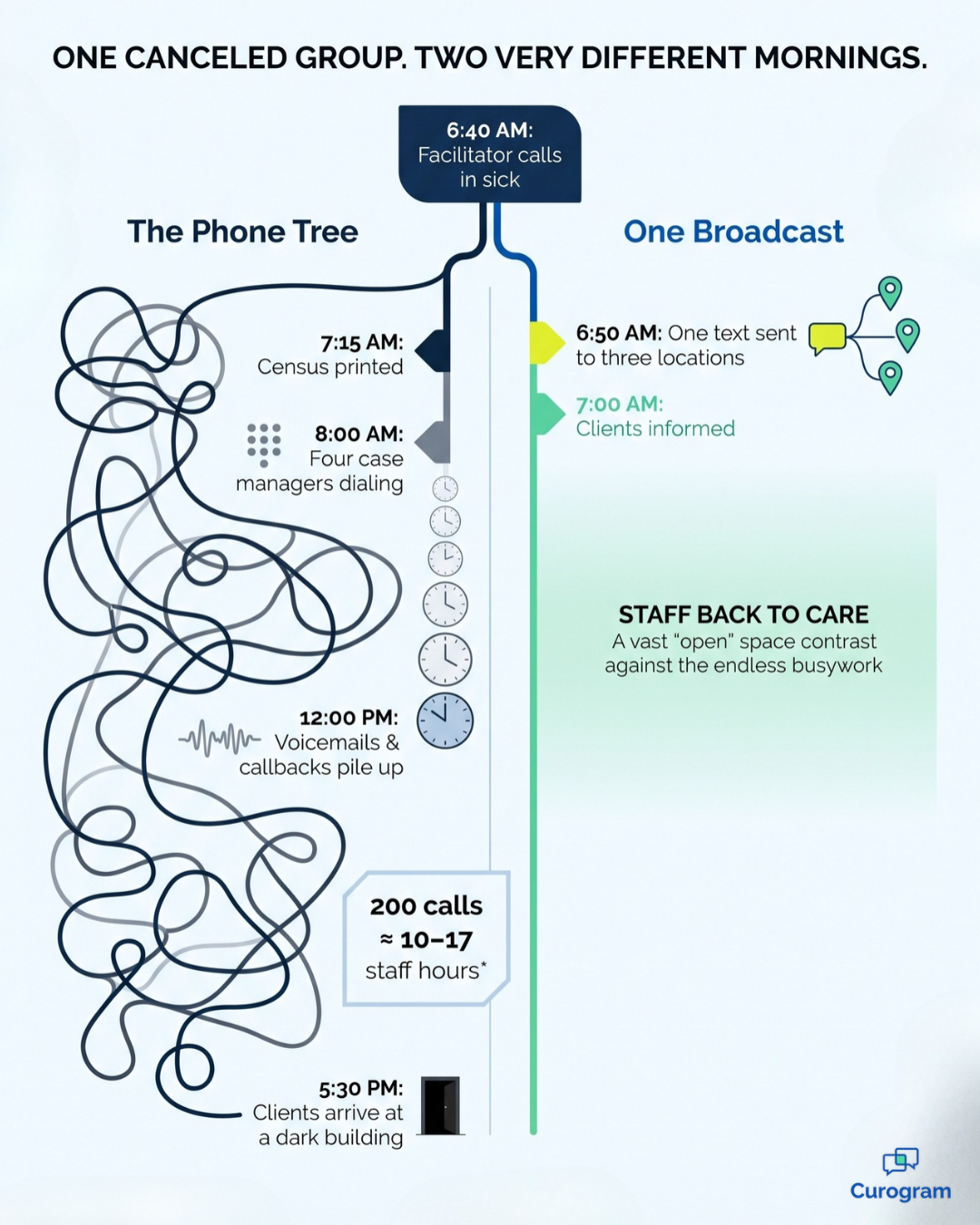
Here's how one cancellation plays out without broadcast texting:
- At 6:40 a.m., an IOP facilitator calls in sick, and tonight's groups at three locations have to be canceled.
- The program coordinator prints the census and divides the call list among four case managers.
- Hours of dialing follow, filled with voicemails, wrong numbers, full mailboxes, and callbacks that interrupt other sessions.
- Someone posts a portal announcement as a backup, and almost no one sees it.
- That evening, several clients still arrive at a dark building.
Welligent group cancellation notifications shouldn't depend on who happens to answer the phone. Yet for many agencies, that's exactly how they're delivered today.
What the Call Sheet Really Costs
The math adds up quickly. Consider an illustrative example: 200 calls at 3 to 5 minutes each equals roughly 10 to 17 staff hours for a single announcement.
Those hours come from case managers and peer specialists who already carry full caseloads. They also come from access and intake teams whose phones are busy long before any emergency begins. And every client who never receives the message is a client who may miss care, which feeds the no-show problem your programs are already working to reduce.
The Roster in the Cabinet
Many program directors keep a laminated phone roster taped inside a cabinet door. It isn't a backup; it's the agency's real plan.
Those directors also know the hard truth behind it. The clients least likely to get the call are often the ones who can least afford a wasted bus trip.
How a One-Click Broadcast Reaches Every Program
Curogram works as a virtual access center assistant for agencies with many programs. It adds the panel-wide texting Welligent was never built to include. And it delivers each message to the one place nearly every client already checks: their texts.
What You Can Send, and to Whom
Curogram's Mass Messaging feature lets your team send one text to a large group of clients with a single click. Because Welligent appointment data flows into Curogram, staff can filter the schedule by location, date, or provider before sending.
That makes segmented client messaging by program and location practical, without rebuilding a call list every time. You can read more in our guide to Welligent behavioral health mass messaging.
Common uses include:
- Urgent group cancellations
- Welligent weather closure alerts for one location or every location
- Day-program activity changes for I/DD families
- Updates for foster families
- Crisis check-ins and alumni outreach
For a CCBHC, this matters. An SMS broadcast for CCBHC client panels can reach one program's clients without bothering clients in another.
How It Connects to Welligent
Curogram connects to Welligent through its integration engine using a private API. Appointment data flows into Curogram, which lets staff filter by schedule. To set it up, you need a Welligent user ID and password.
The connection runs in one direction. Curogram does not write patient records, appointments, or appointment statuses back to Welligent. Welligent stays your record for charts and billing, and Curogram handles outreach. Learn more on our Welligent integration page.

Where CaredFor Fits
Some Welligent agencies also use CaredFor, ContinuumCloud's alumni app. CaredFor is built for peer support, events, and alumni groups, and it's useful for that work. However, clients must download the app and join before they can use it.
Curogram does a different job:
Real-time notices sent by plain SMS. A text needs nothing but a phone.
For people on the wrong side of the digital divide, that simple message often feels more personal than any app.
What an Informed Panel Looks Like
Text messages see a 98% open rate. A portal announcement, by comparison, only reaches clients with an activated account who happen to log in that day.
There's also evidence of what one message to a full panel can accomplish. In Curogram client data from clinical settings, a multi-location medical practice sent SMS recalls to existing patients. Within a month, 35% of those patients scheduled an appointment, and 1,240 patients were seen from recall messages alone.
These are cross-specialty medical results rather than behavioral health results, but they show the reach of a single panel-wide send at organizational scale.
Here's how the shift looks in daily operations:
| Task | Phone Tree | One-Click Broadcast |
|---|---|---|
| Build the list | Print the census and divide it among staff | Filter by location, date, or provider |
| Write the message | Repeat it on every call | Type it once |
| Reach 200 clients | 10 to 17 staff hours (illustrative) | One send |
| Clients without portal access | Often missed | Reached by text |
| Staff time afterward | Spent on callbacks | Returned to care |
This is what an informed panel means in practice. The 200-name call sheet becomes one targeted send, and your emergency communication plan stops depending on how quickly four people can dial.
Now imagine the next closure morning. The text reaches every affected program in the time it takes to write it. I/DD day program families adjust their transportation before the vans roll. Nobody in early recovery stands at a locked door wondering whether the program gave up on them.
Meanwhile, your case managers spend those reclaimed hours where they matter most: with clients.
Rolling Out Broadcast Texting Across Your Programs
A broadcast tool only delivers value if your team is prepared to use it the moment something goes wrong. The best time to configure it is during a quiet operational week, not in the middle of an early-morning scramble.
Here's a practical way to get started:
- Connect Welligent. You'll need a Welligent user ID and password. Once connected, appointment data flows into Curogram, so staff can filter by location, date, or provider.
- Decide who can send. Identify the coordinators and program leads responsible for broadcasts at each program or location. Clear ownership prevents the wrong announcement from reaching the wrong client panel.
- Write templates ahead of time. Draft short messages for the moments you know will come, like group cancellations, weather closures, and schedule changes. Keep every template free of diagnoses, treatment details, or program names that reveal care.
- Confirm consent. Make sure clients have agreed to receive texts, and give every message a clear way to opt out.
- Plan the follow-up. Designate who handles the phone calls a broadcast may generate. Staff also still update canceled appointments in Welligent, since Curogram doesn't write appointment statuses back to the EHR.
A good closure text is short, plain, and discreet. Here's an example your team could adapt:
"Due to weather, all services at our Main Street location are closed today. Please call [main number] with questions or to reschedule."
That message gives clients the essential information without revealing anything about their care. It works equally well for a foster parent, an I/DD family member, or someone attending outpatient therapy.
Finally, practice before you actually need it. Send a low-stakes notice first, such as a holiday schedule update, so your team's first real broadcast doesn't happen during an emergency.
Retire the Phone Tree Before the Next Snow Day
Welligent does a great deal for your agency, keeping documentation, schedules, and billing organized across every program you operate. But it has no built-in way to send one message to all of your clients at once.
Curogram fills that gap, so one click can reach every client, program, or location. And because text messages see a 98% open rate, your announcement is considerably more likely to be read than a portal post.
It helps to think of the two platforms as having different responsibilities. Welligent supports your work: clinical documentation, billing, and program management. Curogram supports your clients in the moment they need information. That's the short text that saves someone a wasted trip and saves your staff a lost day.
Broadcast text messaging for Welligent multi-program organizations is no longer an optional extra. It's a basic part of access and safety. When a storm hits or a group falls through, your clients deserve to hear about it quickly, in a format they already use every day.
Your staff deserve better, too, because every hour spent working through a phone tree is an hour pulled away from care. Case managers and peer specialists should not serve as the delivery system for a message that software can send in seconds.
Consider what your last closure cost in staff hours and missed visits. If the answer is uncomfortable, the solution isn't additional dialing.
The next weather closure should not become a staffing event. It should be one message, sent once, to exactly the right clients. That's the kind of agency-wide emergency texting behavioral health leaders can rely on.
Schedule a Demo and bring your program list along with the story of your last closure scramble. We'll build a segmented broadcast for your agency live, so you can see how quickly it works.