
 Jo Galvez

With Curogram working alongside Welligent, the client gets an SMS link, taps it, and fills out the packet on their phone.
There's no account to create, no email address, and no password. Welligent Connect's portal intake suits clients who will register and log in.
A foster youth with no email or a person in early recovery on a new number often won't. Those packets end up on a clipboard in a public lobby.
By text, clients answer sensitive history questions at home, in private, and at their own pace.
A login screen keeps more people out of behavioral health intake than most program directors expect. From the client's side, it's often the first form they can't finish.
Think about the clients your access center has the hardest time reaching. A 17-year-old in foster care has a phone but no email she checks.
A man three weeks into recovery is on his third phone number this year. A woman with an intellectual disability relies on her mother for every form.
Each of them can open a text, and few will register for a portal.
Welligent Connect works as designed for clients who log in. Clients who never get that far meet a clipboard in a crowded lobby on admission day. They answer trauma questions within earshot of strangers. Some leave pages blank, and some leave.
Our position is plain. The clients who need the most support deserve the easiest paperwork, and the easiest route is the text message their phone already receives.
For executive directors and program leads, this is an access question as much as an efficiency one. Boards and accreditors ask how the agency reaches the people it serves. Intake that depends on digital literacy is hard to defend in that room.
A text-first packet changes the answer. The form travels to whoever handles the paperwork, opens on any phone with a browser, and gets done before the first visit. Staff still review every packet, and the portal stays open for clients who prefer it.
Why Portal Intake Leaves Out the Clients Who Need Care Most
What a Portal Assumes About a Client
Portal intake assumes an email inbox, a remembered password, a device with a full browser, and patience to register before care starts. Those assumptions fail most often for the clients behavioral health agencies exist to serve.
Phones are the main way many of them get online. In Pew Research Center survey data from 2025, 34% of adults in households earning under $30,000 relied on a smartphone with no home broadband.
That's the digital divide in behavioral health access, since Medicaid caseloads draw heavily from those households.
The Lobby Version of the Same Packet
From the client's side, a portal-first intake often unfolds like this:
- An outpatient client gets portal instructions in the mail.
- She has no laptop, and a library computer times out mid-registration.
- Admission day arrives with nothing done.
- A clipboard full of personal questions appears in a crowded lobby.
- One page asks about trauma history within earshot of strangers.
- She leaves it blank, or she walks out.
Who Gets Left Behind
Program directors know the pattern well. Clients who abandon intake are rarely the ones who needed care least.
Caregivers carry a heavy load here. The mother of an I/DD consumer may handle paperwork for three agencies, each with its own portal and password.
A foster parent opening a case gets one more login on top of school and court forms. When the portal is the only route, each of these households has to clear a tech hurdle before anyone screens for need.
How Text Intake Works for Clients Without Email or a Laptop
Agencies looking for no portal intake forms in behavioral health care usually want one thing: a packet that opens from a text.
Tap, Answer, Submit
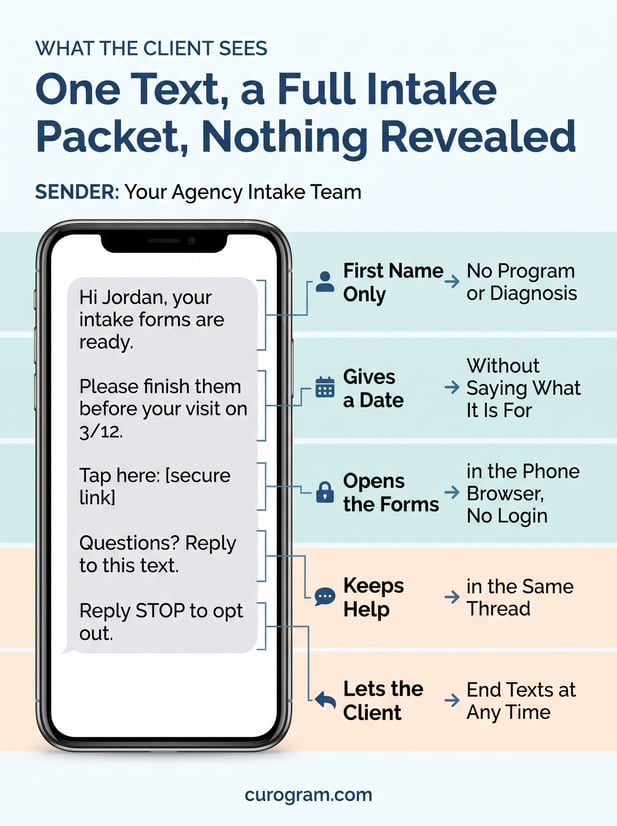
The client gets a short text with a secure link, and one tap opens the packet in the phone's browser. Mobile intake forms without an email account leave nothing to register and nothing to remember.
Forms fit a phone screen and skip questions that don't apply. Consents take a finger signature, and an insurance card photo takes seconds.
Forms can follow the client's preferred language. That's client-friendly digital intake in mental health: fewer steps, plain screens, and no account.
When a Caregiver Fills It Out
I/DD caregiver form completion works the same way. Staff send the link to the parent or support coordinator who handles paperwork, and that person fills it out from their own phone. Nobody shares a login.
Foster care follows the same pattern. The link can go to the foster parent opening the case, so household documents arrive before the first home visit. If a question comes up mid-form, caregivers can text the agency back through 2-way HIPAA texting.
Privacy and Pace at Home
Private intake completion at home changes what clients are willing to write down. A trauma history answered on a couch, days before the visit, gets more care than one rushed in a lobby.
For SUD programs covered by 42 CFR Part 2, the text holds only a neutral link and instructions. A glance at the lock screen reveals nothing about treatment.
What Staff See on Their End
Welligent connects to Curogram through a private API that syncs appointments. Form answers don't write into the Welligent chart on their own. They arrive typed in Curogram's dashboard, and staff enter them into Welligent through their usual step. Clients see none of this.
That same Welligent integration already runs mass texting for Welligent users and appointment reminder texts for Welligent users.
Access center leads can read Welligent intake paperwork workflow for access center staff. The full overview lives in digital client intake forms for Welligent behavioral health organizations.
Curogram Highlight: Secure Online Forms That Need No Login
Secure Online Forms reach clients by text and open in any phone browser, with no app, account, or password.
Agencies build a packet per program, with on-screen consents, insurance photos, and questions that show only when they apply.
Automated reminders nudge clients who haven't finished. Completed forms land in a HIPAA-compliant, SOC 2 Type II certified dashboard for staff review.
For clients who'd rather not text, the portal stays available. Learn more on our page for online intake forms for Welligent users.
The Completed Intake, Client by Client
Three Clients, Three Packets
Intake plays out like this for the three clients from the start of this piece. These are illustrative examples, not client cases.
|
Client |
How the Packet Arrives |
What Changes |
|---|---|---|
|
Foster youth, 17 |
Her foster parent gets the link |
Case documents arrive before the home visit |
|
IOP applicant in early recovery |
Neutral text to his current number |
Consents signed two days before admission |
|
I/DD consumer |
Her mother completes it Tuesday night |
Enrollment forms ready for intake day |
In each case, the first session opens with a conversation. Nobody hands over a clipboard.
Proof That Clients Act on Texts
Atlas Medical Center, a Curogram client, cut no-shows from 14.20% to 4.91% in three months with automated SMS reminders. Atlas isn't a behavioral health agency, and forms weren't part of that result. It does show that a well-timed text moves people to act.
The same tap-a-link approach carries over to easy telemedicine for virtual first visits, with no app to install. Directors also get a line for the board report: intake at our agency no longer depends on digital literacy.
Conclusion: Care Shouldn't Start with a Password
The clients who need the most support should get the most accessible paperwork. Welligent keeps your clinical record. Curogram handles their side of intake: a phone with SMS, and often no email, no laptop, and no patience left for another account.
Ask your access center how many admission packets came back complete before arrival last month. That number shows how many clients your current route reaches. Behavioral health intake forms clients complete by text are how agencies raise it.
Schedule a demo to see the client side end to end, from the text on a basic smartphone to the finished packet in staff hands.
Frequently Asked Questions