
 Aubreigh Lee Daculug

Welligent's own reminders run through Welligent Connect, so they only reach clients who set up a portal account. That leaves out many of the clients most likely to miss care. The result is "The Empty Group Chair."
With Curogram, clients reply to confirm or cancel before group starts. Curogram clients average a confirmation rate above 75% and no-show rates 53% below the industry average.
A reminder nobody reads isn't really a reminder. It's a line in a log.
That quiet problem sits inside many behavioral health organizations today. The session is booked, and the system records a sent reminder. Yet by mid-afternoon, a third of the IOP group's chairs are still empty.
Nothing about the clinical quality has changed. The clinicians are experienced, the groups are well facilitated, and the program design is sound. What failed was delivery, because the reminder went to a portal account the client never opened.
Here's where automated appointment reminders for Welligent behavioral health programs either work or fall apart.
Welligent is a strong platform for clinical records, scheduling, and billing across many service lines. But its built-in reminders depend on Welligent Connect, the client portal, and the people your programs serve are often the least likely to log in.
Consider who those clients are: someone two weeks into SUD recovery who just switched phones, a young adult in foster care without a steady email address, a caregiver fitting an I/DD day program around two jobs, or a CMHC client with no home internet. Each of them can receive a text message, but few will reliably remember a portal password.
When reminders miss them, the financial damage compounds quickly. Groups operate under capacity, and clinical teams lose momentum. Medicaid revenue tied to each session slips away, one empty chair at a time.
This guide explains why portal-based reminders leave gaps and how SMS reminders for behavioral health EHR users close them. You'll see how Curogram connects with Welligent, what the connection does and doesn't do today, and what results look like in practice.
The objective is straightforward. Every client with a phone should get the message, and every chair should have a name on it before the session begins.
Why Group Chairs Sit Empty When Reminders Live Behind a Portal
What Welligent Does Well, and Where Reminders Stall
Welligent was built for behavioral health and human services. It handles multi-program documentation, scheduling, and billing in one place. For large agencies, that is a real strength.
The gap is in how reminders reach people.
Here's the heart of the Welligent Connect reminder limitations:
A reminder only lands if the client activated a portal account and actually checks it. Many of your highest-risk clients never do, so the reminder fires into an account no one opens.
How One Missed Message Becomes a Missed Week
Follow a single IOP session through the system:
- Staff book the session in Welligent.
- The reminder posts to Welligent Connect.
- The client changed phones last month and never set up the portal.
- No reminder arrives, and the client misses a third straight session.
- The group runs with eight of twelve chairs filled.
- The team starts discharge paperwork for a client who never got the message.
That final step is the painful one. The client didn't abandon treatment; the message simply never reached them.
What Empty Chairs Cost at Scale
When you study behavioral health no-show rates, Medicaid programs tend to land at the high end. One Oregon community mental health program found its Medicaid clients missed 24% of appointments. A study of a public-sector psychiatric clinic found a 36% no-show rate for first visits, inside a 26% to 50% range reported in earlier research.
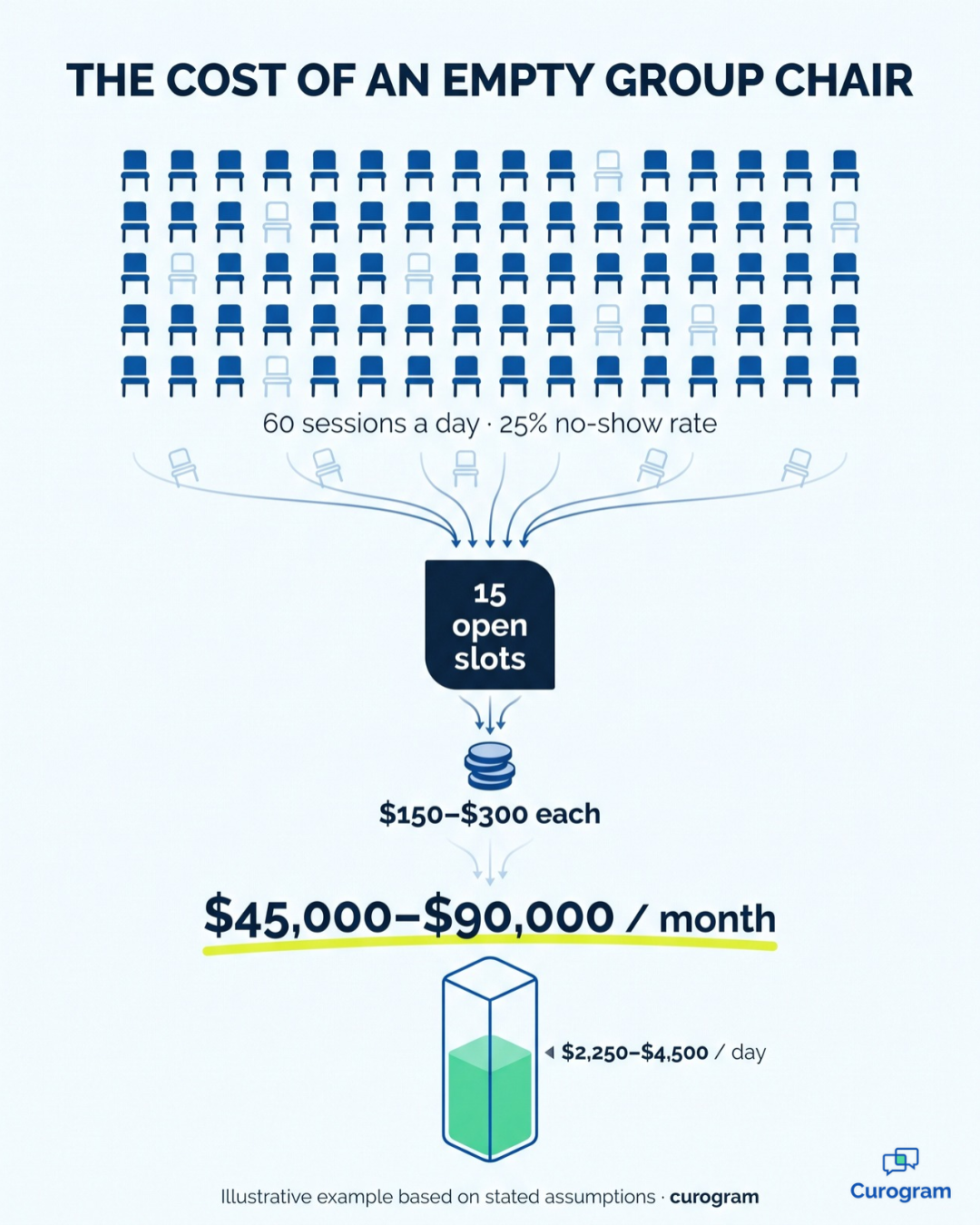
Here's an illustrative example to show the math.
Say your organization runs 60 IOP sessions a day with a 25% no-show rate. That's 15 empty slots each day.
At $150 to $300 per session, you lose $2,250 to $4,500 a day.
Over a month of about 20 program days, that adds up to $45,000 to $90,000. Back-to-back misses can also hurt treatment outcomes and put reimbursement at risk. Meanwhile, access center staff spend their mornings on dozens of confirmation calls.
The People Behind the Census Report
The program director watches the census line slide, even though care quality hasn't dropped. The group facilitator rebuilds the session plan because a third of the room is missing. The executive director tells the board the deficit isn't a clinical problem.
It's a delivery problem, and delivery problems have delivery fixes.
How Curogram Keeps Your Census Full Without Replacing Welligent
Curogram acts as a virtual access center assistant. It's a reminder layer built for organizations whose clients live on the far side of "The Portal Wall." Every reminder goes out as a plain text to any phone that can receive one.
If you're looking for a Welligent appointment reminder alternative, here's the key point. You don't replace Welligent. You add a delivery channel that reaches the clients the portal misses.
| Workflow piece | How it works |
|---|---|
| Reminder timing | You choose the cadence, such as 3 days, 1 day, and 2 hours before a session |
| Message templates | Wording can change by appointment type or location |
| Client replies | Clients reply YES to confirm, or reply to cancel or ask for a new time |
| Staff follow-up | Cancellations show up early, so the access center has time to backfill the slot |
This is two-way appointment confirmation texting, not a one-way blast. Each reply opens a real conversation your staff can see and act on.
Now for the honest part about the connection. Welligent doesn't offer a public API, so Curogram connects through a private API integration that uses a Welligent user login. It pulls appointment data into Curogram, which lets reminders go out on schedule without manual uploads.
Data flows one way today. Client replies stay in Curogram and don't write back to Welligent on their own. When a client cancels or asks to reschedule, your staff update the Welligent schedule. Welligent remains your system of record for scheduling, notes, and billing.
Ask about this in your demo. You deserve a clear map of what syncs and what your team handles by hand.
Here's why this setup fits behavioral health work:
- IOP tracks: Steady attendance shapes outcomes, and SAMHSA's IOP guidance ties engagement to retention. Early confirmations protect that streak.
- CCBHC outpatient panels: Hundreds of daily visits get reminders without anyone picking up a phone.
- I/DD day programs: When a caregiver's number is on file, the caregiver gets a reminder they can answer in one word.
- School-based programs: Reminder timing can be set around bell schedules.
Automation here feels more personal, not less. The text is discreet and lands where the client already looks. It asks for a one-word reply, not a password.
When Age Stops Deciding Who Shows Up: The Attended Visit
Here's what Curogram's reminder and confirmation workflow has delivered, based on Curogram client data from clinical settings:
-
53% lower no-show rates than the industry average across Curogram clients
-
14.20% → 4.91% no-show rate at Atlas Medical Center in three months, 3X better than the industry average
-
75%+ average appointment confirmation rate, fully automated
-
1,100+ appointments confirmed per month at Covina Arthritic Clinic, with no manual calls
-
These results come from many kinds of medical clinics, not just behavioral health. Still, the delivery works the same way. A text reaches a phone, and a reply confirms the slot.
That changes how the day starts. Confirmations arrive before the access center opens. Cancellations become chances to backfill, not surprises. Staff call only the few clients who didn't reply, not the whole day's list.
Most CCBHC no-show reduction strategies focus on clinical engagement, and those efforts matter. But engagement can't begin if the client never got the message. Fixing delivery first gives every other strategy a fair shot.
Here's the room you're working toward.
IOP groups start with every chair filled. CCBHC quality scores show real progress, not missed messages. I/DD transport rosters are set early in the morning, and the census line on the board report finally trends up.
To go deeper, read our guides on reducing IOP no-shows with an access center workflow and text confirmations for clients who will never use a portal.
For setup details, see our Welligent automated appointment reminders SMS guide, our Welligent mass texting overview, and the main Welligent integration page.
Let Welligent Run the Program and Let a Text Fill the Room
Welligent manages your programs effectively. It holds the clinical record, the schedule, and the Medicaid billing that keep your organization operating. Those responsibilities matter, and nothing here requires changing them.
What Welligent can't do alone is reach the client who never opened the portal. That's the gap Curogram fills, with automated SMS reminders and two-way replies that reach every client with a phone.
Consider the partnership this way. Welligent is designed for your clinical documentation and billing, while Curogram is designed for your clients' daily reality. That reality is a text they can answer in five seconds from any phone, with no password required.
The pairing also means your team stops chasing the schedule. Confirmations arrive automatically each morning, and cancellations surface while there's still time to fill the slot. Your access center can focus its morning on the few remaining clients who need a personal call.
So start with a number you can actually act on. Pull the no-show rate for each program, then multiply the missed sessions by your average session rate. For many organizations, that figure is the most expensive line that never appears on a budget report.
Then decide whether your organization wants to keep paying it. "The Empty Group Chair" doesn't have to set your census, and a reminder that actually arrives is one of the simplest ways to change that. Clients will barely notice, except that they start showing up.
Ready to see how this would work across all your programs? Schedule a Demo with our team, and bring your no-show rates by program and daily session counts. We'll map the reminder workflow against your actual Welligent schedule and show you exactly what syncs and what staff handle.