
How to Modernize the Osmind Interventional Psychiatry Patient Payments
💡 Patient payments for Osmind can be faster and simpler with secure text-to-pay tools. Curogram lets mental health clinics send one-click payment...
9 min read
Jo Galvez
:
February 5, 2026
A patient just finished their last TMS session. They feel better. They trust your care. But when the bill arrives three weeks later, it sits on the kitchen counter. Then it moves to a junk drawer. Then it's gone.
This scene plays out in clinics every single day. For practices that rely on Osmind to manage patient care, unpaid balances can pile up fast. TMS runs 30 sessions or more. Ketamine needs repeat visits. Spravato has complex co-pays. Each missed payment chips away at your bottom line.
The hard truth? Paper bills don't work anymore. People toss them. Portals feel like a chore. And every day a balance sits unpaid, your practice loses money.
That's where the Osmind EMR ROI for patient payments comes into play. When you pair Osmind with a text-to-pay tool like Curogram, you change the game. Instead of mailing statements and hoping for the best, you send a secure link right to the patient's phone. They tap. They pay. Done.
This shift does more than speed up payments. It cuts your billing costs. It frees up staff time. And it keeps your revenue cycle healthy. For clinics that offer high-ticket treatments, this matters a lot.
In this article, we'll show you why old billing methods fail. We'll break down the numbers behind SMS payments. And we'll give you a clear plan to recapture lost revenue. If you run a practice that uses Osmind, this guide is for you.
Let's fix the unpaid balance problem for good.
Every clinic has a villain. It's not the front desk. It's not the patient. It may be the billing system itself. When you rely on paper or portals, you create gaps where money slips through. For clinics that focus on TMS, Ketamine, or Spravato, those gaps grow fast.
Let's break down the three main ways old billing methods hurt your practice.
Treatments in your clinic aren't cheap. A TMS course can cost thousands. Even with insurance, the patient share adds up. When bills are high, people tend to delay. They wait until next month, then the month after that.
Why Big Bills Get Ignored
Large amounts feel scary. Patients don't know how to fit them into their budget. So they set the bill aside. This is a key reason why reducing psychiatric A/R days is so hard with paper.
The Delay Effect on Cash Flow
Every week a bill sits unpaid, your cash flow suffers. You still pay the staff. You still pay for supplies. But the money owed to you stays stuck. This gap can threaten clinic stability over time.
The Lost in the Mail Syndrome
Paper statements have a simple flaw. They get lost. They get tossed. They sit in piles of junk mail. For every envelope you send, you spend money on postage and staff time. When those envelopes go unnoticed, you lose money.
Most clinics spend $12 or more per paper statement when you add labor and postage. Yet there's no promise the patient will act. Many statements go straight to the trash. This is money wasted.
Text messages have a 98% open rate. Paper mail, on the other hand, only gets opened around 20% at best. If your goal is revenue recapture for medical practices, the numbers tell the story.
The Portal Friction Penalty
Patient portals sound great in theory. In practice, they cause headaches. Patients forget their login. They can't find the link. They give up.
Many patients only use the portal once or twice a year. They can't recall their password. The reset process feels like a chore. So they skip it. This is a major cause of non-payment in specialty mental health.
After a Ketamine session, patients may feel tired or foggy. Asking them to log in and pay right away sets them up to fail. A simple text link removes this barrier. It meets patients where they are.
Speed matters in billing. The faster you collect, the healthier your practice becomes. SMS billing cuts the gap between service and payment from weeks to hours. This shift changes everything about your revenue cycle.
Here's how the numbers stack up when you compare old methods to text-to-pay.
|
Metric |
Traditional Paper Billing |
Curogram Text-to-Pay |
|
Days-to-Pay |
45-60 Days |
<48 Hours |
|
Staff Time per Bill |
10-15 Minutes |
<1 Minute |
|
Collection Rate |
~70% |
>95% |
|
Cost per Statement |
$12.00+ (Labor/Postage) |
Negligible |
With paper billing, most practices wait 45 to 60 days for payment. That's two months of cash stuck in limbo. With text-to-pay, the same payment can arrive in under 48 hours.
When cash comes in faster, you can pay bills on time. You can invest in growth. You can handle slow months without panic. This is the core of interventional psychiatry billing efficiency.
Faster payments build on each other. One quick payment today means more cash next week. Over a year, this adds up to major gains.
Every paper bill takes 10 to 15 minutes of staff time. You need to print, stuff, stamp, and mail. Then you wait. Then you follow up. With SMS, the whole process takes less than one minute.
When staff spend less time on billing, they can help patients. They can answer phones. They can fill open slots. This boost in output lifts the whole practice.
Chasing unpaid bills is draining work. It wears on your team. When payments flow in on their own, morale goes up. Staff feel less stressed.
Text-to-pay can push your collection rates up to 95%. This jump means real money in your pocket.
People check their phones all day. A text is hard to ignore. And when the payment link is right there, acting on it takes seconds. This is psychiatric collection rate improvement at its best.
If your clinic bills $100,000 a month and collects 70%, you lose $30,000. At 95%, you lose just $5,000. That $25,000 difference adds up to $300,000 a year.

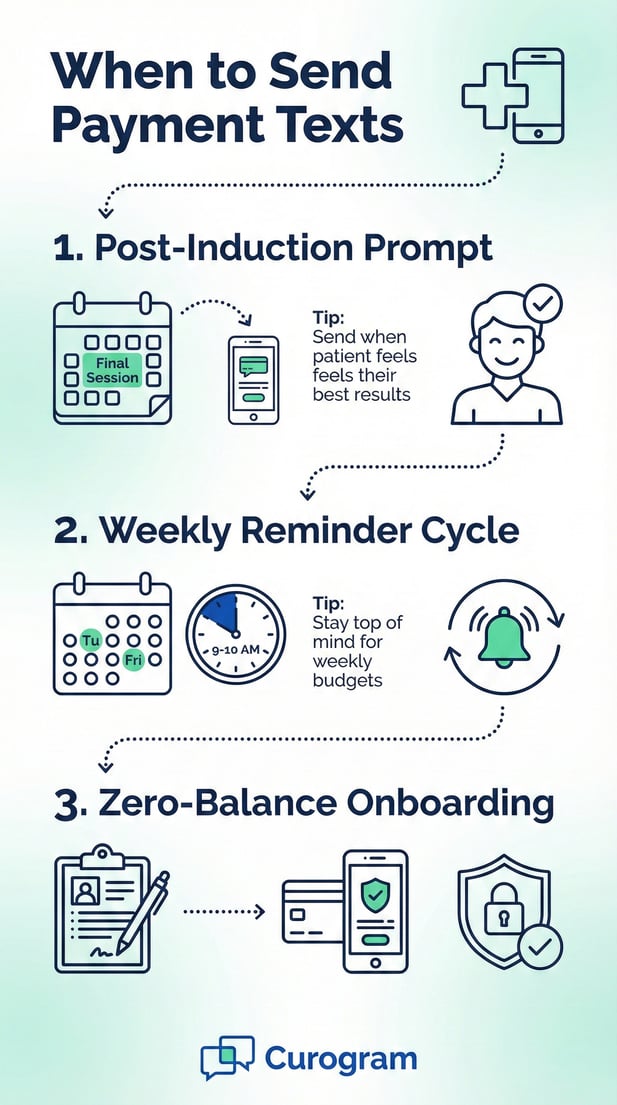
Timing is key when you ask for payment. Send a text too soon, and the patient feels rushed. Send it too late, and they've moved on. The best approach uses specific moments in the patient journey to get the best results.
Smart timing turns a simple text into a powerful tool. Here are three proven methods that work for clinics using Osmind every day.
The Post-Induction Prompt
After a patient finishes a Ketamine series, they often feel great. They're happy with their care. They see real progress in their mental health. This is the perfect moment to send a payment link. The value of your service is fresh in their mind.
Patients who feel better are more willing to pay. They want to settle up and move forward. A text sent at this moment feels like a natural close to the treatment, not a cold ask for money.
Why Good Feelings Help Collections
When patients feel better, they value the care more. They see the cost as worth it. The link between their mood lift and your treatment is clear. This makes them eager to complete the process. A payment becomes part of saying thank you for good care.
How to Set Up the Trigger
Curogram lets you set rules based on visit type. When the final session is marked complete in Osmind, the system sends the text. No manual work needed. Your staff doesn't have to remember. The software handles it all. This is how mental health text-to-pay collections should work.
Automated Weekly Cycle
Some balances need a gentle nudge. An automated weekly text keeps your clinic top of mind without being pushy. Most practices find Tuesday or Friday morning works best for these reminders.
The key is to stay present without being annoying. A weekly check-in shows you care about getting paid, but it respects the patient's time and budget. This balance builds trust while moving money into your account.
Why These Days Work
Tuesday hits after the Monday rush when people start to plan their week. Friday catches people before the weekend when they have time to handle money matters.
Both days fit into how most people budget and manage their bills. Testing both can show you which day works best for your patient base.
Setting the Right Tone
The text should be friendly, not pushy. A simple "Your balance is ready" works well. Include the amount and the link. Keep it short and clear. Don't use all caps or exclamation marks. The goal is to inform, not to pressure. Patients respond better to calm, clear messages that make paying easy.
The best way to avoid unpaid balances is to collect upfront. During digital intake, you can use text-to-pay to gather deposits or card-on-file details. This stops debt before it starts.
Patients expect to pay something when they book high-cost care. They're ready for it. Meeting that expectation early sets the tone for the whole relationship. It also protects your practice from no-shows who leave you with unpaid prep costs.
For high-cost care like TMS, ask for a deposit when booking. The text goes out with the intake forms. Patients expect it. They're ready to pay. This upfront collection helps reduce psychiatric A/R days from the very start of the patient journey.
Storing a card lets you charge balances as they come up. This works well for Spravato co-pays that happen on a set schedule. The patient agrees once during intake. You collect with ease after each visit. No chasing. No waiting. Just smooth, steady cash flow that keeps your practice healthy.
Practice owners and billing managers have common concerns when it comes to adding a new payment tool. Change can feel risky, even when the benefits seem clear. Let's address the top questions we hear about SMS billing and revenue recapture for medical practices.
These answers draw from real clinics that use Curogram with Osmind every day. They've tested these methods and seen the results firsthand.
Does this increase our overhead costs?
No. In fact, most clinics see costs go down. The savings on labor and postage alone cover the software fee many times over. You're not adding expense. You're trading a bad system for a good one.
Think about what you spend now on paper billing. Add up the envelopes, stamps, printer ink, and staff hours. Then add the cost of follow-up calls and second notices. The total is much higher than most owners realize.
If you spend $12 per paper bill and send 200 bills a month, that's $2,400. With text-to-pay, that cost drops to nearly zero. Add the boost in collection rates, and the return is 5x to 10x. This is why the Osmind EMR ROI for patient payments jumps so high with SMS tools.
Paper billing has hidden costs that don't show on reports. Printer ink runs out. Envelope stock needs restocking. Staff work overtime to chase old debts.
SMS billing removes all of these quiet drains on your budget. The savings show up in ways you might not expect at first.
How does this help with Spravato co-pay assistance?
Spravato programs can cover a big chunk of the cost. But there's often a remaining balance that the patient must pay. This leftover amount can be hard to collect with old methods. Text-to-pay makes it simple.
The confusion around co-pay math often leads to non-payment. Patients don't know what they owe. They wait for a bill that makes sense. A clear text with the exact net total cuts through this fog.
You text the exact amount after assistance is applied. The patient sees a clear number with no guesswork. They know what they owe down to the cent. No confusion about what insurance paid or what the program covered. Just a simple total and a way to pay it.
The link takes them straight to checkout. They tap, enter card info, and pay. The whole thing takes under a minute. No login needed. No portal to find.
This drives up your collection rate fast. It turns a complex billing situation into a simple task that patients complete right away.
Is it easier to collect for TMS with this tool?
Yes. TMS brings unique billing challenges that most payment systems can't handle well. Patients face high out-of-pocket costs spread over many sessions.
The total can feel crushing. Text-to-pay makes this manageable by breaking it into smaller pieces.
A 30-session course means 30 chances to collect. Instead of one scary bill at the end, you keep the balance low throughout. Patients pay as they go. The debt never piles up into something they can't face.
You can send payment links throughout the 30-day treatment cycle. Weekly texts with small amounts feel less daunting than one big bill.
Patients fit these amounts into their weekly budget. They don't have to save up or borrow. This approach keeps everyone happy.
Weekly or bi-weekly texts match how people budget their money. They pay small amounts often rather than large sums rarely. This approach keeps balances low and cash flowing.
It's a key part of strong interventional psychiatry billing efficiency. Your patients stay current, and your books stay clean.

The old way of billing costs you money every day. Paper gets lost. Portals get ignored. And your team spends hours on tasks that don't move the needle. Every minute spent chasing a late payment is a minute not spent on patient care.
It's time to flip the script. A modern payment system changes how your practice runs from day one. Here's what you can expect when you make the switch.
When you add text-to-pay to your Osmind workflow, you turn billing from a burden into a strength. Payments come in faster. Staff have more time. Patients feel cared for, not hounded. The whole vibe of your practice shifts.
This isn't just about money, though the money matters. It's about running a practice that works smoothly. When billing flows, everything else flows too. Your team can focus on what they do best: helping patients get better.
Within the first month, most clinics see A/R days drop. Collection rates climb. The front desk breathes easier without the pile of unpaid bills to manage. Patients start paying faster because the process is simple. These wins stack up week after week.
Over a year, the savings add up to thousands of dollars. The boost in revenue lets you invest in better care, new tools, or more staff. You build a practice that thrives instead of one that just gets by.
This is the real power of psychiatric collection rate improvement over time. Want to see this in your practice?
Schedule a 10-Minute Demo today to calculate your specific Osmind EMR ROI for patient payments and see how Curogram can modernize your revenue cycle.
💡 Patient payments for Osmind can be faster and simpler with secure text-to-pay tools. Curogram lets mental health clinics send one-click payment...
💡 Text-to-pay changes how imaging centers handle billing. This system lets centers collect payments from Veradigm users through simple text links.
💡 Text-to-pay in Veradigm helps imaging centers collect payments faster and reduce admin work. This mobile payment method sends secure links...